





When we talk about the beauty of skin, hair, and body, the conversation sooner or later comes down to protein. Not because there is some special “beauty protein diet.” Simply because the body needs amino acids to synthesize its own proteins: keratin in hair, collagen and other structural proteins in the skin, and muscle tissue.
This topic becomes especially noticeable during weight loss. Calories in the diet go down, but the body’s need for полноценного nutrition does not disappear. If you simply cut portions, it is easy to reduce protein along with calories. For appearance, this matters not because of the promise “eat more protein and your skin will look younger,” but for a much more practical reason: hair and skin depend on an adequate supply of nutrients, and the way the body looks also depends on how much muscle mass can be preserved while losing weight. We already talked separately about what nutrition can actually change in skin condition.
That leads to a practical question: if you need enough protein but calories are limited, which foods give you the best return?
Chicken breast has long become almost a symbol of “the right protein”: lots of protein, not much fat, and easy-to-understand calories. In 100 g of cooked breast, there are about 31 g of protein and 165 kcal. Those numbers really are good. But if you compare foods not by the usual 100 grams, the picture becomes more interesting.
For example, squid has noticeably less protein per 100 g. In a standard table, it immediately loses to chicken. But around 190–200 g of squid will give you the same roughly 30 g of protein for 175–185 kcal. The calorie difference is small, while the portion is almost twice as large. For someone watching calories, that is already a very different comparison.
That is why the question “where is there the most protein” is better phrased more precisely: how much protein do we get per 100 kcal, and how much of the food itself do we need to eat to reach the same amount of protein.
Why 100 grams tells you very little about how “efficient” a food really is
One hundred grams is convenient for a label, but not very convenient for real-life comparison. One hundred grams of chicken breast, yogurt, egg white, or lentils are completely different portions in terms of calories, protein, fat, and satiety. It is much more telling to give every food the same task: provide about 30 g of protein.
Then you can immediately see:
- how many calories it takes;
- how much food will actually be on the plate;
- how much fat or carbohydrate comes along with that protein.
This is exactly where some foods turn out to be more interesting than they look in a per-100 g table.
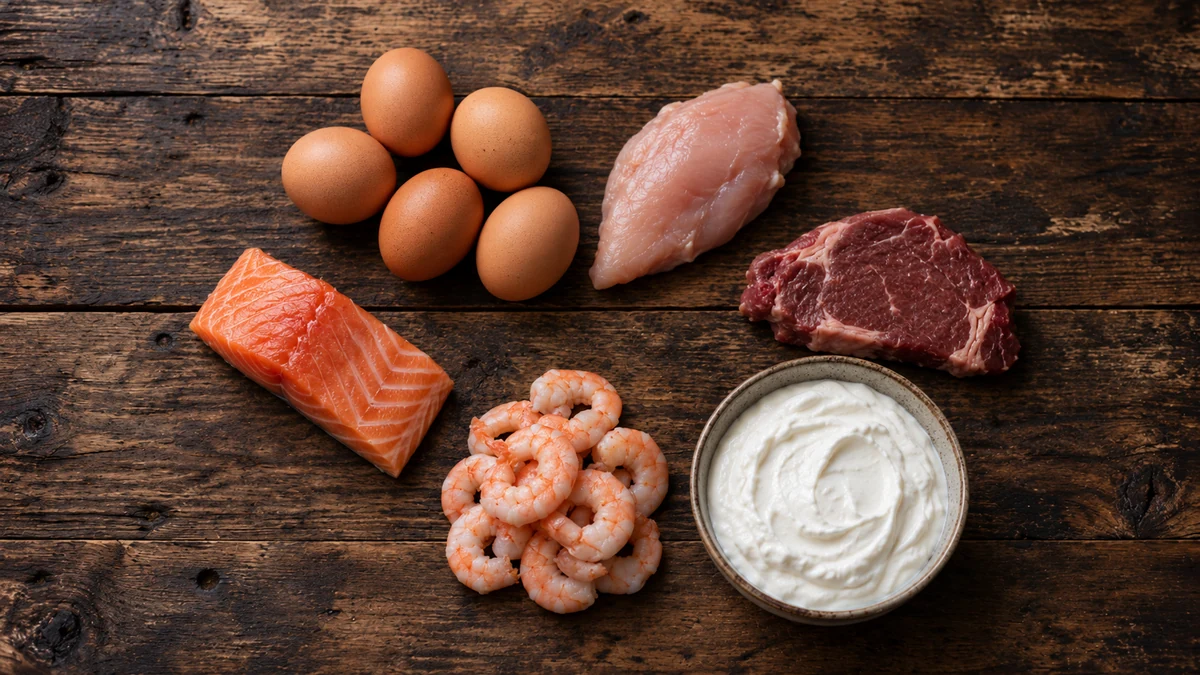
Thirty grams of protein from shrimp is about 120–125 kcal. From lean white fish, about 130–145. From chicken breast, about 160. From squid, about 175–180. And from salmon, already around 280 kcal.
This is not a ranking of “good” and “bad” foods. If what you need right now is protein with the fewest possible calories, shrimp or cod will be more efficient than salmon. Salmon, in turn, provides not only protein but also fat, including long-chain omega-3s. We looked in more detail at how to choose different types of fish and what to cook with them in our article about fish for skin and hair.
How much you need to eat to get 30 g of protein
The values below are rounded. They may vary slightly depending on the specific type of product, brand, and cooking method.
| Food | Protein per 100 kcal | Portion for ≈30 g of protein | Calories per portion | Fat |
| Shrimp | ≈24 g | ≈125 g | ≈124 kcal | <1 g |
| Cod / hake / pollock | ≈22 g | ≈145–150 g | ≈135 kcal | ≈1 g |
| Tuna in water | ≈22 g | ≈120 g | ≈135 kcal | ≈1 g |
| Pollock | ≈21 g | ≈130 g | ≈140 kcal | ≈1–2 g |
| Egg white | ≈21 g | ≈270–275 g | ≈140–145 kcal | <1 g |
| Turkey breast | ≈21 g | ≈105 g | ≈140 kcal | ≈2 g |
| Chicken breast | ≈19 g | ≈100 g | ≈160–165 kcal | ≈3–4 g |
| Squid | ≈17 g | ≈190–195 g | ≈175–180 kcal | ≈3 g |
| 0% Greek yogurt / high-protein yogurt | ≈16–18 g | ≈270–300 g | ≈170–180 kcal | minimal |
| 2% cottage cheese | ≈13 g | ≈270 g | ≈225–230 kcal | ≈6 g |
| Salmon | ≈11 g | ≈135 g | ≈275–285 kcal | ≈17 g |
| Whole eggs | ≈8 g | ≈235–240 g | ≈365–370 kcal | ≈25 g |
| Cooked lentils | ≈8 g | ≈330 g | ≈385 kcal | ≈1 g |
| Cooked chickpeas | ≈5–6 g | ≈340 g | ≈550 kcal | ≈9 g |
For precise diet tracking, it is still best to check the label of the specific product. But for comparing categories, a table like this shows the differences well.
Which protein sources are the most calorie-efficient
If you look only at the protein-to-calorie ratio, the leaders are quite obvious: shrimp, tuna in water, cod, haddock, pollock, turkey breast, and egg white. With most of them, you can get 30 g of protein for roughly 125–145 kcal.
Chicken breast is a little lower, but it remains a very strong option. Its main advantage is not even the absolute minimum in calories, but its compactness: about 100 g of cooked meat already gives you those notional 30 g of protein.
Squid is interesting for a different reason. In pure protein density, it is behind chicken breast, but it lets you eat an almost twice larger portion for only a small calorie premium. For many people, that matters more than a 15–20 kcal difference. If 100 g of meat looks like too small a dinner on the plate, nearly 200 g of squid may feel completely different, while providing a very similar amount of protein.
An even clearer example is egg white. To get 30 g of protein, you need about 270 g of product, while the calories for that portion stay around 140 kcal. In volume, that is already a large serving of food.
Dairy products tell a similar story. Cottage cheese or 0% Greek yogurt will not necessarily beat fish in protein per 100 kcal, but 250–300 g is already a full bowl of food. For breakfast, that format is often much more convenient than yet another serving of meat. In our selection of breakfasts for skin and hair, there are options where protein is paired with fiber, fruit, berries, and other familiar foods.
A simple list of “the highest-protein foods” does not show this. One food gives you a very compact portion, another gives you much more food for similar calories. Both can work perfectly well in the same diet.
What about eggs, legumes, and salmon?
It is easy to look at the table and decide that eggs, lentils, or salmon are “inefficient” protein sources. But that oversimplifies nutrition. Yes, to get about 30 g of protein from whole eggs, you would need to spend around 370 kcal. From cooked lentils, about 385 kcal. From chickpeas, over 500. But along with the protein, we also get other nutrients. In eggs, a substantial part of the calories comes from fat, and they also provide choline and other nutrients. In legumes, you get carbohydrates, fiber, folate, potassium, iron, and magnesium. In fatty fish, you get omega-3s.
It is especially unfair to judge legumes only by the “protein per calorie” metric. They work at the same time as a source of plant protein and fiber, so they occupy a different place in the diet than shrimp or chicken breast. If you want to use them more often, we have a separate подборка of dishes with chickpeas, lentils, and beans.
This is exactly where confusion often appears in nutrition advice. A product can be a good source of protein, but not at all the lowest-calorie way to get that protein. These are different characteristics, and one does not cancel out the other.
How to use this in a normal diet
There is not much point in looking for one absolute champion. It is more practical to have several groups of foods for different situations. When you need to add protein with almost no extra calories, shrimp, white fish, tuna in water, turkey, and egg white work best. When you want a larger portion, squid, egg whites, lean fish, and high-protein/Greek yogurt become especially interesting. When you want fats and other nutrients along with protein, it makes perfect sense to keep salmon, whole eggs, nuts, and seeds in your diet. And with legumes, there is no need to try to make them compete with chicken breast at all. They are a полноценная part of lunch or dinner, where protein, carbohydrates, and fiber come together in one meal.
With such different products, it is much easier to build normal meals rather than endless “protein feedings.” For example, you can add fish or poultry to vegetables and potatoes, an egg to grains or salad, and legumes to a stew. In our selection of balanced lunches and dinners, we showed exactly this principle with ready-made dishes.
If you like big salad bowls, protein pairs especially well with vegetables. A complete meal is easier to assemble by adding fish, eggs, cheese, meat, or legumes to the vegetables. You will find several options like this in our hearty everyday salads.
This approach is especially convenient during weight loss. If part of your protein comes from foods with high protein density, more room stays in your daily calorie budget for everything else: vegetables, fruit, grains, bread, oil, cheese, or dessert.
That is exactly why there is no need to get fixated on chicken breast. Some days, 100 g of breast really will be the most convenient solution. On another day, 200 g of squid for almost the same calories may bring much more satisfaction at dinner. For breakfast, it may be easier to eat a large portion of yogurt or an omelet, and get part of your weekly protein from fish and legumes.
If the goal is to get enough protein at moderate calories, per-100 g numbers show only part of the picture. A much more practical question is: how many calories do my 25–30 g of protein cost, and how much food do I get for those calories? That is when the difference between chicken breast, squid, shrimp, yogurt, and lentils becomes truly clear.
Sources
- U.S. Department of Agriculture, Agricultural Research Service. FoodData Central.
- Hudson JL, Wang Y, Bergia RE III, Campbell WW. Protein Intake Greater than the RDA Differentially Influences Whole-Body Lean Mass Responses to Purposeful Catabolic and Anabolic Stressors: A Systematic Review and Meta-analysis. Advances in Nutrition. 2020.
- Hansen TT et al. Dietary protein and appetite sensations in individuals with overweight and obesity: a systematic review. European Journal of Clinical Nutrition. 2021.
- EFSA Panel on Dietetic Products, Nutrition and Allergies. Scientific Opinion on Dietary Reference Values for protein. EFSA Journal. 2012.