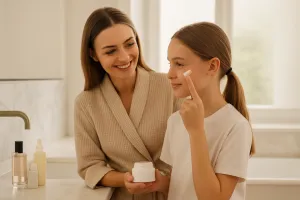






In adolescence, appearance is rarely "just appearance." It's not just about skin, hair, body odor, first breakouts, or interest in makeup. It's also about self-perception, shame, comparisons, the feeling of "something's wrong with me," or, conversely, the first attempt to say: "this is my body, and I want to decide for myself what to do with it."
That's why the topic of care easily becomes a tension zone between adults and teenagers. Parents want to help, but sometimes support sounds like control. Care — like criticism. And a conversation about skin or appearance — like a hint that the child needs to be "fixed" urgently.
This article is not about perfect appearance or the "right" teenager. It's about something else: how to support a teenager during a time when the body is changing, self-esteem becomes more vulnerable, and care should remain safe, simple, and without excesses.
Why the topic of appearance is so sensitive in adolescence
In adolescence, not only the body changes, but also the way a child looks at themselves. What might not have mattered at all before suddenly becomes significant: skin, hair, smell, clothing, the "normality" of the face, comparisons with peers, reactions on social media.
Several things add up simultaneously:
- hormonal changes that genuinely affect skin, sweating, sensitivity, and sleep;
- increased attention to how others see you;
- a desire for more autonomy: "don't decide everything for me";
- higher sensitivity to shame and criticism;
- a digital environment where appearance is often presented as a project of endless improvement.
Therefore, even phrases that seem neutral to an adult — "wash properly," "look at your skin," "you should start taking care of yourself" — can sound much more painful than we think.
If you find it helpful to look more broadly at age-related features, the child's age and nervous system: a brief guide for parents can help. It provides an important framework: not everything that looks like "resistance" or a "sharp reaction" is stubbornness or dramatization.
Support or pressure: where is the line
Most parents don't want to hurt their teenager. But the topic of appearance is tricky: it's very easy to unknowingly shift from care to control.
Support sounds something like this:
- "If you want, we can choose something simple and comfortable together."
- "You don't have to look perfect to take care of yourself."
- "I don't want to correct you. I want to help if it's important to you."
- "We can find solutions together, without haste or shame."
Pressure sounds different:
- "Something needs to be done about you."
- "You see how it looks, don't you?"
- "At your age, you should already be taking care of yourself."
- "No one goes around like that."
- "First, tidy yourself up, and then..."
The difference is not only in words but in the adult's position. Support acknowledges that a teenager's body is not a parental project. Pressure comes from the idea that the child needs to be urgently conformed to a norm.
Care should not become another way to say "you're not good enough"
In culture, care is often presented as something obviously beneficial. But for a teenager, it easily becomes another source of anxiety:
- you need to look better;
- you need to have cleaner skin;
- you need not to shine;
- you need to hide breakouts;
- you need to know which products are "right";
- you need not to fall behind trends.
If, against this backdrop, an adult actively controls, checks, comments, compares, or shames, care ceases to be nurturing. It becomes a signal: "your natural version is not okay." That's why it's so important for a teenager to understand: care is not about fixing yourself, but about treating yourself a little more attentively and safely. More about a basic, calm routine without unnecessary steps in the article Minimal care 12-17: a simple 3-step routine
Where safe care begins
In adolescence, it's almost always better to start care not with "actives," complex schemes, and trendy jars, but with simplicity. Not because the teenager is "still young," but because the skin and nervous system usually don't need overload.
A good start is not ten steps and not constant trend testing. It's a clear foundation that can be maintained without stress.
What's important at the principle level:
- not rushing with aggressive products;
- not copying adult routines;
- not focusing solely on trends from TikTok or Instagram;
- not turning every redness or breakout into an "emergency";
- not buying care as a way to alleviate adult anxiety.
Separately about why a teenager doesn't always need acids, retinol, and "adult" actives from social media, in the article Trendy care from social media: when a teenager doesn't need acids, retinol, and "adult" actives.
Social media affects not only self-esteem but also perceptions of "normal" care
Today, a teenager rarely learns about care through a dermatologist or even through parents. Much more often — through content. Through videos promising "perfect skin" in a minute. Through influencers showing multi-step routines. Through "before/after" comparisons. Through filters that erase skin texture as if normal, living skin is already a problem.
It's important to understand here: social media can pressure not only directly, when a teenager starts to think worse of their appearance. They can also pressure indirectly — by creating the feeling that without complex care, actives, acids, patches, and constant "work on yourself," something is wrong with you.
That's why sometimes a teenager asks not just for a cream. But for "what everyone is getting now." Not protection or comfort, but access to a certain image of "correct" appearance.
About how to notice when content starts undermining self-esteem - our article Social media and appearance: how to notice when content "undermines" self-esteem.
If you want to look more broadly at the topic of screens, stimuli, and overload, it's worth reading how to reduce overstimulation: screens, light, sleep, and attention. This helps to see: the digital environment affects not only mood but also sleep, tension, and overall well-being.
Acne, breakouts, sensitive skin: what's needed is not criticism, but support
One of the most painful topics in adolescence is skin. Especially if acne, inflammation, post-breakout marks, or strong dissatisfaction with oneself appear.
At this moment, it's easy for an adult to fall into one of two extremes:
- either devalue: "don't make it up, everyone had that";
- or start over-controlling: "don't touch," "apply this urgently," "what did you eat again?", "look at yourself."
Neither reaction is very helpful. Because the teenager often already experiences shame, anxiety, and the desire to hide.
It's important to separate two things here:
- the skin problem is real — and it shouldn't be devalued;
- self-esteem should not be destroyed because of the skin condition — and this is the area of adult support.
Separately about how to talk about acne without hurting, and when it's worth seeing a doctor, will be in the article If a teenager has acne: how to talk without destroying self-esteem (and when to see a doctor).
Sometimes the problem is not just in care, but in overload
Not everything that "shows up" on the skin is solved with a new jar. And not all irritability, exhaustion, or worsening appearance means the teenager "let themselves go."
Sometimes skin, sleep, and overall well-being worsen against the backdrop of:
- chronic fatigue;
- overload from studies;
- lack of sleep;
- internal anxiety;
- conflicts;
- constant comparison with others;
- high levels of stimuli without recovery.
That is, sometimes the body isn't "failing," but signaling that resources are low. That's why the topic of appearance shouldn't be separated from the topic of the nervous system and recovery. More about this will be in the article Stress in a teenager "shows up" on the skin and sleep: how to recognize overload.
Makeup, experiments, style: not everything needs to be forbidden, but boundaries are needed
Teen interest in makeup, hairstyles, care, coloring, style, or individual appearance rituals doesn't always mean superficiality or "obsession." Often it's a way to:
- explore oneself;
- feel control over a changing body;
- find one's language of self-expression;
- try to belong to a group;
- hide vulnerability;
- feel "more normal" alongside others.
Therefore, the ban "because it's too early" doesn't always work. But a complete lack of boundaries doesn't help either. A working position for an adult here sounds something like this: "I don't want to fight your interest in appearance. I want it to be safe, without shame, and without harm to the skin or self-esteem."
Separately about simple rules of makeup and hygiene for teenage skin will be in the article Makeup and hygiene: simple rules to avoid skin problems.
Teen autonomy is important, but it doesn't mean the complete absence of an adult
A teenager indeed needs more autonomy. But autonomy doesn't mean: "figure it out yourself, I'm not interfering."
Nor does it mean: "I'll decide everything for you because you don't understand yet."
The most useful position is somewhere in the middle:
- not taking away the teenager's voice;
- not mocking their interests;
- not imposing care as a duty;
- remaining nearby as an adult support;
- helping to critically look at trends, not just banning everything;
- maintaining boundaries where safety is concerned.
A teenager often doesn't need an adult who controls everything. They need an adult who doesn't disappear, doesn't shame, and doesn't make appearance the main topic of the relationship.
When to be alert
Not every interest in skin, style, or mirrors is a problem. But there are situations when it's worth looking more closely.
For example, if you notice that the teenager:
- constantly compares themselves to others;
- suddenly becomes ashamed of their body or face;
- avoids photos, people, school, or activities because of appearance;
- often speaks harshly and devaluingly about themselves;
- panics over breakouts or "imperfections" of the skin;
- asks for aggressive care not out of interest, but out of desperation;
- sleeps worse, looks exhausted, becomes more irritable against the backdrop of anxiety about appearance;
- is noticeably dependent on social media evaluations.
In such cases, it's important not to rush with lectures. It's better to try to understand first: does the teenager want to "become more beautiful," or are they actually trying to cope with shame, anxiety, overload, or fear of rejection.
What helps the most
In the topic of teenagers and appearance, it's usually not perfect words that work, but repeated experiences:
- I'm not shamed;
- I'm not judged every time someone looks at me;
- I'm not told that something's wrong with me;
- I'm helped if I ask;
- I'm not forced to "fix myself" to be acceptable;
- my body is not a field for criticism;
- care can be simple, calm, and without excesses.
Sometimes this becomes the best foundation for confidence: not automatic compliments and endless advice, but the experience of a safe adult presence nearby.
Main idea
Teen interest in appearance shouldn't be ridiculed or dramatized. There can be a lot behind it: curiosity, vulnerability, the desire to belong, shame, the need for control, self-discovery.
The adult's task here is not to make the teenager "right" or "perfectly groomed." The task is to help maintain the feeling that you can take care of yourself without shame, without excesses, and without waging war on your own body.