





When the body can't keep up with recovery, the first signals often manifest through sleep, facial appearance, mood, and fatigue.
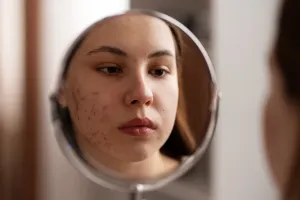
A teenager says they're "just tired," yet for the third night in a row, they can't fall asleep. In the morning, they sit silently at the table, spend a long time looking at their face in the mirror before school, react sharply to a simple question, and then disappear into their phone as if it's the only place where they're left alone. Parents notice acne, lack of sleep, irritation, a messy room, and a lack of energy. But sometimes, it's not stubbornness or a "bad attitude" behind this, but a nervous system that hasn't had a chance to calm down for weeks.
Teen stress rarely appears as a single, clear-cut problem. It's not always one test, one conflict, or one failed conversation. More often, it's an accumulation: school, social media, appearance comparisons, peer relationships, hormonal changes, uncertainty, sleep deprivation, adult expectations, shame about skin or body, and the feeling that they "have to cope," even when there's no resource left inside.
That's why overload in a teenager might not manifest as a big drama but as a collection of small physical signals. They have trouble falling asleep. They wake up tired more often. They become more irritable. They start avoiding conversations about appearance. They touch their face more. They try aggressive treatments for breakouts or, conversely, abandon skincare altogether. They get tired of people but can't be without their phone. And when an adult only sees the behavior, it's easy to miss the main point: the body has long been saying that the tension is too much.
It's important not to turn every pimple or bad night into an alarming conclusion. Teenage skin can change due to hormones, genetics, cycles, sweat, sports, cosmetics, insufficient cleansing, overly active care, or an individual tendency to acne. Sleep can be disrupted by the natural teenage shift in biorhythms, academic load, gadgets, light, late-night texting, or the habit of "stretching the day" in silence. But if skin, sleep, mood, and behavior change simultaneously, persist for several weeks, and interfere with daily life, it's worth looking beyond the bottles in the bathroom. It's worth asking: what in the teenager's life has become too heavy for their system?
Why stress can show on the skin
The skin is not a "screen of emotions" in the literal sense. Not every breakout means the child is nervous, and not every acne flare-up can be explained by stress. But the skin is connected to the nervous, hormonal, and immune systems. When the body lives in tension for a long time, sleep, appetite, recovery, inflammatory responses, self-control levels, and behavior around care change. A teenager might touch their face more often, injure breakouts, wash until it squeaks, apply multiple actives at once, or try everything they see on social media.
It's important to speak very precisely here. Stress is not the sole cause of acne. The phrase "it's all because of nerves" almost always sounds like blame to a teenager: as if they're at fault for their skin's reaction. It's more accurate to say: if acne is already present, prolonged overload can exacerbate flare-ups, and the breakouts themselves can amplify shame, anxiety, and the desire to control the face. This creates a vicious cycle: stress affects behavior and recovery, the skin reacts, the skin's reaction worsens self-esteem, and self-esteem raises tension again.
In adolescence, this cycle is particularly vulnerable because the face becomes part of social life. Photos, videos, mirrors, jokes, comments, comparisons, filters, and "perfect" skin in feeds can make even moderate acne a very painful experience. An adult might see "a couple of breakouts," but a teenager might feel like everyone is looking only at them. That's why care should start not with pressure but with a safe framework. If a broader context is needed, it's worth returning to the main material on this topic - teen appearance: safe care without extremes.
Sleep often shows overload before words do
In teenagers, sleep often first indicates that the nervous system is no longer recovering. Not just because the child went to bed late. In adolescence, the biorhythm can indeed shift later, but that doesn't mean the body needs less sleep. For ages 13-18, the guideline remains about 8-10 hours of sleep per night. If a teenager regularly sleeps significantly less, it's harder for the body to regulate emotions, concentration, appetite, learning, stress response, and a sense of basic stability.
Overload doesn't always look like the classic "can't fall asleep." Sometimes a teenager falls asleep quickly but wakes up feeling shattered. Sometimes they lie in the dark, replaying conversations, grades, faces, conflicts, the upcoming day. Sometimes they delay sleep because the night becomes the only time when no one asks, evaluates, or questions them. Sometimes during the day, they're sluggish, but in the evening, they seem to come alive again because the phone, light, short videos, and messages keep the nervous system in an excited state.
On the surface, this might look like indiscipline. Inside, it often resembles a system that hasn't found a gentle way to transition from tension to rest. That's why evening conflicts around sleep rarely help. When an adult enters the room with the phrase "turn it off immediately," the teenager's body might hear not care but a new mobilization. And instead of falling asleep, they get another round of resistance, shame, or anger.
Here, it's better to work not on fighting for a perfect routine but on an evening transition. If the family already has the topic of difficult evenings, read about evening without battle: 7 steps for easier sleep. A teenager doesn't always need control over every minute. More often, they need a predictable framework: less bright light, fewer interrogations before bed, a clear household ritual, a warm shower, plain water by the bed, the chance to be silent, and the feeling that tomorrow doesn't start with accusations tonight.
Three connections to notice
One bad day is not a signal of catastrophe. A teenager might be gloomy, silent, sharp, or exhausted after a tough week. The important thing is not one symptom but a recurring pattern. Overload is usually visible where several areas change simultaneously: sleep, skin, mood, learning, appetite, communication, and the ability to recover after rest.
The first connection - sleep and irritability. If a teenager sleeps poorly, it's harder for them to withstand ordinary irritants. The question "did you do your homework?" might sound like an attack. The request to tidy up might feel like proof that they're misunderstood again. This doesn't mean boundaries aren't needed. But it does mean that adults should see not just rudeness but the exhaustion behind a sharp reaction.
The second connection - skin and shame. A teenager might say they don't care, but at the same time avoid photos, not want to go to school, cover their face with hair, wear a hood, or react aggressively to any comment about their skin. If an adult only says "don't touch your face," the child might hear "something's wrong with you." It's better to talk about skin as part of health, not as part of appearance evaluation.
The third connection - fatigue and avoidance. When a teenager refuses a club, doesn't want to see friends, postpones studying until night, or suddenly loses interest in what they used to love, it's not always "laziness." Sometimes avoidance becomes a way not to add another demand to a system that's already overloaded. Here, it's more helpful not to immediately press for results but to see where the load can be reduced and a sense of manageability restored.
In the material child's age and nervous system: a short guide for parents, we've already discussed that behavior is often not a separate problem but a language of regulation. In adolescence, this language becomes more complex: the child is no longer small but not yet an adult; they may appear independent but remain very sensitive to comparison and pressure inside.
Signs of overload in a teenager
There's no need to keep a diary of every emotion or turn the child into an object of observation. But it's worth noticing recurring changes, especially if they last more than two to three weeks, intensify, or start interfering with school, sleep, communication, and daily life.
- Sleep: the teenager has trouble falling asleep, wakes up often, wakes up exhausted, drastically shifts their schedule, falls asleep during the day, can't get up even after enough hours in bed.
- Skin: breakouts become more frequent or painful, the child constantly touches their face, injures breakouts, over-dries the skin, tries many new products at once, or completely abandons care.
- Body: more frequent complaints of headaches, stomachaches, nausea, tension, fatigue, weakness, especially against the backdrop of learning, conflicts, or social load.
- Mood: the teenager becomes sharper, more tearful, more indifferent, or very irritable; reacts more strongly than usual; takes longer to "get over" conflicts.
- Behavior: avoids friends, clubs, school, mirrors, photos, conversations about appearance; stops doing what used to bring joy.
- Concentration: struggles to keep tasks, forgets simple things, postpones everything until night, starts fearing even subjects or tasks they used to handle.
This list is not intended for self-diagnosis. It's meant to change the parental question. Not "what's wrong with you?" but "where has it become too much?". Not "why aren't you sleeping again?" but "what's preventing your body from shutting down?". Not "don't touch your face," but "I see you're very tense about your skin, let's not make this a war."
How to talk without increasing shame
When stress shows on the skin and sleep, parents often want to help quickly: buy a product, schedule a doctor, take away the phone, ban sweets, force earlier bedtimes. Some of these actions can be helpful, but only if they don't sound like an accusatory verdict. A teenager with breakouts and sleep deprivation often already feels that their body is letting them down. If an adult adds a tone of control to this, the child might close off even more.
It's better to start with neutral observation rather than evaluation. For example: "I see that lately, it's been harder for you to wake up, and your skin also seems to be reacting more. I don't want to criticize you. I want to understand where we can reduce the load." Or: "I don't need you to explain everything right now. But I'm here, and we can figure it out in small steps." Such phrases don't make the teenager a problem. They restore the feeling that the adult isn't attacking but is on their side.
It's especially important to speak carefully about the face. Phrases like "don't scratch," "don't squeeze," "look what you've done," "you need to get yourself together" can be heard as "it's embarrassing with you." Better: "The skin is irritated right now, let's help it calm down," "Let's not punish the skin with aggressive products," "If you want, I can help find a doctor or simple care."
Sometimes the best start isn't a big conversation but a change in tone at home. Fewer questions before bed. Fewer comments about appearance. Fewer phrases that start with "you again." More short signals: "I see the day was tough," "We can talk tomorrow," "We won't sort everything out today," "I'm here." For a teenager who has been holding their face, grades, social roles, and internal tension all day, this can be the first feeling that at home, they don't have to mobilize again.
Care during stress: less heroism, more stability
During a period of teenage overload, care shouldn't become another complex project. If the child sleeps poorly, worries about appearance, studies a lot, and feels "not right," a ten-step routine is almost certainly not going to be supportive. It will become another proof that they need to "fix themselves." In a stressful period, the skin usually needs not experiments but basic clarity: gentle cleansing, moisturizing, sun protection in the morning, individual anti-inflammatory products as needed, and without mixing everything at once.
If a teenager starts battling with their skin, the adult should first reduce the intensity of this battle. Don't buy the tenth active. Don't compare with someone else's "perfect" skin. Don't demand immediate results. Don't turn every breakout into a family meeting. It's better to return to the question: what currently soothes the skin, and what irritates it? What is the child really ready to do daily? What minimum care doesn't humiliate, exhaust, or create new shame?
If acne noticeably affects self-esteem, causes pain, leaves marks, or doesn't respond to basic care, it's better not to delay professional help. In the article teen acne: when to talk not just about care but also about support, this logic is important: treating acne is not about "making the child prettier," but about reducing inflammation, pain, shame, and the risk of scars. Also read about the first visit to a dermatologist if the skin needs professional help.
A dermatologist doesn't cancel emotional support, and a psychologist doesn't replace skin treatment. In many situations, both directions are needed, but in different proportions. If breakouts exacerbate shame, and shame increases control over the skin, the child needs not one "magic cream," but an adult team that doesn't scare, shame, or reduce everything to appearance.
What can be changed at home without pressure
Teen stress can't always be quickly removed. Not every school can be changed, not every social situation can be immediately corrected, not every anxiety can be resolved with one conversation. But at home, the number of irritants that daily wear down the system can be reduced. This isn't about a perfect routine. It's about small, repetitive supports that the body begins to recognize as safe.
- Make the evening less conflictual. Don't start difficult conversations about grades, skin, room, and phone 20 minutes before sleep. At this time, the nervous system should already be winding down, not mobilizing again.
- Reduce light and stimulation. Not as a punishment "I'm taking away the phone," but as an agreement: the body needs a transition. You can start with less light, a quieter tone, shorter scrolling, charging the phone not in bed.
- Simplify care. If the skin reacts, don't add three new actives at once. It's better to return to basics and assess what truly helps and what creates more irritation.
- Reduce evaluative language. Less "you again," "you always," "it's impossible to influence you." More "let's see where it became too hard."
- Return simple signals of care to the body. A warm shower, a clean pillowcase, water by the bed, comfortable clothes, a calm breakfast, a short walk without a lecture sometimes work better than a long conversation about discipline.
You can start with one evening. Not with a complete reboot of the routine, not with a big family conversation, not with a new rule for a month. Just with an evening where the adult slightly lowers the intensity: quieter light, fewer complaints, a shorter list of demands, a simple reminder about a shower or care without pressure, the phrase "we won't sort everything out today." For a teenager, this can be a physical signal: now there's no need to defend, you can gradually exhale.
These steps don't cure anxiety disorders, depression, severe acne, or chronic insomnia. But they reduce the background noise. And for a teenager living in constant internal tension, reducing the noise can already be the start of recovery.
When professional help is needed
There are situations where waiting for them to "grow out of it" isn't advisable. A dermatologist should be consulted if acne is painful, spreads quickly, leaves scars or dark marks, or if the child avoids school, photos, communication, sports, or usual activities because of their skin. A pediatrician or family doctor should be consulted if there are recurring physical complaints, severe fatigue, drastic changes in weight, appetite, cycle, frequent headaches, or sleep disturbances that don't resolve with lifestyle changes.
A psychologist or psychotherapist should be consulted if the teenager is long withdrawn, has lost interest in most things, is constantly tense, sharply avoids social life, or can't cope with school due to fear or exhaustion. It's also important not to dismiss phrases like "I can't take it anymore" or "I don't care." Not every such phrase means a crisis, but each deserves calm adult attention, without ridicule, punishment, or moralizing.
If there's a feeling that the teenager might be in danger or can't be left alone, immediate help from adults and professionals who can ensure safety is needed. In such a situation, it's not worth waiting for a "convenient moment" or trying to resolve everything with home conversations. The best parental action is to quickly organize support and be there without panic and blame.
The main thing is not to find the guilty party, but to see the system
When stress in a teenager manifests on the skin and sleep, it's very easy to look for one cause. Blame gadgets. Blame hormones. Blame cosmetics. Blame school. Blame laziness. Blame social media. But teenage overload rarely has one button. More often, it's a system where sleep deprivation increases irritability, irritability worsens relationships, relationships increase stress, stress exacerbates the skin, the skin increases shame, shame delays sleep, and the cycle closes.
The adult's task is not to break this cycle by force, but to find a place where tension can be eased. Somewhere it will be a dermatologist. Somewhere - an evening without a fight. Somewhere - reducing clubs. Somewhere - a pause in conversations about grades. Somewhere - an honest admission: "We seem to want too much from you." Somewhere - a gentle return to basic care. Somewhere - professional psychological support.
A teenager won't always thank you immediately. They might grumble, refuse, say "everything's fine," while carefully checking if the adult really isn't attacking. But if there's someone nearby who sees not just pimples, dark circles, and sharp answers, but the system's fatigue, the child has a chance not to be left alone with it. Sometimes this is the first step towards the skin, sleep, and mood gradually ceasing to be a language of anxiety and becoming part of a living, imperfect, but calmer body again.
References
- Centers for Disease Control and Prevention. Sleep and health.
- American Academy of Sleep Medicine. Recommended amount of sleep for pediatric populations: a consensus statement.
- American Academy of Dermatology Association. Acne can affect more than your skin.
- HealthyChildren.org. Teen acne: how to treat and prevent this common skin problem.
- HealthyChildren.org. Teen mental health: how to know when your child needs help.
- American Academy of Pediatrics. Helping adolescents feel in control during stressful times.
- UNICEF Ukraine. How to recognize stress in adolescents.
- UNICEF Parenting. How to recognize signs of distress in children.
- National Institute of Mental Health. Children and mental health: is this just a stage?