





Teenage acne requires calm support, clear skincare, and timely medical assistance.
Teen acne is rarely just a skin story. For adults, it might be “just pimples,” a temporary phase almost everyone goes through. For a teenager, it’s often a completely different experience: the face suddenly becomes a topic that cannot be hidden, the mirror a place of tension, and any comment from adults sounds louder than they intended.
That’s why the first task for parents is not to find the strongest remedy or “take control of the situation,” but to maintain connection. Acne can be treated. However, how adults talk about skin can either help a teenager navigate this period with greater resilience or amplify shame, fixation on appearance, and the feeling that something is “wrong” with them.
This article is about how to talk to a teenager about acne without pressure, which home actions truly make sense, where cosmetic care ends and the dermatologist’s zone begins, and why self-esteem is as important here as anti-inflammatory cream.
Acne is not “dirty skin” and not the teenager’s fault
One of the most dangerous household misconceptions is explaining acne by lack of cleanliness. “You’re not washing properly,” “don’t touch your face,” “don’t eat that,” “look at what’s on your forehead” – an adult might say this almost automatically, but a teenager hears something else: “my face is unpleasant,” “I’m to blame,” “I’m being scrutinized.”
In reality, acne is related to the work of the sebaceous glands, hormonal changes, follicle blockage, inflammation, and the skin’s reaction to its own pubertal rhythm. Yes, care is important. Yes, some habits can worsen the situation. But acne doesn’t arise from “uncleanliness” and doesn’t disappear with aggressive cleansing until it squeaks.
Moreover, excessive washing, alcohol-based toners, frequent scrubs, self-extraction, and chaotic layering of actives can irritate the skin, weaken the barrier, and make the face even more reactive. In adolescence, this is especially unfortunate: the child tries to “fix” the problem but ends up with burning, dryness, redness, and even more frustration.
Therefore, the first adult message should be simple: “You’re okay. This is a skin condition that can be managed. We won’t shame you. We’ll help.”
Why adults’ words carry so much weight here
A teenager is still forming their self-image. They are no longer a small child who perceives the body mainly functionally, but not yet an adult with a more or less stable self-esteem. Face, skin, hair, body odor, clothing, voice, peers’ reactions – all become part of the internal question: “Am I okay?”
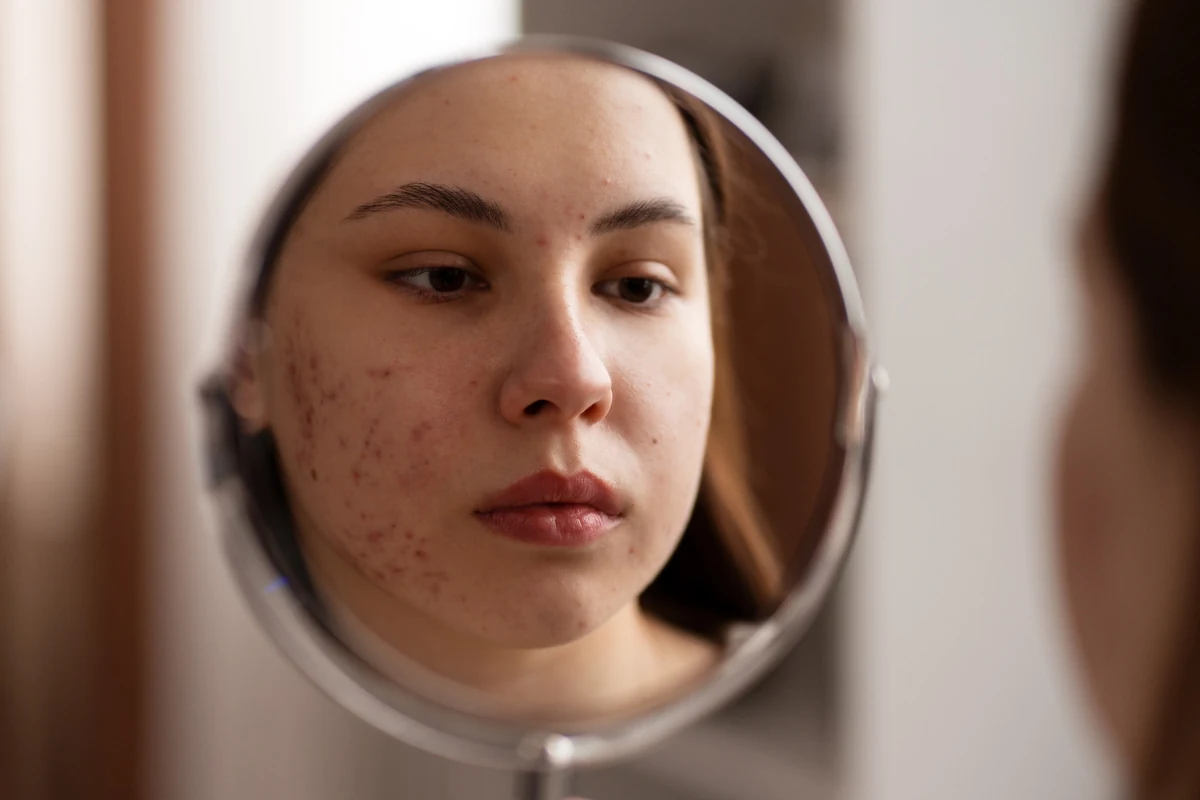
Against this backdrop, acne may be experienced not as a dermatological symptom but as a social threat. A teenager might avoid photos, not want to go to school, react sharply to jokes, get angry at advice, lock themselves in the bathroom, or spend hours examining their skin. It’s not always “drama.” Often, it’s an attempt to cope with the feeling of losing control over their appearance.
Here, it’s important to remember the general logic of the article “Teen and Appearance: How to Talk Without Shame”: support doesn’t start with evaluation. It begins with the adult stopping to view the teenager’s body as a project that urgently needs improvement.
Sometimes the best first phrase isn’t “we need to get you something for the pimples,” but “I see this upsets you. Would you like us to think together about what can be done?” In this phrase, the main thing is that the teenager doesn’t become the problem. The problem becomes the skin condition, which can be discussed without humiliation.
How not to talk about acne
There are phrases that seem practical to adults but sound like a blow to a teenager’s self-esteem. Especially if they are said in front of others, in the mirror, before leaving the house, or after the child has already spent a long time getting ready and trying to look normal.
- “What’s that on your face?”
- “Have you seen yourself?”
- “Don’t eat sweets, or you’ll break out again.”
- “We need to do something about this, it can’t go on.”
- “At your age, I just washed my face, and it went away.”
- “Don’t exaggerate, everyone’s been through it.”
The problem with these phrases isn’t just their harshness. They take away the teenager’s right to their own experience. If they feel ashamed, hurt, or scared, the phrase “everyone’s been through it” doesn’t reassure. It rather conveys: “Your feelings are unnecessary.”
It’s better to speak in a way that makes the teenager feel not controlled, but supported:
- “Acne is common in adolescence, but that doesn’t mean you just have to endure it.”
- “We can come up with a gentle plan and see how your skin reacts.”
- “I don’t want to pressure you. Let me know if you want to talk about it now.”
- “If it bothers you that I comment on your skin, I’ll stop.”
- “Let’s handle this calmly, without panic and without experiments.”
Such phrases don’t make the problem less real. They just don’t add shame to it.
What can be done at home without aggressive treatment
A home strategy for teenage acne should be simple, stable, and not feel like punishment. If the routine takes half an hour, stings, dries out, involves ten bottles, and is accompanied by parental control, the teenager will quickly start to sabotage it or perform it with irritation.
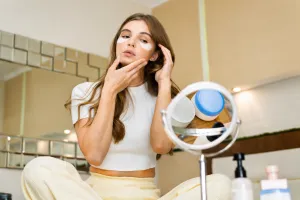
The basic start is gentle cleansing twice a day, a light non-comedogenic moisturizer, sun protection in the morning, and avoiding aggressive rubbing. If the teenager uses makeup or heavy SPF, it’s important that the product washes off well in the evening, but without the feeling of “scrubbing the skin clean.”
If breakouts are mild, adults often want to immediately buy “something strong.” But with teenage skin, strength doesn’t always equal benefit. In many cases, regularity, patience, and gradualness are more important. Products with benzoyl peroxide, salicylic or azelaic acid, adapalene, or other actives may be appropriate, but they shouldn’t be introduced all at once. The skin needs time to adapt.
It’s also worth mentioning extraction. Telling a teenager “don’t touch your face” doesn’t help much. Often, it’s an impulsive action arising from anxiety or anger at the skin. It’s better to explain without scaring: constant trauma to breakouts increases the risk of marks, spots, and scars. You can offer alternatives: patches for individual spots, short nails, a mirror without magnification, an agreement not to examine the skin in poor light in the evening.
What not to do
With teenage acne, it’s easy to go to extremes. On one side – “it’ll pass on its own.” On the other – endless experiments, masks, acids, alcohol, toothpaste on inflammation, home “cleanses,” TikTok advice, and random antibiotics from the medicine cabinet. Both extremes can prolong the problem.
Don’t self-prescribe systemic medications, antibiotics, hormonal agents, or isotretinoin for a teenager. These are not cosmetic products but medical treatments with indications, contraindications, and monitoring. Similarly, don’t drastically change the diet to “now you can’t have sweets, dairy, bread, and everything you love.” Evidence-based medicine doesn’t support the idea of a universal diet that cures acne for everyone. Nutrition can affect well-being and, in some individuals, the skin, but turning food into a system of guilt for a teenager is dangerous.
It’s also undesirable to make acne a family project where every adult has an opinion. Comments from grandmothers, relatives, familiar cosmetologists, and “mom’s friend who was helped” often create a sense around the teenager that their face has become an open topic for discussion. It’s better to keep this topic within a narrow, safe circle: the teenager, one calm adult, and, if necessary, a doctor.
When a dermatologist is needed
Consulting a dermatologist is advisable not only when “things are really bad.” In fact, early consultation often saves months of chaotic attempts and reduces the risk of post-acne marks. It’s especially important not to wait if breakouts are painful, deep, spreading quickly, leaving scars, or persistent dark/red spots.
A consultation is needed if acne doesn’t improve after several months of stable basic care, if home remedies cause severe irritation, if the teenager starts avoiding people because of their skin, or if the whole family is already living in a mode of constant face discussion.
A separate reason for consultation is the psychological burden. If a teenager suddenly loses interest in socializing, refuses photos, doesn’t want to leave the house, constantly compares themselves to others, or reacts painfully to any mirror, it’s not “a whim over pimples.” It’s a signal that the skin is already affecting their inner support. In such cases, dermatological help can go hand in hand with psychological support.
Preparation for the consultation should be read separately in the material First Visit to the Dermatologist: How to Prepare a Teen. The main idea is simple: the doctor should not be a figure of shame. They are someone who helps sort out the skin condition, not judge appearance.
How to prepare the conversation about the doctor
Parents often make a mistake by presenting the dermatologist as the last resort after long unsuccessful attempts: “Well, if you can’t take care of it yourself, we’ll go to the doctor.” In this frame, the visit is perceived as punishment or proof of failure.
It’s better to say otherwise: “We can talk to the doctor so we’re not guessing. It doesn’t mean there’s something wrong with you. It means the skin needs a clear plan.”
It’s important to agree in advance who will speak at the appointment. The teenager can be offered a choice: they describe the problem themselves, the adult helps, or they want to spend part of the appointment without parents. For many, this is crucial: acne concerns an intimate feeling of the body, and having a voice here is very important.
Before the appointment, you can briefly note: when the breakouts started, what has been tried, what worsened the condition, if there are painful elements, if marks remain, what products are currently used. But don’t turn this into a “dossier of problems.” The wording should remain neutral: not “terrible skin,” but “there are inflammatory elements on the cheeks and forehead, sometimes painful, leaving spots.”
Acne, stress, and sleep: what’s important to notice
A teenager’s skin doesn’t live separately from the nervous system. Overload, lack of sleep, constant tension, conflicts, exams, body changes, and social pressure can affect how a teenager experiences acne, even if they aren’t the sole cause of breakouts. Sometimes the problem isn’t just the number of elements on the skin, but how much attention, anxiety, and shame have accumulated around them.
If breakouts worsen against a background of chronic fatigue, poor sleep, or strong emotional stress, it’s worth looking more broadly: not just at the bottle in the bathroom, but at the daily rhythm, amount of sleep, level of tension, and way of recovery. This topic is logically continued in the material Stress in a Teen on Skin and Sleep: Signs of Overload.
Co-regulation works well here, not moralizing. It’s hard for a teenager to calm down if there’s an adult nearby who speaks with panic, irritation, or disgust. A calm voice, neutral face, respect for boundaries, and the ability not to pressure – these are not trifles, but a real part of support. This is discussed more broadly in the material Co-regulation Through Connection: Voice, Face, and Boundaries.
How to support self-esteem while the skin is being treated
Treating acne doesn’t always yield quick results. It often takes weeks, and sometimes months, to see stable improvement. For an adult, this sounds normal. For a teenager who sees themselves in the mirror every day and compares themselves to filtered faces on social media, it can be an almost unbearable wait.
Therefore, it’s important not to put life on hold until the skin is “clear.” Don’t convey: “When it’s all over, you’ll look good again.” It’s better to support an experience where the teenager already has the right to be visible, attractive, interesting, funny, talented, alive – not after treatment, but during it.
Practically, this means a few simple things. Don’t comment on the skin without permission. Don’t discuss acne in front of relatives. Don’t examine the teenager’s face up close. Don’t take photos “for comparison” if they don’t want it. Don’t reduce praise to appearance, but don’t avoid warm words as if the face has become a forbidden topic.
You can say: “I like you as you are.” “I see more than just skin.” “It’s important to me that you feel better.” “We’ll act calmly.” These aren’t magic phrases, but they reduce loneliness.
What a teenager should feel
The best result of parental support isn’t a perfectly chosen care routine on the first try. It’s a state where the teenager feels: they aren’t shamed, rushed, viewed as a problem, or left alone. They are helped, but control over their own body isn’t taken away.
Acne can be unpleasant, painful, and psychologically challenging. But it shouldn’t become the language through which the family talks to the teenager about their worth. The skin may need treatment. Self-esteem requires caution. And contact – an adult who will say at the right moment: “We’ll figure it out. And you are not reduced to what’s happening with your face right now.”
References
- American Academy of Dermatology Association. Updated guidelines for the management of acne vulgaris. 2024.
- National Institute for Health and Care Excellence. Acne vulgaris: management. NICE guideline NG198.
- DermNet. Topical therapy for acne.
- DermNet. Acne in children.
- Mayo Clinic. Acne - diagnosis and treatment.
- Dunn L.K., O’Neill J.L., Feldman S.R. Acne in adolescents: quality of life, self-esteem, mood, and psychological disorders. Dermatology Online Journal.