







PDRN, polynucleotides, exosomes, growth factors, and cosmetic microneedles are often described as regenerative technologies. Here’s what actually stands behind these terms, what results you can realistically expect, and why the same ingredient works differently in a cream versus an injectable treatment.
The word “regeneration” has become one of the most prominent terms in modern cosmetology. It is used to describe PDRN creams, injectable polynucleotides, exosome-based products, PRP, microneedling, lasers, and collagen biostimulators. But these are not one single group of methods, nor do they all work through the same mechanism. Some support the skin barrier and epidermal renewal, some trigger healing through controlled injury, and injections deliver a product directly into the tissue.
That is why a cream with PDRN does not replicate the effect of an injectable product, and a product labeled exosomes cannot automatically be equated with a professional protocol using purified extracellular vesicles. To understand the real potential of a product or procedure, it is important to look not only at the name of the active ingredient, but also at the form of the substance, the delivery method, the depth of action, and the quality of the evidence for that specific product.
The idea of supporting the skin’s ability to function normally fits well into a well-age skincare strategy. At the same time, “regenerative” does not automatically mean effective, innovative, or better than conventional care. Sometimes the most important restorative step is not an exotic ingredient, but a stable barrier, photoprotection, and timely treatment of a dermatological condition.
What actually regenerates in the skin
The skin is constantly renewing itself. Keratinocytes are formed in the basal layer of the epidermis, mature, move toward the surface, and eventually form the stratum corneum. Intercellular lipids maintain its integrity, while cells in the dermis synthesize and remodel collagen, elastin, and other components of the extracellular matrix.
When the skin is intact, it is more accurate to speak of physiological renewal and maintenance of its functions. After injury, repair begins: an inflammatory response, formation of new tissue, and subsequent remodeling. Superficial damage may heal without a visible trace. After deeper damage to the dermis, however, the skin does not always return to its original structure — scar tissue may become part of the repair process.
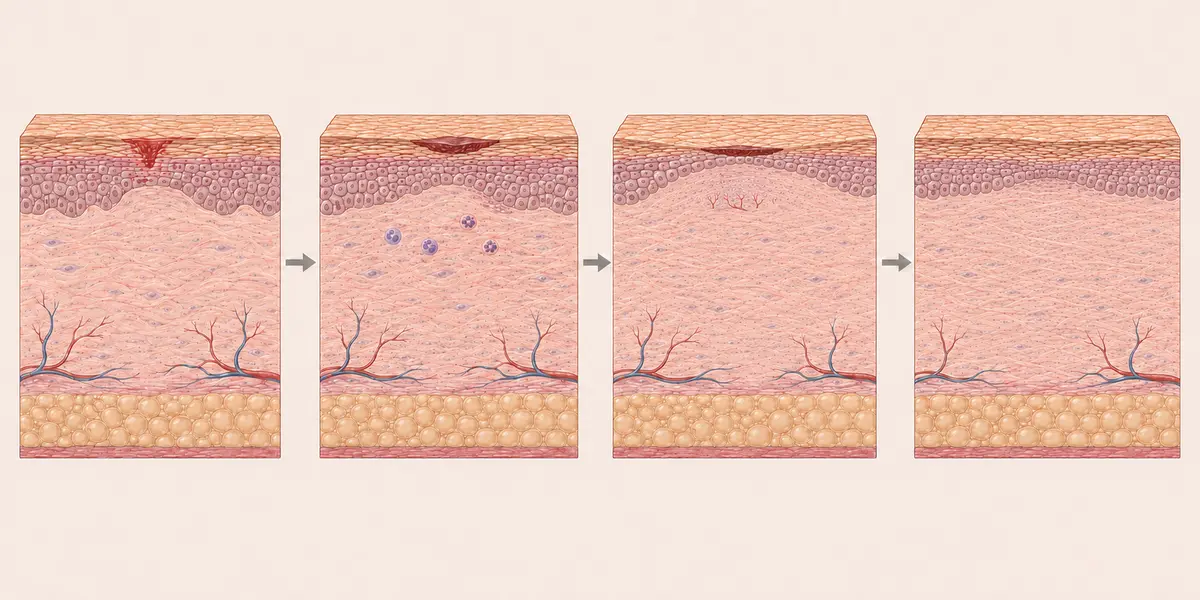
Fig. Simplified scheme of skin healing after injury: inflammatory response, epidermal recovery, formation of new blood vessels, and subsequent tissue remodeling.
In professional procedures, this response is used in a controlled way. Fractional lasers, microneedling, and peels of a certain depth create controlled injury, after which the tissue remodels. It is this remodeling — not the injury itself — that can gradually improve texture and reduce the appearance of fine lines or atrophic scars.
More redness, pain, or peeling does not mean stronger rejuvenation. Excessive impact increases the risk of prolonged inflammation, post-inflammatory pigmentation, infection, and scarring. Skin does not need the maximum possible stimulus, but one that is sufficient and controlled.
That is why phrases like “cell reset,” “awakening youth,” or “complete regeneration” say almost nothing about the actual result. A meaningful claim names a specific change: reduced water loss, faster healing, improved elasticity, collagen matrix remodeling, reduced wrinkle depth, or less visible scars.
Cream, procedure, and injection: different levels of action
Home care
Cosmetics work primarily with the stratum corneum and epidermis. They can reduce water loss, replenish lipid deficiency, support normal exfoliation, calm irritation, correct pigmentation, and protect the skin from ultraviolet radiation. This is not “just a surface effect.” A stable barrier directly affects comfort, reactivity, and the skin’s ability to tolerate active skincare.
Ceramides, cholesterol, and fatty acids help support the intercellular lipid structure. Occlusive ingredients reduce water evaporation. Niacinamide can improve barrier function, reduce inflammatory manifestations, and help with uneven pigmentation. Retinoids influence epidermal renewal, and with long-term use may improve signs of photoaging and the condition of the dermal matrix. Daily photoprotection limits new UV damage, without which any restorative program quickly loses its meaning.
An active ingredient’s ability to pass through the stratum corneum depends on the molecule’s size and structure, solubility, stability, concentration, and delivery system. That is why a laboratory study of a substance on cells does not prove that a cream containing that substance will provide the same effect in living skin. The most practically valuable evidence comes from studies of the finished formula.
A cream can support barrier repair, normal epidermal renewal, and protection against damage. But it cannot replicate laser remodeling or injection-based delivery into the dermis. You can find an overview of actives with the clearest roles in our article on how to choose a serum after 35.
Lasers, peels, and microneedling
These methods trigger healing through controlled physical, thermal, or chemical воздействия. The result depends on the depth of the procedure, the condition of the skin, equipment settings, technique, and the time allowed for recovery.
Superficial procedures mainly affect the epidermis. Deeper ones can influence the dermal matrix and produce more visible improvements in texture, wrinkles, or scars, but they require longer recovery and carry a higher risk of complications.
There is no need to keep injuring the skin in order to maintain “regeneration.” Combining acids, retinoids, spicules, home rollers, and professional procedures without sufficient intervals can sustain inflammation and disrupt the barrier. The disappearance of peeling does not yet mean that all remodeling processes are complete.
Injectable techniques
In injectable cosmetology, the regenerative category usually includes techniques whose effect is linked to a tissue response and gradual skin remodeling. These primarily include PRP therapy, polynucleotide products, and collagen biostimulators. Injection makes it possible to deliver a product into a specific layer of tissue, bypassing the stratum corneum barrier, but whether a method belongs to the regenerative category is determined not by the route of administration itself, but by its mechanism of action.
PRP contains plasma with an increased concentration of platelets and the signaling molecules associated with them, which take part in tissue repair processes. Polynucleotide products are used for gradual improvement in hydration, elasticity, and skin texture. Products based on poly-L-lactic acid, calcium hydroxyapatite, and other biostimulatory materials induce a tissue response that may be accompanied by the formation of a new collagen matrix. The mechanisms and level of evidence differ across these methods, but what they share is a focus not only on immediate correction, but also on gradual changes within the tissue.
Not all injections belong to this category. Non-crosslinked or lightly modified hyaluronic acid in a skin booster format primarily improves hydration and tissue properties, so it is more accurate to view it as a separate biorevitalization approach rather than automatically calling it a regenerative technique. Denser hyaluronic acid gels are used to create or restore volume. Botulinum toxin reduces the activity of certain muscles by blocking neuromuscular transmission. So botulinum therapy and conventional contour correction address different concerns and do not belong to methods whose main goal is skin remodeling.
We discussed the differences between these categories of products in more detail in our article on injectable trends in aesthetic medicine.
PDRN, exosomes, peptides, and spicules: what we know about popular technologies
PDRN and polynucleotides
PDRN and PN are derived from purified DNA, traditionally from fish-based raw materials. In scientific papers and manufacturers’ documentation, these terms are not used in exactly the same way. PDRN is more often described as a mixture of shorter deoxyribonucleotide chains, while PN refers to longer polynucleotide molecules with different physical and rheological properties. However, there is no universal boundary that clearly divides all products into these two categories. For practical choice, what matters is the specific product, its composition, concentration, molecular characteristics, and route of administration.
Injectable polynucleotides are used for gradual improvement in skin hydration, texture, elasticity, and overall appearance. Clinical studies report positive changes, including in the periorbital area, but most of these studies involve small sample sizes, different protocols, and different assessment methods. This is a promising category with clinically visible potential, though its evidence base is not yet as standardized as that of botulinum toxin, retinoids, or well-studied laser methods.
In practice, this means polynucleotides may improve certain skin quality parameters, but they do not create volume like a filler and do not provide mechanical tissue lifting. Results develop gradually and depend on the product, the treatment area, the initial condition of the skin, and the course of procedures.
PDRN or Sodium DNA in a cream works under different conditions. Given the size of nucleotide fragments, there is no reason to expect them to pass through an intact stratum corneum and reproduce the effect of an injection. A finished topical formula may hydrate, soothe, and support recovery of the superficial layers, if that has been demonstrated in studies of that specific product. It is not correct to transfer the results of injectable studies to a cream.
“Salmon DNA” is a simplified name for purified DNA fragments obtained from fish-derived raw materials. “Vegan PDRN” is mostly a commercial term rather than a standardized scientific one. It may refer to nucleotide materials of plant or biotechnological origin, but they should not be considered a direct equivalent of classic PDRN without data on the composition and characteristics of the substance.
Exosomes and other extracellular vesicles
Extracellular vesicles are microscopic membrane-bound particles that cells release into the surrounding environment. They carry proteins, lipids, and nucleic acids and transmit signals between cells. Exosomes are one type of extracellular vesicle: they form within the cell’s endosomal system and are then released outside the cell.
In scientific work, particles can be called exosomes only when their origin has been confirmed. This is difficult to determine in a finished material, so researchers often use the more precise umbrella term “extracellular vesicles.” In the cosmetic industry, the word exosomes is used more loosely. It may refer to purified extracellular vesicles, cell secretome, culture medium containing products of cellular secretion, plant-derived vesicle-like particles, or multi-component raw materials with a commercial name. These are not equivalent materials, even if they are marketed under the same term.
Extracellular vesicles are indeed of interest in regenerative medicine. In laboratory and preclinical studies, they affect the inflammatory response, healing, fibroblast activity, and extracellular matrix formation. Early clinical studies in aesthetic medicine also show improvement in certain skin parameters, including hydration, elasticity, pigmentation, and wrinkle severity. However, most studies are still small, and the products and protocols differ significantly. So a positive result with one specific product does not prove the effectiveness of all products labeled exosomes.
The number of particles is not, by itself, a measure of quality either. The phrase “billions of exosomes” says nothing about their origin, composition, or biological activity. To evaluate a product, what matters is the source of the material, the method of production and purification, particle characteristics, their contents, stability, purity, sterility, and storage conditions. Without this information, a large number on the packaging remains a marketing claim.
Simply applying a product to intact skin and using it after a laser procedure or microneedling are two very different modes of action. The stratum corneum limits the penetration of large biological structures, so a surface-level cosmetic should not be expected to deliver the same result as procedural administration. After laser treatment or microneedling, the protective barrier is temporarily disrupted, and components may penetrate more deeply. At the same time, the risk of introducing microorganisms, impurities, and substances not intended for contact with open microchannels also increases. That is why after such procedures only products whose manufacturer has explicitly intended them for this method of use and ensured the necessary quality and sterility requirements should be used. An ordinary cosmetic serum should not be introduced into procedure-created channels simply because the word exosomes appears on the label.
Injectable use requires even stricter control. For example, in the United States there are no FDA-approved exosome products, and products intended to treat or alter the structure and function of the body are considered by the regulator to be drugs and biological products that must undergo appropriate review.
Peptides and growth factors
Peptides are a large group of molecules with different structures and functions. Signaling peptides mimic certain natural signals, transport peptides may bind specific substances such as copper, and some peptides affect enzyme activity. Cosmetic neuromodulating peptides are designed to influence processes associated with facial muscle contraction, but in mechanism and strength of effect they are not a topical equivalent of botulinum toxin. Effectiveness depends on the specific peptide sequence, its concentration, stability, ability to penetrate the skin, and the composition of the formula as a whole.
Growth factors are signaling proteins involved in regulating cell division, migration, and activity. In topical cosmetics, their use is complicated by large molecular size and instability. Delivery systems may change penetration and help preserve activity, but the result must be evaluated for the finished product. A growth factor, cell secretome, culture medium, and fermented extract are not interchangeable types of raw material.
Spicules and cosmetic “microneedles”
Spicules are microscopic needle-like structures usually obtained from sponges. When rubbed into the skin, some of these particles enter the superficial layers, cause a tingling sensation, and may temporarily enhance the delivery of other components.
Spicules are better understood as a physical way of affecting the barrier and a potential delivery system, rather than as a standalone regenerative active. The result depends on the shape, size, quantity, and processing of the particles, the formula of the product, the intensity of application, and the condition of the skin.
This is not the same as professional microneedling. During a procedure, the specialist controls needle length, depth, density, and the number of passes. In a cosmetic product, the distribution of spicules and the actual depth of their penetration are far less predictable. Strong tingling confirms physical irritation, but does not prove new collagen formation.
Products with spicules should not be applied to skin with active inflammation, a compromised barrier, pronounced burning, or poor tolerance to mechanical irritation. During a flare of rosacea, active dermatitis, or inflammatory breakouts, experimenting with enhanced delivery of ingredients is especially inappropriate.
How to choose a product or procedure without chasing trends
It makes more sense to start not with a fashionable ingredient, but with the specific change you want to address. Dryness and a damaged barrier require restorative care. The foundation of photoaging management remains daily SPF, retinoids when not contraindicated, and professional procedures when indicated. Atrophic scars require controlled remodeling, and loss of volume will not be corrected by a cream with a “regenerative” active.
- Dryness and a compromised barrier: gentle cleansing, hydrating and occlusive components, lipids, and reducing irritating triggers.
- Photoaging: photoprotection, retinoids, and other topical actives with clinically confirmed effects.
- Uneven texture and atrophic scars: lasers, microneedling, peels, or a thoughtful combination of these.
- Reduced hydration and elasticity: home care, skin boosters, polynucleotides, PRP, or other methods depending on the underlying issue.
- Loss of volume or tissue support: fillers, collagen biostimulators, lipofilling, or surgical correction when indicated.
How much stimulation can the skin handle?
Healing does not end when the redness fades. After the initial inflammatory response, new tissue forms, and the matrix may continue to remodel for weeks or months. That is why intervals are determined by the depth of the procedure, the skin’s response, and the protocol — not by the desire to repeat the stimulus as quickly as possible.
Persistent burning, redness, peeling, a painful reaction to water, or sudden intolerance to familiar cosmetics are signs of overload. In that situation, irritating actives and injuring procedures should be stopped until the skin recovers.
Post-procedure care
After a peel, laser treatment, or microneedling, the skin usually needs gentle cleansing, simple restorative care, and photoprotection. Acids, retinoids, scrubs, and spicules should be reintroduced according to the timeframe recommended for the specific procedure. There is no universal rule that “after three days, it’s fine.”
After injections, it is important to protect the puncture sites, avoid creating additional infection risk, and follow the physician’s recommendations. Moderate swelling, soreness, and bruising may be a short-term reaction. Increasing pain, sudden blanching or grayish-purple discoloration of the skin, spreading redness, purulent discharge, visual disturbance, or a general worsening of well-being require urgent medical attention.
How to spot an exaggerated promise
A cream cannot reproduce the effect of an injectable product simply because it contains an ingredient with the same name. Spicules do not offer the same depth control as professional microneedling. The word exosomes does not confirm either the composition of the product or the delivery of functional vesicles into the dermis. Polynucleotides may improve certain skin quality parameters, but they do not replace fillers, surgical lifting, or treatment of a dermatological disease.
Phrases like “complete cellular rejuvenation,” “guaranteed new collagen,” “replacement for injections,” or “skin restoration in one procedure” do not describe a measurable result. By contrast, a sound claim states what exactly changed, after what period it was evaluated, and by what method it was measured.
The regenerative approach does genuinely expand the possibilities for working with skin quality, but it does not cancel out the basics. Photoprotection, a stable barrier, control of dermatological conditions, and consistent work on a specific concern remain more important than chasing the newest ingredient. The value of a technology is determined not by the scale of the promise, but by how well its mechanism and depth of action match the real task.
Sources
- Peña O. A., Martin P. Cellular and molecular mechanisms of skin wound healing. Nature Reviews Molecular Cell Biology, 2024.
- Sitohang I. B. S. et al. Topical tretinoin for treating photoaging: a systematic review of randomized controlled trials. International Journal of Women’s Dermatology, 2022.
- Carniol P. J., Hamilton M. M., Carniol E. T. Current Status of Fractional Laser Resurfacing. JAMA Facial Plastic Surgery, 2015.
- Lee K. W. A. et al. Polynucleotides in Aesthetic Medicine: A Review of Current Practices and Perceived Effectiveness. International Journal of Molecular Sciences, 2024.
- Welsh J. A. et al. Minimal information for studies of extracellular vesicles (MISEV2023): From basic to advanced approaches. Journal of Extracellular Vesicles, 2024.
- U.S. Food and Drug Administration. Public Safety Alert Due to Marketing of Unapproved Stem Cell and Exosome Products. 2019.




-lazy-placeholder.webp)
-medium.webp)