





A natural-looking result in aesthetic medicine is often described too simplistically: as if it were enough to use less product, choose a “gentle” procedure, or ask the doctor to make sure nothing is noticeable. In reality, the invisibility of intervention begins much earlier — with a precise understanding of what exactly has changed in the face, what concerns the person, and which features they do not want to lose. Without this conversation, even a technically flawless correction can create a “foreign” feeling when looking at one’s own reflection in the mirror.
Well-age does not require giving up procedures, nor does it declare every wrinkle untouchable. It changes the criterion for a good result. The goal is no longer an abstractly younger face, but a more rested appearance, a softer transition between areas, better skin quality, or the restoration of some lost proportions without unifying facial features. In a broader article about how well-age differs from anti-age and skin longevity, we considered this shift as a change in the language of the industry. Here, something else is more important: how it works at the level of a specific face and a specific decision.
The face does not age in a single layer
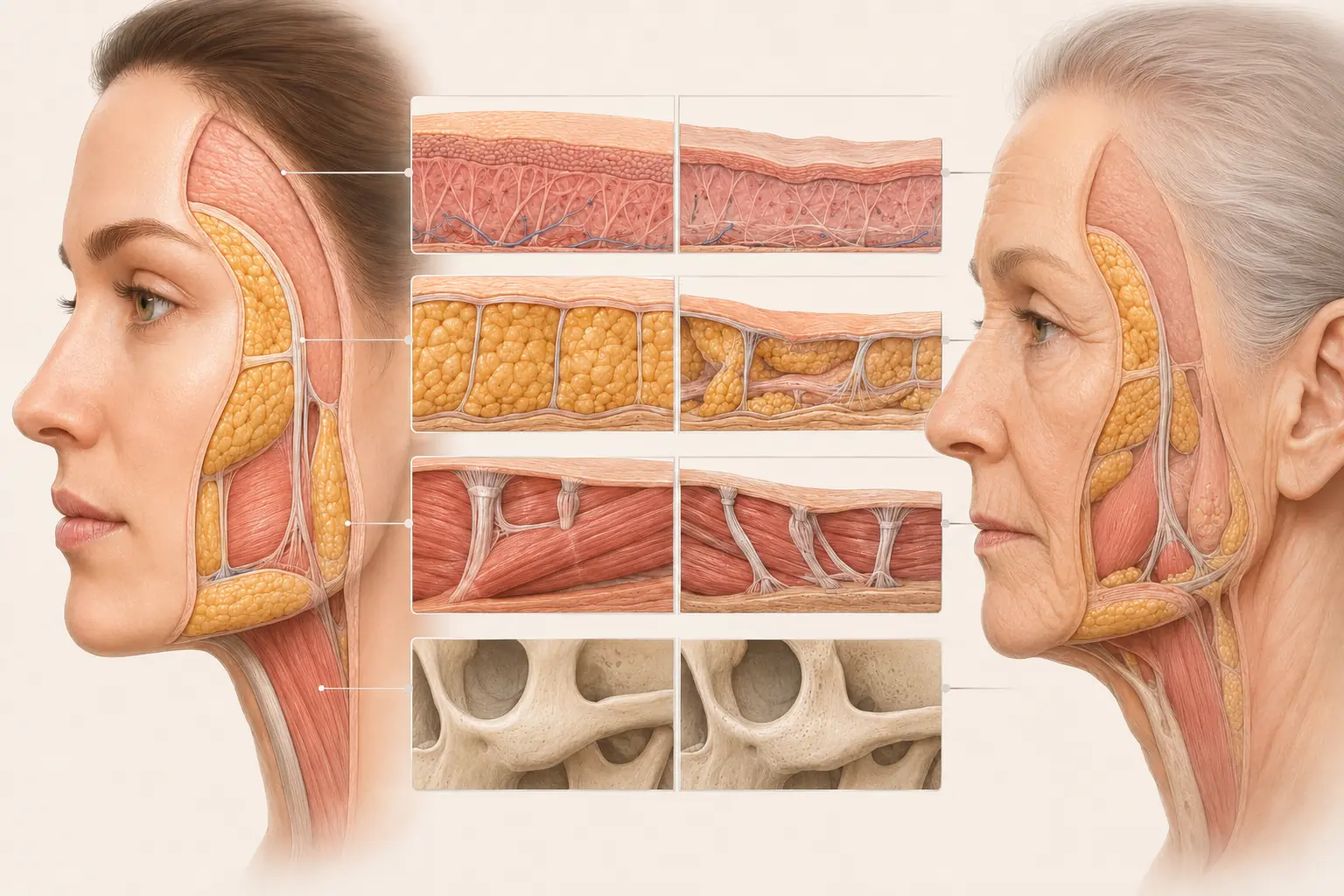
Age-related changes are not limited to wrinkles and “collagen loss.” Over time, the properties of the skin, the distribution of superficial and deep fat compartments, muscle tone and activity, the ligamentous apparatus, and the bony support all change. These processes occur at different rates and depend on anatomy, facial expressions, hormonal changes, weight fluctuations, sun exposure, and lifestyle. That is why two people of the same age may have completely different concerns, and the same fold near the mouth may have different causes.
For example, a person sees that the nasolabial fold has become deeper and quite logically thinks: if the indentation is bothersome, it should be filled. But different processes can make the fold more noticeable — changes in support in the midface, tissue descent, bite characteristics, mouth mobility, weight fluctuations, or even light and shadow on dry, dull skin. Outwardly, the problem has one name, but the solutions may be opposite: support another area, work on the skin, avoid injecting directly into the fold, or refuse to correct it altogether. This makes it clear why aesthetic medicine does not work by the principle of “see a line — fill a line.”
Likewise, a “tired face” is a description of an impression, not a ready-made diagnosis. Different changes can create it, so first their cause must be clarified, and only then should correction be discussed.
Why a doctor needs old photographs
That is why a full assessment is not limited to a front-facing photograph. The doctor looks at the face at rest and in motion, evaluates the profile, asymmetry, skin quality, proportions, and how individual areas influence one another. Old photographs of the person can also be useful, but not as an order to “make me look like I did at 25.” They help distinguish an age-related change from a feature that has always been part of the face: natural asymmetry, a characteristic chin shape, shadows under the eyes, or a particular lip movement. Sometimes what is now perceived as a defect turns out in old photographs to be a familiar anatomical feature, only slightly emphasized by age.
Digital visualization also helps reveal details, but as we already wrote in the article about cosmetic dermatology in the digital age, simulation is not a guarantee of the future result. On a screen, you can locally remove a shadow or shift a contour without changing anything around it. In a living face, any correction becomes part of a system of tissues, proportions, and movements. That is why the result cannot be projected with pixel-level precision.
Here well-age intersects with the idea of skin longevity and the biological age of the skin, but it does not duplicate it. Diagnostics can help describe pigmentation, the vascular component, hydration, or texture. They do not provide a ready-made aesthetic solution and do not determine what the face should look like. The data obtained refine the conversation with the doctor, but in themselves are not an indication for intervention.
A good plan does not begin with the name of a procedure
A person often comes to a consultation with a ready-made request: “I want filler in my cheekbones,” “I need botulinum toxin,” or “recommend a device-based lifting procedure.” This is understandable — on social media, procedures are presented as separate products with a predictable effect. However, a different formulation is more useful for the doctor: what facial expression is concerning, when it became noticeable, how it looks in motion, and what exactly the person would like to change. “I don’t want to look angry when I’m calm,” “my face looks exhausted after weight loss,” “I’m bothered by uneven tone, not wrinkles” — such descriptions provide more information for choosing a solution than the name of the desired procedure.
What to change and what must be preserved
It is equally important to define the boundaries. What facial expressions does the person want to preserve? Do they like their natural asymmetry, lip shape, sharp cheekbones, mobile forehead? What definitely do they not want to see after the procedure? In practice, preserving individuality often depends precisely on these answers. A doctor may technically improve a proportion according to averaged canons, while at the same time removing the trait by which the person recognizes themselves.
It is also useful to separate one’s own desire from a reaction to a random photo, another person’s comment, or a series of filtered faces in the feed. If until yesterday a certain area was not bothersome, but today seems like an urgent problem after a video about “profile flaws,” a pause may be more accurate than immediate correction. It does not invalidate the concern. On the contrary, it makes it possible to check whether this desire will remain once the external impulse disappears.
In a well-age plan, there is no mandatory set of procedures “by age.” Chronological age — 35, 45, or 60 — is not in itself an indication for injections, laser treatment, or collagen stimulation. Likewise, there is no medical need to correct every sign of aging that a doctor is able to see. A minimally sufficient plan chooses one or several priority tasks, defines the sequence, and leaves time to evaluate the result. The face does not have to undergo a full “upgrade” if the person is concerned by one specific change.
Six questions before a procedure
Before making a decision, it is worth getting clear answers to several questions:
- What exactly does the doctor see, and which structures or processes influence it the most?
- What result is realistic, and what will this procedure not correct?
- Can treatment begin with a smaller volume or a single stage?
- What may change in facial expressions, proportions, and the sense of one’s own face?
- What side effects are expected, what complications are possible, and what will the clinic do if they occur?
- How long will the effect last, and what will happen if nothing is repeated afterward?
The last question is especially important. A maintenance procedure should not imperceptibly turn into an endless obligation. A person should understand not only the cost of the first stage, but also the logic of subsequent decisions, the possibility of stopping, and the limit beyond which additional intervention no longer improves the result.
One tool cannot correct all age-related changes
Different methods work with different components of aging. Products and procedures for tone and texture do not restore lost support; botulinum toxin changes the activity of certain muscles but does not restore volume; a filler can support tissues or correct a contour, but that does not make it a universal treatment for laxity or skin quality. Calling all this “rejuvenation” is convenient, but too imprecise: a method may perform its local task well while at the same time not changing what the person actually considers the problem.
This article deals primarily with non-surgical and minimally invasive methods. They have limits: not every tissue descent, skin excess, or structural change can be convincingly corrected with injections or device-based procedures. If the method does not match the task, an honest plan may involve consultation with a plastic surgeon or a refusal to intervene, rather than endlessly adding procedures with ever more modest effect.
One complaint — two different routes
Let us imagine two people with the same complaint: “After losing weight, my face started to look tired.” In the first person, old photographs show that the midface used to be fuller, and after stable weight loss, hollowness and sharper transitions appeared. At the same time, the skin retained a relatively even tone, and the expression does not noticeably change throughout the day. The doctor may discuss volume loss, assess whether its restoration would actually improve proportions, and begin with a minimal step in the area that has the greatest influence on the overall impression.
In the second person, weight is still fluctuating, under-eye shadows become stronger after lack of sleep, the skin has uneven tone and irritation, and in photos taken under different lighting the “tiredness” looks completely different. Adding volume will not necessarily eliminate the main cause of that impression. The first stage may be weight stabilization, treatment of a dermatological condition, simpler home care, and reassessment after a defined period of time. If a specific structural change remains after that, the conversation about a procedure will become more precise.
This example is not a ready-made treatment scheme. It shows the route of decision-making itself: the doctor does not translate the word “tiredness” into the language of a single procedure, but checks what the visible change consists of, what can be postponed, and what truly requires correction. The same complaint does not oblige the same plan.
More methods do not mean a more precise plan
At the same time, the multilayered nature of aging does not mean that everyone needs a combination of methods. On the contrary, it easily becomes a marketing justification for an excessively large plan. Theoretically, a task can be found for every available device or product. Practically, what matters is determining which change has the greatest influence on the overall impression and whether correcting it is worth the intervention, recovery, risk, and cost.
Sometimes one precise step changes the perception of the entire face more than working on five areas at once. Sometimes a staged combination of methods is appropriate, but time is needed between stages: swelling must subside, the result must stabilize, and it must become clear how the correction has affected proportions and facial expressions. Otherwise, temporary unevenness after the first procedure becomes a reason for the second, swelling after the second becomes grounds for “balancing” a third area, and the face is corrected further before there has even been a chance to see the previous result. The problem here is not necessarily a large dose. It may lie in a series of decisions, each of which was made too early.
A separate discussion is needed about skin quality. It truly affects how features, shadows, and transitions between areas are perceived, but the phrase “work on quality” does not make any procedure gentle or necessary. In the article about injectable methods for skin hydration, texture, and density, we examined individual tools in more detail. Within well-age, something else matters: belonging to the category of methods for improving skin quality does not yet mean that a given procedure is needed by a specific person. The choice should be determined by the condition of the skin, the indications, and the expected result.
Home care should not be opposed to procedures or used to try to replace what cosmetics cannot do. Its role is different: to support the barrier, control specific conditions, reduce photodamage, and avoid adding unnecessary irritation to the skin. If professional interventions are combined with an ongoing struggle against the consequences of too many active ingredients, the system contradicts itself. That is why well-age skincare without overloading the skin remains the foundation even in cases where a person chooses aesthetic medicine.
Where correction ends and self-loss begins
An erased face rarely appears in a single moment. More often, the path looks entirely reasonable: slightly relax forehead movement, add a little volume to the cheekbones, even out lip asymmetry, smooth one more shadow, and then do an early touch-up while the previous result has not yet stabilized. No individual step seems excessive. But gradually, the smile moves differently, the forehead participates less in conversation, familiar asymmetry disappears, and all transitions become equally smooth. Individuality is lost not only through “too much product,” but also through the accumulation of small correct decisions without a shared limit.
Zero wrinkles is not a neutral goal. Expression lines appear where the face moves, so their complete elimination changes not only the resting photograph, but also the way surprise, doubt, joy, or irony are conveyed. Likewise, restoring volume does not mean recreating a youthful face: tissues, ligaments, and bony support all change together with age, and adding gel does not return the entire system to its previous state. Youth is not stored in a separate hollow that can simply be filled. Good correction works with the reality of the present face, rather than trying to literally rebuild its version from twenty years ago.
A natural-looking result does not cancel the risks
The desire to “remain yourself” should not push safety into the background. The risk profile depends on the method, the area, the procedure parameters, health status, and the specialist’s qualifications. After botulinum toxin, unwanted weakness of adjacent muscles, asymmetry, or drooping of the eyelid or eyebrow are possible. Depending on the type of laser or other energy-based procedure, burns, prolonged pigment changes, infections, or scarring may occur. Fillers can cause swelling, bruising, nodules, infectious and delayed inflammatory reactions, and the rare entry of product into a vessel can lead to tissue necrosis, visual impairment, blindness, or stroke. This is not a complete list, but an explanation of why the words “minimally invasive,” “natural,” or “biocompatible” are not synonyms for safe.
The doctor’s qualifications matter not only at the moment the procedure is performed. They are also reflected in the ability to take a medical history, identify contraindications, explain alternatives, state the limits of the method, and have an action plan in case of complications.
When the professional answer is “enough”
Another professional skill is knowing when to say “enough” or “not now.” If expectations cannot be fulfilled, the concern constantly shifts from one area to another, and a minor feature causes intense and exhausting anxiety, the next procedure may not bring relief. In such a situation, a pause, an additional consultation, or a recommendation to seek psychological support is part of responsible medicine, not a refusal to hear the person.
A good well-age result does not necessarily make others ask what exactly was done. More often, they simply see the face as a whole: less tired, calmer, with preserved facial expressions and familiar features. But being unnoticed by others is not the only criterion. What matters is that the person recognizes themselves, understands the cost and limits of the intervention, and does not feel obliged to constantly correct the next sign of time.
Well-age in aesthetic medicine is not a separate procedure and not a new name for “natural rejuvenation.” It is a way of making decisions: first define the task, then choose the minimally sufficient step, and calmly assess the result. Sometimes the decision will be correction, sometimes refusal of it. The face is not preserved at a certain age. It is helped to change in such a way that the person does not disappear behind those changes.
Sources:
- Swift A., Liew S., Weinkle S. et al. The Facial Aging Process From the “Inside Out”. Aesthetic Surgery Journal. 2021; 41(10): 1107–1119.
- Philipp-Dormston W. G., De Boulle K., Gronovich Y. et al. The Patient Journey in Facial Aesthetics: Findings from a European Consensus Meeting on Improving the Quality of Life for Patients Receiving Botulinum Toxin Injections. Clinical, Cosmetic and Investigational Dermatology. 2024; 17: 329–337.
- U.S. Food and Drug Administration. Dermal Fillers (Soft Tissue Fillers). Official FDA materials on the use of and risks associated with dermal fillers.
- Zargaran D., Zoller F., Zargaran A. et al. Complications of Cosmetic Botulinum Toxin A Injections to the Upper Face: A Systematic Review and Meta-Analysis. Aesthetic Surgery Journal. 2022; 42(5): NP327–NP336.
- Ramsdell W. M. Fractional CO2 Laser Resurfacing Complications. Seminars in Plastic Surgery. 2012; 26(3): 137–140.
- Pereira I. N., Chattopadhyay R., Fitzpatrick S. et al. Evidence-Based Review: Screening Body Dysmorphic Disorder in Aesthetic Clinical Settings. Journal of Cosmetic Dermatology. 2023; 22(7): 1951–1966.