






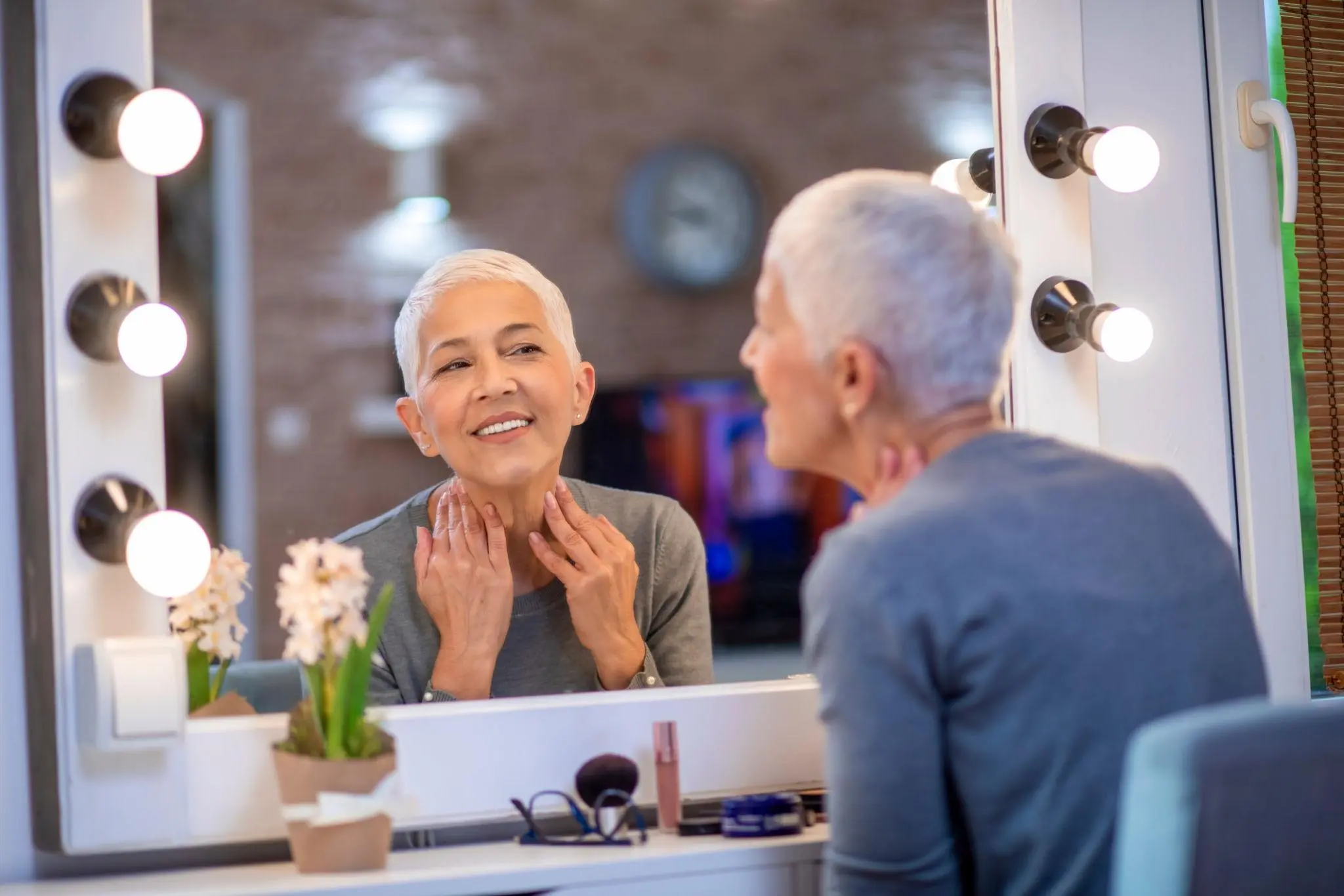
The camera scans your face, the app announces your “skin age,” and a gap of just a few years can easily feel like a verdict. If the number is lower than your chronological age, your skincare must be working. If it is higher, it must be time to urgently add more actives. At the same time, beauty products are increasingly promising to support skin longevity, protect “youthful” cells, or even restore some of the skin’s lost biological time. All of these claims are rooted in real areas of research, but there is still a gap between a scientific model, a device reading, and an advertising promise — one that marketing often bridges with a single elegant sentence.
That is exactly why skin longevity should be viewed without falling into either of two extremes. It is not an empty buzzword invented solely for a new label, but neither is it a ready-made technology for controlling age. In the broader conversation about how well-age differs from anti-age and longevity, skin longevity offers a useful scientific horizon. The only question is what exactly a brand, laboratory, or diagnostic service means by longevity — and what evidence it uses to support that meaning.
Skin longevity: a longer functional lifespan, not ageless skin
Skin longevity does not yet have a single clinical definition, nor does it refer to a standardized metric that can be measured with one test. The most accurate way to understand the term is as a framework: how to preserve the skin’s functions for longer — its ability to protect the body, retain water, recover after damage, support immune defense, and withstand environmental stress. Read this way, the goal is not a face without age, but tissue that can keep doing its job for as long as possible.
This is an important distinction, because skin does not age according to a single scenario. Changes take place in the epidermis, dermis, blood vessels, extracellular matrix, pigment system, and immune system. With age and under the influence of external factors, DNA damage accumulates, gene regulation shifts, mitochondrial function becomes impaired, the share of senescent cells rises — cells that no longer divide but continue to affect the tissue — and intercellular communication is remodeled. At the same time, collagen and elastin fibers change, the barrier weakens, and the pace of recovery slows. None of these processes on its own equals “skin age,” and one cosmetic effect cannot automatically be taken as an effect on the entire system.
Intrinsic aging is further shaped by the exposome — the sum of exposures the skin encounters over a lifetime. The best studied of these is ultraviolet radiation, but tobacco smoke, air pollution, climate conditions, and other lifestyle factors also matter. Some mechanisms already have their own names and evidence base. For example, inflammaging as one of the mechanisms behind age-related changes describes the role of chronic low-grade inflammation, while the link between glycation, collagen, and skin firmness explains how non-enzymatic reactions between sugars and proteins can alter tissue properties. In women, hormonal transitions add another layer to this picture, so chronological age alone does not explain how hormonal changes affect the skin after 40.
So the scientifically honest version of skin longevity sounds fairly restrained: reduce the accumulation of damage, support function, and avoid interfering with repair. It does not erase wrinkles or stop time. Its value lies in shifting the scale: looking not only at fast visible effects, but also at whether the skin maintains resilience over the long term.
Does skin have a biological age of its own?
Chronological age is simple: it is the amount of time since birth. Biological age is more complex, because it cannot be observed directly. In science, it is an estimated value built from selected features: molecular changes, functional indicators, or a combination of both. The result depends on what exactly was measured, which population the model was built on, and what outcome it is meant to predict. One algorithm may reproduce chronological age better, another may try to predict health risks, and a third may link molecular data to a specific phenotype. At present, there is no universal number that fully captures the pace of aging in a person — or in their skin alone.
The best-known area in this field is epigenetic clocks. These analyze DNA methylation patterns, meaning chemical marks linked to the regulation of gene activity. These are not mutations, nor literal “damage to the code,” but one layer of control over how that code works. In 2018, researchers introduced the Skin & Blood Clock, optimized for cells and tissues including skin, blood, fibroblasts, and epithelial cells. The model estimated the chronological age of samples quite accurately and became a useful tool for laboratory research. However, accurately reproducing passport age does not mean that the clock can just as accurately describe firmness, barrier function, healing capacity, or the future speed of wrinkle formation.
Later models attempt to bring molecular assessment closer to what happens visibly in the skin. For example, the VisAgeX study used methylation patterns from epidermal samples taken from 378 women and compared them with wrinkle scores and visual age assessments. This is an interesting step: the model is trained not only to guess a date of birth, but to connect molecular data with a specific manifestation of aging. However, in the test sample, the link between the VisAgeX prediction and visual age progression was relatively weak: the correlation coefficient was 0.30, and the mean absolute error was 6.17 years. In an independent dataset, those figures were 0.48 and 4.67 years respectively. So while the model points to a promising research direction, it still does not offer a ready-made way to determine the skin’s “true” age. Its result also depends on the chosen phenotype, the sampling method, the characteristics of the study group, and the quality of external validation. A test like this cannot be equated with consumer photo analysis.
The science of aging biomarkers itself is also still in the process of standardization. An international group of researchers in Nature Medicine explicitly noted that there is still no single consensus on how such markers should be validated before clinical use. For a test to be reliable, showing a correlation with age is not enough. It must be shown to work consistently across different populations, be reproducible in other laboratories, be linked to clinically meaningful outcomes, and respond appropriately to change over time. For that reason, “biological skin age” is more accurately described today as a class of research models rather than a ready-to-use diagnosis.
What devices, photos, and algorithms actually see
In clinics and apps, very different procedures may be grouped under the same label of “skin age diagnostics” — from standardized photography to measurements of barrier-related parameters. Some of them do provide useful data. We have already written about what digital skin diagnostics changes: its practical value lies first of all in standardizing observations and tracking change over time.
| Method | What it can assess | What the result does not prove |
|---|---|---|
| Standardized photos and 3D imaging | Wrinkles, texture, pigmented spots, redness, contour changes | The molecular age of cells or the condition of all skin layers |
| Corneometry and TEWL measurement | Hydration of the stratum corneum and the intensity of water loss through the skin | The overall pace of aging or the skin’s collagen “reserve” |
| Cutometry | The skin’s mechanical response to controlled suction, including parameters of elasticity and shape recovery | The direct quantity or quality of collagen fibers |
| Ultrasound and other imaging methods | Thickness, echogenicity, and structural tissue features within the limits of a specific device | A single assessment of biological age without professional interpretation |
| AI analysis of photos or selfies | Visual features the algorithm has learned to recognize and compare with a database | Epigenetic age, cellular aging, or a medical prognosis |
| Epigenetic clock | A statistical estimate based on DNA methylation patterns in a specific sample | The full state of the skin, if the model was not validated specifically for that task |
Even objective instruments require standardized conditions. Hydration and water loss are influenced by temperature, humidity, the measurement site, prior cleansing, and the time elapsed since product application. Photos are affected by lighting, camera settings, makeup, facial expression, and the processing algorithm. AI does not “see age” as a biological essence: it detects patterns it was trained on. If the training dataset covers a limited group by age, sex, or phototype, the result cannot be generalized to all users without additional validation.
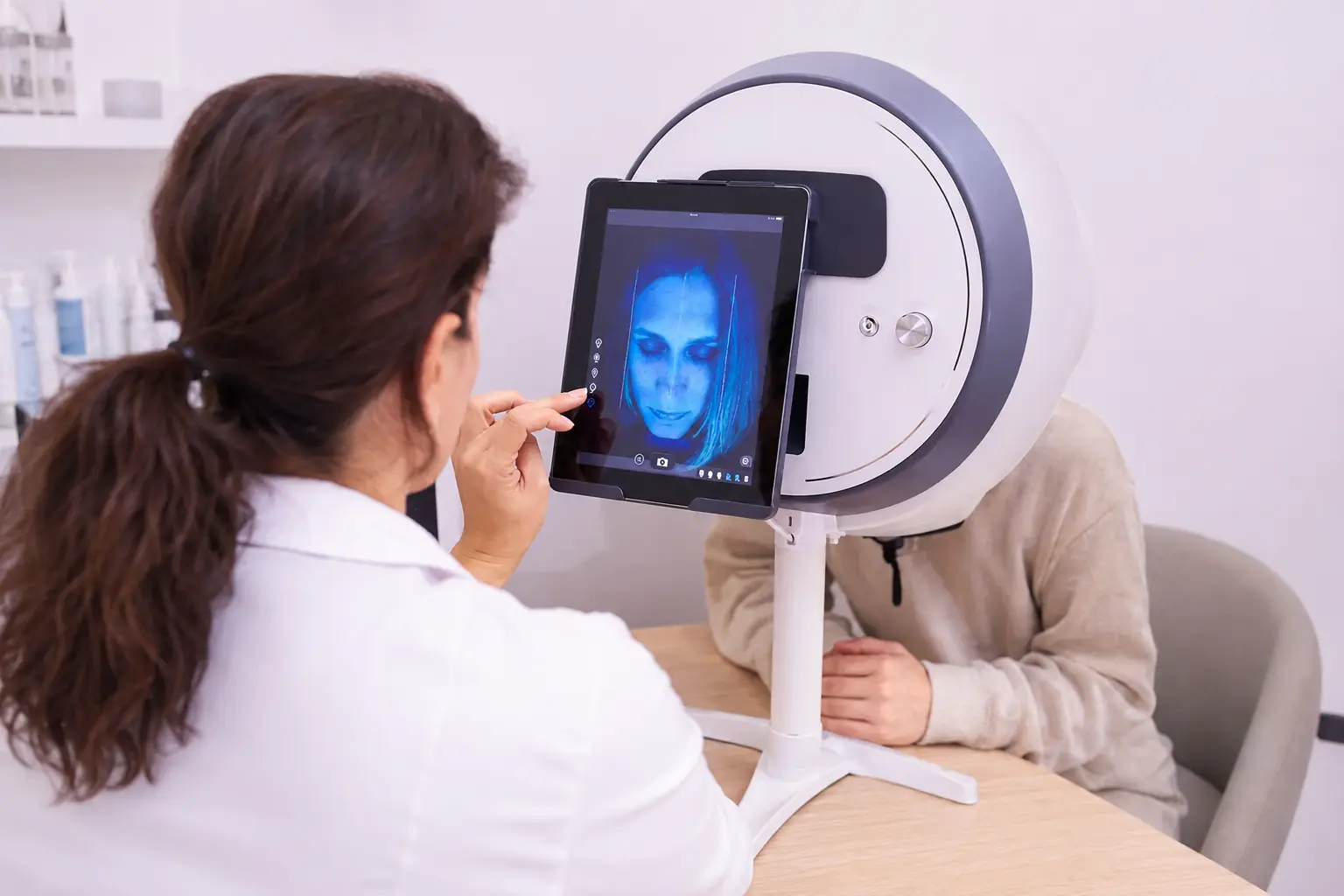
Under the right conditions, digital and device-based analysis helps answer specific questions. A series of photos taken in the same lighting can show changes in pigmentation or wrinkles, corneometry can show the effect of a moisturizer, and TEWL measurement can indicate the intensity of transepidermal water loss and indirectly reflect barrier status. Data like this is useful when interpreted within the limits of the chosen method.
Where a scientific term turns into a marketing promise
Marketing does not begin the moment a beautiful word appears. It begins when the scale of the conclusion exceeds the scale of the evidence. A change in wrinkle depth is not the same as cellular rejuvenation, increased hydration does not prove an extended tissue lifespan, and the result of an experiment with a single ingredient cannot automatically be transferred to a finished formula. Even European criteria for cosmetic claims require truthfulness, evidential support, and consistency between the message and the available data. If a study confirms an effect for eight hours, it cannot justify a promise lasting two days. The same logic applies to bold longevity claims.
Before believing in “rejuvenation of the skin’s biological age,” it is worth asking four questions:
- What exactly was measured? Photos, hydration, elasticity, expression of individual genes, or DNA methylation all provide different types of data.
- What was the study conducted on? A result in cell culture, reconstructed skin, and a controlled study of a finished product in humans do not carry the same evidential weight.
- What was the result compared against? Without a control group, a sufficient number of participants, a described protocol, and statistics, a percentage “improvement” says very little.
- Does the conclusion match the method? A device that assesses wrinkles can report on wrinkles. To speak about a change in biological age, a defined and properly validated biomarker is required.
The term skin longevity does not necessarily conceal exaggeration. It can describe a fully rational strategy: photoprotection, barrier support, control of inflammatory conditions, timely treatment of dermatoses, and careful use of methods with proven efficacy. What should raise suspicion is not the words longevity or age clock themselves, but claims about a “youth reset,” “age reversal,” or “activation of longevity genes” without explaining which indicator changed and why that change matters for a person.
The science of skin aging is moving toward more complex and more accurate models, where molecular data is combined with function and visible signs. For now, though, the more honest answer is almost never a single age displayed on a screen, but a profile: how well the skin retains water, responds to stress, recovers, changes in pigmentation, and changes in structure. That is the real strength of skin longevity. The term brings attention back to the skin’s long-term functional lifespan — as long as it is not pushed to promise more than science can currently measure.
Sources
- Jin S. et al. Hallmarks of Skin Aging: Update. Aging and Disease, 2023.
- Horvath S. et al. Epigenetic clock for skin and blood cells applied to Hutchinson Gilford Progeria Syndrome and ex vivo studies. Aging, 2018.
- Moqri M. et al. Validation of biomarkers of aging. Nature Medicine, 2024.
- Bienkowska A. et al. Development of an epigenetic clock to predict visual age progression of human skin. Frontiers in Aging, 2024.
- Krutmann J. et al. The skin aging exposome. Journal of Dermatological Science, 2017.
- Qassem M., Kyriacou P. Review of Modern Techniques for the Assessment of Skin Hydration. Cosmetics, 2019.
- Park H. et al. Development and application of artificial intelligence-based facial skin image diagnosis system. International Journal of Cosmetic Science, 2024.
- European Commission. Commission Regulation (EU) No 655/2013, 2013.
- Sub-Working Group on Claims. Technical document on cosmetic claims, version of 3 July 2017.





-lazy-placeholder.webp)
-medium.webp)