






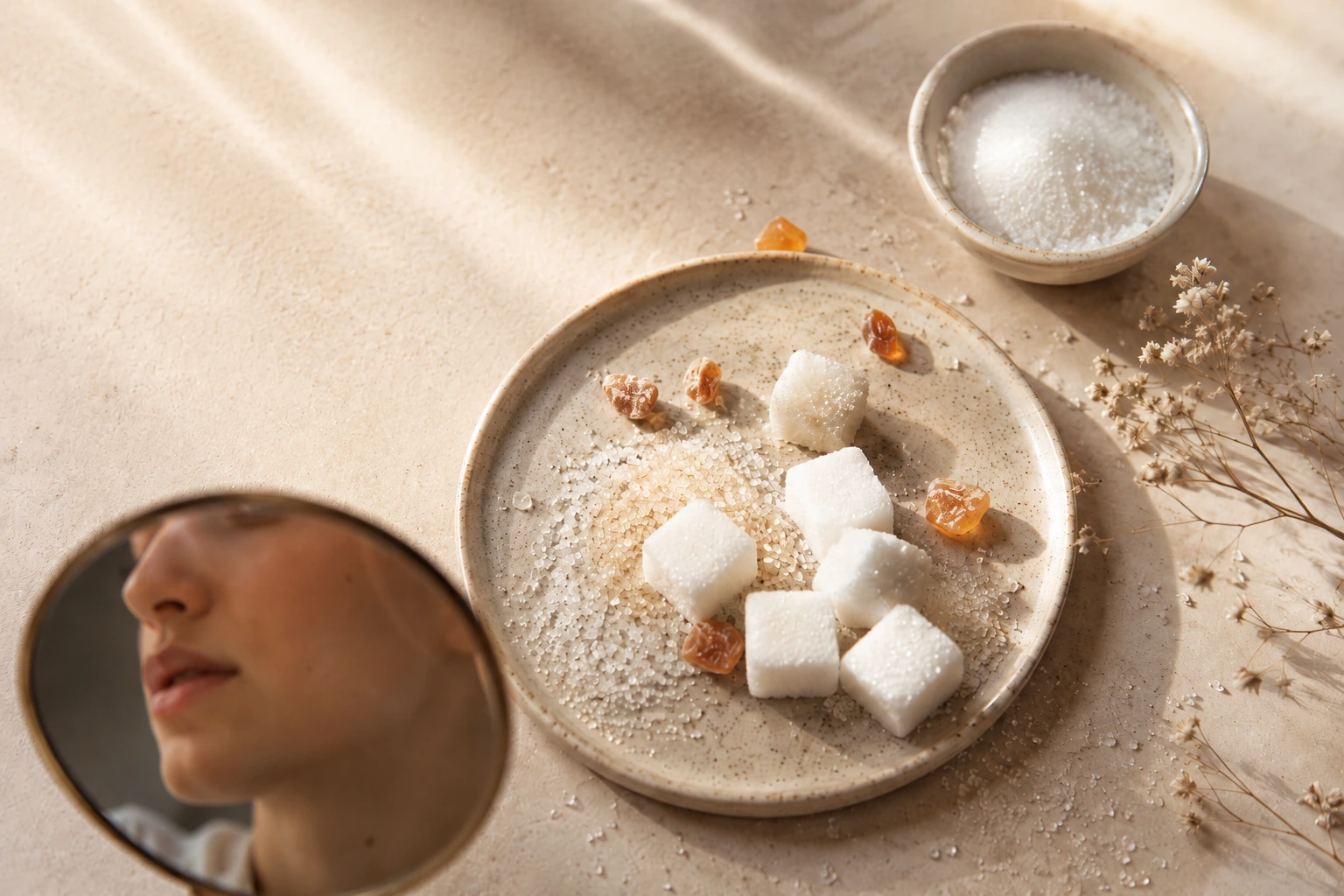
There are topics in the beauty world that very quickly turn into convenient scare stories. Glycation is one of them. The moment this word comes up, it is almost automatically followed by phrases like “sugar that destroys collagen,” “sweets that age your face,” “no desserts after 35,” and a fresh list of foods you are supposedly meant to fear.
But the body does not work in such a linear way. Skin does not age from a single slice of cake. Collagen does not “break down” after one pasta dinner. And at the same time, glycation is not a marketing invention. It is a real biochemical process that does matter for tissues, especially over the long term: when high blood sugar, inflammation, oxidative stress, ultra-processed food, sleep deprivation, inactivity, and cooking methods built around intense browning, dark crusts, and dry high heat all come together year after year.
This topic matters because it helps us talk about how food, rituals, and flavor can support the body without a culture of restriction. Not through fear of what is on the plate, but through awareness of the everyday choices we repeat.
That is why an honest conversation about glycation does not begin with bans. It begins with understanding: what exactly is happening, where the evidence is solid, and where exaggeration turns food into yet another source of anxiety.
What glycation is, in simple terms
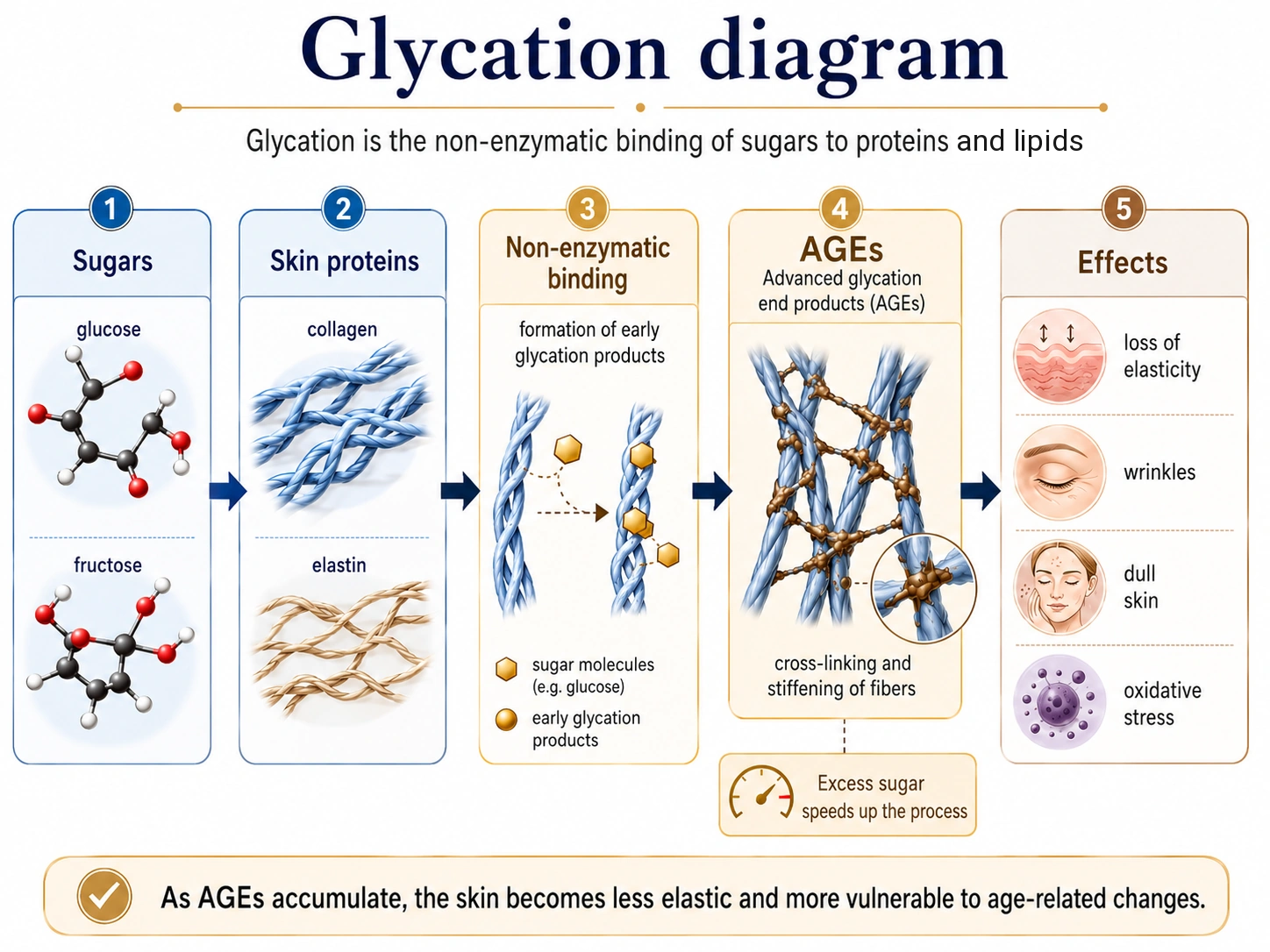
Glycation is a process in which sugar molecules bind to proteins, fats, or other biomolecules without the help of enzymes. Over time, this can lead to the formation of advanced glycation end-products, or AGEs.
If we translate that into the language of skin, the key players here are not the sugar on your plate itself, but long-living protein structures in the tissues. Collagen, for example. It is one of the most important proteins in the dermis: it helps skin maintain density, firmness, and structural support. When unwanted “cross-links” gradually build up in collagen fibers, the tissue can become stiffer, less elastic, and less responsive to repair.
What matters here is not to overstate it. Glycation is only one of the mechanisms behind skin aging. Alongside it are photoaging, chronic inflammation, hormonal changes, reduced collagen synthesis, smoking, stress, sleep, eating habits, and the condition of the blood vessels and skin barrier. But glycation does explain particularly well why skin is not a separate “surface” but a living tissue shaped by the body’s overall metabolic environment.
Our previous article on what food can really do for the skin — and what should not be attributed to it was needed as a kind of protective framework. Food does not replace SPF, retinoids, gentle cleansing, or a dermatologist. But it can change the background against which the skin repairs itself, reacts, looks dull, or preserves its resilience for longer.
Why glycation started being demonized
Because it is a very convenient story for selling fear.
It has a simple villain: sugar. It has a beautiful scientific word: glycation. It has a visible outcome that almost everyone fears after 30 or 35: loss of firmness, dullness, wrinkles, a “tired” face. And it comes with a ready-made formula: cut out sweets and you will save your collagen.
The problem is that this formula is far too crude.
First, glycation is happening in the body all the time, even without pastries. It is part of the biochemistry of being alive. The point is not to “zero out” the process, but to avoid creating the conditions that accelerate it excessively.
Second, the most convincing examples of AGE accumulation are linked to long-term metabolic disturbances, especially chronically elevated glucose levels. That is not the same thing as having dessert as part of a normal diet.
Third, skin does not age because of one product, but because of the environment it is repeatedly exposed to. If someone sleeps 5 hours a night, lives under stress, does not move enough, does not use SPF, smokes, eats mostly ultra-processed food, and constantly experiences sharp glucose swings, then glycation becomes part of a much bigger picture. But pulling chocolate out of that picture and treating it as the whole problem is scientifically weak and psychologically harmful.
Food should not turn into a moral test. There is no need to romanticize sweets, but there is also no need to make them a symbol of personal failure.
Where the kitchen comes in: glycation, crust, and the Maillard reaction
In the kitchen, we see a closely related kind of chemistry every day, even if we do not call it by its scientific name. When bread browns, meat develops a crust, onions turn golden, or roasted pumpkin takes on a deeper aroma, the Maillard reaction is at work — the interaction of sugars and amino acids under heat.
It is what gives food so much of what we love: deep aroma, darker color, caramel notes, that roasted and browned flavor. A kitchen without the Maillard reaction would be far paler.
But this is also where the nuance begins. Advanced glycation end-products can form not only inside the body, but also in food during cooking. They are especially promoted by dry high heat: frying, grilling, roasting to a dark crust, prolonged browning. This is particularly true for foods high in protein and fat.
That does not mean you need to fear everything roasted. Flavor has a right to a crust. Food should still contain joy. But if every day is built around heavily fried, dried-out, deeply browned, and ultra-processed food, then this is no longer just an aesthetic of taste — it becomes a culinary background that can add extra strain to the system.
Why cooking method can matter more than a “forbidden food”
When it comes to glycation, it is very easy to get stuck on lists: this is allowed, that is not. But for real life, it is far more useful to think in terms of techniques rather than rules.
The same chicken can be boiled in soup, stewed with vegetables, roasted at a moderate temperature, or fried to a dark, dry crust. Technically, it is the same product. Biochemically and sensorially, it becomes a different dish.
The same carrot can be raw, lightly cooked, stewed, roasted until sweet, or nearly charred on the grill. Again, this is not just about different flavors. It is about different ways of handling heat, moisture, time, and the food’s surface.
The gentlest culinary strategies here are very simple:
- choose stewing, boiling, soups, steaming, and slow moist cooking more often;
- do not make a dark crust your everyday default;
- use acidic marinades based on lemon juice, vinegar, yogurt, or tomatoes;
- add spices, herbs, garlic, onions, and greens so flavor does not rely only on heavy browning;
- keep crisp and roasted foods as part of variety, not as your only cooking style.
This is not an anti-glycation diet. It is simply a mature, balanced way of cooking — one in which flavor does not have to be aggressive to feel deep. That is why old home techniques sometimes turn out to be surprisingly modern: for example, slow braising as part of home-cooking depth creates flavor not through dry overheating, but through time, moisture, acidity, beetroot, meat juices, and the gradual layering of aroma.
Sweets: not the enemy, but part of the context
The biggest mistake in the glycation conversation is reducing everything to the phrase “sugar ages you.” It sounds dramatic, but it explains reality badly.
For the skin, what matters is not the mere fact that someone occasionally eats sweets. What matters is how often the diet causes sharp glucose spikes, whether it contains enough protein, fiber, fats, slow carbohydrates, vegetables, legumes, grains, and fermented foods, whether there is movement after meals, and whether sleep is adequate. Dessert after a полноценный lunch and a sweet coffee with cookies instead of breakfast are two very different scenarios for the body.
What works best here is not restriction, but composition.
Sweets are gentler on the system when they are not alone — when there is protein, fiber, fat, and perhaps an acidic or bitter note alongside them. For example, plain yogurt with berries, nuts, and a small amount of honey is not the same as a sugary drink on an empty stomach. A piece of chocolate after a meal is not the same as spending the whole day on quick sugary snacks.
In this sense, it is not only nutrition science that helps, but also flavor culture: contrast in taste can bring pleasure without excessive sweetness. When something sweet is paired with salt, acidity, bitterness, nutty depth, or a dense texture, it often stops demanding quantity. Precision becomes enough.
What happens to the skin over the long term
Collagen in the dermis renews slowly. It is not a fast-turnover tissue that completely changes within a few days. So the processes that affect its quality should not be judged on the scale of “ate it today, aged tomorrow,” but on the scale of years.
When advanced glycation end-products accumulate in tissues, they can affect collagen and elastin structures, make protein fibers stiffer, intensify oxidative stress, and sustain inflammatory signaling through receptors linked to AGE-related mechanisms. In the skin, this may be associated with reduced elasticity, dullness, slower recovery, and a drier-looking pattern of aging.
But again: this is not an isolated switch. If a person protects themselves from the sun, gets enough protein in the diet, moves, maintains muscle, does not live in constant sleep deprivation, does not smoke, reduces ultra-processed food, and does not turn every meal into a sugar-fat amusement ride, they are already doing more for their skin than any fear of the word “glycation” ever could.
Skin does not love perfection. It loves repeated conditions in which it does not have to keep putting out fires.
An anti-glycation plate without the neurosis
A gentle anti-glycation approach does not look like a chart of restrictions. It looks more like a plate built around balance.
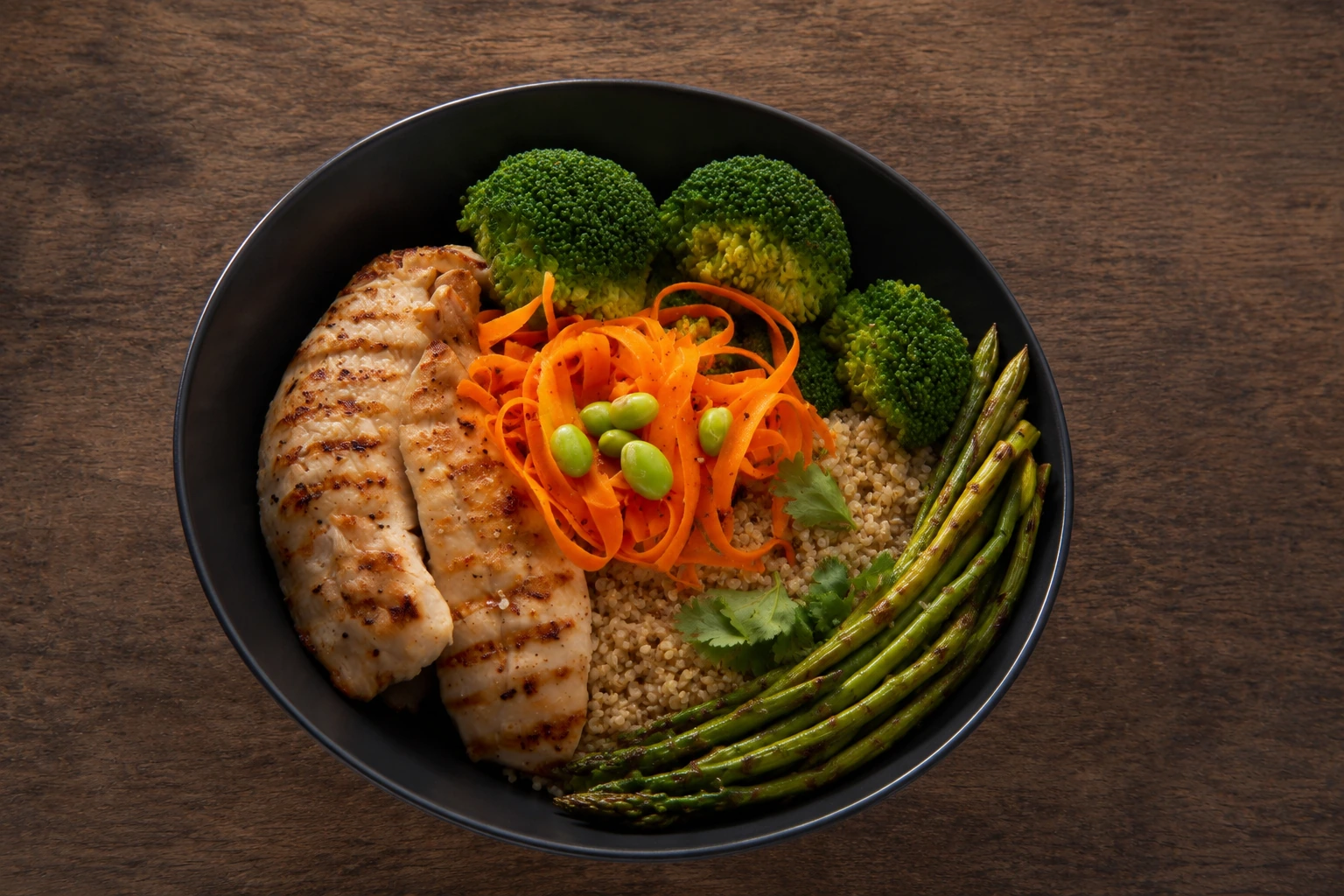
There is protein there — fish, eggs, poultry, legumes, cultured dairy, tofu, or other sources that suit the person. There is fiber — vegetables, greens, berries, grains, seeds, legumes. There are fats — olive oil, nuts, avocado, fatty fish if it is part of the diet. There is an acidic accent — lemon, vinegar, fermented foods, a yogurt-based sauce, pickled vegetables. There are spices and herbs. There is color.
And there is a normal place for pleasure.
Because a plate created only for control quickly becomes psychologically cold. A person may manage it for a week, a month, sometimes even a season. But the body does not live in charts. It lives in repeated gestures: making soup, adding herbs, not over-frying, not eating sweets in a vacuum, making dinner warmer, leaving dessert not as an enemy but as a small part of the day.
In everyday cooking, depth often comes not from complicated “correct” rules, but from simple things: seasonal produce, herbs, mushrooms, warm grains, acidity, a gentle sauce, a few spices. That is exactly how seasonality, herbs, and spices add depth to a dish without the need to push flavor with sugar, excess fat, or a constant dark crust.
What about skincare “against glycation”?
In cosmetology, glycation is a topic too. Some active ingredients are studied in the context of oxidative stress, inflammation, protection of protein structures, barrier support, and their effect on dullness and elasticity. But it is important here not to replace one meaning with another.
A cream cannot “cancel out” your dietary background, sleep, sun protection, and lifestyle. And vice versa: what is on your plate does not replace thoughtful skincare. If the skin has already lost density, become drier, thinner, or more reactive, it needs support on different levels: SPF, gentle cleansing, hydration, barrier formulas, antioxidants, retinoids or other actives when indicated, and sometimes specialist guidance.
Glycation simply reminds us that the skin is not separate from the body. It does not live only in a cream jar. It lives in circulation, sleep, stress, nutrition, sun exposure, movement, hormonal changes, and the small decisions made every day.
When it is worth being more attentive
There are situations in which glycation stops being a beauty curiosity and becomes part of broader health care. For example, if there are carbohydrate metabolism disorders, insulin resistance, diabetes, sharp glucose swings, pronounced abdominal obesity, chronic inflammation, or cardiovascular risks. In those cases, the question is no longer whether “sugar ages the face,” but how the body handles energy overall.
In such situations, it is not a good idea to build rigid plans on your own based on social media advice. It is better to have a proper medical route: a family doctor, an endocrinologist if needed, tests, and a real risk assessment — not fear of fruit or porridge.
Because an anti-aging strategy that worsens your relationship with food is a bad strategy, no matter how beautifully it is packaged.
Glycation without fear is about mature moderation
You can love roasted potatoes. You can eat chocolate. You can fry food sometimes. You can cook a festive dish with a dark crust and not think about collagen in that moment.
But you can also notice the pattern: the body has an easier time when most food is not ultra-processed, not over-fried, not built around sugar and fat, and not eaten in a rush instead of a proper meal. Skin does better when the metabolic background is calmer. The nervous system does better when the kitchen does not become a field of guilt.
Glycation is not a reason to fear food. It is a reason to cook more consciously.
Not perfectly. Not sterilely. Not “correctly” in a performative sense. But in a way that puts moisture, color, protein, fiber, acidity, spices, gentle heat, and a little room for joy on the plate more often.
Because beauty in cooking does not begin where we ban everything. It begins where we finally understand what we are doing.