






At the beginning of summer, the bathroom easily transforms into a territory of seasonal prohibitions. Retinol is postponed until autumn, acidic toner is hidden away, and vitamin C serum is almost treated as just another sunscreen.
In reality, active ingredients do not share a common summer calendar. Glycolic acid, salicylic acid, azelaic acid, retinol, and L-ascorbic acid work differently and have varying irritation potential. The season itself does not provide sufficient grounds to either cancel all of them or continue the previous routine unchanged.
Three factors become crucial: the state of the skin barrier, actual sun exposure, and how well the skin is already accustomed to a specific product. In summer, these conditions change more rapidly: heat, sweat, water, more frequent cleansing, and longer hours outdoors are added to the active formula.
Three questions before changing your routine
How does the skin feel right now?
Oily shine alone does not necessitate canceling retinoids or adding more acids. It is far more important to check for tightness after washing, flaking around the nose, prolonged redness, or burning from a cream that was previously comfortable. If you notice any of these, it’s best to postpone introducing new active ingredients and focus on "calming" the skin.
When the surface shines but retains moisture poorly, the tolerance for active formulas often decreases. This condition is discussed in detail in the article about oily and dehydrated skin in summer.
How much sun will there actually be?
The usual route between home and the office and a week by the sea present different conditions, even if the same products are on the shelf. The duration of time spent outdoors, the ability to stay in the shade, wear a hat, and reapply sunscreen after swimming and sweating matter. Assess your day realistically, and only then make decisions about your care routine and structure.
The amount of product, water resistance, and reapplication are discussed separately in the article about SPF in the city, at the beach, and near water.
Is this a tried-and-true product or a new experiment?
A retinoid that the skin has tolerated steadily for several months and the first application of a strong retinol three days before vacation are not the same scenarios.
The beginning of use is less predictable. It is during the first weeks that dryness, redness, flaking, and burning are more likely to occur. Testing the limits of tolerance before a flight, hike, or beach vacation is inconvenient: the skin is already irritated, and avoiding the sun becomes more difficult.
Retinoids: the season does not cancel tolerance rules
Retinoids are often discussed as a single substance, although this group includes prescription medications and cosmetic forms of varying strengths: tretinoin, tazarotene, adapalene, retinal, retinol, and other vitamin A derivatives.
Their main summer issue is practical. Retinoids can cause dryness, redness, flaking, and burning, and irritated skin tolerates ultraviolet light, wind, saltwater, and repeated cleansing worse. For certain products, instructions explicitly warn about increased sensitivity to the sun.
If a topical retinoid is prescribed for acne or another dermatological condition, a self-imposed seasonal break may disrupt the therapeutic regimen. It’s better to adjust the frequency and duration of use with a doctor.
With cosmetic retinol or retinal, there is more room for maneuver. When the skin becomes more sensitive, you can return to a lower frequency, allow for more neutral evenings, and not increase the concentration before the period of active sun.
Practically, this means:
- to follow the specific product's instructions regarding application timing;
- not to use retinoids on sunburned, cracked, or distinctly irritated skin;
- not to introduce a new retinoid and a strong acidic product simultaneously;
- to stick with a simple moisturizer instead of a multi-layered active scheme;
- to reduce frequency if the skin does not have time to return to a comfortable state between applications.
Evening application does not replace daytime sun protection. The skin does not start each morning with a clean slate just because a retinoid was used before bed.
A separate rule applies to pregnancy and planning: topical retinoids are generally not recommended during this period. Here, it’s worth relying on the doctor’s recommendation and the specific product’s insert.
“Acids” is too broad a term for a single piece of advice
An acidic toner with a low concentration, professional glycolic peel, salicylic serum for comedones, and azelaic acid for rosacea should not receive the same seasonal instructions.
The substance itself, concentration, pH, product format, frequency of use, and skin condition all matter.
AHA: sun warnings here are quite specific
Glycolic and lactic acids belong to alpha-hydroxy acids. They affect the bonds between corneocytes, help to even out texture and tone, but can increase skin sensitivity to ultraviolet light.
The FDA recommends using sunscreen, protective clothing, and limiting sun exposure while using AHAs and for a week after discontinuation. Therefore, skipping toner only the evening before the beach is insufficient if it has been used regularly before.
At-home formulas with low concentrations and professional peels cannot be evaluated on the same scale. The higher the intensity of exfoliation, the more important control of the procedure, subsequent care, and the ability to realistically avoid the sun become. The timing of a strong peel is determined by a specialist, not by the name of the month on the calendar.
Salicylic acid: different action, but the same basic caution rules
Salicylic acid in cosmetics is usually classified as BHA. It is lipophilic, so it works well in formulas for oily skin and comedones. It should not be mechanically equated to glycolic acid: there is no similar separate warning for BHA regarding a week after discontinuation, as there is for AHA.
At the same time, salicylic acid can dry and irritate, especially when present simultaneously in cleansing, toning, serum, and localized treatment. Photoprotection remains a fundamental part of care, and if tightness or burning occurs, the frequency should be reconsidered.
In summer, the skin is often overloaded not by one acid, but by the entire attempt to control shine: more frequent washing, salicylic toner, clay mask, mattifying base, and long-lasting SPF. After a few days, sebum doesn’t disappear, but water and basic cream start to sting.
Azelaic acid operates under different rules
Azelaic acid is used for acne, papulopustular rosacea, and post-inflammatory pigmentation. It is not a classic exfoliant in the same sense as glycolic acid and is often used in long courses.
There is no reason to automatically remove it for the entire summer. However, tingling, dryness, and irritation are possible, especially at the beginning or when combined with other active formulas. If the product is part of a treatment regimen, it’s better to change the frequency after consulting a dermatologist.
Vitamin C: antioxidant support without the status of “liquid SPF”
Topical vitamin C is often recommended specifically in the morning. The logic is clear: antioxidants can complement protection against oxidative stress related to ultraviolet light.
But research results cannot be automatically applied to any jar labeled Vitamin C. The most convincing photoprotective data have been obtained for specific stabilized combinations of L-ascorbic acid with other antioxidants, particularly vitamin E and ferulic acid.
Even such a formula remains a supplement. It does not form an even layer with a defined SPF, does not have a standard water resistance rating, and does not compensate for missed reapplication of sunscreen after swimming.
L-ascorbic acid requires an acidic environment, so some serums may sting. This sensation is felt more strongly after acids, retinoids, tanning, or excessive cleansing. Derivatives of vitamin C are sometimes tolerated more gently, but their properties depend on the specific molecule and the entire formula.
The morning routine is convenient as long as it works in real life. If the serum pills under SPF, increases redness, or causes you to apply less sunscreen, the theoretically beautiful combination loses its meaning. The product can be used less frequently, moved to another time according to the instructions, or replaced with a formula that the skin tolerates better.
The color of the vitamin serum should be assessed considering what it was like from the start when you first opened the bottle. Noticeable darkening, changes in smell or consistency may indicate instability, but the acceptable shade depends on the specific formula. It’s more reliable to rely on the manufacturer’s recommendations regarding storage and the shelf life after opening.
When the problem is not with one active ingredient, but with their order
In the morning — acidic serum with vitamin C. In the evening — retinol. Every other day — glycolic toner. Cleansing with salicylic acid twice a day. On weekends — at-home peeling, because “SPF clogs pores.”
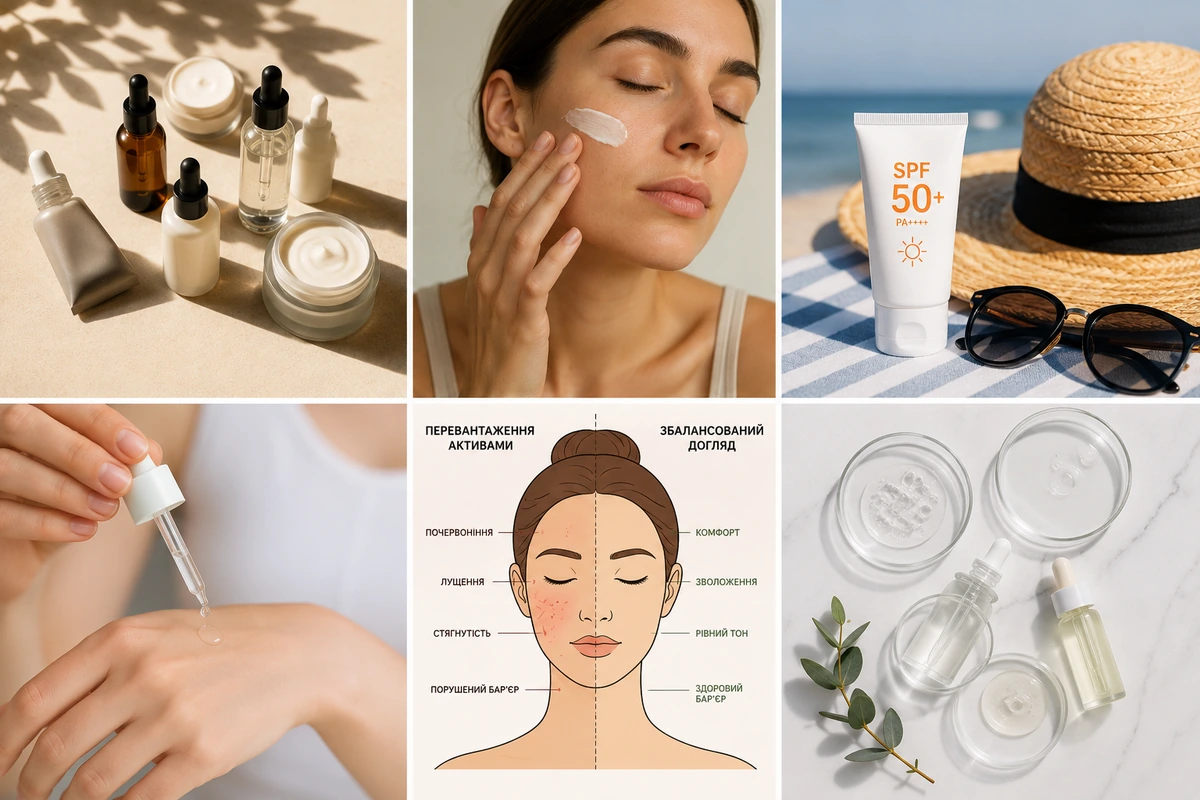
Each product separately may have a logical purpose. Together, they do not leave the skin with enough neutral days. In the heat, this becomes noticeable more quickly: sweat stings, cream burns, dryness appears around the nose, and shine still returns.
It’s more useful to count not the jars, but the functions:
- how many products accelerate exfoliation;
- how many of them can dry or irritate;
- whether there are breaks between active evenings;
- whether basic cleansing remains comfortable;
- whether it is possible to apply SPF in sufficient quantity;
- whether the skin returns to a normal state before the next application.
When cosmetics start to sting, an additional soothing serum on top of an unchanged routine does not always solve the problem. It’s worth first finding the source of the overload. The line between a short sensory reaction and a signal of a damaged barrier was separately discussed in the article about stinging as a stop signal.
Before vacation, it’s better not to change everything at once
A new serum, a stronger retinol, or an at-home peel are often introduced just before a trip: there’s a desire to quickly even out tone and texture. This is an unfortunate moment for a product with unpredictable reactions.
Ahead may be a flight, dry air, different water, the sea, a pool, and longer hours outdoors. If a new product causes irritation, simplifying the routine will be more difficult, and some trusted cosmetics will remain at home.
A week before the trip, it’s wiser not to increase the concentration of retinoids, not to introduce a new peel, and not to build a complex combination of actives. Trusted cleansing, comfortable moisturizing, and sunscreen that you don’t want to remove in ten minutes are more beneficial than an urgent attempt to “refresh” the skin.
After sun exposure, the routine can be reassessed
After a day at the beach, a long walk, or severe overheating, there is no need to automatically apply the usual active just because it’s its day on the schedule.
If the skin is calm, not red, and not burning after cleansing, the proven routine can remain unchanged. A hot, tight, or irritated surface requires a simpler evening: gentle cleansing and comfortable basic care.
One pause will not ruin the accumulated results. Applying an active to already irritated skin, on the contrary, can significantly reduce its tolerance for a long time.
Reduce frequency or stop completely?
A brief mild stinging does not always indicate damage, especially if it passes quickly and does not worsen with each application. The dynamics are much more important.
The frequency can be reduced when dryness and sensitivity are moderate, and the skin returns to a comfortable state between active evenings. A complete pause is appropriate in cases of sunburn, cracks, swelling, weeping, pronounced burning, or reactions even to water and neutral cream.
Prescription products remain a separate category. If a retinoid, azelaic acid, or another product was prescribed by a doctor, it is not advisable to change the regimen drastically without consultation.
Summer routines should remain manageable
Retinoids, AHA, salicylic and azelaic acids, and vitamin C do not share a common date after which they are prohibited from remaining in care. Each ingredient has its own action, evidence base, irritation potential, and usage rules.
In summer, the quality of the entire system becomes especially evident. Does cleansing not over-dry? Are there neutral evenings for the skin? Is it comfortable to apply sunscreen in the required amount? Is there a need to cover irritation with yet another active product?
A well-tuned routine does not cling to the schedule at any cost. It allows for continuing what the skin tolerates steadily, reducing intensity when conditions change, and calmly taking a break when the barrier needs time to recover.
Sources
- American Academy of Dermatology Association. Retinoid or retinol?
- Reynolds R. V. et al. Guidelines of care for the management of acne vulgaris. Journal of the American Academy of Dermatology. 2024.
- U.S. Food and Drug Administration. Alpha Hydroxy Acids.
- U.S. Food and Drug Administration. Labeling for Cosmetics Containing Alpha Hydroxy Acids.
- U.S. Food and Drug Administration. Beta Hydroxy Acids.
- DermNet. Topical retinoids.
- DermNet. Azelaic acid.
- Murray J. C. et al. A topical antioxidant solution containing vitamins C and E stabilized by ferulic acid provides protection for human skin against damage caused by ultraviolet irradiation. Journal of the American Academy of Dermatology. 2008;59(3):418–425.
- Lin F. H. et al. Ferulic acid stabilizes a solution of vitamins C and E and doubles its photoprotection of skin. Journal of Investigative Dermatology. 2005;125(4):826–832.