






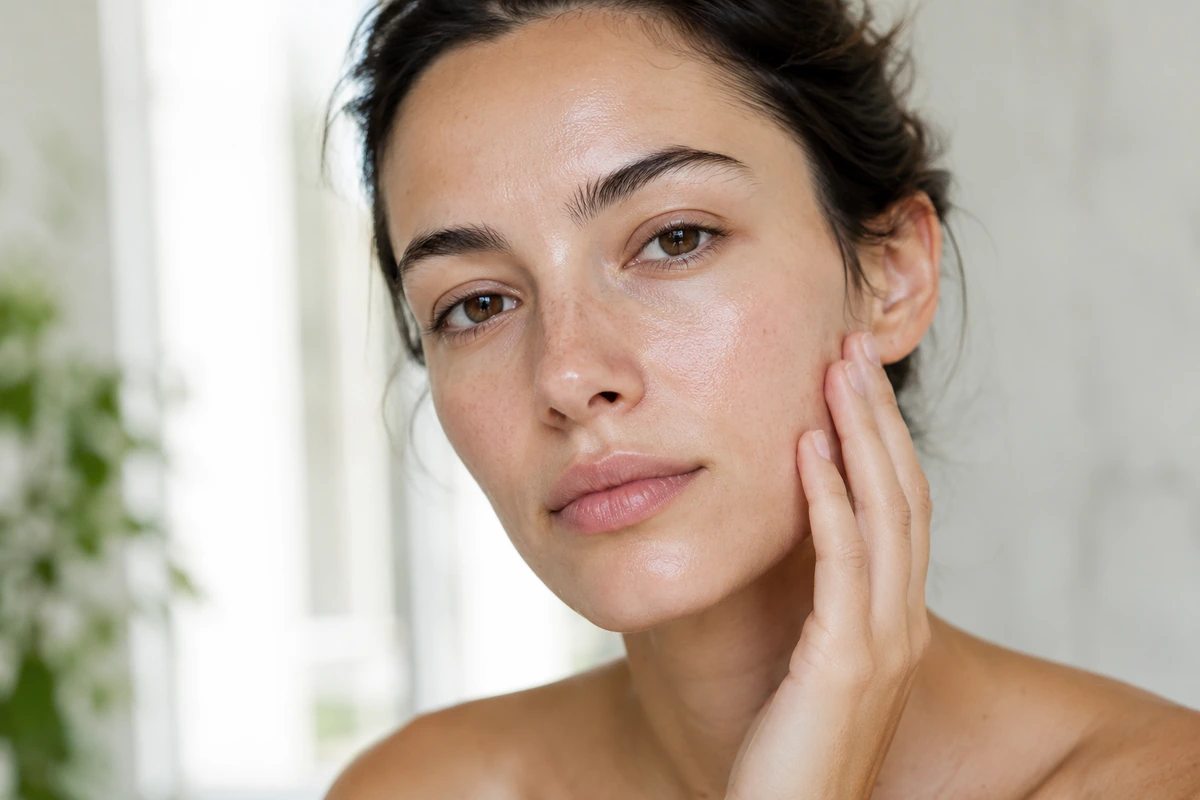
On a hot day, your skin may start to look shiny just an hour after washing, yet by evening suddenly feel tight after a shower. Your forehead and nose seem oilier, dryness shows up on your cheeks, SPF feels heavy, and foundation both “slides off” and emphasizes uneven texture at the same time. Even a serum your skin handled perfectly well in spring may suddenly start to sting.
At first glance, this seems contradictory: if the skin is oily, how can it also be dehydrated? In reality, oiliness, sweat, and the stratum corneum’s ability to hold water are different physiological processes. In summer, they often change at the same time, but not always in the same direction.
The skin may produce enough sebum—or even a lot of it—sweat actively, and still become less effective at retaining water. Heat is only part of the picture: sun exposure, sea water or chlorinated water, frequent showers, towels, friction, air conditioning, and several layers of cosmetics all add up. Summer skincare becomes much more precise once we stop judging skin condition only by how shiny it looks.
Three processes that are easy to confuse
Sweat is produced by the sweat glands. Its main role is to help the body regulate temperature. As water evaporates from the skin’s surface, the body cools down. Along with moisture, salts and other components of sweat also reach the surface.
Sebum is produced by the sebaceous glands. It is a complex lipid mixture that helps protect the skin’s surface, influences its microbial environment, and partly helps reduce water loss.
Separately, there is the water held within the stratum corneum. This ability depends on the condition of the skin barrier, the composition of intercellular lipids, the level of natural moisturizing factor, cleansing frequency, temperature, air humidity, and external irritants.
These systems are connected, but they are not interchangeable. Sweat on the surface does not mean the stratum corneum is well hydrated. A large amount of sebum also does not guarantee that the skin is reliably holding onto water.
In a hot environment, sweating becomes more intense, the skin’s surface gets shiny faster, and transepidermal water loss may increase. Cosmetics mix with sweat, sebum, and environmental particles. The skin feels damp, but once the sweat evaporates—or after washing or showering—tightness quickly appears.
What oily but dehydrated skin looks like
“Dehydration” is not a permanent skin type or a separate medical diagnosis. It describes a condition in which the stratum corneum temporarily retains water less effectively than usual.
Dry skin usually has a deficit of sebum and its own lipids. Oily skin produces sebum more actively. But both dry and oily skin can become dehydrated, rougher, more sensitive, or less elastic.
In summer, this is often noticeable through several signs:
- the T-zone gets shiny quickly, but the cheeks feel tight after washing;
- makeup breaks down on oily areas while also highlighting fine flaking;
- the skin surface seems uneven, even though sebum production has not decreased;
- a lightweight gel feels refreshing for a short time, but an hour later the skin feels uncomfortable again;
- a rich cream creates a film, but without it dryness appears;
- after the sea, the pool, or an air-conditioned room, familiar products feel harsher than usual;
- basic skincare starts to sting even though the formula has not changed.
In this situation, surface shine is easy to mistake for proof of excessive oiliness. That often leads to more aggressive skincare: more foaming cleansers, alcohol-based toners, mattifying masks, brushes, acids, and frequent washing.
For a short while, the surface may seem cleaner and drier. Then the shine returns, now against the backdrop of an irritated and uneven stratum corneum. The skin does not necessarily start automatically producing more sebum in response to every cleanse. More often, the changes simply become more obvious: oiliness remains, while comfort and water-retention capacity worsen.
Sweat rarely acts alone
Sweat itself is not considered a direct cause of acne. The risk of breakouts rises when moisture is combined with sebum, occlusion, friction, and prolonged contact with wet clothing or fabric.
These conditions often occur under a tight hat, sports helmet, mask, collar, backpack straps, or synthetic clothing. Habits matter too: frequently touching the face, wiping it with a shared towel, or rubbing away sweat with a tissue.
After exercise, a long walk, or working in the heat, it is better to gently blot sweat with a clean cloth. As soon as possible, it can be rinsed off with water or a mild cleanser. Vigorous rubbing does not make the skin cleaner—it only adds mechanical irritation.
Small, uniform breakouts that itch or appear after every episode of heavy sweating deserve special attention. They are not always typical acne. Heat rash, folliculitis, contact irritation, or a reaction to occlusive cosmetics can look similar.
When cleansing becomes part of the problem
In hot weather, the urge to wash your face is completely natural. Sweat, sebum, SPF, makeup, and dust particles all mix together on the skin. But rinsing away sweat and doing a full multi-step cleanse are not the same thing.
For most people, the practical foundation is still gentle cleansing in the evening, morning washing according to the skin’s needs, and additional cleansing after intense sweating.
After a short walk, cool or lukewarm water may sometimes be enough. After a workout, heavy SPF, and makeup, a cleanser will be needed. In the evening after the beach, water-resistant sunscreen may require a separate first removal step, followed by a gentle water-based cleanse.
Double cleansing remains a tool, not a mandatory daily ritual. Its purpose is to remove long-wearing products without prolonged rubbing. If there was no water-resistant SPF or makeup on the skin, two steps may be unnecessary.
A useful test comes a few minutes after washing. The skin should not stay tight for long, burn, or demand that you immediately apply everything on your shelf. That “squeaky clean” feeling often signals not superior cleansing, but over-removal of surface lipids.
If even water starts to sting, and your basic cream suddenly causes discomfort, the issue is no longer just summer shine. In that situation, it helps to understand separately when brief stinging may be expected and when the skin is signaling that it needs you to stop.
Summer texture affects how consistently you stick to your routine
A cream may have a well-designed formula, but in sticky heat people start applying it less often or using too little. A rich serum clashes with SPF, several layers begin to pill, and the morning routine gradually turns into a battle against tackiness.
This is not just about comfort. A product that feels unpleasant to wear is harder to use consistently. We discussed this in more detail in our piece on sensory skincare—how texture, scent, finish, and stinging shape the real-life tolerability of cosmetics.
A summer routine can often be lightened without replacing everything. For example, you can keep one moisturizing layer instead of several similar ones, move a richer cream to the evening, or stop duplicating the same actives across serum, toner, and cream.
At the same time, a lightweight texture should not be “empty.” Water and humectants refresh quickly, but sometimes the skin also needs emollients, ceramides, and other lipid components that support the barrier.
For oily skin, this does not necessarily mean a dense occlusive balm all over the face. Often, a light emulsion is enough—one that does not leave a heavy film, but keeps the skin calm for more than just the first five minutes after application.
Within professional skincare lines, products with different functions can be combined without reducing summer care to mattifying alone. For example, the Skin Tech collection includes products for cleansing, hydration, blemish-prone skin, and photoprotection. The specific formula should be chosen according to the skin’s current condition and how it responds to heat, water, and daily cleansing.
The sea: your skin gets more than salt water
Sea water has a complex mineral composition. Controlled salt-based and balneological treatments are indeed studied in the context of certain inflammatory dermatoses. But a typical beach day takes place under entirely different conditions.
Along with sea water, the skin is exposed to UV radiation, wind, sand, sweat, a towel, and several layers of SPF. Salt water dries on the surface, the person goes back into the sea, towels off, reapplies protection, and repeats this cycle several times.
Intact skin may tolerate such a day without visible consequences. Reactive, irritated, or recently over-treated skin tends to respond more sharply.
Salt is felt most strongly where there are already micro-injuries: around the nostrils, after shaving, on scratched areas, fresh breakouts, or skin that was actively exfoliated the day before. Burning after contact with sea water does not prove that it is “disinfecting” or treating breakouts. More often, it points to a lowered tolerance threshold.
After swimming, it is worth rinsing off sea water with fresh water if possible. It is better to blot the face rather than rub it. If the day in the sun continues, the sunscreen layer needs to be restored. For more on product amount, reapplication, and protection near water, see our guide to sun protection in real everyday life.
It is best to leave full cleansing for the evening, when you need to remove water-resistant SPF, makeup, and accumulated impurities. Using a cleansing gel after every dip in the water is usually unnecessary.
The pool: chlorine is only one part of the story
After the pool, dryness is often automatically blamed on chlorine. For very dry, atopic, or already irritated skin, chlorinated water really can become an extra source of discomfort. But the whole chain of events matters.
The skin spends a long time in the water and comes into contact with a swimsuit, cap, and goggles. After swimming, the person takes a hot shower, uses body wash, shampoo, washes their face, and then rubs vigorously with a towel.
The reaction depends on the condition of the skin barrier, water temperature, the concentration of disinfecting agents, how well the pool is maintained, and what happens after swimming. Some people tolerate regular swimming with no issues. Sensitive skin needs a gentler post-pool scenario.
Pool water should be rinsed off with fresh water. A cleanser should be used only where it is truly needed, without repeated washing “until squeaky clean.” After showering, the skin should be blotted and a moisturizer applied before it has fully dried.
If the pool is outdoors, SPF needs to be reapplied after swimming. The label “water-resistant” does not mean the protective layer will survive an endless number of swims, towel-offs, and sweating.
Air conditioning and the sharp switch between two environments
In summer, the skin often lives through two different climate scenarios in a single day.
Outside it is hot, the face gets shiny, and sweat evaporates more slowly. A few minutes later, the person is in a car, office, or hotel room with cool air.
In many air-conditioned spaces, the air also becomes drier. Prolonged exposure to a direct stream of cold air can increase tightness, especially around the eyes, on the cheeks, and around the mouth. This is most noticeable for skin that was already cleansed too aggressively in the morning or left without a comfortable moisturizing layer.
A mist gives a quick cooling sensation, but it does not always solve the problem. A water spray evaporates and, on its own, does not replace a product that helps hold moisture in.
A more reliable strategy starts earlier: gentle morning cleansing, a sufficient moisturizing layer under SPF, no unnecessary mattifying, and the chance to restore comfort in the evening.
Sometimes the air-conditioning problem does not start in the office—it starts at the bathroom sink in the morning.
How to adapt skincare to the day you’re actually having
A summer routine does not need to be the same for the office, a workout, and the beach. What matters more than the number of products is whether the routine matches the day’s real demands.
An ordinary day in the city
In the morning, gentle washing, one moisturizing layer, and SPF are often enough. If your serum, cream, and sunscreen create three sticky films, it is worth checking whether each step is performing a distinct function.
Shine during the day can be gently blotted with a clean tissue or blotting paper. There is no need to keep wiping the face with an alcohol-based toner.
A workout or a long walk
It is better not to smear sweat around with a towel. After exertion, it is worth rinsing it off, especially from areas under a hat, collar, or straps.
If the day outdoors continues, sunscreen should be reapplied after cleansing. In the evening, the skin more often needs calm cleansing and hydration—not extra exfoliation.
The beach or the pool
Before heading out, apply SPF and add clothing, shade, and physical protection. After being in the water, rinse the skin with fresh water, blot it dry, and restore the sunscreen layer.
In the evening, remove water-resistant products without scrubs or brushes. If the face is red, hot, or burning, it is better to skip active skincare that evening.
A day under air conditioning
A mattifying morning routine can easily become too much here. Skin that looked shiny on the way in may feel tight around the mouth and on the cheeks a few hours later.
In that case, it helps to review not just the cream, but the whole sequence: cleansing, hydration, SPF, air temperature, and the direction of the cold airflow.
An evening after heat does not call for cosmetic punishment
After a sticky day, the urge is to “finally cleanse everything properly.” That is often when skincare becomes too intense: oil cleanser, foam cleanser, enzyme powder, acid toner, serum, mask, retinoid, and cream.
For skin that has spent the whole day dealing with sun, sweat, SPF, water, and air conditioning, that sequence can become another burden.
The goal of evening care is simpler:
- Remove makeup, water-resistant SPF, sebum, and impurities without prolonged rubbing.
- Restore a sense of comfort to the skin.
- Give it as much lipid support as it needs today.
Sometimes a light emulsion is enough. On another day, a cream with ceramides may be needed. For dry or irritated areas, a richer product can be used locally.
Cooling and hydration are not the same thing either. A cream from the fridge can pleasantly reduce the feeling of heat, but low temperature alone does not restore the barrier. Ice and very cold compresses can increase irritation, especially in reactive skin or rosacea.
When the reaction goes beyond seasonal adjustment
Moderate oiliness, sweating, and brief tightness after a shower can often be improved with simpler care. But not every summer rash is acne, and not every redness should simply be covered with a soothing mask.
It is worth seeing a dermatologist if:
- the rash itches intensely and consists of many similar-looking elements;
- painful or pus-filled lesions appear;
- the redness does not go away after cooling down and resting;
- the skin burns even after water and a neutral cream;
- there is pronounced flaking, cracking, or swelling;
- the reaction repeats after every pool visit, SPF, or specific product;
- the condition keeps worsening even after simplifying the routine.
This may be how contact dermatitis, folliculitis, acne flare-ups, rosacea, atopic dermatitis, or other conditions that require professional assessment can present.
Skin that already had a low tolerance threshold before summer deserves particular attention. Heat rarely acts alone. It layers on top of active formulas, lack of sleep, hormonal changes, stress, and existing irritation. We covered this in a separate article on why skin after 35–40 sometimes suddenly starts reacting to a familiar routine.
Summer skincare does not start with mattifying

In summer, skin does not always need more cosmetics. More often, it needs a more precise sequence: remove sweat without aggression, do not leave sea water or chlorinated water on for too long, support the barrier after showering, avoid overloading the morning with layers, and use enough SPF.
Oily shine can be removed with a tissue. A damaged barrier is not fixed that quickly.
That is why the key summer question is not “how do I keep my face matte all day,” but “does my skin stay comfortable between cleansing, sun, water, and cool air?”
It may get shiny, sweat, and change throughout the day. That is not necessarily a sign that something is wrong. It is how a living system adapts to temperature, humidity, and the rhythm of the season.
References
- American Academy of Dermatology Association. How to control oily skin.
- American Academy of Dermatology Association. Face washing 101.
- American Academy of Dermatology Association. 12 summer skin problems you can prevent.
- Kim S., Park J. W., Yeon Y., Han J. Y., Kim E. Influence of exposure to summer environments on skin properties. Journal of the European Academy of Dermatology and Venereology. 2019;33(11):2192-2196.
- Green M., Kashetsky N., Feschuk A., Maibach H. I. Transepidermal water loss: environment and pollution - a systematic review. Skin Health and Disease. 2022;2(2):e104.
- Engebretsen K. A., Johansen J. D., Kezic S., Linneberg A., Thyssen J. P. The effect of environmental humidity and temperature on skin barrier function and dermatitis. Journal of the European Academy of Dermatology and Venereology. 2016;30(2):223-249.
- O’Connor C., McCarthy S., Murphy M. Pooling the evidence: a review of swimming and atopic dermatitis. Pediatric Dermatology. 2023;40(3):407-412.