






We’re used to judging skincare by the ingredient list. We look at the actives, concentrations, skin type, brand promises, a cosmetologist’s recommendations, reviews, and how the texture looks in photos. But there’s another layer—less visible on a product page and almost impossible to capture in a standard description: how a product actually feels on living skin. Not in theory, not in a pretty swatch, not in an INCI list, but in the moment when the cream touches your face, the serum spreads across your cheeks, SPF goes on as a second layer, and the scent lingers longer than you expected.
That’s where sensory skincare begins. It’s not a separate trend or a new category of cosmetics. It’s a broader way of looking at skincare: not just “what’s in it,” but “what happens to me when it touches my skin.” Do you want to keep it on your skin? Or do you want to wash it off a minute later? Does the texture feel protective—or like a film? Does the fragrance support the ritual—or turn into unnecessary sensory noise? Does a slight sting pass quickly—or become a signal you can’t ignore?
In that sense, skin is not a passive surface for applying a formula. It is constantly receiving signals: mechanical, thermal, chemical, neural, inflammatory, emotional. Sometimes those signals are very quiet: slight warmth, softness, comfort after cleansing. Sometimes they are sharper: tightness, stickiness, itching, burning, the feeling of “something foreign” sitting on the skin. The point of sensory skincare is not to fear every sensation. Quite the opposite—it’s to learn how to tell them apart.
Why “comfortable skincare” is not a small thing
In beauty, the word “comfort” can sometimes sound too soft, almost unserious. As if it’s about pleasantness rather than performance. But in real life, comfort often determines whether someone will use a product consistently at all. Even a very well-formulated product can end up sitting on the shelf if it stings, feels sticky, smells too strong, pills, creates a mask-like feel, or simply clashes with the rhythm of everyday life.
This is especially obvious for people with sensitive, reactive, dry skin, or skin prone to rosacea or atopy. For them, skincare is not just about “applying an active.” It’s a daily negotiation with the skin: how gently to cleanse, which cream won’t trigger burning, whether today is a good day for an acid, whether it’s better to stick to the basics, whether the skin can handle a fragranced product after a day of sun or wind.
But sensory skincare is not only for reactive skin. Even someone without marked sensitivity may notice that in the morning they want light, quick, almost imperceptible textures, while in the evening they prefer something more cocooning. That a rich cream feels like too much in summer, but that same richness feels protective in winter. That after a stressful day, a scent that once felt comforting suddenly becomes intrusive. Cosmetics come into contact not only with the skin, but also with the nervous system, habits, room temperature, mood, fatigue, and expectations.
Skin doesn’t feel the “jar” — it feels the entire contact
When we say, “this cream didn’t work for me,” that can describe very different experiences. It may truly have caused irritation. It may have conflicted with another active. It may have been applied to an already compromised barrier. Or it may simply have had a texture the body experienced as unpleasant. It may have smelled in a way that turned the ritual from care into added sensory load.
That’s why sensory skincare starts with more honest language. Not just “bad cream,” but what exactly happened?
- Texture: is the product light, rich, slippery, sticky, waxy, oily, watery, film-forming?
- Timing: does the discomfort appear right away, after a few minutes, after a second layer, under SPF, in the evening?
- Area: does it feel unpleasant all over the face, or only on the cheeks, around the nostrils, around the mouth, on the eyelids?
- Intensity: is it mild awareness of the product, tingling, tightness, itching, burning, pain?
- After-effect: does the skin calm down, turn red, get drier, become shiny, start itching, make you want to wash the product off?
These questions do not replace a dermatologist or provide a diagnosis. But they do help avoid throwing everything into one basket. “I feel uncomfortable” is not always an allergy. “It stings” is not always a catastrophe. “It feels sticky” does not necessarily mean irritation. At the same time, “you just have to push through it because the active is working” is a dangerous oversimplification too.
Texture: when the formula is good, but the body says no
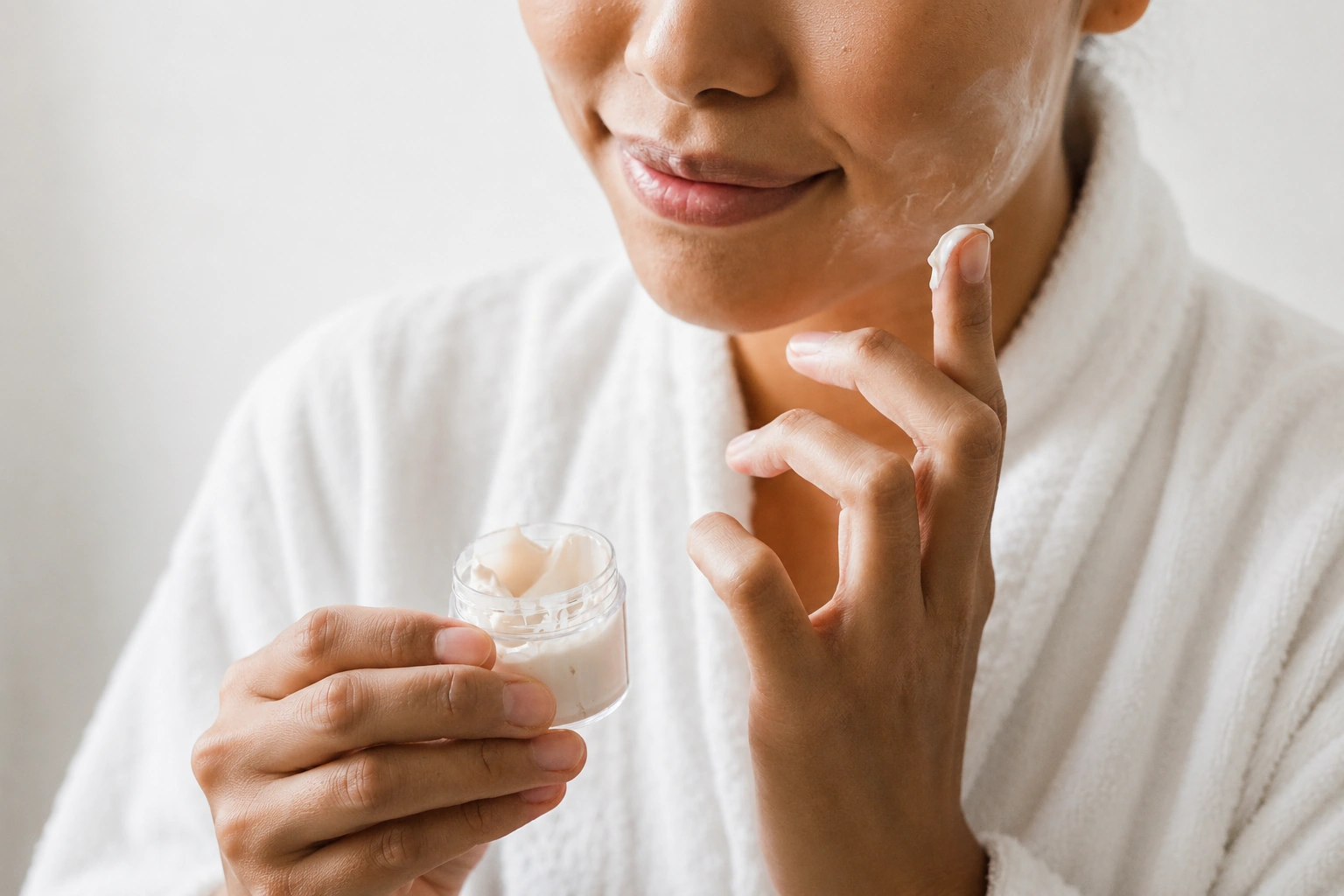
Texture often decides a product’s fate faster than its active ingredients do. The exact same cream can feel velvety to one person and suffocating to another. A lightweight serum may feel lovely in the first few seconds, but leave behind a tackiness that makes you want to keep touching your face. A rich balm may support dry skin beautifully, but for someone who cannot stand a heavy layer, it will feel psychologically and physically unacceptable.
Importantly, sensory discomfort does not always mean harm. If there is no redness, itching, rash, burning, swelling, or worsening of the skin’s condition, the issue may simply be texture tolerance rather than a dangerous reaction. But in real skincare, that still matters. A product you constantly want to wipe off your face rarely becomes a stable part of your routine.
This is where sensory skincare is especially helpful for people who have spent years trying to find the “right cream” and still cannot explain why almost nothing suits them. Sometimes the answer is not that the skin needs an even more sophisticated formula, but that it needs a different weight, a different absorption speed, a different finish, a different number of layers.
We explore this in more detail in the article why texture alone can create a sense of discomfort. There, we look separately at stickiness, film-like feel, the “greenhouse” effect, rich creams, silicone finishes, and those situations where a product seems technically sound, but the body simply does not want to keep it on.
A small observation
If you often say, “creams just don’t suit me,” it may be worth spending a few days observing not only your skin’s reactions, but also the language of sensation. The issue may not be “creams in general,” but a specific type of finish: too greasy, too dry, sticky, matte, powdery, or occlusive. It sounds minor, but those details are often exactly what make skincare feel realistic again.
Fragrance: ritual, memory, and sensory noise
Scent in cosmetics is one of the most complex topics, because it is not merely functional. It is tied to memory, mood, the feeling of cleanliness, the impression of luxurious care, freshness, and physical closeness to oneself. For some people, the scent of a cream is part of the evening ritual: a signal that the day is over, the skin is cleansed, and it’s time to slow down. For someone else, that exact same fragrance is an extra irritant that lingers on the face, interferes with sleep, or creates the impression that the skin is “overloaded.”
In sensory skincare, it matters not to turn fragrance into an automatic enemy. For some people, a soft scent genuinely supports consistency and makes the routine feel emotionally warmer. But it matters just as much not to romanticize fragrance when the skin—or the nervous system—is already asking for quiet. If, after a full day, active cleansing, sun exposure, stress, or a reaction to a new product, a scent starts to feel irritating, that is not a whim. It is part of the overall sensory load.
Extra caution is especially important for people with highly reactive skin, a tendency to contact reactions, atopic dermatitis, rosacea, or periods of barrier damage. In such cases, a fragrance blend—even one that sounds very “natural”—may be one factor too many. Not because all fragranced products are bad, but because at that particular moment the skin may need fewer stimuli.
We covered this topic in a separate article: how fragrance in skincare can feel pleasant—or become an unnecessary sensory factor. It is not about banning scent, but about drawing a more precise line between ritual and overload.
Stinging: not every signal means effectiveness
One of the most common sensory myths in skincare goes like this: if it stings, it’s working. There is a dangerous appeal to that phrase. It offers a simple explanation for a complex sensation and seems to reassure us: the discomfort has a purpose, the skin is just “renewing itself,” the active has “kicked in,” the result will be stronger.
But skin should not have to prove a product’s effectiveness through pain. A brief, mild sting can sometimes accompany active formulas—for example acids, certain forms of vitamin C, retinoids, or products for acne-prone skin. Still, that does not mean burning, itching, swelling, rash, or the feeling that your face is on fire should be tolerated for the sake of results.
In sensory skincare, it is important to look not only at the fact that it stings, but at the whole pattern. Is it brief or long-lasting? Mild or escalating? Does it disappear without a trace, or leave redness behind? Did it appear only with a new active, or does even your basic cream sting now? Does it happen every time, or was it a one-off against the backdrop of wind, sun, chlorinated water, or overly harsh cleansing?
This distinction is explored in detail in the article when a product stings: how to tell the difference between formula activity and a stop signal. For this pillar article, the key point is simple: sensory skincare does not teach you to fear actives, but it also does not allow every burning sensation to be dismissed as “normal.”
When the issue isn’t one product, but the skin’s condition
There are times when cosmetics seem to change for no visible reason. A familiar cream suddenly starts to sting. SPF feels heavy. A serum that used to feel comforting now leaves tightness behind. After washing, you want to put on something soothing immediately—but even a soothing cream feels off. In those moments, it is easy to decide that “nothing works for me anymore.” But often, what has changed is not the whole routine, but the skin’s tolerance.
The barrier can become more vulnerable after actives, sun, cold, wind, lack of sleep, stress, illness, harsh cleansing, frequent testing of new products, or a combination of several irritating factors. When skin is in that state, it may react more sharply even to things it would normally tolerate well. And then sensory signals are not a whim, but an early clue: the routine needs simplifying.
There is an important distinction here. Sensory skincare does not mean that every unpleasant feeling must immediately be “treated” with a large number of restorative products. Sometimes adding three more jars only increases the burden. A much more accurate strategy is to remove the non-essentials for a short time, keep gentle cleansing, basic hydration, sun protection if it is tolerated, and see whether the skin returns to a calmer baseline.
Sensory skincare is not fear of cosmetics
There is a risk of misunderstanding this topic and starting to fear any active, fragrance, rich texture, or new product. But sensory skincare is not about fear. It is about precision. Skin can love actives when they are introduced at the right time. It can tolerate fragrance well if there is no reactivity and the scent genuinely supports the ritual. It can need a richer texture when the barrier is dry and depleted. The problem begins not when a product is felt, but when the sensation is ignored.
Skincare as dialogue, not an endurance test
Good skincare makes room not only for instructions, but for feedback. We apply a product—and the skin responds. Sometimes the response is very simple: comfortable, soft, calm. Sometimes it is mixed: not bad exactly, but I want less of a layer. Sometimes it is clear: it burns, it itches, it feels tight, I don’t want this.
The problem with many modern routines is that they are built like a program to be completed: cleanse, toner, essence, serum, cream, SPF, actives on schedule, a mask on a certain day. In a system like that, it is easy to lose real contact. A person keeps applying what is “supposed to work,” even when the skin has been signaling overload for several days already.
Sensory skincare brings back a simple question: what do I feel after this step? Not in the sense of anxiously scanning every pore, but in the sense of mature attentiveness. Does it feel calmer? Do I want to touch my face because it feels sticky? Is the scent creating tension? Does the skin seem to “exhale” after the cream? Or, on the contrary, does it feel as though something urgently needs fixing?
The question sounds almost too simple. But it is exactly what often saves people from two extremes: testing every new thing without restraint, or becoming completely afraid of cosmetics.
How to read sensory signals without panicking
Sensory sensations are not always perfectly precise as a diagnostic tool. They can be amplified by anxiety, fatigue, expectation of a negative reaction, or previous bad experience. But that does not mean they should be dismissed. It is more accurate to treat them as information that needs to be checked in context.
A quick map
- Comfort: the product does not get in the way, does not trigger the urge to wash it off, and the skin feels calmer after application.
- Neutral feel: you notice the texture, but it does not irritate you and does not leave an unpleasant after-effect.
- Sensory rejection: there is no obvious reaction, but the texture, stickiness, scent, or layer on the face keeps bothering you.
- Possible irritation: there is burning, tightness, redness, dryness, or discomfort after application or after several uses.
- Stop signal: pain, intense burning, swelling, itching, rash, weeping, blistering, or a reaction that keeps recurring.
This map does not replace professional advice, but it helps avoid collapsing everything into one undifferentiated experience. Sometimes what is needed is not a new jar, but a texture change. Sometimes it is stepping away from fragrance for a period. Sometimes it is a pause on actives. And sometimes it is a visit to a dermatologist—especially if the reaction repeats, worsens, or goes beyond ordinary discomfort.
Sensory skincare as a more mature form of care
There is a kind of skincare built around the desire to fix the skin quickly. It often sounds tense: remove, speed up, brighten, dry out, smooth, renew, tighten. In that mindset, it is easy to miss the moment when the skin can no longer handle the number of interventions. There is another approach—slower, more attentive, and no less effective in the long run. It does not reject actives, but places tolerance, consistency, and a sense of safety alongside them.
That is what sensory skincare is about. It does not deny the science of ingredients. On the contrary, it makes it more human. Because a formula does not work on abstract skin, but on a particular face: in a particular season, after a particular day, with a particular level of stress, sleep, dryness, habits, and previous experience.
When a person starts hearing these signals, skincare becomes not chaotic and not anxious, but more precise. You can choose a lighter texture not because “rich creams are bad,” but because right now the body needs lightness. You can remove fragrance not because fragrance is always dangerous, but because in this period the skin needs quiet. You can stop an active not because it is “bad,” but because the signal has become too loud.
There is a quiet maturity in that kind of care: not forcing the skin to stay silent, not demanding endurance from it, not trying to prove effectiveness through discomfort. But gradually learning to understand where cosmetics support your connection with yourself—and where they become just one more stimulus you want to step away from.