





Spicule-based skincare promises better active ingredient delivery, skin renewal, and an at-home microneedling effect. We look at how these microparticles interact with the skin, what you can realistically expect from them, and who may want to avoid this type of care.
Alongside exosomes and PN/PDRN, spicules have become one of the more talked-about directions in modern regenerative cosmetology. Their mechanism, however, is different: spicules work primarily through a physical effect — they alter the stratum corneum and may help certain substances penetrate more easily. That is why it is important to separate what the technology can actually do from promises of “regeneration” or an at-home replacement for professional procedures.
What are spicules, and why are they added to skincare?
Spicules are microscopic needle-like elements of sponge skeletons. Depending on the species, they may be made of silicon dioxide or calcium carbonate. For cosmetic and experimental systems, the particles are purified, milled or fragmented, and then incorporated into a cream, essence, or another carrier. When applied, these solid particles mechanically interact with the stratum corneum — the outermost part of the epidermis.
One of the best-known examples in this category is Reedle Shot by the Korean brand VT Cosmetics. The ingredient list for Reedle Shot 100 includes Silica, meaning silicon dioxide, while a patent application by VT Co., Ltd. describes needle-like structures derived from a freshwater sponge. The numbers 50, 100, 300, or 700 indicate the brand’s internal intensity levels, not puncture depth or settings on a microneedling device.
How spicules interact with the skin — and why this is not microneedling
During application and rubbing, some of the microscopic needle-like particles remain on the surface, while others enter the stratum corneum at different angles and to different depths. This mechanical contact explains the characteristic tingling sensation. It temporarily changes barrier density, affects exfoliation, and creates uneven micro-pathways through which certain components of the formula may penetrate more easily. This mechanism has been shown in a study on transdermal delivery using marine sponge spicules.
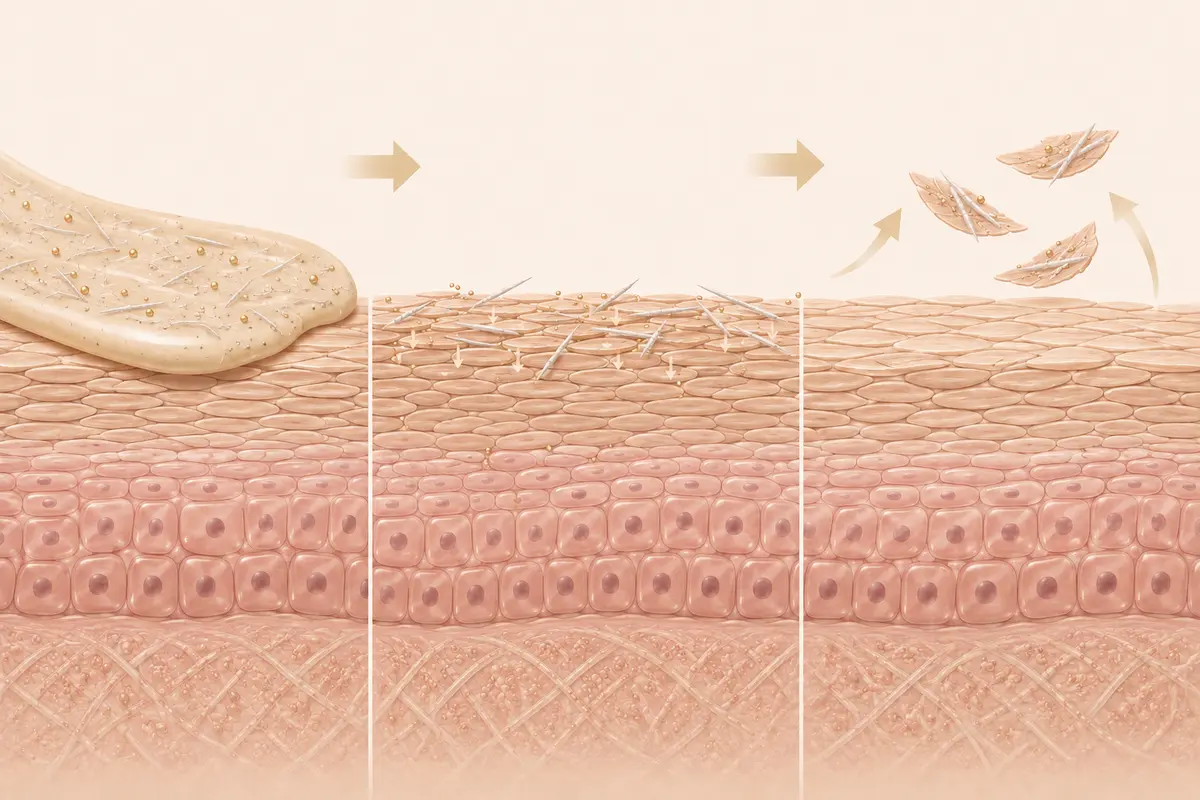
Fig. Mechanism of action of a spicule-based product: application, entry of spicules into the stratum corneum, and gradual removal from the skin surface.
The stratum corneum is not a smooth, solid film: it is made up of corneocytes and intercellular lipids. When a hard particle wedges between them, the arrangement of cells and lipids changes in that specific area. This creates two connected effects: the surface exfoliates more actively, and the barrier becomes more permeable in certain spots.
The length of a spicule does not equal how deeply it enters the skin. The particle does not sink into the skin completely: it may lie almost parallel to the surface, enter only with its tip, or remain outside. Its position depends on the particle’s shape, the product texture, the force and duration of rubbing, and the characteristics of the skin itself.
Some spicules may remain in the stratum corneum for a while. This is why tingling can sometimes be felt not only during application, but also later — when touching the skin, washing the face, or applying the next product. Over time, the particles are removed from the surface together with the natural shedding of stratum corneum cells.
Microneedling works differently. During the procedure, sterile metal needles repeatedly enter and exit the skin. With a motorized device, a professional sets the depth and speed according to the treatment area and goal. A series of controlled micro-injuries triggers a healing process, during which collagen and elastin remodeling may occur.
| Parameter | Spicules in skincare | Professional microneedling |
|---|---|---|
| Working element | Numerous solid needle-like particles within the formula | Sterile metal needles in a disposable cartridge |
| Direction and depth | Different angles, uneven entry, no precisely set depth | Repeated punctures with controlled parameters |
| Main area of action | Mostly the stratum corneum and the skin surface | The epidermis and, depending on the settings, the dermis |
| Main purpose | To alter the stratum corneum, enhance exfoliation, and support the formula’s performance | To create controlled micro-injury and trigger tissue repair |
| Expected result | A smoother surface and the effect of the active ingredients in that specific product | Improvement of texture, wrinkles, or atrophic scars within appropriate indications |
So, spicule-based cosmetics and microneedling rely on a similar idea of mechanical stimulation, but they implement it in different ways. Spicules do not replace a professional procedure, and the phrase “microneedling in a bottle” remains a marketing metaphor.
What results can you expect from spicule-based skincare?
What happens immediately after application
The skin may become slightly red, and tingling may linger for some time and intensify when touched. This is a direct response to mechanical contact, not a finished cosmetic result. In the following days, dryness and more noticeable flaking are possible. As excess corneocytes shed, the surface may look smoother and the tone more even.
The first visible changes are mainly surface-level. Exfoliation removes uneven horny flakes, while moisturizing components in the formula soften the skin and help it reflect light better. That is why smoothness and radiance can appear sooner than structural changes in deeper layers.
What the result may look like after several uses
How pronounced the result will be depends on more than just the number of spicules. Their shape and processing, the base formula, additional active ingredients, and frequency of use all matter. This is why the effect of Reedle Shot or any other finished product belongs to the entire formula — not to the needle-like particles alone.
Spicules are not anti-aging actives in themselves. Their role is to physically alter the stratum corneum and create conditions in which certain components of the product may work more actively. A realistic expectation from this type of care is a smoother skin surface, more regular exfoliation, and the effect delivered by the specific formula.
With regular use, the key is balancing exfoliation with barrier recovery. If the skin has time to recover, smoothness may be maintained from one application to the next. If the intensity or frequency is too high, dryness, tightness, and sensitivity can appear instead of a better result.
Correction of atrophic scars, visible dermal remodeling, and formation of a new collagen framework require a deeper and more controlled intervention. That is why spicule-based skincare is more accurately viewed as an active product for working with the skin surface, not as an at-home regenerative procedure.
How to use spicule-based skincare without overloading the barrier
Spicules are not an essential step in a routine. If gentle cleansing, moisturizing, and sun protection already give you the result you want, there is no need to add a mechanically active product just for the sake of an intense sensation. If you are interested in the format, treat it as potentially irritating skincare that should be introduced gradually.
Who should postpone the experiment?
Do not apply spicule-based products to wounds, scratches, sunburn, weeping areas, picked breakouts, or skin immediately after laser treatments, peels, injections, microneedling, or other procedures that disrupt the barrier. You should also avoid combining them on your own with a dermaroller, at-home device treatments, or other potentially irritating interventions unless the manufacturer explicitly allows that combination.
During a flare-up of rosacea, perioral, atopic, or contact dermatitis, or when the skin is highly reactive and burns even from basic products, it is better to postpone the experiment until the skin is stable. Acne itself is not an automatic contraindication, but spicules should not be rubbed intensely into picked or damaged breakouts, pustules, or painful inflammatory nodules.
Where to start
First, test a small amount of the product on a limited area, and assess the reaction not only immediately but also the next day. If the manufacturer offers several intensity levels, choose the lowest one for your first use and apply the product less often than the maximum allowed by the instructions. Apply it without prolonged massage and finish with a simple moisturizer, if that matches the recommendations for the specific formula.
At the beginning, do not layer a retinoid, AHA or BHA acids, benzoyl peroxide, a scrub, or a very acidic form of vitamin C on the same evening. This is not about universal incompatibility, but about reducing cumulative irritation. If your skin tolerates the product well, other actives can be reintroduced gradually. During the day, use your usual broad-spectrum sunscreen.
When tingling is no longer normal
Mild, short-lived tingling is expected with this type of product, but the intensity of the sensation does not indicate how strong the future result will be. We have covered how to tell the difference between a formula working and a stop signal separately. The product should be washed off and discontinued if you develop:
- severe or increasingly sharp pain;
- pronounced swelling, hives, or blisters;
- bright redness that does not subside;
- weeping, crusting, or a sudden worsening of dermatitis.
If the reaction persists, gets worse, or signs of infection appear, consult a doctor.
Spicule-based skincare can be an additional step for skin that tolerates active care well. After several uses, it is important to assess whether the surface has become smoother — and whether persistent redness, dryness, or increased sensitivity has appeared.
Sources
- Zhang S, et al. Skin Delivery of Hydrophilic Biomacromolecules Using Marine Sponge Spicules. Molecular Pharmaceutics. 2017;14(9):3188–3200. DOI: 10.1021/acs.molpharmaceut.7b00468.
- Tansathien K, et al. Development of Sponge Microspicule Cream as a Transdermal Delivery System for Protein and Growth Factors from Deer Antler Velvet Extract. Biological & Pharmaceutical Bulletin. 2019;42(7):1207–1215. DOI: 10.1248/bpb.b19-00158.
- Zhang C, Duan J, Huang Y, Chen M. Enhanced Skin Delivery of Therapeutic Peptides Using Spicule-Based Topical Delivery Systems. Pharmaceutics. 2021;13(12):2119. DOI: 10.3390/pharmaceutics13122119.
- Kim TG, Lee Y, Kim MS, Lim J. A Novel Dermal Delivery System Using Natural Spicules for Cosmetics and Therapeutics. Journal of Cosmetic Dermatology. 2022;21(10):4754–4764. DOI: 10.1111/jocd.14771.
- Lee NE, Kim JE, Bang CY, Bang OY. Nano-Encapsulated Spicule System Enhances Delivery of Wharton’s Jelly MSC Secretome and Promotes Skin Rejuvenation: Preclinical and Clinical Evaluation. International Journal of Molecular Sciences. 2025;26(20):10024. DOI: 10.3390/ijms262010024.
- VT Co., Ltd. Cosmetic Composition Including Microneedles Impregnated with Cica Extract as Active Ingredient and Method for Manufacturing Same. US20240408000A1. 2024.
- U.S. Food and Drug Administration. Microneedling Devices. Accessed 10 August 2026.
- VT Cosmetics. Reedle Shot 100: Ingredients, Directions and Cautions. Official Product Information. Accessed 10 August 2026.