





Polynucleotide injections promise to make the skin more hydrated, firmer, and smoother. Alongside them, the range of PDRN creams, serums, and masks is rapidly expanding, and the phrase “salmon DNA” has already become a familiar beauty term. Yet the same abbreviation may refer to very different products: a viscous injectable intended for placement into the skin, and a cosmetic product applied to its surface. The outcome depends on the composition, the delivery method, and the data available for the finished formula itself.
In our article on regenerative cosmetology, we already explained how the skin’s physiological renewal differs from healing and why the word “regeneration” requires precision. Now let’s focus on PN and PDRN: how they differ, what happens after injection, how to assess the promised effect, and why a PDRN serum is not a home version of an injectable treatment.
PN and PDRN: what the name actually means
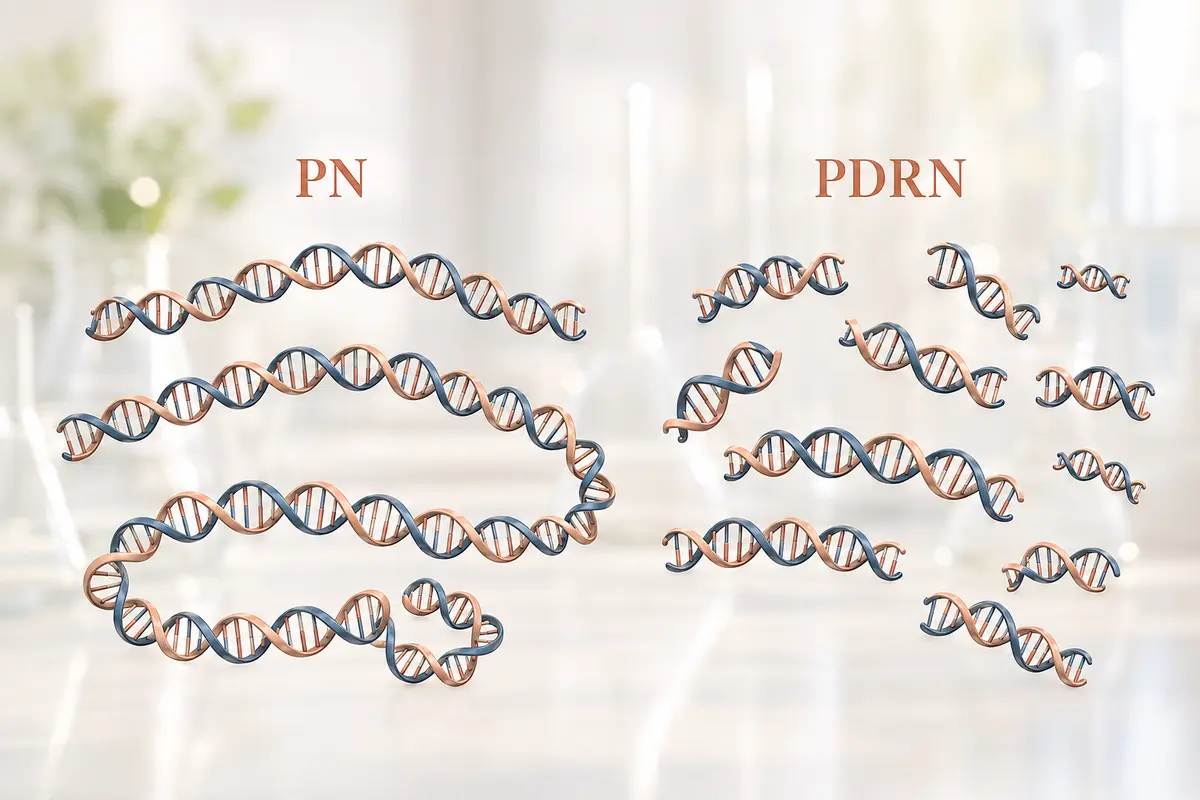
Polynucleotides, or PN, are long chains made up of many nucleotides. In aesthetic medicine, this usually refers to highly purified DNA chains. PDRN, or polydeoxyribonucleotide, is more often used to describe a mixture of shorter DNA fragments. The traditional raw material is salmonid reproductive cells, from which proteins and other impurities are removed, while the DNA is purified and fragmented into the required range.
The popular name “salmon DNA” tells you only about the origin. A product’s properties are influenced by molecular weight and fragment length, concentration, degree of purification, viscosity, stabilization method, and any additional components. For example, a formula with hyaluronic acid may provide different early hydration and mechanical smoothing than a product without it.
There is still no single international boundary between PN and PDRN, and in publications these terms often overlap. In 2025, the authors of one review proposed using a molecular weight of 1500 kDa as a reference point: shorter polymers to be called PDRN, longer ones PN. This is a useful scientific proposal, but not a regulatory standard. So if a package says PN or PDRN, that label should always be read together with the specifications of the actual product.
What happens after injection
PN and PDRN are not two fundamentally different substances. Both are made of chains of deoxyribonucleotides, but PN has longer chains, while PDRN has shorter ones. Because of this, they behave somewhat differently immediately after injection.
PN stands out more for the physicochemical properties of its longer chains. It holds water and affects the viscoelasticity of the injected formula, creating a temporary hydrated environment at the injection site. Enzymes then gradually cut these chains into shorter fragments and later into nucleotides and nucleosides. Some of these breakdown products may be reused by cells to synthesize their own nucleic acids.
PDRN already consists of shorter chains, so water retention is not considered its main property. After injection, it is also broken down into smaller components that may take part in cellular metabolism. One of the best-studied mechanisms of pharmacological PDRN is linked to activation of adenosine A2A receptors. In healing studies, this pathway has been associated with regulation of the inflammatory response, VEGF formation, angiogenesis, and tissue repair.
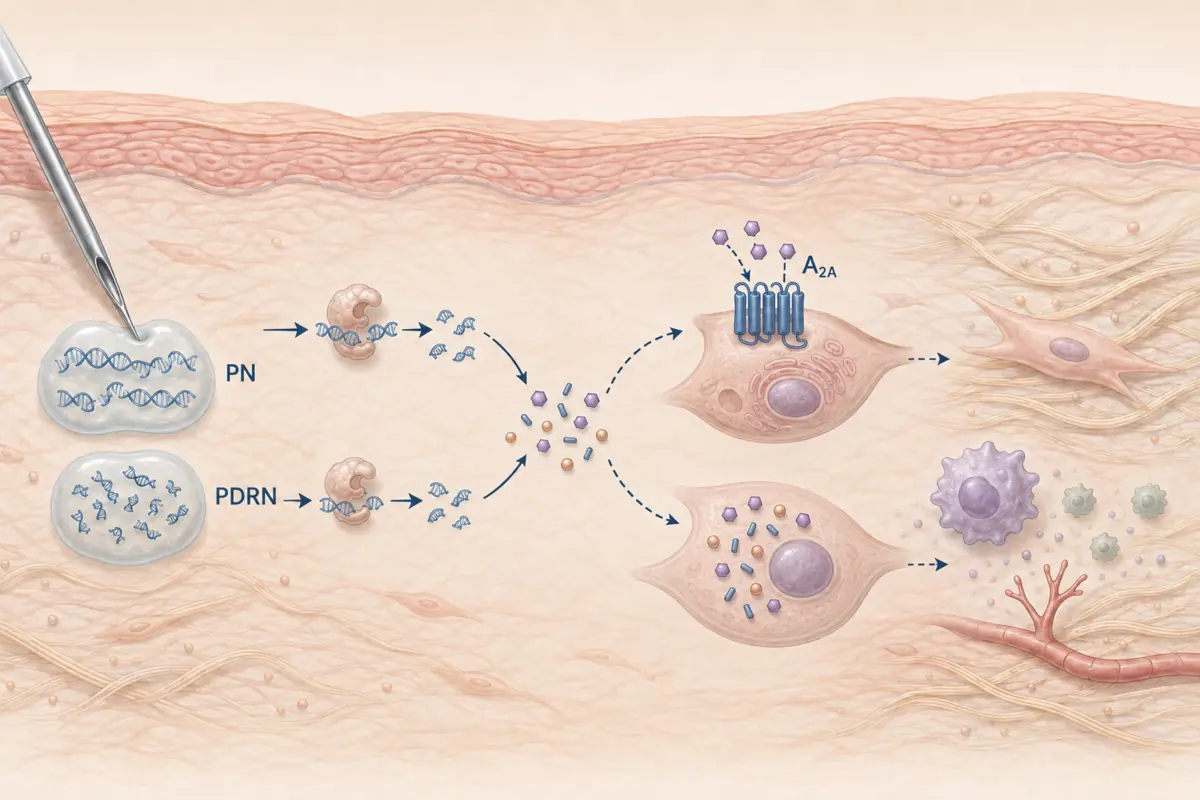
Fig. Schematic illustration of the transformation pathways of PN and PDRN in the skin
So, the difference between PN and PDRN is most noticeable at the beginning: the long PN chains have a stronger effect on hydration and the viscoelastic properties of the formula, while for pharmacological PDRN the better-studied mechanisms are nucleotide salvage and action via A2A receptors. After breakdown, the biological pathways of PN and PDRN partially converge. PN does indeed pass through a stage of shorter fragments, but this does not mean a ready-made PDRN drug is formed in the tissue.
What results to expect from injections
Studies have reported improvements in hydration, elasticity, texture, and fine lines after a course of injections. The result develops gradually. In the first few days, the surface may look smoother because of the injected fluid and local swelling. The actual changes in texture are best assessed a few weeks after the course is completed, once the papules and swelling have resolved.
Clinical studies most often describe a course of two to four procedures spaced several weeks apart. The exact schedule is determined by the specific product, area, and treatment goal. It is still not possible to reliably state a universal duration of results because of the lack of robust large-scale studies.
What the studies show
A 2025 systematic review combined nine studies with a total of 219 patients. The papers reported reduced wrinkles and improved texture and elasticity, while adverse events were mostly mild and short-lived. At the same time, the quality of the studies was rated as low to moderate, and differences in products, techniques, treatment areas, and measurement methods did not allow for a meta-analysis.
An important limitation of this review is that it included the study by Pak and co-authors involving 72 participants, which had already been retracted in 2016 because of improper disclosure of funding and conflicts of interest. Those participants were included in the total figure of 219, so this summary should not be viewed as a set of nine equally valid and equally reliable studies.
In 2026, a systematic review of seven randomized studies involving 183 participants was published. Four studies addressed aesthetic skin improvement, one focused on prevention of postoperative scars, and two on wound healing. The most consistent results were seen in wound healing. In aesthetic medicine, the overall picture also looks positive, but small sample sizes, different formulas, and non-uniform assessment criteria still do not allow the best product or a universal protocol to be identified.
One of the few direct comparisons of PN with hyaluronic acid was conducted in 27 participants. This was a split-face study: different products were injected on the two sides of the same participant’s face to reduce the influence of individual skin differences. Both sides showed improvement in certain hydration and elasticity parameters. PN demonstrated better changes in roughness and pore volume in part of the instrumental measurements, but overall aesthetic assessments did not differ significantly. Still, a small sample of 27 people does not prove the superiority of the entire PN class over hyaluronic acid.
What this method is suitable for
PN and PDRN injections are considered primarily a method for improving skin quality. A course may be appropriate for reduced hydration, fine lines, uneven microtexture, loss of elasticity, and thin skin that looks dry and tired. Depending on the specific product and indications, treatment may be used not only on the face but also in the delicate periocular area, the neck, the décolletage, or the backs of the hands.
This is an option for those who want gradual changes without adding visible volume or altering facial proportions. The result is not assessed immediately after the procedure, but after the course is completed and the swelling has resolved: early surface smoothing is partly related to the injected solution and the tissue response. The expected effect is more hydrated, smoother, firmer skin, not a change in facial features.
If the main goal is to restore lost volume, correct active facial expressions, achieve a pronounced lifting effect, or treat acne, rosacea, pigmentation, or dermatitis, a different method or a separate treatment plan is needed. By contrast, the scenario of gradually improving skin quality without changing facial proportions fits well with the approach described in our article on well-age in aesthetic medicine.
PN and PDRN in cosmetics and post-procedure care
In cosmetic ingredient lists, PDRN or related DNA-derived raw materials are most often labeled as Sodium DNA. DNA molecules are large, charged, and hydrophilic, so they penetrate intact stratum corneum poorly. Smaller fragment size and special delivery systems may theoretically improve penetration, but this has to be measured for the finished product. The words “low molecular weight” on packaging are not enough to conclude that the active ingredient reaches the dermis.
A cream or serum with PDRN may be a pleasant and effective skincare product, but the whole formula is what matters. Glycerin and hyaluronic acid increase hydration, panthenol and lipids support the barrier, and occlusive components reduce water loss and soften the skin. To assess the contribution of PDRN separately, a controlled study of the finished product is needed. Experiments on cell cultures or tissue fragments can explain a possible mechanism, but they do not show how much of the substance reaches living skin layers after ordinary topical application.
Plant, microbial, and synthetic materials marketed as “vegan PDRN” are also appearing on the market. Origin alone does not make a product weaker or stronger. What matters is the polymer structure, fragment length, purity, stability, delivery method, and the clinical data for the specific formula. A marketing name does not prove that such a material behaves the same way as fish-derived PDRN.
After laser or microneedling
PN and PDRN may appear in a post-procedure protocol in different formats. Injectable PN is used mainly to improve hydration, elasticity, and overall skin quality. PDRN is more often considered as a way to support tissue recovery after controlled injury. A separate option is professional PN or PDRN products applied to the skin after the procedure.
After ablative laser treatment and medical microneedling, the integrity of the skin barrier is temporarily disrupted. For injections, a sterile product specifically intended for intradermal use is required. A product applied during the procedure or immediately onto open microchannels must also be explicitly designated by the manufacturer for that use. A regular cosmetic serum, even one containing PN or PDRN, is not suitable for application into compromised skin.
In home care, a product with PN or PDRN may be used when the recovery plan after a specific procedure allows it. During this period, it remains a cosmetic product, not a continuation of injectable treatment. Trying to enhance its effect with a home dermaroller is not advisable: a cosmetic formula is not designed to be introduced into the skin.
Safety and product selection
The designation PN or PDRN by itself says nothing about the quality or safety of a product. What matters is the manufacturer, composition, concentration, molecular weight of the polynucleotides, auxiliary components, and the intended use of the specific formula. The product must be officially approved for injectable use, and the instructions should specify the route of administration, recommended treatment areas, contraindications, and storage conditions. Cosmetic serums and ampoules for topical use must not be injected into the skin.
Before the procedure, it is worth asking for the name of the product and to see the packaging. It should be intact and should show the manufacturer, batch number, and expiration date. A sterile product in single-use packaging is used for injections and opened immediately before the procedure. The choice between PN and PDRN should be based not on the popularity of the name, but on the treatment goal, the injection area, and the characteristics of the finished formula. Product selection should be especially careful for the skin around the eyes, where swelling occurs more often and may last longer.
The DNA from which PN and PDRN are obtained differs from fish proteins, and purification removes most protein impurities. However, anyone with a fish allergy should inform their doctor before the procedure. It is just as important to mention previous reactions to injections, herpes, allergic conditions, and any medications being taken. The procedure is not performed in the presence of an active infection, herpetic eruptions, marked inflammation, or skin damage in the treatment area. During pregnancy and breastfeeding, such injections are postponed because there are not enough safety data.
Redness, moderate tenderness, papules, local swelling, and bruising are expected reactions and usually subside within a few days. Infection, persistent swelling, inflammatory nodules, and vessel injury occur much less often. Increasing severe pain, sudden blanching or a net-like discoloration of the skin, rapidly worsening swelling, purulent discharge, or fever require urgent medical evaluation. Any vision disturbance after injections in the facial area is a reason to seek emergency medical care.
What to ask before the procedure
- What exact product is planned for injection, and what is its regulatory status in this country?
- Is it PN, PDRN, or a combined formula with hyaluronic acid, lidocaine, or other components?
- What are the concentration, raw material origin, and manufacturer-recommended treatment areas?
- Which skin characteristic is the procedure intended to improve, and how will the result be assessed?
- Why has the doctor chosen this specific course, and what data is the protocol based on?
- Which post-injection reactions are expected, and which symptoms require urgent medical attention?
A good treatment plan starts with a specific goal. If the concern is dryness, fine wrinkling, or uneven texture, a well-chosen product may provide gradual, moderate improvement. Volume loss, active facial expressions, pronounced ptosis, or a dermatological condition require a different strategy.
Polynucleotides have an interesting biological rationale and have already accumulated positive clinical data, but the evidence base still does not allow us to speak of one standard effect for all PN and PDRN. The fairest approach is to assess not the popularity of the name, but the specific product: what it contains, what use it is intended for, and whether the result after a course can be evaluated without being skewed by early swelling.
Sources
- Lampridou S., Bassett S., Cavallini M., Christopoulos G. The Effectiveness of Polynucleotides in Esthetic Medicine: A Systematic Review. Journal of Cosmetic Dermatology, 2025; 24: e16721.
- Kream E. J., Anooshiravani N., Hosking A.-M., Boen M., Fabi S. G. Global Trends and Evidence Evaluation: A Systematic Review of Polynucleotide and Polydeoxyribonucleotide Therapy in Dermatology. Dermatologic Surgery, 2026. Online ahead of print.
- Alhussain A. M., Albusayys S. T. M., Alfhadi M. A. et al. Polynucleotides and Polydeoxyribonucleotides for Skin Rejuvenation, Postoperative Scar Prevention, and Wound Healing: A Systematic Review of Randomized Clinical Trials. Cureus, 2026; 18(7): e112403.
- Lee Y. J., Kim H. T., Lee Y. J. et al. Comparison of the Effects of Polynucleotide and Hyaluronic Acid Fillers on Periocular Rejuvenation: A Randomized, Double-Blind, Split-Face Trial. Journal of Dermatological Treatment, 2022; 33(1): 254-260.
- Marques C., Porcello A., Cerrano M. et al. From Polydeoxyribonucleotides (PDRNs) to Polynucleotides (PNs): Bridging the Gap Between Scientific Definitions, Molecular Insights, and Clinical Applications of Multifunctional Biomolecules. Biomolecules, 2025; 15(1): 148.
- Colangelo M. T., Galli C., Guizzardi S. The Effects of Polydeoxyribonucleotide on Wound Healing and Tissue Regeneration: A Systematic Review of the Literature. Regenerative Medicine, 2020; 15(6): 1801-1821.
- Squadrito F., Bitto A., Irrera N. et al. Pharmacological Activity and Clinical Use of PDRN. Frontiers in Pharmacology, 2017; 8: 224. Corrigendum: Frontiers in Pharmacology, 2022; 13: 1073510.
- Journal of Korean Medical Science. Notice of Retraction: Pak C. S. et al. A Phase III, Randomized, Double-Blind, Matched-Pairs, Active-Controlled Clinical Trial and Preclinical Animal Study to Compare the Durability, Efficacy and Safety Between Polynucleotide Filler and Hyaluronic Acid Filler in the Correction of Crow’s Feet: A New Concept of Regenerative Filler. Journal of Korean Medical Science, 2016; 31(2): 330.
- U.S. Food and Drug Administration. Microneedling Devices: Getting to the Point on Benefits, Risks and Safety. Updated 2025.