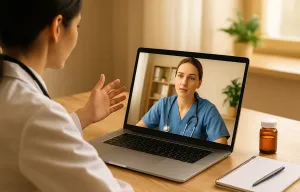






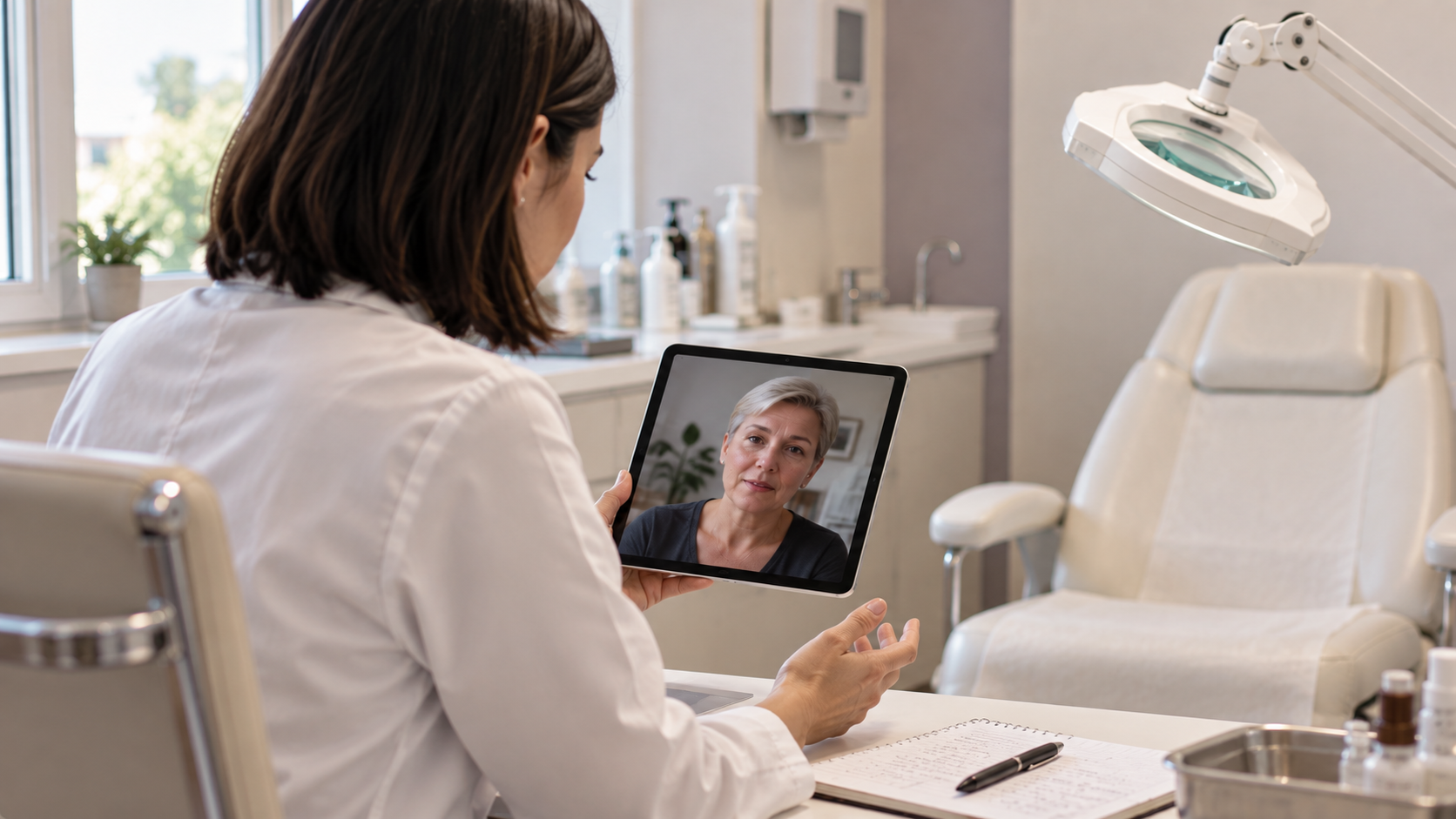
Sometimes, yes — at least part of the treatment or follow-up can absolutely move online. A dermatologist can remotely monitor acne that has already been diagnosed, assess the response to treatment, review photos of breakouts, and decide whether additional testing is needed. A cosmetologist or aesthetician can review your home routine, identify irritating product combinations, help simplify your regimen, and track how your skin changes over time.
At the same time, a camera only sees what makes it into the frame. It cannot feel the temperature of the skin, tell whether a lesion is painful when pressed, assess its firmness, or show what is happening beneath the surface. Even the color on screen may differ from real life because of lighting, automatic white balance, and smartphone processing. In dermatology, that matters: the shade of inflammation or pigmentation is also clinical information, and a BMJ review specifically discusses color errors in mobile medical photography. So the question is not simply whether you can “show your skin on video.” What matters more is this: what problem are we trying to solve, who is looking at the skin, and whether the information available remotely is enough for them.
The word “cosmetologist” can mean very different things in different countries, from an aesthetic skincare professional to a physician. In this article, by an online cosmetologist consultation we primarily mean support with skincare and the condition of the skin. Medical diagnosis, prescribing medication, and treating disease depend on the specialist’s actual qualifications and the rules of the country where they practice.
What can actually be seen through a screen
Photography has long been a working tool in dermatology. Teledermatology can take place as a video appointment or asynchronously: the patient sends photos, a description of symptoms, and other clinical information, and the dermatologist reviews them without a live call. Teledermatology guidelines cover both formats. Photos can show the location of lesions, their number and distribution, the shape of visible elements, scaling, some vascular and pigmentary changes, and post-acne marks. A series of photos is especially useful for tracking progress: the AAD recommends photos not only for remote consultations, but also for monitoring how a rash changes or how well treatment is working.
But “visible in a photo” does not mean “visible with complete accuracy.” Color is a good example. Smartphones automatically adjust exposure and white balance, while medical photography needs to reproduce shades as accurately as possible. The BMJ review highlights significant color errors that can occur when images are taken on mobile devices.
On darker skin, the problem becomes even more noticeable. Inflammation does not always look bright red, and some signs may be far less obvious. Rosacea, for example, is more often missed or mistaken for other conditions on darker skin, as the American Academy of Dermatology notes. The 2025 JAMA Dermatology recommendations state that photographic technologies have historically been calibrated primarily on lighter skin, which means images of darker skin tones may be reproduced inaccurately. When photographing inflammation and pigmentation across different skin tones, lighting, background, distance, and standardization all matter. That is why a photo taken by a window and the same face under a yellow bathroom light can look like two different skins.
A good photo can sometimes be more useful than a video call
Video feels more like a “real” appointment: the specialist sees the person in real time and can ask them to turn their head or bring the camera closer. But a moving image with compression, poor lighting, and constantly shifting auto-exposure does not necessarily show the skin better. A 2026 meta-analysis looked at 155 teledermatology studies. Overall diagnostic agreement between remote and in-person assessment was around 76%. The authors found no significant difference by type of communication — store-and-forward, real-time, or hybrid.
This does not mean that a teledermatologist is “76% accurate.” It refers specifically to agreement between remote and in-person assessment across very different studies and clinical situations. But the finding makes one thing clear: the communication format alone does not determine the quality of remote dermatology. A few sharp photos in normal lighting, combined with a clear medical history, may be more informative than ten minutes of video where the camera keeps changing the color of the face.
Why a smartphone photo does not replace dermoscopy
It is especially important not to overestimate a regular photograph when a new or suspicious skin lesion is involved. In professional teledermatology, a dermatoscope may be used in such cases — an optical instrument that provides a detailed view of structures a regular camera cannot show. In NHS England pathways, dermoscopic images are an important part of remote assessment when skin cancer is suspected; patient-taken photographs alone may not be enough for these pathways.
In the meta-analysis mentioned above, diagnostic agreement for skin cancer increased from 67% without dermoscopy to 80% when dermoscopy was used. So being able to show a dermatologist a photo of a mole or another lesion is useful. But that does not turn a smartphone into a dermatoscope.
Dermatologist or cosmetologist: who should you see online?
The simplest line to draw is not between professions, but between tasks. If the main question is “what is going on with my skincare routine?”, a cosmetology consultation may be perfectly appropriate. If the question is “what condition is this, and how should it be treated?”, you need a medical specialist.
| Concern | Online cosmetologist | Online dermatologist |
| Reviewing your current home routine | yes | yes |
| Simplifying a routine and removing unnecessary actives | yes | yes |
| Choosing cosmetic products | yes | yes, if it is part of management |
| Assessing how well skincare is tolerated | yes | yes |
| Tracking changes using a series of photos | yes | yes |
| Acne, rosacea, or dermatitis as a medical condition | skincare can support treatment | diagnosis and treatment |
| Medical diagnosis | depends on the specialist’s medical qualifications | yes |
| Prescription medication | only with the appropriate medical authority | if the dermatologist is allowed to prescribe it in the relevant jurisdiction |
| A new or suspicious skin lesion | not a task for cosmetic consultation | dermatologist; an in-person exam or dermoscopy may be needed |
| Skin scraping, biopsy, laboratory diagnostics | no | requires an in-person stage |
| Injectable or device-based procedure | in person | in person, if the procedure is indicated |
For example, someone says: “My cheeks are always red, my skin burns, and creams for sensitive skin barely help.” A cosmetologist can review cleansing, acids, retinoids, exfoliation frequency, SPF, and the products that seem to trigger burning. Sometimes that is enough to reveal an overloaded routine. But persistent redness, burning, and reactivity can also be signs of rosacea, dermatitis, or another condition that needs medical assessment. In that case, the next step should be a dermatologist.
A good remote consultation does not have to solve the whole problem in the same chat. Sometimes its most useful outcome is helping you understand where to go next.
In short: cosmetologist, dermatologist, or in-person appointment?
Online cosmetologist — when you need to review skincare, product compatibility and tolerance, adjust your routine, or track changes after making those adjustments. Online dermatologist — when you have persistent breakouts, suspected skin disease, acne, rosacea, dermatitis, need a medical decision, or want follow-up on treatment that has already been prescribed. The AAD explains that dermatologists use telemedicine both for new concerns and chronic conditions, although some cases move to in-person care after remote assessment. An in-person appointment is needed when dermoscopy, palpation, biopsy, scraping, laboratory testing, a procedure, or simply more information than remote assessment can provide is required.
Can skincare be chosen from a photo?
From one selfie? Doubtful. A proper online skincare consultation does not begin with a camera determining your “skin type.” Skin has a history. What is the person using now? Which products were added most recently? When did the irritation start? Does the skin burn after water? How does it tolerate a retinoid or acids? Has there been acne, rosacea, atopic dermatitis, or contact dermatitis in the past? What medications is the person taking? Have there recently been peels, lasers, or other procedures?
This is exactly the kind of clinical context used alongside photos in teledermatology. The AAD advises preparing your medical history, previous skin problems, medications, allergies, and the timing of your current symptoms before a remote appointment. In a cosmetology consultation, the list of products plays a similar role: without it, the specialist can see today’s skin, but not how it got there. So a good outcome of an online consultation does not have to be a basket of five new products. Sometimes it is more useful to keep two old ones, remove one irritating product, and add nothing else for several weeks.
If a reaction appears after cosmetics, it is important not to confuse choosing a “gentler” product with diagnosing an allergy. A home cosmetic patch test and clinical patch testing answer different questions — we covered this separately in “At-home patch testing for cosmetics: what it really shows — and what it doesn’t”. The same applies to acne: follow-up photos can be excellent for showing progress, but painful deep lesions, scarring, or a persistent course are no longer a question of choosing one more cleansing gel. We discuss that line in a separate piece, “Teen acne: how to talk about it without shame and when to see a dermatologist”.
When online works well — and when skin needs to be seen in person
Teledermatology is especially useful when the goal is not to “guess from a photo” for the first time, but to monitor. Are there fewer inflamed lesions? How is the skin tolerating the prescribed medication? Has flaking decreased? Did the rash return after the regimen changed? Is post-inflammatory pigmentation getting lighter? For these tasks, a series of images taken under similar conditions can be very informative. The AAD specifically names monitoring changes and response to treatment as one use of photographs in remote dermatology.
Online care also works well as a first step. The dermatologist receives photos and history, assesses the situation, and decides whether care can continue remotely or whether an in-person exam is needed. In the NHS teledermatology system, it is used, among other things, for triage, diagnosis, monitoring, and prioritizing further care. The AAD also advises checking before contacting an online clinic who exactly will be providing the consultation, whether you can send photos and medical history, and whether an in-person follow-up can be arranged if needed.
For a cosmetologist, online consultations are especially convenient in two situations: reviewing a routine and providing follow-up over time. Here, the specialist usually needs knowledge, the skin’s history, and the ability to see what changed after the skincare routine was adjusted. Physical presence adds much less than it does during a procedure or medical examination. And some things, by definition, remain in-person only. You cannot perform a biopsy, scraping, injection, or device-based procedure over video. A regular photo does not replace dermoscopy when dermoscopy is needed. A camera cannot palpate a lesion.
How to get more from an online consultation than a list of products
The quality of remote skin care depends heavily on what the specialist receives before the conversation begins.
How to photograph your skin
The AAD recommends removing makeup from the area you need to show, turning off filters, ensuring good lighting, and taking several sharp photos. The image should not have strong shadows, glare, or color distortion. For the face or a large area, it is useful to take:
- a general shot showing where the problem is located;
- a medium shot;
- a close-up of the most representative area;
- if needed, a photo from another side or angle.
For a localized lesion, it can sometimes be helpful to show scale. NHS England describes a similar principle for professional teledermatology pathways: a locator image, a close-up with a measuring scale, and an additional detailed image; when skin cancer is suspected, dermoscopy is added. If the photos are needed for comparison over time, try to repeat the lighting, distance, and angle. Otherwise, “the pigmentation disappeared” may simply mean it was a sunnier morning. Beauty mode, automatic smoothing, filters, and apps that alter skin tone are best turned off before a consultation. Here, a prettier photo may be a less useful one.
Check who is on the other side of the screen
A polished Instagram profile and the word “expert” in the bio do not explain someone’s qualifications. If the consultation concerns a disease, diagnosis, or medical treatment, you need to understand who exactly is providing medical care and what authority they have. If the goal is skincare, it is worth looking at the specialist’s education, how they work, and whether they know when to refer a client to a dermatologist if the problem goes beyond cosmetics.
There is one more useful criterion: who sells the recommended products. An online consultation can be an independent service, or it can be part of a clinic, store, or cosmetic brand. That is not automatically a problem. A brand specialist may know its formulas very well. But the person should understand whether the recommendation is built from the entire available market or from one specific shelf. Sometimes the best test of independence is very simple: can the consultation end with the words “don’t buy anything for now”?
What if AI is assessing the skin?
A photo taken on a phone can be analyzed using specialized programs. They assess wrinkles, pigmentation, redness, “pores,” texture, and even calculate a conditional “skin age.” From the outside, this can resemble a consultation: a person uploads a photo, the system detects certain features, and a result appears on screen a few seconds later.
But it is important to understand that AI works with an image and with the data it was trained on. A cosmetologist, in turn, can add the history of skincare, reactions to products, and the person’s goals. A dermatologist also works with the medical context: symptoms, history, possible diagnoses, and whether tests or treatment are needed.
This is especially noticeable in beauty tech, where an elegant number can easily be perceived as an objective medical indicator. What is really behind “biological skin age” and similar measurements is something we explored separately in “Skin longevity and biological skin age: science or marketing?”. Online consultations have not made the dermatologist’s or cosmetologist’s office unnecessary. They have moved beyond the office the things that do not always require physical presence: routine review, progress monitoring, part of medical assessment, and follow-up consultations.
Skin can be shown through a screen. But a good online specialist is not defined by the ability to give any answer from a photo. They understand exactly when a photo is no longer enough.
Sources
- Martyin K, Meznerics FA, Bokor LA, et al. Diagnostic accuracy of teledermatology for skin diseases: a systematic review and meta-analysis. Frontiers in Medicine. 2026;13.
- Cummins MR, Ong T, Ivanova J, et al. Consensus Guidelines for Teledermatology: Scoping Review. JMIR Dermatology. 2023;6:e46121.
- Grinnell M, Hurtado ACM, Guidotti R, Elbuluk N. Digital Photography Guide for Dermatologists With Special Considerations for Diverse Populations. JAMA Dermatology. 2025;161(6):635-641.
- Zoltie T, Blome-Eberwein S, Forbes S, Theaker M, Hussain W. Medical photography using mobile devices. BMJ. 2022;378:e067663.
- American Academy of Dermatology. How to take pictures of your skin for your dermatologist.
- American Academy of Dermatology. Telemedicine: How to get quality care.
- NHS England. A teledermatology roadmap: implementing safe and effective teledermatology triage pathways and processes.