






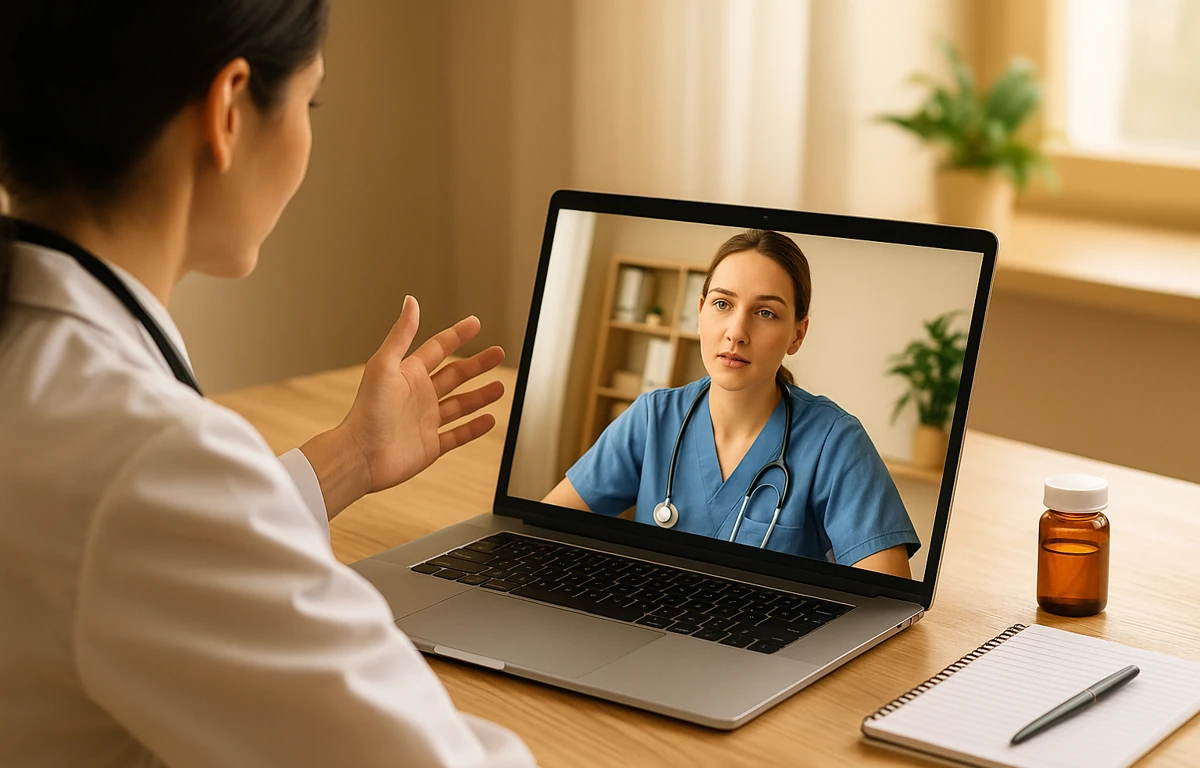
Just a few years ago, an online doctor’s appointment was often seen as a backup option: fine if there was no alternative, but “real” medicine still happened in the office. Now that line is far less clear. Lab results can be discussed with a doctor hundreds of kilometers away, a cardiologist can track a patient’s home readings, a dermatologist can assess photos of the skin, and in parts of Europe, an electronic prescription can already travel digitally from one country to another. At the same time, a smartphone still can’t palpate an abdomen, listen to lungs, or perform a biopsy. So before an online consultation, a more useful question is not “does telemedicine work?” but something more specific: what exactly does the doctor need to see, hear, measure, or check in my case? The answer often determines whether a screen is enough.
Telemedicine is no longer just a video call with a doctor
In everyday speech, telemedicine is often used to mean a video appointment. In reality, the term is much broader. The WHO defines telemedicine as remote clinical care between a patient and a healthcare professional or between healthcare professionals themselves. It can happen in real time or asynchronously—for example, when a person sends photos, documents, or test results and the doctor reviews them separately.
Sometimes a doctor needs video. Sometimes a conversation is enough. And in dermatology, well-taken photos can reveal more than ten minutes of video in poor lighting.
A systematic review of 79 studies comparing video and telephone consultations found that video produced the same or better clinical outcomes, with the greatest advantage in situations where the doctor needed visual information, where voice-only communication was more difficult, or where visual contact affected patient engagement. In other situations, the phone may do the job perfectly well. (pubmed.ncbi.nlm.nih.gov)
Another major part of modern telemedicine is home monitoring. A blood pressure monitor, glucose meter, pulse oximeter, scale, and other devices can show how a measurement changes over the course of a day, a week, or longer. HHS, for example, includes blood pressure, glucose, weight, and cardiac and respiratory metrics in remote patient monitoring. One blood pressure reading taken in the office and a series of home measurements collected over two weeks are simply different bodies of information.
And telemedicine does not necessarily mean a person sitting alone at home with a smartphone. India’s public eSanjeevani platform operates in two formats. In one, the patient consults with a doctor remotely and directly. In the other, the person visits a local health worker, who can connect a doctor or specialist from another facility if needed. As of August 16, 2026, more than 493 million consultations had been delivered through eSanjeevani. (cdac.in)
For the patient, this is still remote medicine, even if part of the care happens nearby and part of it takes place dozens or hundreds of kilometers away.
When it really is enough to have your doctor on your smartphone
You could try to make a simple list: a cold—online, abdominal pain—in person, acne—online, an injury—in person. The problem is that real medicine does not sort itself quite so neatly into boxes. One person with a long-established migraine wants to talk about how a new medication worked. Another is experiencing a sudden, unusual headache for the first time in their life. The symptom has the same name, but in those two cases the doctor needs very different information. So a better dividing line between online and in-person care is not so much between disease names as between types of clinical information. If the key elements are the patient’s history, already completed tests, trends in measurements, or good-quality images, remote care often gives the doctor much of what they need. When tissues need to be palpated, lungs auscultated, part of a neurological exam performed, a sample collected, or an instrumental study carried out, the possibilities of an ordinary screen become much more limited.
| Situation | Online is often a good fit | When an in-person step may be needed |
| Discuss lab work, an X-ray, MRI, or other completed results | ✓ | rarely |
| Reassess prescribed treatment | ✓ | if the condition has changed or an exam is needed |
| Discuss a medication’s effect or tolerability | ✓ | sometimes |
| Monitor a chronic condition using home readings | ✓ | periodically |
| Get a second opinion on medical records | ✓ | if needed |
| Show a rash or another visible skin change | ✓ | if dermoscopy, tests, or a biopsy are needed |
| A new symptom has appeared, but the overall condition is stable | often as a first step | the doctor may advise an examination |
| Need to continue already prescribed treatment or renew a prescription | often | depends on the medication and local rules |
| Assess an injury | sometimes as a first point of contact | often |
| Palpation, a procedure, or an instrumental examination is needed | ✓ | |
| There are signs of a potentially urgent condition | urgent care is needed |
HHS lists typical remote-care tasks as reviewing lab results and imaging, addressing skin problems, medication management, postoperative follow-up, some common complaints, rehabilitation, and remote monitoring. (telehealth.hhs.gov)
Follow-up visits are a completely different conversation
It is much easier to continue an existing medical story through a screen. The doctor has seen the person before, knows their history, may have performed a physical exam, reviewed the initial tests, and prescribed treatment. The next conversation becomes specific: has the pain lessened, how has the blood pressure changed, have side effects appeared, what did the follow-up test show?
Australia’s Medicare system highlights the value of that connection particularly well. For most GP telehealth consultations, the established clinical relationship rule applies: generally, the patient must have had an in-person contact with that doctor or the same practice within the previous 12 months. There are exceptions, and since November 2025, registration with MyMedicare has become another pathway to some telehealth services even without such a visit in the past year. (health.gov.au)
This model is interesting for the idea behind it: telemedicine is especially convenient when it extends a relationship with a care team that already knows the patient.
Skin shows up well on camera. But not all of dermatology fits into a photo
For dermatology, remote care almost seems like the obvious format: much of the information is visual. In 2026, a systematic review and meta-analysis of 155 teledermatology studies was published. The overall diagnostic agreement between remote and in-person assessment for skin diseases was about 76%. For skin cancer, the use of dermoscopy increased diagnostic agreement from 67% without it to 80%. (frontiersin.org)
That 76% should not be read as “the accuracy of an online dermatologist.” The studies included different conditions, image-transfer methods, and clinical scenarios. But the amount of accumulated data now allows teledermatology to be seen as a normal tool of practical medicine rather than a camera experiment.
For a remote consultation, it is best to prepare several photos: a wider shot so the location of the change is clear, and a close-up in normal light. No beauty filters, color alterations, or excessive editing. If a rash is changing, several photos taken under similar conditions can show the progression far more accurately than the phrase “it seemed redder yesterday.”
A camera, however, does not solve everything. A suspicious lesion may require dermoscopy or a biopsy. A reaction after a cosmetic product is also not always clear from a single photo: irritation and allergic contact dermatitis may require entirely different diagnostic approaches. We looked in detail at the difference between trying a cosmetic at home and clinical patch testing in the article “At-Home Cosmetic Patch Testing: What It Really Shows—and What It Doesn’t”.
For acne, remote care can also be convenient for tracking progress and managing already prescribed treatment. But when breakouts become painful, leave scars, or noticeably affect a teenager’s life, the issue is already broader than choosing one more bottle. We have a separate article on this: “Teen Acne: How to Talk About It Without Shame and When to See a Dermatologist”.
What a screen can’t convey—and when an in-person exam is needed
During a standard appointment, a doctor gathers much more information than it may seem to the person sitting on the other side of the desk. They press on the abdomen and watch where pain appears. They listen to the lungs. They check strength, sensation, reflexes, and mobility. They assess a lesion by touch. They use an otoscope, dermatoscope, or another instrument. Sometimes ten minutes of conversation only lead up to the main part of the visit—an ECG, blood test, ultrasound, X-ray, or another study.
Some things can be brought into the home. A person can measure their temperature or blood pressure, show movement in a joint, or perform a few simple tests in front of the camera. Digital stethoscopes, portable ECGs, and other devices exist that expand the possibilities of remote examination. But an ordinary phone still does not allow a doctor to fully assess touch, tissue resistance, some neurological signs, or perform laboratory testing. That is why the phrase “you need to come in person” after an online appointment can actually be a good outcome. The doctor has already heard the history, assessed the urgency, and understood which specialist or test may be needed next. Sometimes remote contact simply helps the patient reach the right next step faster.
It is different, of course, in obviously urgent situations. Severe chest pain, marked shortness of breath, loss of consciousness, signs of a stroke, significant bleeding—these are not situations for looking for a convenient slot in the online consultation calendar.
For many other conditions, a hybrid model is more interesting. The patient comes to the clinic for what truly requires physical presence: an examination, procedure, lab test, or imaging. Discussion of results, some follow-up visits, or home monitoring can move online. HHS already describes hybrid care specifically as a combination of remote and in-person contacts depending on the patient’s needs and the type of care involved. Typical scenarios include follow-up, chronic conditions, behavioral health, nutrition, and remote monitoring. (telehealth.hhs.gov)
That is perhaps the most interesting shift of all. Medicine no longer has to choose between the office and the smartphone. Each format can simply keep the part of the work it does best.
How to make an online consultation genuinely useful
The least important part of preparation is spending ten minutes looking at yourself on camera and checking whether the microphone works nicely. The connection, of course, should be decent. But what the doctor really needs first is your story.
When did the symptoms begin? What happened next? What has changed over the past few days? What medications are you taking, and at what doses? What treatments have you already tried? Do you have any allergies? What were your temperature, blood pressure, pulse, or other relevant readings? Do you have previous reports, lab work, or test results? The phrase “it’s been going on for a while” says very little. “It started about three weeks ago, got worse over the first five days, and since then has barely changed” is a completely different kind of information.
If the symptom can be seen, it is better to take photos before the call. If it appears only after exertion, eating, a certain body position, or using a specific product, that is worth noting too. Home measurements make sense as a trend. One random blood pressure reading taken right before the consultation is less useful than a series of measurements taken under comparable conditions, if that is what the doctor asked for.
Can you get a prescription after an online consultation?
In many systems, yes—but there is no single international rule. The conditions depend on the country, the type of medication, where the patient is located, the doctor’s licensing, and whether local rules allow that specific drug to be prescribed remotely. Rules differ especially for controlled substances.
At the same time, e-prescriptions can already work across national borders. The MyHealth@EU infrastructure is gradually connecting the national systems of EU countries. Where the relevant services are already in place, ePrescription and eDispensation make it possible to transmit an electronic prescription to a pharmacy in another country, while the Patient Summary can provide a healthcare professional with key details on allergies, current medications, past illnesses, and surgeries. Implementation still varies between countries, so the European e-prescription is not yet a universal pass to any pharmacy in the EU. (health.ec.europa.eu) This is already a very different level of remote medicine: not only the patient can travel, but part of their medical information can travel too.
Is talking to AI telemedicine?
An AI chat or symptom checker on its own is not. By the WHO definition, telemedicine involves remote clinical care between a patient and a healthcare professional or between healthcare professionals. AI can help you prepare for an appointment: organize the timeline of symptoms, decode an unfamiliar term in a report, or help formulate questions for the doctor. Algorithms have also long been used to work with images and measurements.
In beauty tech, that line is especially easy to blur. A camera scans the face, the app gives a “skin age,” pigmentation level, or a list of issues—and the interface looks almost like diagnostics. How meaningful those numbers are depends on what exactly the system measures and how it interprets the result. We wrote separately about this in the article “Skin Longevity and Biological Skin Age: Science or Marketing?”.
Before a real online consultation, it is much more practical to check something else: who exactly will be consulting you, what that person’s professional qualifications are, whether they are authorized to provide medical care to a patient in the relevant jurisdiction, how the service handles documents, and where you will be referred if an in-person step becomes necessary.
Telemedicine has not replaced the doctor’s office. It has simply broken an ordinary appointment into parts and shown that not every one of them requires the same room. Sometimes you need the doctor’s hands, an instrument, a laboratory, or a procedure. In other situations, their expertise, your medical history, test results, and twenty minutes of a good conversation are enough. And for that kind of conversation, the number of kilometers between you matters less and less.
Sources
- World Health Organization Regional Office for Europe. Scaling up telemedicine in the WHO European Region. Policy brief. 2025.
- Caffery LJ, De Camargo Catapan S, Taylor ML, et al. Telephone versus video consultations: A systematic review of comparative effectiveness studies and guidance for choosing the most appropriate modality. Journal of Telemedicine and Telecare. 2025;31(7):909-918.
- Martyin K, Meznerics FA, Bokor LA, et al. Diagnostic accuracy of teledermatology for skin diseases: a systematic review and meta-analysis. Frontiers in Medicine. 2026;13.
- U.S. Department of Health and Human Services. What can be treated through telehealth? Telehealth.HHS.gov.
- U.S. Department of Health and Human Services. How can I use hybrid care? Telehealth.HHS.gov. Updated June 2026.
- Australian Government Department of Health, Disability and Ageing. Telehealth; Medicare Benefits Schedule, Established Clinical Relationship Criteria.
- Centre for Development of Advanced Computing. eSanjeevani National Telemedicine Service. 2026.
- European Commission. Electronic cross-border health services - MyHealth@EU.