







A home trial of a new product can be helpful when the skin becomes reactive. However, it is not equivalent to medical patch testing and does not answer all questions regarding the cause of the reaction.
When skin suddenly starts reacting to familiar care after the age of 35-40, not only does the routine change, but the very sense of security shifts. What was once a regular purchase now appears as a potential risk: a new cream, a new serum, even a "gentle" formula for sensitive skin is no longer perceived neutrally. This often stems not from capriciousness or excessive anxiety, but from real experiences—burning, redness, discomfort, or a new flare-up after using a product that was intended to be beneficial.
At this point, many seek a home patch test as a simple, quick, and seemingly smart way to protect themselves from mistakes. And there is logic in this desire. By applying a product to a small area of skin, one can at least avoid applying it all over the face right away. It can slightly reduce the risk and provide preliminary feedback before full use. However, the problem is that too much is often expected from this home trial. It is almost perceived as a mini home diagnosis, although its capabilities are actually much more modest.
To make this article truly useful, it is important to immediately distinguish three different things: a household home trial of a new product, a repeated open application test (ROAT), or open application test, and clinical patch testing by a dermatologist. They are similar only at the level of the external idea of "applying something and seeing what happens." But in terms of purpose, precision, and interpretation, they are different tools.
Why reactive skin has a need to check something in advance
For stable skin, a new product often enters life almost unnoticed. It is simply started to be used. For reactive skin, everything is different. Here, every new launch carries questions: will it be too much, will the barrier break, will it take a long time to bring the skin back to calm? That is why a home trial appears not as a precaution for the overly cautious, but as a normal gesture of respect for skin that has ceased to be predictable.
This is especially familiar to those who have recently experienced burning, tingling, unexpected redness after washing, worsened tolerance to acids, retinoids, scented formulas, or multi-layered care schemes. In such states, a person rarely looks for the perfect jar. More often, they seek a way not to harm themselves again. And a home trial can be part of such logic—not aggressive, not heroic, but attentive.
What people actually call a "home patch test"
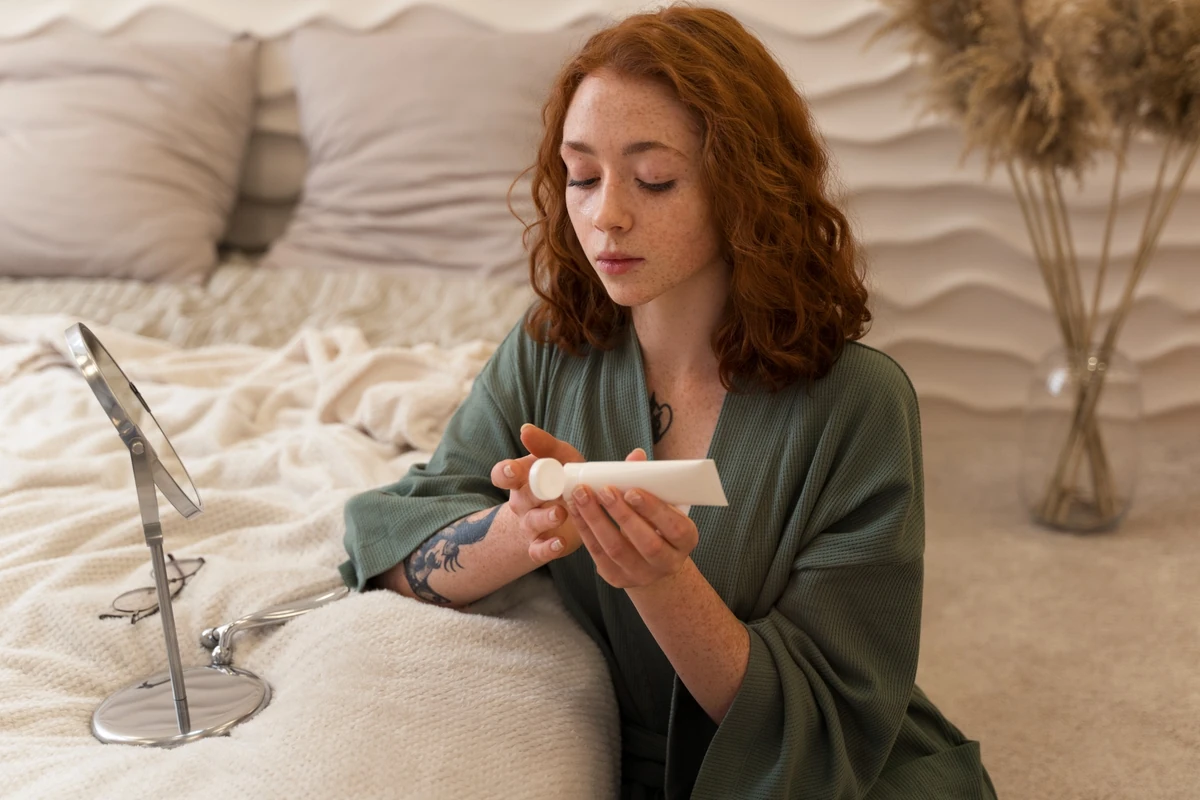
In the simplest sense, a home trial is a test application of a new product on a small area of skin, repeated over several days. The American Academy of Dermatology recommends testing a new product on a small area of skin twice a day for 7-10 days, choosing a spot where the product will not be actively rubbed off or washed away, such as the inner arm or the elbow crease. They also advise using the usual amount of product and leaving it on the skin as long as it would during actual use. For rinse-off products, this is about as long as they typically remain on the skin.
This is an important point that many overlook. If you apply a tiny drop for half an hour and then decide that the product is "tested," you are not testing real use, but a very conditional contact. A home trial only makes sense if it at least roughly reproduces a real scenario. Otherwise, it may give too optimistic a response where the skin actually needs more caution.
What is useful in this logic
A home trial does not replace clinical precision, but it helps avoid making a gross mistake. If the skin has already lost some tolerance, the ability not to expose the entire face to contact with a new formula right away is already significant. In this sense, a home trial is not about diagnosis, but about risk management.
What is dangerous in this logic
The danger begins where a small household test is attributed too much evidential power. If the home trial goes smoothly, it does not mean that the product is guaranteed to be suitable for the face. If the trial causes discomfort, it does not necessarily mean that you are dealing with an allergy. This distinction determines the quality of subsequent decisions.
Where ROAT fits in, and where it is just a household check
In dermatological logic, there is the concept of a repeated open application test, or ROAT. DermNet describes it as a simple way to check a product through repeated application to a small area of skin with subsequent observation for contact dermatitis. This means it is no longer a random test of "I'll just dab it behind my ear," but a more disciplined format of home observation for a specific product.
This is a useful distinction. Because if you are at home repeatedly applying your own product to a small area of skin and observing how it reacts over several days, this is closer to an open application test than to full patch testing. But even in this variant, you are still testing an entire formula in home conditions, not individual standardized allergens. That is why ROAT can be a practical, but not diagnostic tool.
How a home trial fundamentally differs from clinical patch testing
Professional patch testing is a diagnostic procedure for suspected allergic contact dermatitis. AAD explains that patches are usually applied to the back, left on the skin for a certain period, and then the results are read. Cleveland Clinic also describes this as a multi-day procedure with reaction assessment after several days. DermNet adds that patch tests are used to identify the causes of allergic contact dermatitis, and standard baseline series cover the most important common allergens.
The key here is not just that the patches are applied by a doctor. The key is in standardization. In clinical testing, not "just cream" is used, but individual allergens in tested concentrations and carriers. This allows for a more precise assessment of the immune response than any home trial with an entire cosmetic formula. A home test is not such a tool.
In other words, clinical patch testing answers the question: can allergic contact dermatitis be suspected and which allergens should be looked at more closely? A home trial answers a much more modest question: do I see a clear problem with this specific product on a small area of skin here and now? This is also useful knowledge, but it is knowledge of a different scale.
What a home trial can actually show
The strength of a home test lies not in depth, but in simplicity. If noticeable burning, redness, itching, swelling, or persistent discomfort appears on a small area of skin, that is already enough to avoid rushing to apply the product all over the face. For reactive skin, this information is indeed practical. It can timely stop a failed launch.
A home trial is particularly useful in several scenarios:
- after a period of reactivity, when the skin has not yet regained full tolerance;
- after an allergic or allergy-like reaction, when you are cautiously reintroducing basic care;
- when a new product does not appear obviously "aggressive," but the skin has recently become less tolerant of new launches;
- when you want to reduce the risk of a rough failed start, rather than obtain a home "diagnosis."
Conditionally speaking, a home trial only adequately answers a very narrow household question: "Do I see a noticeable negative reaction on a small area of skin to this product before full introduction?" For such a question, it truly makes sense.
What it does not show - and this is more important than anything
It does not guarantee that the product will suit the face
If a home trial goes smoothly, it does not mean that the product is guaranteed to be suitable for the face. The skin on the forearm, behind the ear, on the neck, and on the face is not the same territory. The face is often thinner, more sensitive, and more actively interacts with water, cleansing, sun, wind, SPF, makeup, and other layers of care. Therefore, a neutral reaction on the arm is not a promise of calm use on the face. This is a clinically logical limitation even with a correctly conducted home trial.
It does not show which specific ingredient triggered the reaction
If the formula contains fragrances, preservatives, acids, plant extracts, essential oils, or a complex combination of substances, the result of the home test only shows the reaction to the product as a whole. But you will not find out what exactly triggered it. That is precisely why standardized patch tests are needed, not a home trial with a jar.
It does not reliably distinguish allergy from irritation
This is one of the main limitations. DermNet explicitly states that reactions to cosmetics can be related not only to allergic contact dermatitis but also to irritant contact dermatitis or sensitive skin. This means that the skin may respond poorly not because the immune system is already sensitized to a specific allergen, but because the barrier is depleted or the formula is too active for its current state. A home trial alone does not reliably differentiate these scenarios without clinical interpretation.
This is where one of the most typical mistakes arises: a person sees burning or redness and immediately decides that they have "an allergy to everything." In reality, it could be a completely different scenario. If this question resonates with you—where is the allergy and where is another form of reactivity—it is worth moving on to the material "Cosmetic Allergy: Why Even an Expensive Cream Can Cause a Reaction."
Why after 35-40 this tool is both useful and weak at the same time
After 35-40, the skin often changes not only in appearance but also in its very logic of tolerance. It may retain water less effectively, calm down more slowly, and lose reserves more quickly after stress, seasonal changes, travel, active ingredients, or over-cleansing. At this point, a home trial is indeed useful, as it prevents overloading the entire face with a new product right away. But it is also at this point that it can easily mislead: because reactivity after 35-40 is often related not to a single allergen but to a broader knot of causes.
This means that a negative home trial does not always mean "this product is objectively bad forever," and a calm trial does not always mean "this product is safe for full launch." Sometimes it only indicates the state your skin was in at that moment. This broader context is separately explored in the material "Why After 35-40 Skin Suddenly Starts Reacting to Everything: Barrier, Hormones, Sensitization, and Silent Inflammation.".
How to conduct a home trial so that it at least does not lie too much
The main principle here is simple: the test should be as close to real use as possible. If it is a leave-on product, it should be left on the skin. If it is a cleansing or other rinse-off product, it should be kept on the skin for about as long as it typically contacts the skin in routine use. If the product is used daily, one short contact does not provide a real picture. That is why the AAD's recommendation for reapplication twice a day for 7-10 days is so valuable: it at least partially brings the home trial closer to real life.
The second important thing is to test only one new product at a time. If the skin has become reactive, chaotic testing of three or five new products does not provide clarity, but only darkens the picture. It then becomes impossible to understand whether the skin reacted to a specific formula, to the sum of all launches, or to the overall accumulated overload.
The third thing is not to draw conclusions too early. The absence of a reaction after a few hours does not yet mean that the product has passed the test calmly. Some reactions only manifest after repeated contact. That is why one hasty trial often gives a false sense of security. This is especially relevant for delayed-type reactions, which ROAT and patch testing are aimed at.
The fourth thing is to consider the type of product. Some active ingredients, such as retinol or glycolic acid, can cause temporary mild irritation even without an allergy. AAD separately notes that such a reaction is sometimes expected and temporary. Therefore, it is not only the presence of any sensation that matters, but also its intensity, duration, and nature.
Typical mistakes that make a home trial almost meaningless
The most common mistake is to test a product once and think that this is sufficient. The second is to apply it differently than it will actually be used. The third is to check the product on a random area of skin that does not behave the same way as the face. The fourth is to test several products almost simultaneously. The fifth is to try to self-diagnose an allergy based on the results of a short household trial.
There is also another subtle but common mistake: after a calm trial, a person immediately starts using the product all over the face daily, in a full routine, even along with other actives. For reactive skin, this is too abrupt a transition. Even if the trial went smoothly, full introduction of the product is better done gradually, allowing the system to show how it tolerates not only the formula itself but also the rhythm of its use.
In other words, a home test does not like haste. It works only where there is calmness, repeatability, and a willingness not to overestimate its power.
What cosmetics often react to
In the topic of cosmetic reactions, it is important to remember one more thing: the skin often responds not to abstract "cosmetics," but to specific groups of components. DermNet names fragrance and preservatives as some of the most common causes of contact reactions to cosmetics, while PPD in hair products is another significant trigger. They also remind that the word unscented does not necessarily mean the absence of aromatic substances, and labels like hypoallergenic or fragrance-free do not guarantee personal tolerance. This means that labeling can be a useful hint, but it does not replace observing the actual reaction of the skin.
That is why a home trial should not turn into a hunt for one "bad component" or a belief in one "safe label." For reactive skin, it is more important not to find a magical inscription on the packaging, but to reduce the overall load and carefully observe the behavior of the skin as a whole.
When a home trial is no longer sufficient
There are situations where a home test is no longer so useful as it is insufficient. If reactions occur regularly, if rashes or swelling are increasingly severe, if there is weeping, pronounced itching, or lesions on the eyelids, lips, or neck, or if you have unsuccessfully tried to restore care several times, a home trial ceases to be an adequate tool. At this point, more precise diagnostics are needed.
Clinical patch testing is precisely needed when there is a suspicion of allergic contact dermatitis and it is necessary not just to see that "something is wrong," but to understand the source of the reaction more precisely. DermNet notes that baseline series of allergens can identify over 70% of significant allergens, and additional series can be added as needed depending on the situation. This is the level of precision that a home trial does not provide.
What to do if a reaction appears during the trial
If redness, itching, swelling, or noticeable burning appears on a small area of skin, there is no need to continue the test "for clarity." It is better to stop immediately. AAD recommends rinsing off the product, not using it again, and if necessary, applying a cool compress or petroleum jelly. If the reaction is pronounced or does not subside, it is advisable to consult a dermatologist.
After this, it is very easy to fall into another trap—starting to search for a rescue product in a panic. But after a reaction, the skin often needs not new experiments, but a quiet base, predictability, and a minimum of launches. This point is dedicated to the material "Skin Recovery After an Allergic Reaction: How to Restore Trust in Cosmetics."
Conclusion
A home "patch test" is a useful but very modest tool. It can help avoid applying a questionable product all over the face at once. It can timely reveal a gross negative reaction. It can become part of a more cautious care logic when the skin has become reactive and no longer wants experiments without warning.
But it does not diagnose. It does not identify the exact allergen. It does not reliably distinguish allergy from irritation. It does not guarantee that a calm trial on the arm means the same calm life for the formula on the face. And that is why the most accurate attitude towards it is this: it is neither a verdict nor an indulgence, but a small test of caution.
At the moment when the skin has become unpredictable, this is sometimes already a lot. But if it has truly lost stability, a home trial is insufficient. Then a broader context, a slower strategy, and, in some cases, more precise clinical diagnostics are needed. For reactive skin, this is a very mature thought: not to demand that a small tool answer everything, but to use it precisely where it truly helps.
Sources
- American Academy of Dermatology. How to test skin care products.
- DermNet. Open application test.
- DermNet. Patch tests: Skin Contact Allergy Tests Explained.
- Cleveland Clinic. Patch Testing for Skin Allergies: Procedure & Results.
- DermNet. Cosmetics Allergy: Causes, Symptoms, and Treatment.
- DermNet. Baseline series of patch test allergens.






-lazy-placeholder.webp)
-medium.webp)