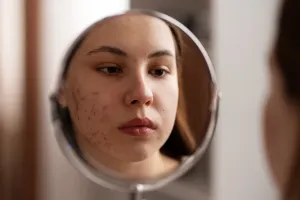






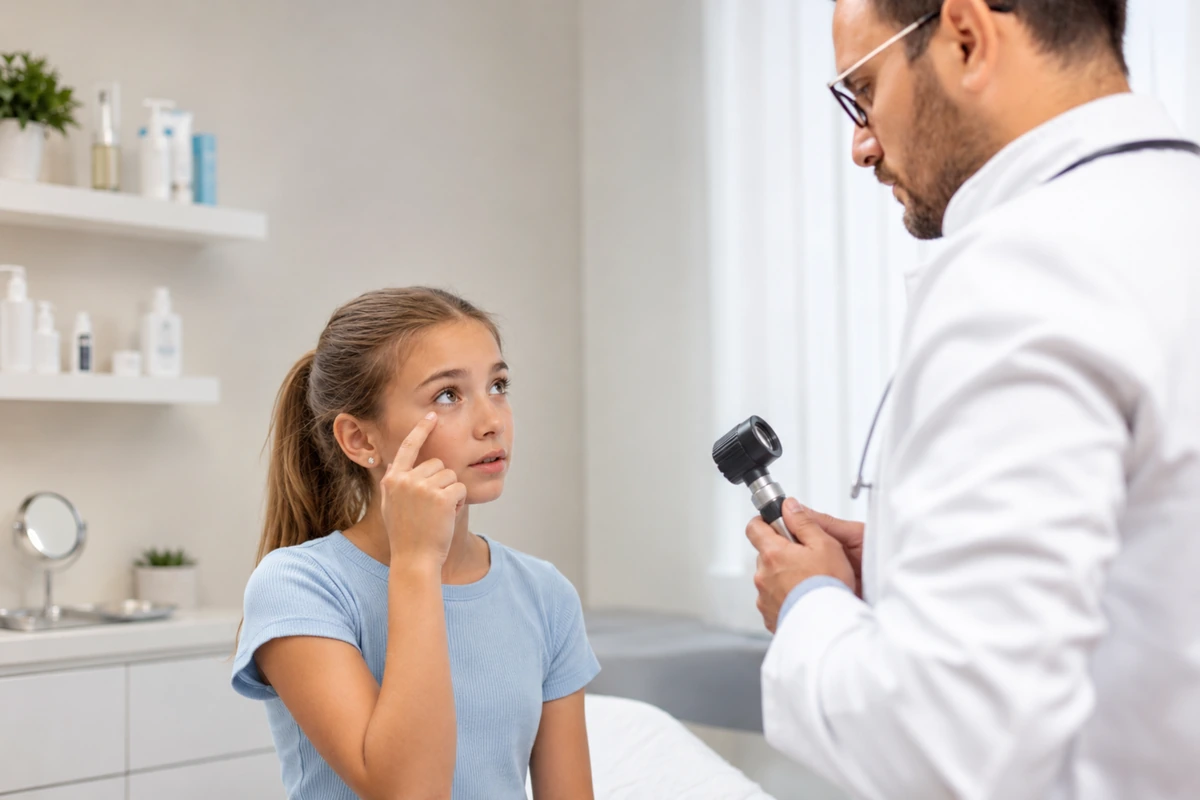
A first visit to a dermatologist is rarely just a medical event. For an adult, it may seem like simple logistics: book an appointment, show up, show the breakouts, get a skincare plan. For a teenager, it’s often much more complicated. Their skin is not some abstract organ. It’s their face in the mirror, selfies, school, friends, social media, comments, comparisons, and the fear that people are looking too closely. That’s why even the well-meaning idea of “let’s go see a doctor” can sound to them like: “there’s something wrong with you.”
That’s exactly why a first dermatology appointment should be prepared not only as a consultation about acne, comedones, irritation, or skin sensitivity. It is also a moment of adult support. The way parents frame the reason for the visit, how they speak in the office, how they react to the treatment plan, and whether or not they inspect the teen’s face every day afterward can either reduce the tension or turn skin into a source of shame for years.
This article is not about exactly when to see a dermatologist for acne. For that, it’s worth reading the separate piece teen acne: how to talk about it and when to see a dermatologist. The focus here is different: how to make the first visit feel emotionally safe, practically clear, and mature enough that a teen does not feel like a small child being taken somewhere to be “fixed.”
It’s important to distinguish between a routine dermatology visit and situations that need faster medical evaluation. If a rash appeared suddenly, is spreading quickly, or comes with pain, fever, swelling, open sores, or involvement of the eyes, lips, mouth, or genital area, this is no longer something to “schedule calmly sometime.” In such cases, it’s better to seek medical care sooner, because this may not be just about acne or skincare, but about a possible acute reaction or infection.
Not “we need to show your face,” but “let’s figure out what will help your skin”
The biggest mistake often happens before the appointment is even booked. An adult may say: “Your whole face has broken out, you need to see a doctor,” “I can’t look at this anymore,” or “If you don’t go now, you’ll end up with scars.” Even if those words come from worry, what a teenager hears is not care, but judgment. Their body becomes a topic of discussion, and the dermatologist visit becomes proof that they have somehow “failed.”
A different approach works better. No dramatizing, no scare tactics, no dismissing. Something more like: “I can see your skin is reacting right now, and I don’t want you to have to guess what to do on your own. Let’s talk to a doctor calmly so we can understand what to keep in your routine, what to stop, and what plan will be safe.” That shift matters: the teenager is not the problem. The problem is uncertainty, conflicting advice, too many products, fear of making mistakes, irritation, pain, or discomfort. An adult should not take away a young person’s right to their own face. They can help with information, logistics, payment, booking the appointment, and talking to the doctor, but they should not turn skin into a family control project. More on this in teens and appearance: how to talk without pressure or shame.
What to explain to a teenager before the appointment
What scares teens is often not the doctor, but the unknown. Will someone examine their face from up close? Will they have to remove their makeup? Will the doctor ask awkward questions? Will mom or dad speak for them? Will someone say they’re “washing their face wrong,” “eating badly,” or that it’s “their own fault”? The less clarity there is, the more room there is for anxious imagination.
Before the visit, it helps to explain briefly that a dermatologist is not looking at whether skin is “pretty or ugly,” but at medical details: the type of lesions, inflammation, the condition of the skin barrier, irritation, marks left after breakouts, and the possible impact of skincare, medication, hormonal changes, sports, makeup, or habits. This is not an exam in cleanliness and not a test of character. The doctor needs to understand what is happening with the skin so they are not treating it blindly.
You can say directly: “You do not have to look perfect for a dermatologist. In fact, it’s important for the doctor to see your skin as it really is.” If a teenager uses concealer or foundation and is not ready to go without it, it’s best not to turn that into a battle. A gentler agreement works better: “You can come in whatever feels more comfortable for you, but you’ll probably need to remove makeup before the exam. It’s a good idea to check with the clinic in advance whether they have a place to cleanse your face, and to bring something convenient with you, like makeup wipes.”
This may seem like a small thing, but only at first glance. For a teenager, makeup is sometimes not about “beautifying,” but about being able to leave the house at all. If an adult abruptly takes away that support, the visit begins not with trust, but with conflict. Makeup, hygiene, and non-stigmatizing safety rules deserve a separate focus, but in the context of a first appointment, the main thing is not to shame a teen for wanting to cover breakouts.
What to prepare so the appointment is actually useful
A good dermatology visit cannot be built around “just do something.” The doctor needs information, but this does not have to feel like preparing an investigative file. A few simple things are enough to help move from chaos to a plan more quickly.
- A list of what the teenager actually uses. Not the ideal version of what they’re “supposed” to use, but the truth: cleanser, moisturizer, SPF, foundation, acid toner, patches, scrub, pharmacy cream, TikTok products, anything that goes on the face, back, or chest.
- A short history of the problem. When it started, whether the condition comes and goes in waves, whether there are painful breakouts, whether marks remain afterward, and whether there are breakouts on the back, chest, or along the hairline.
- What they have already tried. Not to blame anyone, but so the doctor does not prescribe the same thing again or can understand what caused irritation.
- Photos of flare-ups, if the skin changes in cycles. There is no need to photograph the face every day. But a few calm, clear photos taken on days of more noticeable breakouts, irritation, or reactions can help the doctor see the pattern if the skin looks different at the appointment.
- The teenager’s own questions. This is the most important item. Not only the parents’ questions, but what the teen actually wants to know: “Can I wear makeup?”, “Can I keep doing sports?”, “Will the marks go away?”, “How long until I see results?”, “What should I do if it burns?”
If an adult wants to help, they can suggest that the teen save their questions in their phone. But those questions should not be edited from above. A question like “Can I cover my pimples?” may seem less important to parents than “What medication is needed?”, but sometimes it is exactly what determines whether the teen will follow the plan at all. If treatment ignores real life, it quickly becomes just another rule no one follows.
How adults should behave in the exam room

In the exam room, it is very easy to take up all the space without meaning to. Parents worry, want to explain, remember details, speak quickly, interrupt, and answer questions that were addressed to the teenager. From the outside, it looks like care. From the inside, for the teen, it can sound like: “I’m not really here. People are talking about my face without me.”
A good strategy is to give the doctor a brief summary at the start, then hand the conversation over to the teenager. For example: “We came because the breakouts have been going on for several months, home care hasn’t helped much, and we’d like a safe plan. I can add details if needed, but it’s important that you speak directly with him / her.”
That is a powerful gesture. It shows the teenager that the adult is not disappearing, but also not taking over their experience. They are there if needed to remember a medication, pay, clarify instructions, or arrange the next visit. But the central person in the conversation remains the one whose body and skin are being discussed.
Another important thing: do not comment on appearance during the exam. There is no need to say, “Look, this is the worst area,” “The chin is really awful,” “She covers it up,” or “He doesn’t do anything.” Even if the doctor is professional and does not pick up that tone, the teenager has already heard enough. It is much better to speak neutrally: “The chin area is the main concern,” “There are painful lesions,” “The breakouts leave marks,” or “We don’t understand what might be causing irritation.”
A teenager needs a voice of their own and a little privacy
A first dermatologist visit is a good moment to gradually help a teenager learn how to speak with a doctor independently. Not because parents are no longer needed, but because health gradually becomes part of personal responsibility. A teen needs to learn how to ask questions, describe symptoms, and say things like “I’m uncomfortable,” “I didn’t understand,” “I’m afraid of side effects,” or “I won’t be able to do this in the morning.”
Sometimes it makes sense to offer part of the conversation without the parents present. This depends on age, country, clinic rules, the topic of the consultation, and the teenager themselves. But even the phrase “If it would feel easier to ask something without me here, that’s completely okay” can lower tension significantly. It does not distance a parent from their child. It shows that the adult is not threatened by the child’s separateness.
In dermatology, this may not be only about acne. A teenager may feel embarrassed to ask about breakouts on the back or chest, irritation after shaving, sweating, dandruff, hair, breakouts after sports, reactions to cosmetics, or the connection with their menstrual cycle. If every question has to pass through a parent’s face first, some important things simply will not be said.
This is also where the idea of co-regulation becomes very visible. In a stressful situation, a teenager often picks up not only on words, but on tone, gaze, breathing pace, and facial expression. If the adult is tense, shaming, or dramatizing, the teen’s body tenses too. If the adult speaks calmly, does not rush, does not exaggerate, and does not turn the situation into a catastrophe, the visit becomes easier. That is why the article co-regulation through connection: voice, face, and boundaries is not extra psychology here, but a practical part of the medical experience.
What questions to ask the dermatologist
After the exam, the most vulnerable part often begins: the treatment plan. A teenager may nod along and remember almost nothing. Parents may remember medication names but not understand the logic. Then the confusion starts at home: what goes on in the morning, what goes on at night, whether SPF is allowed, whether moisturizer is needed, when to expect results, and what to do if the skin burns.
That’s why the goal of a first visit is not to leave with the most complicated regimen possible, but with a plan that can actually be followed. The questions should be not only about “how to treat it,” but about the teenager’s real life.
- What is the working explanation for the skin condition? Is this acne, irritation, perioral dermatitis, a contact reaction, folliculitis, seborrheic dermatitis, or a combination of several conditions?
- What is the goal for the next 8–12 weeks? Completely clear skin is not always realistic quickly. Sometimes the first goal is to reduce inflammation, pain, irritation, or the number of new breakouts.
- What should definitely be removed from the routine? A teen’s bathroom shelf is often overloaded with actives, acids, scrubs, drying products, and random purchases.
- What should stay simple? Cleansing, moisturizing, SPF, and the treatment product should all be clear and manageable. Without a solid base, a complicated regimen usually falls apart fast.
- Which reactions are normal, and which are not? Mild temporary irritation is not the same as strong burning, swelling, or a sudden worsening. A teenager should know when to message the doctor or come back sooner.
- How should treatment be combined with makeup, sports, and sun protection? If the doctor ignores these topics, the plan stays theoretical.
- What should we do if the regimen turns out to be hard to manage or the skin starts reacting strongly? It is important for a teen to know whether they can contact the doctor, what can be paused temporarily, and what should not be changed without guidance.
- When is a follow-up needed? Without a check-in point, a teenager may either give up after two weeks or keep pushing through irritation for too long.
These questions help keep dermatology from turning into a magical ritual of “we got prescribed something, we’ll see.” They bring structure back. And they help the teenager feel that treatment is not punishment for having bad skin, but a clear process that can be discussed and adjusted.
After the appointment: not face-checking, but supporting the plan
What happens after the visit matters a great deal. Parents often leave the office relieved and immediately switch into control mode: “Did you apply it yet?”, “Show me, is it better?”, “Why did you break out again?”, “You definitely didn’t eat anything unhealthy, right?” That quickly turns treatment into not help, but a daily interrogation.
It works better to agree on something different. For example: “Let’s make a simple routine chart on the mirror or in your phone so you don’t have to keep everything in your head. I’m not going to check your face every day, but I can remind you about the evening step if you want me to.” Again, the boundary matters: the adult supports, but does not take control of the body.
If the dermatologist prescribed a treatment product, it is important not to pile five more products on top “for faster results.” Teen skin often suffers not only from acne, but from skincare overload. So after getting a medical plan, it helps to return to basics: gentle cleansing, moisturizer, sun protection, the prescribed product, and patience. For more on a simple routine without extra pressure, see minimal skincare for ages 12–17: what to keep simple and safe.
It is also worth agreeing that results should not be judged every day. Skin does not change on command. There are cycles of inflammation, irritation, adjustment to medication, and the effects of stress, sleep, sports, the menstrual cycle, and changes in weather. If every evening becomes a search for “better or worse,” the teenager starts living under a microscope. That is exhausting, even when the treatment is actually working.
If the teenager is scared, angry, or refuses
Refusing a visit does not always mean indifference. Often it is self-protection. A teenager may be afraid the doctor will say something unpleasant, that they will have to show their skin without makeup, that their parents will hear personal answers, that something “strong” will be prescribed, or that they will be controlled even more afterward. If that fear is met with pressure, the chance of trust gets smaller.
It can help to begin not with booking, but with choice. “Would you rather start with an online consultation or an in-person visit?”, “Would you feel more comfortable with a female doctor or a male doctor?”, “Do you want me to stay in the room the whole time, or would you prefer part of the conversation on your own?”, “Do you want to write your questions yourself?” Even if the choice is limited, it restores a sense of participation.
If a teenager reacts very sharply to the topic of their skin, it is worth looking more broadly. Sometimes it is not only about the breakouts, but about overload, anxiety, lack of sleep, social pressure, comparisons, painful comments, or the feeling that their body is “letting them down.” In such cases, the dermatology path needs to be careful, not forced. The article teen stress on the skin and in sleep: how to recognize overload talks separately about how stress can show up in skin, sleep, and overall well-being.
How to tell whether the doctor interaction was a good one
Not every appointment that ends with a prescription is a good appointment for a teenager. A good interaction has a few clear signs. The doctor speaks to the teenager, not only to the parents. They do not shame the teen for makeup, diet, TikTok, “wrong” skincare, or attempts to treat themselves. They explain what is happening with the skin in plain human language. They give a plan that can be repeated at home. They warn about possible reactions. And they leave room for a “silly” question without making the teen afraid to ask it.
After an appointment like that, a teenager does not necessarily walk out feeling cheerful. They may be tired, quiet, or skeptical. But the main feeling should remain: people spoke to me normally. I was not humiliated. My face did not become the object of someone else’s panic. There is a plan. I can try.
If it went differently—if the doctor was rude, dismissive, failed to explain, pressured them, or ignored the teenager’s questions—that does not mean “dermatologists don’t help.” It means that this particular interaction was not a good fit. For a teenager, it matters a lot to hear an adult say: “I’m sorry that felt unpleasant. We can find a different specialist.” That helps restore trust not only in medicine, but in the adult as well.
The first visit can become not a trauma, but a step in growing up
During adolescence, a person gradually learns how to live in their body without constant outside evaluation. That is not easy, especially when skin is changing, reacting, getting inflamed, looking shiny, hurting, or leaving marks. An adult cannot take that experience away completely. But they can make sure shame is not added on top of it.
A good first visit does not promise a quick miracle. It does something else: it reduces chaos, separates myths from facts, explains realistic timelines, and offers a path in which the teenager is not left alone with the mirror, the social media feed, and random advice.
A first dermatologist visit can be an important turning point. Not because everything will quickly disappear afterward. But because a teenager may see for the first time that skin can be talked about calmly. Medically. Without catastrophe. Without mockery. Without “it’s your own fault.” Without endless inspection of the face. With respect for boundaries and with a real plan.
Sometimes that becomes the most important result of the first consultation. Not just the prescription, not just the regimen, not just the name of an active ingredient. But the experience of this: my body is not a reason for shame. I can be helped in a way that does not make me feel smaller.