







A few months after giving birth, your hair may suddenly start shedding much more than before. You notice it in the shower, on your brush, on your clothes, and your ponytail feels visibly thinner. In most cases, this is postpartum telogen effluvium — a temporary shift in the hair growth cycle after pregnancy. It usually does not require specific treatment, but it does require time.
Why hair sheds so much after childbirth
Hair grows in cycles: some follicles are in the active growth phase, while others move into a resting phase, after which the hair falls out. Normally, these processes are not synchronized, so losing some hair every day is barely noticeable.
During pregnancy, that balance changes. Under the influence of hormonal shifts, especially high estrogen levels, a larger proportion of hair stays in the active growth phase. As a result, hair often feels thicker and less of it ends up on the brush. After childbirth, estrogen levels drop sharply, and a large group of follicles moves into the next phases of the cycle at roughly the same time. The shedding does not happen immediately: first, the hair spends several months in the resting phase. That is why noticeable shedding usually begins when childbirth itself already feels well behind you. DermNet explains this mechanism in more detail. This condition is called telogen effluvium, or telogen hair shedding. The follicles are not destroyed, so even a lot of hair in the bathtub does not automatically mean irreversible hair loss has begun.
Childbirth is not always the only factor. Telogen shedding can also be triggered by significant blood loss, illness with a high fever, surgery, rapid weight loss, marked energy deficiency, or nutrient deficiency. Diffuse hair loss can also occur with thyroid dysfunction. After having a baby, several factors sometimes overlap, so it is not wise to explain any prolonged shedding simply as “postpartum hormones.”
When shedding starts and how long it lasts
Most often, hair starts shedding noticeably about 2–4 months after childbirth, and the most intense shedding often happens around the fourth month. This delay is expected: time passes between the shift in follicle activity and the moment the hair actually falls out. The American Academy of Dermatology notes that the process gradually settles down, and in most women, their usual hair density returns by around the baby’s first birthday, often even earlier.
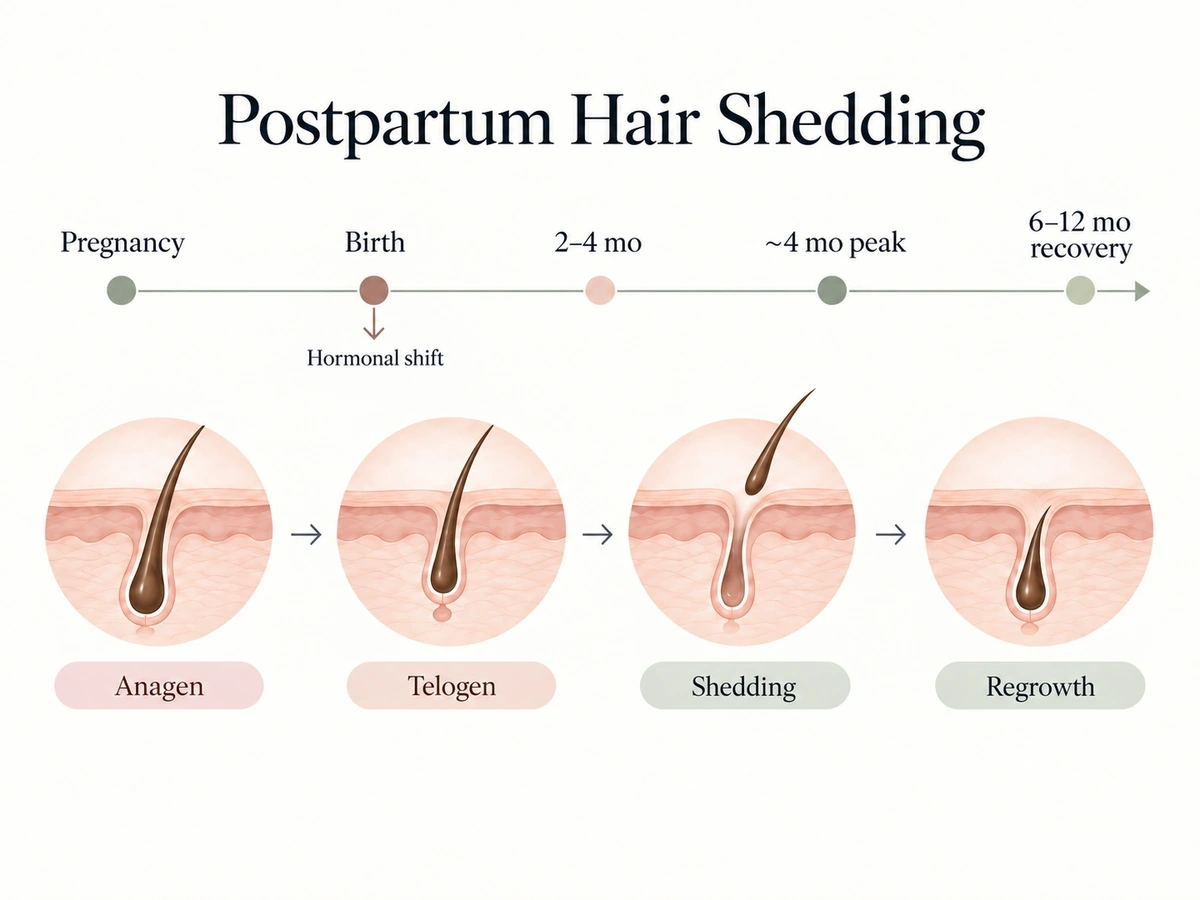
Fig. Postpartum hair shedding: after childbirth, some follicles shift into telogen, which is why increased shedding becomes noticeable after 2–4 months and then gradually eases.
Recovery is easy to underestimate. New hairs may already be growing, but a few centimeters at the roots are not enough to restore the former volume of long hair. That is why short “baby hairs” start appearing along the part, the hairline, and at the temples. They can make styling more awkward, but in the context of postpartum shedding, they are more often a sign of regrowth.
Breastfeeding, which usually happens during this same period, is not considered the main cause of this shedding on its own. The key shift in the hair cycle is linked to pregnancy and postpartum hormonal changes. There is no reason to stop breastfeeding for the sake of your hair.
What actually helps — and what is not worth spending money on
If this is typical postpartum telogen effluvium, the most important thing to say plainly is this: you cannot stop it with shampoo, ampoules, or a hair mask. Hairs that have already entered the telogen phase will complete their cycle. Hair care matters here mainly to avoid adding breakage and mechanical damage on top of the shedding. A gentle shampoo, conditioner through the lengths, less overheating from blow-drying and flat irons, careful detangling, and avoiding constantly tight ponytails can help preserve the hair that was not meant to fall out. Volumizing products can make hair look fuller while it grows back, but they do not affect how quickly the follicles work.
After childbirth, it is also not a good idea to sharply restrict calories, protein, or entire food groups. A pronounced energy or nutrient deficit can itself prolong telogen shedding. Normal hair growth requires amino acids, iron, zinc, and other nutrients, but if you already get enough of them, extra amounts do not speed up the growth cycle. We wrote separately about the role of an everyday diet without “beauty superfoods” in the article Which Fish Is Healthiest: Omega-3s, Mercury, and 7 Simple Dishes.
It is especially important to be careful with biotin. Its deficiency really can be associated with hair loss, but it is rare. There is no convincing evidence that high doses of biotin help hair growth in people who are not deficient. In addition, such supplements can distort the results of some lab tests. The National Institutes of Health specifically draws attention to this.
Iron is a different story. Pregnancy and blood loss during childbirth can indeed increase the risk of deficiency, but that does not mean every woman with postpartum shedding needs to take iron. If deficiency is suspected, it is better to confirm it and treat it as a specific condition rather than as a universal explanation for any hair loss.
| What you can do | What to expect |
|---|---|
| Let the hair cycle run its course | Most postpartum shedding resolves on its own |
| Eat a balanced diet without harsh restrictions | Avoid adding energy and nutrient deficiency to a physiological process |
| Treat hair gently | Less breakage and mechanical damage |
| Use volumizing products | Hair may look fuller, but it will not grow faster because of them |
| Check for possible deficiencies when indicated | Identify an additional cause if one is actually present |
| Do not automatically buy biotin or “anti-hair-loss complexes” | Their benefit for normal postpartum telogen effluvium has not been proven |
Scalp massage, oils, homemade masks, and salon rituals can be a pleasant part of hair care, but there is no basis for presenting them as a way to stop hair that has already entered the shedding phase.
Do you need tests, vitamins, or minoxidil?
With a typical picture — shedding starts a few months after childbirth, is evenly distributed across the scalp, and gradually slows down — not everyone needs a long list of tests. An evaluation makes more sense if there was significant blood loss, anemia during pregnancy, a very restrictive diet, a history of thyroid disease, or other symptoms. Depending on the situation, a doctor may order a complete blood count, iron studies, thyroid function tests, or other investigations. There is no universal “hair loss test.”
Vitamins make sense when a deficiency has been confirmed. Without one, extra doses do not speed up the normal follicle cycle. Minoxidil is a separate question. For ordinary postpartum telogen effluvium that is expected to resolve on its own, it is not a first-line option and not a reason to start self-treatment. Minoxidil may make sense for other diagnoses, such as female pattern hair loss, but first it is important to understand what exactly is happening with the hair.
For women who are breastfeeding, the question of minoxidil should be considered separately. The LactMed database, updated in 2026, allows the use of topical minoxidil once lactation is established, provided that the baby does not come into contact with the treated skin. There is much less data on oral minoxidil, so recommendations remain more cautious. Still, for ordinary postpartum telogen effluvium this does not change the main point: minoxidil is usually unnecessary, because in most cases this condition resolves on its own. It is more appropriate to discuss it when shedding drags on or there is suspicion of another type of alopecia.
When it no longer looks like typical postpartum shedding
Typical telogen shedding is diffuse: hair becomes thinner all over the scalp rather than disappearing from one clearly defined area. The scalp itself usually looks normal — without scarring, marked redness, pain, or severe flaking.
It is worth seeing a dermatologist sooner if:
- clearly defined bald patches appear;
- the center part keeps widening or the crown becomes noticeably thinner;
- there is pain, itching, inflammation, crusting, or scarring changes on the scalp;
- the hair continues to shed heavily with no sign of improvement;
- by around a year after childbirth, hair density is not starting to return;
- the shedding is accompanied by pronounced weakness, symptoms of anemia, significant weight changes, heart palpitations, or unusual sensitivity to cold or heat.
Postpartum telogen effluvium can sometimes make a pre-existing problem more noticeable, such as female pattern hair loss. In a 2024 study of women who had already sought medical care for postpartum shedding, telogen effluvium was often combined with other forms of hair loss. These numbers cannot be generalized to all women after childbirth, because this was a specifically selected clinical group. But the practical takeaway is simple: if the usual postpartum pattern drags on or looks atypical, what you need is an accurate diagnosis — not another serum. The study is available on PubMed Central.
Hair changes after having a baby can affect you more deeply than it may seem from the outside. Especially when your body, daily rhythm, work, relationships, and even your sense of self have changed at the same time. We explore this broader transition in the article I Lost Myself After Having a Baby: What Matrescence Is and Why Your Sense of Self Changes. In most cases of postpartum telogen effluvium, the follicles continue to function normally, and the hair gradually grows back. Here, time — and an accurate diagnosis if the process is prolonged — matters more than trying to “stimulate” growth at any cost.
Sources
- American Academy of Dermatology. Hair loss in new moms: Dermatologist tips.
- DermNet. Telogen effluvium (hair shedding).
- Galal SA, El-Sayed SK, Henidy MMH. Postpartum Telogen Effluvium Unmasking Additional Latent Hair Loss Disorders. Journal of Clinical and Aesthetic Dermatology. 2024;17(5):15–22.
- Olsen EA, Reed KB, Cacchio PB, Caudill L. Iron deficiency in female pattern hair loss, chronic telogen effluvium, and control groups. Journal of the American Academy of Dermatology. 2010;63(6):991–999.
- National Institutes of Health, Office of Dietary Supplements. Biotin: Fact Sheet for Health Professionals.
- National Library of Medicine. Minoxidil. Drugs and Lactation Database (LactMed®). Updated 2026.