






Having a baby changes more than everyday routines. It can change how a woman feels about her body and herself, her relationship with her partner, her sexuality, her sense of freedom, and even how she wants to spend her day. In this Union Beauty collection, we focus on women in this new reality — matrescence, fatigue and intimacy, changes in skin and hair, and gradually making room again for their own needs and desires.

A Woman After Having a Baby
Subtitle: Body, identity, relationships and intimacy in a new reality
Categories:


We Became Only Parents: How Relationships Change After a Baby Is Born
Why partners grow apart after having a baby — and what helps them feel like a couple again.


When Does “Postpartum Skin” Go Away? Realistic Recovery Timelines and Safe Skincare While Breastfeeding
Dryness, acne, and dark spots after childbirth: what happens to your skin and what’s actually safe while breastfeeding


Postpartum Hair Loss: When It Starts, How Long It Lasts, and What Actually Helps
Why hair suddenly starts thinning after childbirth, when fullness returns, and what’s not worth spending money on.


I’m Tired of Being a Mom: How Mental Load Fuels Maternal Burnout
Why you can feel drained even with help — and how mental load quietly saps your energy every single day.

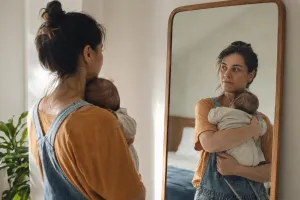
I Lost Myself After Having a Baby: What Matrescence Is and Why Your Sense of Self Changes
Why you can lose your sense of self after having a baby — and how matrescence reshapes your body, roles,...


Burnout, motherhood and sex: what changes after the birth of children
Why desire disappears after the birth of a child and how to gently restore closeness without pressure and guilt.
What changes in a woman’s life after having a baby
After a baby is born, attention naturally shifts toward the child. How they sleep, eat and grow, what they need today and what they may need tomorrow. Against that backdrop, the changes happening to the woman herself can easily start to feel secondary. Yet almost everything may change: her body, daily rhythm, relationships, sexuality, work, the amount of time she has to herself and even her sense of who she is.
Sometimes it comes down to a very simple thought: “I feel like I lost myself after having a baby.” Before motherhood there was work, friends, spontaneous plans, personal rituals, time alone and a body that felt familiar. Those parts of life do not necessarily disappear after a child arrives, but they often need to find their place again.
This transition into motherhood is known as matrescence. It is not only about taking on the role of a mother, but also about how a woman experiences herself, her body, her autonomy, her work, her relationship and her expectations for her own life. There is no single path to follow and no correct pace at which she is supposed to “feel like herself again.” Often, it is less about returning to a former version of herself and more about shaping a new life in which motherhood is an important part of her identity, but not the only one.
The tiredness no one sees
Caring for a child is not just about feeding, walks or sleepless nights. There is also an invisible layer of work: remembering, planning, making appointments, shopping, anticipating needs, organising and keeping dozens of small tasks in mind at the same time.
This mental load can remain enormous even in families where a partner is very involved. The difference often lies between doing individual tasks and being the person responsible for making sure the whole system keeps running. When that responsibility never really switches off, ordinary tiredness can gradually turn into deep exhaustion or maternal burnout.
When a couple becomes a household logistics team
Relationships change after a baby arrives too. Life suddenly involves much more logistics and much less spontaneity. Who gets up tonight, who works, who cooks, who stays with the baby, who gets an hour of quiet — everyday questions can quickly become questions about fairness, resentment and intimacy.
Sex does not exist separately from the rest of life either. Sleep deprivation, constant responsibility, breastfeeding, changes in the body, lack of privacy or the feeling that someone has been touching you and needing something from you all day can affect desire far more than any romantic advice.
Intimacy after having a baby often has to be rebuilt as well — around a new rhythm, new boundaries and two people who have both changed.
The body is adjusting to a new rhythm too
The changes that follow pregnancy and childbirth do not end when a woman leaves the hospital. A few months later, significant hair shedding may begin. Skin can become drier or more sensitive, breakouts may return, pigmentation may linger for longer, and the way a woman sees her own appearance may change too.
Some of these changes gradually resolve on their own, some call for adjustments to skincare, and some symptoms are worth checking rather than endlessly attributing everything to “hormones.”
Self-care can also mean more than trying to fix something. Hair, skincare, clothes, a bath alone, exercise or a favourite fragrance can become small ways of reconnecting with one’s own life — as long as they bring pleasure rather than turning into yet another demand to look good and keep up with everything.
Not going back, but making room for yourself again
Conversations about life after childbirth often revolve around the word “back”: getting your body back, getting sex back, returning to work, restoring the old relationship, becoming yourself again. But not everything has to return to exactly what it was. Life after having a baby is already different. The question does not necessarily have to be how to erase those changes. What matters more is whether this new reality still has room not only for the role of mother, but for the woman herself: her body, relationships, work, beauty, sexuality, friends, quiet, interests and the right to sometimes want something simply for herself.