






A few weeks after giving birth, skin may become dry and sensitive even if it was calm throughout pregnancy. Or breakouts suddenly appear, patches on the face darken, the belly starts to itch, or a scar heals slowly. In the mirror, all of this can blur into one impression: “something happened to my skin.” In reality, each of these changes has its own mechanism and its own outlook.
After childbirth, estrogen and progesterone levels shift quickly, and during breastfeeding the hormonal background may remain different from your usual baseline for some time. On top of that come sleep deprivation, sweat, more frequent showers, constant handwashing, and contact with milk, saliva, laundry detergents, and wet wipes. One “postpartum cream” cannot address this whole mix of causes. First, you need to understand what exactly has changed.
What happens to the skin after childbirth, and how long it lasts
In the first months, skin often behaves unpredictably. Dryness can alternate with oiliness, a familiar product may suddenly start to sting, and breakouts can appear even in people who have not thought about acne in years. On its own, this period does not mean your skin type has changed forever.
Dryness and tightness are often made worse by frequent cleansing, hot water, dry air, friction, and skincare that has become too active for the skin’s current state. You do not need a complicated “recovery program” here. For a few weeks, a gentle cleanser, a fragrance-free cream, and daytime sun protection are usually enough. If the skin is very dry, a cream with ceramides, glycerin, squalane, or petrolatum is usually more helpful than adding another serum.
Itching and redness on the hands often turn out to be irritant contact dermatitis: hands are now exposed much more often to water, soap, and household cleaners. In this case, using cream after every wash and wearing gloves for cleaning matter more than looking for a “hormonal cause.” If cracks are painful, weeping, or not healing, you need a dermatologist: eczema or infection may have developed on top of the irritation.
There is no exact date by which skin “should return to normal.” Simple irritation may ease within a few weeks after changing your routine. Acne, melasma, and stretch marks follow different rules and can linger much longer. It only makes sense to wait for months where natural improvement is actually expected. Painful rashes, severe itching, blisters, pus, or rapid worsening are not part of ordinary recovery.
What does the timeline usually look like? Irritation from frequent washing, sanitizers, or overly active skincare usually starts to improve within days or weeks once the trigger is removed and a barrier-supporting cream is added back. Acne may appear right after delivery or several weeks later and can keep changing through the first months. There is no reliable rule that “everything goes away by three months.” A few isolated pimples can be watched, but painful nodules and scarring should be treated right away rather than waiting until breastfeeding ends.
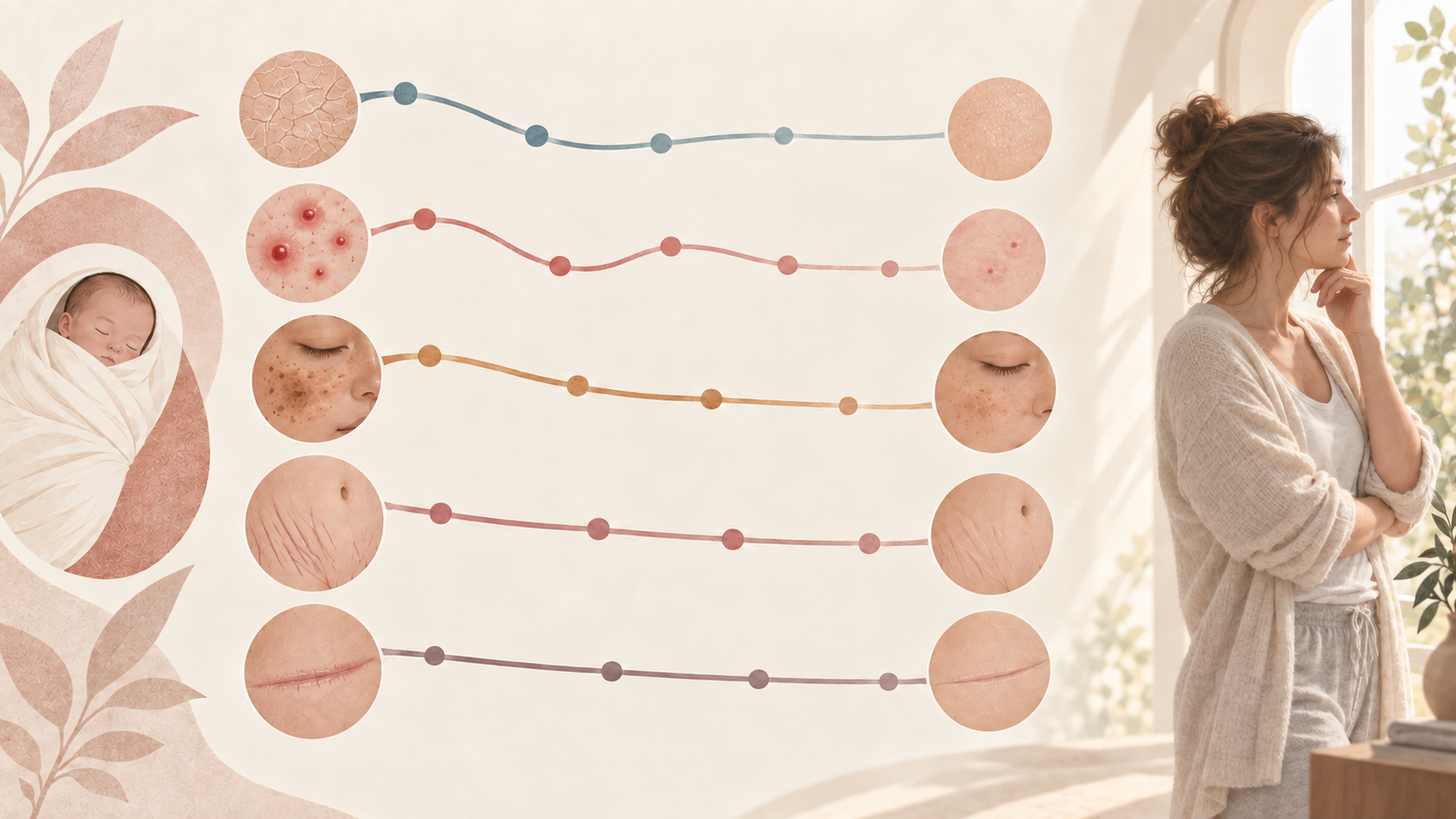
Fig. Postpartum skin changes: reduced dryness and breakouts, fading pigmentation, softer stretch marks, and scar remodeling.
Spots and texture changes usually take longer. Melasma that developed during pregnancy often fades within the first year after childbirth, but persists in about 30% of cases; sun exposure can make it more noticeable again. Stretch marks gradually shift from red or purple to lighter shades over months, and sometimes years. A cesarean scar also does not reach its final appearance right away: collagen remodeling and scar maturation continue for about 12–18 months. So judging its color, thickness, and texture at six weeks as the final result is too early. But healing and maturation are not the same thing: pain, discharge, or increasing redness should not be brushed off with “the scar just needs more time.”
Postpartum facial skincare: dryness, acne, and melasma
When skin has become sensitive
It is best to start by simplifying your routine. A scrub, acid toner, several serums, and a “pore-cleansing” mask all in one evening can easily keep irritation going, even if each product used to suit you on its own. Keep cleansing, moisturizer, and SPF, then reintroduce actives one at a time. That makes it easier to see what your skin tolerates now and not confuse a cosmetic reaction with postpartum changes.
Severe burning even from water, red patches, swollen eyelids, or a rash around the mouth are no longer just “dehydration.” In that situation, active at-home skincare often only muddies the picture. A dermatologist can tell contact dermatitis apart from atopic eczema, rosacea, or perioral dermatitis and choose treatment that is compatible with breastfeeding.
If breakouts appear
Postpartum acne is not something to treat all at once with an alcohol-based lotion, acids, and spot treatments. That kind of routine quickly adds peeling but rarely works faster. For mild breakouts, it is better to choose one active that actually does the job. Azelaic acid works well for inflamed lesions, post-acne marks, and redness-prone skin; benzoyl peroxide is helpful for inflamed pimples. You do not have to start with daily use: two or three evenings a week often gives the skin time to adapt.
Deep painful nodules, breakouts that scar, or acne that does not respond to a home routine within two to three months are better treated with a dermatologist. Breastfeeding does not leave your doctor without options. Newer publications are revisiting old blanket restrictions: they consider how much of a product is actually absorbed, how large an area it is applied to, and whether treated skin may come into contact with the baby. Topical treatments, antibiotics, and other methods are assessed individually instead of stopping all treatment for the entire period of lactation. This approach is outlined in the review on the safety of dermatologic medications during lactation and the 2026 clinical review.
Melasma: why regular SPF is sometimes not enough
Pigmented patches that appeared during pregnancy on the cheeks, forehead, or above the upper lip may fade after childbirth without treatment. But melasma is easily triggered again by sun exposure and does not always disappear just because pregnancy has ended. If the patches persist, daily photoprotection becomes the foundation of care, not just an add-on to a brightening serum.
New melasma research is paying more and more attention to visible light. This mainly means daylight, not your phone screen. For skin prone to melasma, a tinted sunscreen with iron oxides may be useful: it adds protection in the part of the spectrum that regular clear SPF covers less effectively. In a 2025 study of 42 women, both SPF 50+ products prevented melasma from darkening over the summer, while the tinted product performed better on some instrumental color measurements. On the clinical scale, there was no significant difference between the groups. The study was small and funded by the manufacturer of the tested product, so this is an interesting finding, not the final word on the topic. And it is definitely not a reason to treat any foundation as therapy: what matters is strong UVA and UVB protection, enough product, and regular reapplication.
Azelaic acid can work on both breakouts and uneven skin tone at the same time. Niacinamide and vitamin C make sense as part of a routine, but they rarely clear pronounced melasma on their own. Hydroquinone, prescription combinations, peels, and device-based treatments should be discussed with a dermatologist. Melasma is irritation-sensitive, so trying to “hit the pigment harder” can sometimes end in fresh inflammation and even more noticeable patches.
Stretch marks, the belly, cesarean scars, and breast skin
Fresh stretch marks may look pink, red, purple, or darker than the surrounding skin. Over time, they usually fade and become less noticeable, but they rarely disappear completely. Creams and oils soften the skin and reduce dryness and itching, but they cannot “glue back together” altered dermal fibers.
This is exactly where advertising most often substitutes improvement with disappearance. In a systematic review of stretch mark treatments, the authors analyzed 151 studies and 4,806 treatment outcomes. About 90% of the reported results were partial improvement, and only around 3% were complete resolution. Lasers, microneedling, and other procedures can improve the color and texture of stretch marks, especially while they are still fresh, but promises to erase them without a trace do not match what the research shows.
The postpartum belly is not always just a skin issue either. Its appearance is shaped at the same time by stretched skin, the amount of subcutaneous fat, the condition of the fascia, muscle position and tone, and diastasis recti. A cream only works on the surface: it may soften dry skin, but it does not close a diastasis or restore muscle strength. If the abdomen bulges along the midline, there is back pain, a sense of weakness, or difficulty returning to exercise, an assessment by a physical therapist who works with postpartum recovery is likely to be more useful.
A cesarean scar should only be addressed after the wound has closed. As long as there are scabs, discharge, or unhealed areas, the priority is the surgeon’s recommendations and clean, dry healing. Later, silicone gel or silicone sheets may help lower the risk of a raised scar. Massage is sometimes used after full healing if the doctor sees no contraindications. Pain, increasing redness, pus, an unpleasant smell, or separation of the wound edges call for medical assessment, not cosmetic care.
For breast skin, the main issue is usually not “loss of firmness” but friction, moisture, and nipple trauma during feeding. Cracks should not be silently endured and constantly coated with random balms. It is worth checking the baby’s latch; with sharp pain, bleeding, weeping, a rash, or signs of infection, you need help from a doctor or a lactation consultant. Products applied to the nipple should be suitable for that area, and any residue before feeding should be removed exactly as directed.
What can be used while breastfeeding
A label that says “not recommended during lactation” does not always mean a proven risk: often the manufacturer simply has no direct studies in breastfeeding women. At the same time, low absorption does not mean anything can be applied to the breasts. With topical products, what matters is the size of the treated area, the condition of the skin, the duration of use, and whether the baby may come into direct contact with the product on the skin.
| Product or procedure | How to use it while breastfeeding |
| Moisturizers, ceramides, glycerin, squalane, petrolatum | Can be used. Do not leave a cosmetic product on areas that come into contact with the baby’s mouth or skin. |
| Niacinamide and vitamin C | A regular facial skincare routine does not require any special pause because of lactation. |
| Azelaic acid | Considered low risk. Do not apply to the breasts, and do not let treated skin come into contact with the baby’s skin. LactMed notes that about 4% of the dose is absorbed after topical application. |
| Benzoyl peroxide | After application to the skin, it quickly converts to benzoic acid and is considered low risk. Do not apply to the nipples or breasts; wash your hands before contact with the baby. LactMed data. |
| Salicylic acid | Small areas of intact skin are acceptable. Do not use it on large areas, the breasts, or irritated or damaged skin. |
| Adapalene and tretinoin | Topical retinoids are poorly absorbed. LactMed considers topical adapalene probably low risk, although there are no direct studies during breastfeeding. If the medication is needed for treatment, its use should be discussed with a doctor; apply to a small area, not to the breasts, and not where it may come into skin-to-skin contact with the baby. |
| Cosmetic products with retinol or retinal | Their benefit during this period is mostly cosmetic, and the exact amount absorbed depends on the formula. It is simpler to postpone them or replace them with azelaic acid. This is not the same as proven harm after accidental application. |
| Hydroquinone | Because absorption is relatively significant and data are lacking, prolonged use during breastfeeding is not recommended. For melasma, it is better to choose a different plan. |
| Sunscreens | Can be used daily. There is no need to choose only mineral filters because of breastfeeding. Do not apply SPF to the nipples unless necessary. |
| Peels, lasers, microneedling, and injectable procedures | Lactation itself does not automatically make all procedures unsafe, but for many cosmetic interventions there are no good-quality studies during this period. The decision depends on the method, the anesthetic agents used, the treatment area, and the reason for the procedure. It should be planned with a doctor who knows that you are breastfeeding. |
Oral retinoids are a completely different category: isotretinoin is not used during breastfeeding. The same applies to recommendations for a cream—they should not be transferred to tablets or supplements with a similar name. If a product is prescription-only, used over a large area, or applied to damaged skin, it should be assessed separately.
When to see a doctor, and when you can visit a cosmetologist after childbirth
Normal postpartum changes should not come with fever, rapidly spreading painful redness, pus, or involvement of the eyes or mucous membranes. Blisters also need assessment, especially if the rash began late in pregnancy or suddenly worsened after delivery. This can sometimes be a sign of pemphigoid gestationis—a rare autoimmune condition that cosmetics cannot fix.
Do not delay a consultation if a mole has changed shape or color or started bleeding; if a rash is painful or leaves scars; if itching interferes with sleep; if nipple cracks are not healing; or if a cesarean scar becomes red, swollen, or starts leaking fluid. A painful hot area on the breast together with fever may be a sign of mastitis and also needs medical evaluation.
You can go to a cosmetologist once it is clear what exactly they are supposed to address. Dry, irritated skin rarely needs a course of aggressive procedures. Melasma requires disciplined photoprotection and a careful plan, not the strongest peel available. Stretch marks and scars should heal fully first. A first appointment may reasonably end with nothing more than a care plan—and that is a normal outcome, not a missed procedure.
If you want to “restore your skin after childbirth,” start with the simplest steps: remove what irritates it, bring back comfort and sun protection, and then add one product for one specific problem. That makes it easier both to get results and to understand what actually helped.
Changes in appearance after having a baby can be upsetting even when your health is completely fine. You do not have to love every stretch mark or give up the wish to improve something. But the body has not “missed a deadline” if, after three or six months, it still looks different from how it did before pregnancy. In our article on matrescence and the loss of a sense of self after childbirth, we talk in more detail about why the relationship with your body changes during this period along with the rest of life.
Sources
- Lyons C. E., Smith A. D., Schwartzman G. et al. Managing Skin Diseases that Flare During Pregnancy and in the Postpartum Period: Part 2—Management & Safety Considerations. Journal of the American Academy of Dermatology. 2026.
- Ly S., Kamal K., Manjaly P. et al. Treatment of Acne Vulgaris During Pregnancy and Lactation: A Narrative Review. Dermatology and Therapy. 2023;13(1):115–130.
- Zhao L., Fu X., Cheng H. Prevention of Melasma During Pregnancy: Risk Factors and Photoprotection-Focused Strategies. Clinical, Cosmetic and Investigational Dermatology. 2024;17:2301–2310.
- Zhu C. K., Mija L. A., Koulmi K. et al. A Systematic Review on Treatment Outcomes of Striae. Dermatologic Surgery. 2024;50(6):546–552.
- Commander S. J., Chamata E., Cox J. et al. Update on Postsurgical Scar Management. Seminars in Plastic Surgery. 2016;30(3):122–128.
- Yaghi M., McMullan P., Truong T. M. et al. Safety of Dermatologic Medications in Pregnancy and Lactation: An Update—Part II: Lactation. Journal of the American Academy of Dermatology. 2024;91(4):651–668.