






The microbiome long sounded like a word from a lab. Then it became a fashionable password of wellness culture. People started using it to explain everything: breakouts, fatigue, mood, aging, sensitivity, sugar cravings, even how skin reacts to a cream. There is some truth in that, but also a dangerous oversimplification. The microbiome really does play a role in the immune system, barrier function, inflammation, metabolism, and even in how the body responds to stress. But it does not work like a button. You cannot eat one jar of yogurt, add a spoonful of seeds, or buy a “probiotic” product and expect your skin to become clear, calm, and glowing within a week.
The microbiome is the total community of microorganisms that live in a specific environment of the body: in the gut, on the skin, in the mouth, on the mucous membranes. What matters is not simply that they are present, but the balance between different species, their metabolites, the barrier, and the immune response. So when we talk about the microbiome in the context of beauty, it makes more sense to think not in terms of “good” and “bad” bacteria like in a children’s fairy tale, but as a complex ecosystem that is constantly negotiating with the body.
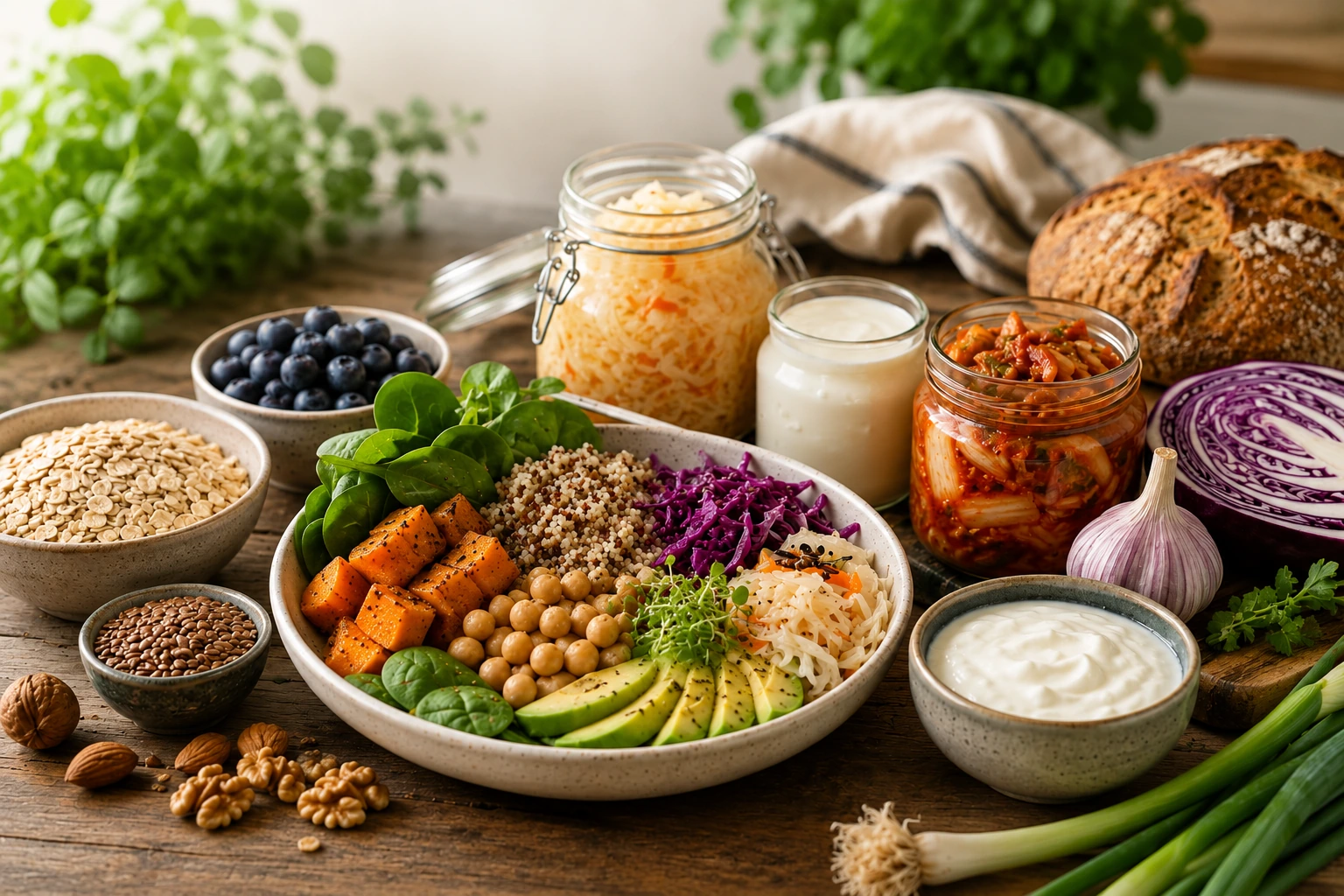
It is better to see the microbiome not as a trend, but as an environment. It likes repetition, variety, gentleness, and time. It does not need heroic detoxes, but ordinary kitchen food: vegetables, legumes, grains, greens, berries, nuts, seeds, fermented foods, slow meals, warm dishes, and a normal dinner rhythm. In that sense, beauty in cooking is born where food supports the body, rhythm, and a sense of safety. Not in restrictions, not in strict lists of “allowed” and “forbidden,” but in how food helps the body return to a state where it can recover more easily.
How the gut microbiome and the skin are connected
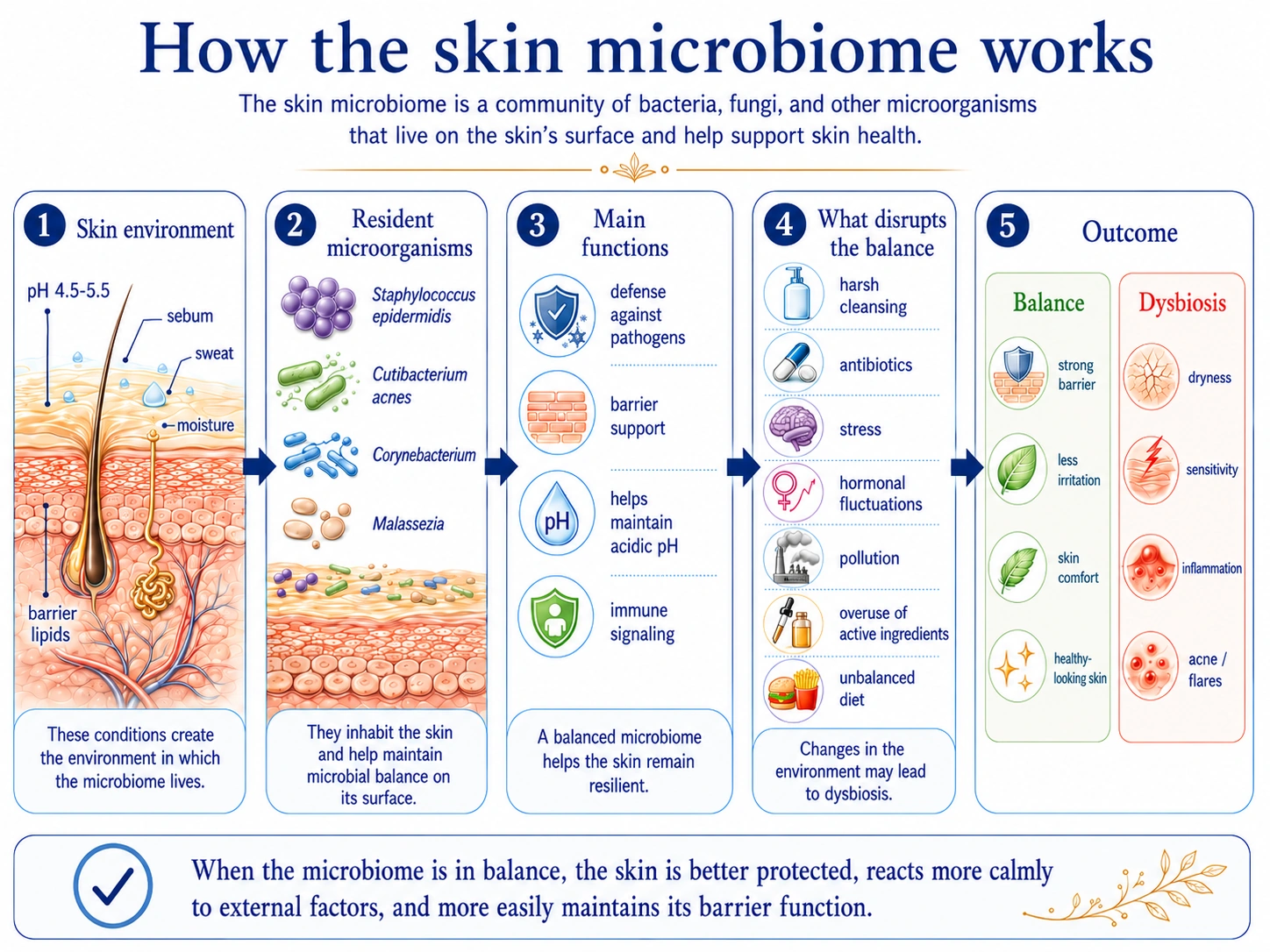
When people talk about the microbiome, they usually mean the gut. And that makes sense: this is where a huge number of microorganisms live, interacting with food, the mucosal lining, immune cells, and metabolic byproducts. But the skin has its own microbiome too. On its surface live bacteria, fungi, viruses, and other microorganisms that are not enemies under normal conditions. They are part of the skin’s ecosystem.
That is why a healthy way of looking at skin today no longer comes down to the idea of “cleaning everything to sterility.” On the contrary, the idea that skin needs balance is becoming more and more important. It needs cleansing, but not aggressive stripping. It needs hygiene, but not constant destruction of its protective film. It needs care, but not an endless attack of actives. In this sense, it is important to remember why the balance of the skin microbiome matters more than sterility.
There is no direct magical tube between the gut and the skin. But there is a complex system of connections: immune signals, microbial metabolites, the state of the gut barrier, the level of systemic inflammation, and hormonal and nervous system responses. This is often called the gut-skin axis. It should not be imagined as a simple formula of “eat this, get that skin.” It is more like a network in which one part of the body influences the overall tone of another.
Most often, the gut-skin axis is discussed in the context of conditions where inflammation, barrier function, and immune response play a noticeable role: acne, atopic dermatitis, psoriasis, rosacea, and increased skin reactivity. This does not mean that all of these conditions “come from the gut.” A more accurate way to say it is this: the gut ecosystem may be one of the factors that shape the body’s overall inflammatory background, the sensitivity of its barrier systems, and how easily it returns to balance.
Fiber for the microbiome: why diversity matters
Fiber is often talked about too mechanically, as if it simply “cleans out” the gut. In reality, its role is more subtle. Some dietary fibers are not digested by our enzymes, but they become a substrate for gut bacteria. When microorganisms ferment certain types of fiber, they produce short-chain fatty acids, including acetate, propionate, and butyrate. These are linked to support for the gut barrier, immune regulation, and metabolic processes.
For the skin, this matters not because butyrate “smooths wrinkles” or fiber “treats acne.” Those would be exaggerated claims. What matters is something else: skin does not live separately from the body. If nutrition supports the gut ecosystem, if it becomes easier for the body to maintain barrier and immune balance, the skin may receive a calmer background for recovery. This is especially important for people whose skin reacts to stress, lack of sleep, sharp dietary swings, alcohol, excess ultra-processed food, or chronic overload.
Fiber is not all the same either. There are soluble and insoluble fibers, more fermentable and less fermentable ones, gentler and rougher forms for digestion. Oatmeal, buckwheat, lentils, beans, chickpeas, apples, berries, greens, cabbage, carrots, beets, flaxseeds, chia, nuts, whole grains — this is not “one nutrient,” but an entire spectrum of structures, textures, and substances. The microbiome does not love the perfect superfood. It loves diversity.
Prebiotics, probiotics, and postbiotics: what is the difference
Fiber and some plant compounds can work as prebiotic support, meaning they serve as a substrate for microorganisms. Probiotics are live microorganisms that, in certain amounts, may have a beneficial effect, but their action depends on the specific strain, the dose, and the person’s condition. Postbiotics are not the live bacteria themselves, but the products of their activity or their components, which may also influence barrier and immune processes.
In an everyday kitchen, this does not mean you need to buy complicated supplements. Often the first step is simpler: give the microbiome more varied plant foods, do not disrupt digestion with drastic experiments, and do not expect a single product to have a therapeutic effect. The microbiome responds better not to rigid control, but to an environment that repeats day after day.
Why diversity matters more than heroics
When someone suddenly decides to “heal the microbiome,” they often do it too intensely: lots of raw vegetables, lots of legumes, lots of bran, lots of fermented foods, lots of supplements. The body may answer with bloating, discomfort, heaviness, and a sense of chaos. And then a useful idea turns into yet another stress.
The kitchen logic of the microbiome is gentler. It is not about a feat, but about gradually expanding the plate. Add greens to a dish. Replace some white bread with whole grain. Cook lentils not as “healthy food,” but as a warm, thick dish with olive oil, spices, and lemon. Add a little fermented vegetables to dinner, if they are well tolerated. Keep pleasure in the diet, but give the body more material to work with.
This is exactly where it matters how to talk about food and skin without inflated beauty promises. Food does not replace a dermatologist, a cosmetologist, treatment, or грамотний догляд. But it creates the background. And sometimes the background matters more than it seems.
Fermented foods and skin: where the benefits are and where the exaggeration begins
Fermented foods are appealing precisely because they carry a sense of life. Kefir, yogurt with live cultures, sauerkraut, kimchi, miso, tempeh, kombucha, naturally fermented vegetables — these are foods whose flavor is shaped by the work of microorganisms. The tang, the light heat, the depth, the aroma, the more complex texture — none of this is accidental, but the result of transformation.
But precision matters here too. Not every fermented food contains live microorganisms at the moment you eat it. If a product has been pasteurized, strongly heated, or technologically processed after fermentation, the live cultures may have been destroyed. Some products have a fermented taste but do not function as a source of live bacteria. And that does not make them “bad.” It simply means they should not be credited with something they cannot provide.
Research on fermented foods shows some interesting things: for some people, regular consumption of different fermented foods may be associated with changes in microbial diversity and immune markers. But this does not mean every person needs the same amount of kefir, kimchi, or kombucha. The microbiome is individual. Digestive reactions are individual. Food culture is individual too.
Fermented does not have to mean exotic
There is a lot that feels new in the word “microbiome,” but in the kitchen there is a lot that is old. Sauerkraut, cultured dairy, starters, fermented vegetables, aged flavors — these are not an Instagram invention. They are ways of preserving food, softening it, deepening flavor, and working with seasonality. In different cultures, fermentation was not a beauty strategy, but part of survival and domestic wisdom.
So fermented foods do not have to look like a trendy ritual. They can be a small sour accent on the plate. A spoonful of yogurt sauce. Kefir alongside a simple dinner. Fermented vegetables next to a warm dish. Miso in soup, if that feels natural in your kitchen. Their strength is not in exoticism, but in regular, quiet presence.
The kitchen influences more than the composition of food — it also shapes how food is prepared
In microbiome conversations, it is easy to get stuck on lists: what to eat, what not to eat, where there is more fiber, where there are more bacteria. But the kitchen is not a spreadsheet. The same product can be experienced differently by the body depending on how it is cooked, what it is paired with, its temperature, the amount of fat, the spices, the timing of the meal, and even the state of the nervous system.
Boiled lentils in a warm soup and a dry protein-and-fiber bar are different bodily experiences. Roasted beets with oil and nuts are not the same as a glass of beet juice on an empty stomach. Homemade porridge with berries and seeds is not the same as sugary cereal with a marketing promise of “high fiber.” For the microbiome, not only nutrients matter, but the context of eating.
That is why the topic of glycation naturally appears alongside the microbiome. It reminds us why the way food is prepared matters no less than the list of products. Not to make us fear fried food, sweets, or a browned crust, but to understand this: the body reads not a single ingredient, but the entire food scenario.
What this can look like in an ordinary kitchen
Warm buckwheat with mushrooms, greens, and a spoonful of fermented vegetables. Lentil soup with carrots, onions, spices, and olive oil. Yogurt sauce with roasted vegetables. Oatmeal with berries, flaxseeds, and nuts. A salad not as a cold obligation, but as part of the plate next to protein and a warm dish.
There is nothing directly “therapeutic” about these combinations. Their strength is that they are repeatable, tasty, and varied enough that the body does not experience care as yet another regime of control. For the microbiome, this often matters more than a random “perfect” product that appears in the diet once a month.
What this means for the skin
Skin is a boundary organ. It is constantly negotiating with the outside world: temperature, sun, wind, microorganisms, cosmetics, fabric, water, air. The gut is also a boundary organ. It negotiates with food, bacteria, metabolites, and the immune system. Both barriers do more than simply “protect.” They recognize, allow, restrain, respond, calm down, or become inflamed.
When the diet is poor in plant diversity, when it contains a lot of ultra-processed foods and little substrate for beneficial microbial activity, that may not show up on the face immediately. But the body may lose part of the support it needs for normal barrier and immune function. In some people this shows up in digestion. In others, in energy. In others, in more reactive skin. In some it may not appear obviously at all, but still remain part of the overall background.
At the same time, it is important to say honestly: there is no universal “diet for beautiful skin.” Acne, rosacea, atopic dermatitis, seborrheic dermatitis, psoriasis, sensitivity, dryness, barrier disruption — these are different conditions with different mechanisms. Diet may be one factor, but not the only cause and not the only answer. For some people, glycemic load, dairy, alcohol, deficiencies, stress, sleep, medications, hormonal fluctuations, skincare, climate, and genetics will matter. The microbiome does not cancel complexity. It simply adds another layer of understanding.
What to eat to support the microbiome without a rigid diet
In practical terms, the strongest idea behind the microbiome is very simple: feed not only yourself, but also the environment inside you. Not aggressively. Not perfectly. Not in a “new life starts Monday” mode. But in a way that gradually makes the plate richer.
Such a plate has several anchors. A plant part — not as decoration, but as real volume: vegetables, greens, legumes, grains, berries, fruit, seeds. Protein, because the skin, the immune system, and recovery need building material. Fats, which make food satisfying, help absorb fat-soluble compounds, and keep nutrition from turning into a dry discipline. A sour or fermented accent, if it suits digestion. And flavor, because without flavor no long-term strategy survives.
This is not a menu or a set of rules. It is more a way of looking at food. If the plate includes different plant fibers, textures, colors, and both warm and fresh elements, the body gets more options for microbial work. If the diet consists only of refined carbohydrates, sweet snacks, little plant food, and lots of chaotic gaps, it becomes harder for the microbiome to maintain diversity.
When the body needs not perfect food, but a calmer rhythm
The microbiome does not live separately from the nervous system. Stress changes digestion, appetite, gut motility, cravings for sweet or fatty foods, and the ability to feel full. And the opposite is also true: chaotic eating can reinforce a sense of inner instability. That is why the kitchen works not only through nutrients, but also through rhythm.
When a person cooks, chops, touches ingredients, smells aromas, hears the sound of water, sees steam rising from a pot, the body receives a signal of presence. This is not a romanticization of domestic life. It is a simple sensory fact: food begins not at the moment of swallowing, but earlier. In this sense, it matters how cooking brings the body back into presence through hands, smells, and warmth.
Dinner is especially sensitive to this. A late heavy meal, rushing, alcohol, sweets against a background of fatigue, endless grazing in front of a screen — none of this is “bad behavior,” but often the nervous system’s way of looking for quick soothing. But sometimes a gentler, warmer, more predictable dinner helps the body shift into a different mode. Not to fall asleep “correctly,” but at least not to remain in daytime tension. This is exactly where it is worth remembering how dinner can help the nervous system transition into recovery.
Fermented foods, fiber, and sensitive skin: without forcing the body
Some people find fermented foods pleasantly supportive. Others react to them with bloating, heartburn, headaches, flare-ups of discomfort, or simple aversion. Some people can easily increase legumes. Others need a very gradual adaptation. Some tolerate cultured dairy perfectly well, and some do not.
There is no moral judgment in that. The microbiome is not an exam in doing things correctly. If a product is considered healthy but your body consistently responds to it badly, that does not mean you should “endure it for the sake of health.” The body does not like coercive strategies, even when they are beautifully described in popular science texts.
People with pronounced digestive disorders, irritable bowel syndrome, flare-ups of inflammatory bowel disease, histamine sensitivity, complex allergic reactions, or conditions where diet is better selected with a doctor should be especially careful. In such cases, “more fiber” or “more fermented food” may be advice that is too blunt. Sometimes what is needed is not general trends, but an individual plan.
The beauty direction without a cult of purity
For beauty culture, the microbiome matters for another reason too: it changes the language of skincare. We are gradually moving away from the fantasy of skin as a surface that must be endlessly cleansed, polished, stimulated, renewed, and controlled. Skin is more like a living ecosystem. It can be strong, but vulnerable. It can tolerate actives, but still need pauses. It can love retinoids, acids, SPF, and professional care, yet still suffer from lack of sleep, stress, a damaged barrier, and a poor nutritional background.
For skincare, this means a simple shift in focus. We are not only choosing a cream “for dryness” or a serum “for glow,” but looking at skin as an organ that lives in constant dialogue with the body. If the barrier is irritated, the nervous system is overloaded, sleep is unstable, and the diet is poor in plant diversity, even good cosmetics may be working against a more difficult background. And vice versa: when external care, food, and rhythm do not conflict with one another, the skin has an easier time responding to support.
That is why the microbiome connects cooking, health, and the beauty direction so well. It does not take attention away from cosmetics. It simply shows that cosmetics work on skin that belongs to the whole body. A cream can support the barrier from the outside. Food can support the internal environment. Sleep can reduce overload. Ritual can restore a sense of safety. And none of these things compete with one another.
A mature beauty logic does not promise that fiber will “clear the skin” or that fermented foods will “bring back the glow.” It says something more precise: varied plant food, carefully introduced fermented foods, sleep, skincare, and a stable rhythm can together create a calmer environment for the skin. It is less loud. But much more honest.
The microbiome begins not with a supplement, but with a repeated gesture
The most interesting thing about the microbiome is that it brings us back to very simple things. To a bowl of soup. To sauerkraut next to a warm dish. To porridge you are not embarrassed to love. To lentils that become delicious not because they are healthy, but because of spices, oil, lemon, and time. To berries, greens, seeds, bread that has structure. To yogurt sauce that makes vegetables not an “obligation,” but delicious food.
The microbiome begins in the kitchen not because the kitchen heals everything. But because that is where the body receives a repeated daily signal: we are not at war with you. We are feeding you. We are giving you diversity. We are not demanding instant results. We are creating conditions in which the skin, the gut, the nervous system, and immune balance can work together a little more easily.
Sometimes this is exactly where mature beauty logic begins: not with the desire to fix the skin quickly, but with the ability to create an environment in which the body does not have to defend itself all the time.
References
- World Health Organization. Healthy diet. Fact sheet. 2026.
- World Health Organization. Carbohydrate intake for adults and children: WHO guideline. 2023.
- Hill C. et al. Expert consensus document: The International Scientific Association for Probiotics and Prebiotics consensus statement on the scope and appropriate use of the term probiotic. Nature Reviews Gastroenterology & Hepatology. 2014.
- Gibson G. R. et al. Expert consensus document: The International Scientific Association for Probiotics and Prebiotics consensus statement on the definition and scope of prebiotics. Nature Reviews Gastroenterology & Hepatology. 2017.
- Salminen S. et al. The International Scientific Association of Probiotics and Prebiotics consensus statement on the definition and scope of postbiotics. Nature Reviews Gastroenterology & Hepatology. 2021.
- Wastyk H. C. et al. Gut-microbiota-targeted diets modulate human immune status. Cell. 2021.
- Leeuwendaal N. K. et al. Fermented Foods, Health and the Gut Microbiome. Nutrients. 2022.
- Vinelli V. et al. Effects of Dietary Fibers on Short-Chain Fatty Acids and Gut Microbiota. Nutrients. 2022.
- Liu X. et al. Regulation of short-chain fatty acids in the immune system. Frontiers in Immunology. 2023.
- Mahmud M. R. et al. Impact of gut microbiome on skin health. Gut Microbes. 2022.
- Jimenez-Sanchez M. et al. The gut-skin axis: a bi-directional, microbiota-driven communication system. 2025.
- Harvard T.H. Chan School of Public Health. The Microbiome. The Nutrition Source.
- Meixiong J. et al. Diet and acne: A systematic review. JAAD International. 2022.