







Summer skincare rarely calls for replacing every product you own. More often, the problem is not the season itself, but the fact that a winter or spring routine is carried into summer without adjusting for heat, sweat, stronger sun, water, air conditioning and more frequent cleansing.
A cream that felt perfect in March may feel heavy in July. A serum that worked calmly in spring may suddenly start to sting after the sea or pool. An SPF that looked good in the city may feel sticky and hard to reapply at the beach. Skin looks shiny, yet feels tight after a shower. You want to wash your face again, add more mattifying products, remove actives — or, conversely, urgently “clear out the pores” with acids.
Summer does not ask you to leave only a cleanser and SPF on the shelf. But it quickly shows which steps have become unnecessary, which textures no longer work in a real day, and which products need a different frequency. In the season of sun and water, it is important to look not at one jar in isolation, but at the whole system: cleansing, hydration, sun protection, active formulas, textures and the way skin behaves between morning and evening.
What changes in summer, and why your usual routine may start giving different results
In summer, your skin type does not change. Oily skin does not turn dry, dry skin does not automatically become oily, and sensitive skin does not disappear just because the air is warmer. What changes are the conditions in which the skin has to maintain balance.
The sun affects exposed areas more intensely. Sweat stays more often on the face, neck, back and under the hair. SPF needs to be applied in a sufficient amount, not as a symbolic thin layer. Sea or chlorinated water, towels and showers add mechanical and chemical stress. Air conditioning abruptly changes the microclimate: after heat, the skin enters cooler, drier air.
Against this background, a familiar routine may become too rich, too active or simply inconvenient. Sometimes the issue is not one product, but the sequence: cleansing “until squeaky clean,” several serums, day cream, SPF, makeup, repeated powdering, an evening retinoid and an acid toner every other day.
Summer skincare begins with a simple question: what exactly is preventing the skin from staying calm right now?
Shine does not always mean the skin does not need hydration
In summer, it is easy to read shine as proof that the skin needs more mattifying, stronger cleansing and less hydration. But sweat, sebum and water in the stratum corneum are different things. The face may look shiny while the skin is holding on to moisture less effectively.
That is why tightness can appear after washing, lightweight textures may feel comfortable for only a few minutes, and richer ones may seem like an unnecessary film. Aggressive cleansing in this situation can briefly make the surface feel drier, but it does not restore lasting comfort to the skin.
This summer contradiction deserves a closer look: why skin can simultaneously shine, feel tight, react more sharply to cosmetics and tolerate water, heat and air conditioning less well. Read more in our article on oily and dehydrated skin in summer.
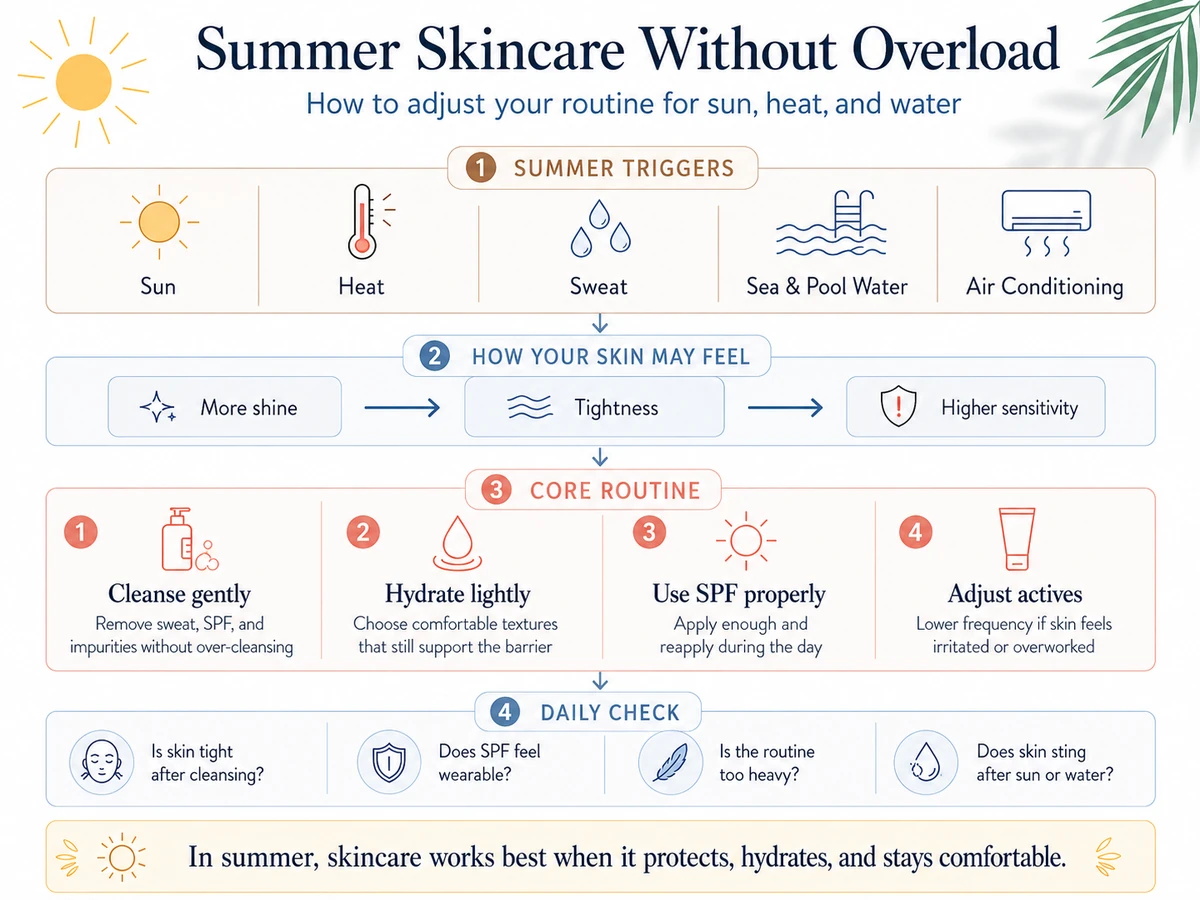
The basic summer routine: cleansing, SPF and textures without unnecessary layers
Cleansing should remove excess, not leave the skin defenseless
In the heat, the urge to wash your face appears more often. Sweat, sebum, SPF, dust, makeup and hand contact all mix on the skin. But there is a big difference between “rinsing off sweat” and “doing a full multi-step cleanse every time.”
After a short walk, water or a very gentle cleanser may be enough. After a workout, a generous layer of SPF and makeup, cleansing should be more thorough. Water-resistant sunscreen may need a first removal step in the evening, but that does not make double cleansing mandatory every morning or after every trip outside.
The main test happens not during washing, but a few minutes afterward. If the skin stays tight for a long time, burns or immediately needs several layers of skincare, the cleansing was too harsh and gentler products are needed.
A summer routine works better when cleansing removes what is unnecessary without leaving the skin exposed. This is especially important if acids, retinoids or other active formulas remain in your routine.
SPF needs to be wearable in real life
Sun protection is the central element of summer skincare. But this is where the gap between recommendation and reality often appears. Someone buys a good SPF, applies too little, does not reapply after sweat or water, and then decides the product “didn’t work.”
SPF behaves differently in the city, at the beach, on the road, after the pool and during a walk. The amount, evenness of application, water resistance, towel friction, sweat, makeup and whether you actually want to reapply the product all matter.
That is why in summer it is worth choosing not only the “most powerful” formula, but also one you can realistically wear in a sufficient amount. If a product is sticky, white, pills or clashes with the rest of your skincare, almost everyone ends up applying less than they need.
All the practical details — how much to apply, when to reapply, what to do near water, how not to forget the ears, lips, parting and backs of the hands — are better covered in a separate guide. That is exactly what our article on SPF in the city, at the beach and near water is about.
In summer, texture becomes part of effectiveness
In the cold season, skin often tolerates rich creams, dense emulsions and several layers of skincare more easily. In the heat, the same sequence can feel like an unnecessary film. The morning routine starts to conflict with SPF, and SPF conflicts with makeup or reapplication.
Lightening the routine does not mean stripping it back to nothing. A lightweight texture should not be empty. The skin may still need hydrating ingredients, emollients, ceramides or soothing formulas — just in another format: not three similar layers, but one clear and comfortable one.
A product that feels unpleasant on the skin is hard to use consistently. So sensoriality is not a minor whim; it is part of real adherence to skincare.
That is why in summer it is important to notice not only the ingredient list, but also how the product sits on the skin: the finish, stickiness, fragrance, the feeling of a film or of comfort. We explored this separately in our article on sensory skincare and how skin experiences cosmetics.
Where overload happens most often: actives, water and air conditioning
Actives do not always have to be stopped, but they need to fit the season
Summer does not automatically require removing all acids, retinoids and vitamin C. At the same time, it reveals routine mistakes faster. If the skin is already irritated by sun, water, sweat and frequent cleansing, a familiar concentration may become harder to tolerate.
New products require particular caution. Starting a strong retinol, an at-home peel or a new acid serum a few days before vacation is not the best scenario. The skin has not had time to adapt, while sun exposure is already increasing.
Vitamin C should not be romanticized either. An antioxidant serum can be a useful part of a morning routine, but it does not replace SPF, is not water-resistant and does not make up for skipped sunscreen reapplication after swimming.
Acids, retinoids and vitamin C each have different rules, so they deserve a separate conversation. We go into detail on what to keep, what to reduce and when to pause in our article on acids, retinoids and vitamin C in summer.
The sea, pool and shower are not just “water”
In summer, the skin comes into contact with water more often, but that does not always mean more hydration. Sea water, the pool, a shower after the beach, hot hotel water, a towel and repeated cleansing can all add up to stress on the barrier.
It is important to remember that the sea is not a universal treatment for breakouts. A pool is not always harmful, but for sensitive or atopic skin it can become an additional irritant. A hot shower after the heat may feel pleasant, but it can easily increase dryness and tightness.
After water, it is better to blot the skin rather than rub it. If the day in the sun continues, SPF needs to be reapplied. In the evening, it is important to remove water-resistant products without scrubs or aggressive friction, then restore comfort with basic skincare.
The point is not to fear the sea or the pool. The point is to see the whole chain: water, towel, sun, sweat, SPF, cleansing and hydration.
Air conditioning can change the skin’s needs within a few hours
A summer day often takes place between two environments. Outside, it is hot, the skin shines and sweat evaporates more slowly. A few minutes later, you enter a cool office, car or hotel room where the air is drier and the airflow may be directed straight at the face.
That is why a mattifying morning routine that seems logical on the way to work can lead to tightness around the mouth, cheeks and eyes a few hours later under air conditioning. Sometimes the problem does not start with the air conditioner itself, but with morning cleansing and an insufficient hydrating layer under SPF.
Mists and thermal water can refresh briefly, but they do not always solve the issue of retaining moisture. They do not replace a formula that supports the barrier, and they do not correct cleansing that is too harsh.
It is better to read a summer day by its stress load, not by the calendar
The office, beach, workout, commute, pool and evening under air conditioning do not require the same routine. A summer routine should respond not to the name of the day in your planner, but to what the skin has already gone through and what still lies ahead.
On an ordinary city morning, gentle cleansing, a comfortable hydrating layer and SPF are often enough. If several serums and creams create stickiness, it is worth keeping only what has a clear separate function.
Near water, the priorities are sun protection, shade, clothing, rinsing after the sea or pool and calm evening cleansing. After a workout, it is better to blot and rinse away sweat, and if the day continues outdoors, restore sun protection. Under air conditioning, the skin may not need stronger mattifying, but gentler cleansing and more stable hydration.
The schedule for actives should also take the day into account. After the beach, overheating or a long walk, an evening without acids or a retinoid often gives the skin more than formally completing the routine at any cost.
When to simplify your routine, and when to seek advice
When the skin starts reacting, the first instinct is often the opposite of what is needed. You want to add a soothing serum, mask, mist, richer cream or another “barrier” product. Sometimes this helps. But if the cause is overload, a new layer only makes the routine more complicated.
Signs that your routine should be simplified:
- burning after water or a neutral cream;
- persistent redness after cleansing;
- flaking that worsens after every active product;
- a film-like feeling from multiple layers;
- being unable to apply SPF in a sufficient amount because of stickiness;
- a situation where the skin is shiny and constantly tight at the same time.
In these cases, it is more logical to keep only gentle cleansing, basic hydration and sun protection for a few days, then reintroduce actives gradually. If tingling becomes regular or appears with products that previously caused no reaction, it is worth checking the signs that help distinguish normal tingling from a signal to stop.
Not every summer skin reaction can be explained by heat or an unsuitable SPF. If a rash is painful, itchy, spreading quickly, accompanied by swelling, weeping, cracks or persistent burning, it is better not to experiment with new products.
This is how contact dermatitis, folliculitis, an acne flare, rosacea, atopic dermatitis or a reaction to a specific ingredient can appear. Skin that already had a low tolerance threshold before summer needs particular attention.
If this sensitivity did not appear only in summer, but gradually became the new normal, it is worth reading our separate article on reactive skin after 35–40.
Good summer skincare is not just a light cream and SPF. It takes into account how a person actually lives during the season: how much time they spend outdoors, whether they swim, exercise, sit under air conditioning, use actives, can reapply sunscreen, and truly tolerate the texture they have chosen.
One unnecessary layer can matter more than it seems. Sometimes it is worth changing your cleanser; sometimes, keeping the retinoid but reducing the frequency; sometimes, taking a pause after the beach instead of following the evening schedule at any cost.
A summer routine does not need to defeat the heat. It needs to leave the skin with enough protection, moisture and breathing room between the sun, water and everyday life.
Sources
- American Academy of Dermatology Association. Sunscreen FAQs.
- American Academy of Dermatology Association. Retinoid or retinol?
- American Academy of Dermatology Association. Face washing 101.
- Green M., Kashetsky N., Feschuk A., Maibach H. I. Transepidermal water loss: environment and pollution — a systematic review. Skin Health and Disease. 2022;2(2):e104.
- Engebretsen K. A., Johansen J. D., Kezic S., Linneberg A., Thyssen J. P. The effect of environmental humidity and temperature on skin barrier function and dermatitis. Journal of the European Academy of Dermatology and Venereology. 2016;30(2):223–249.