

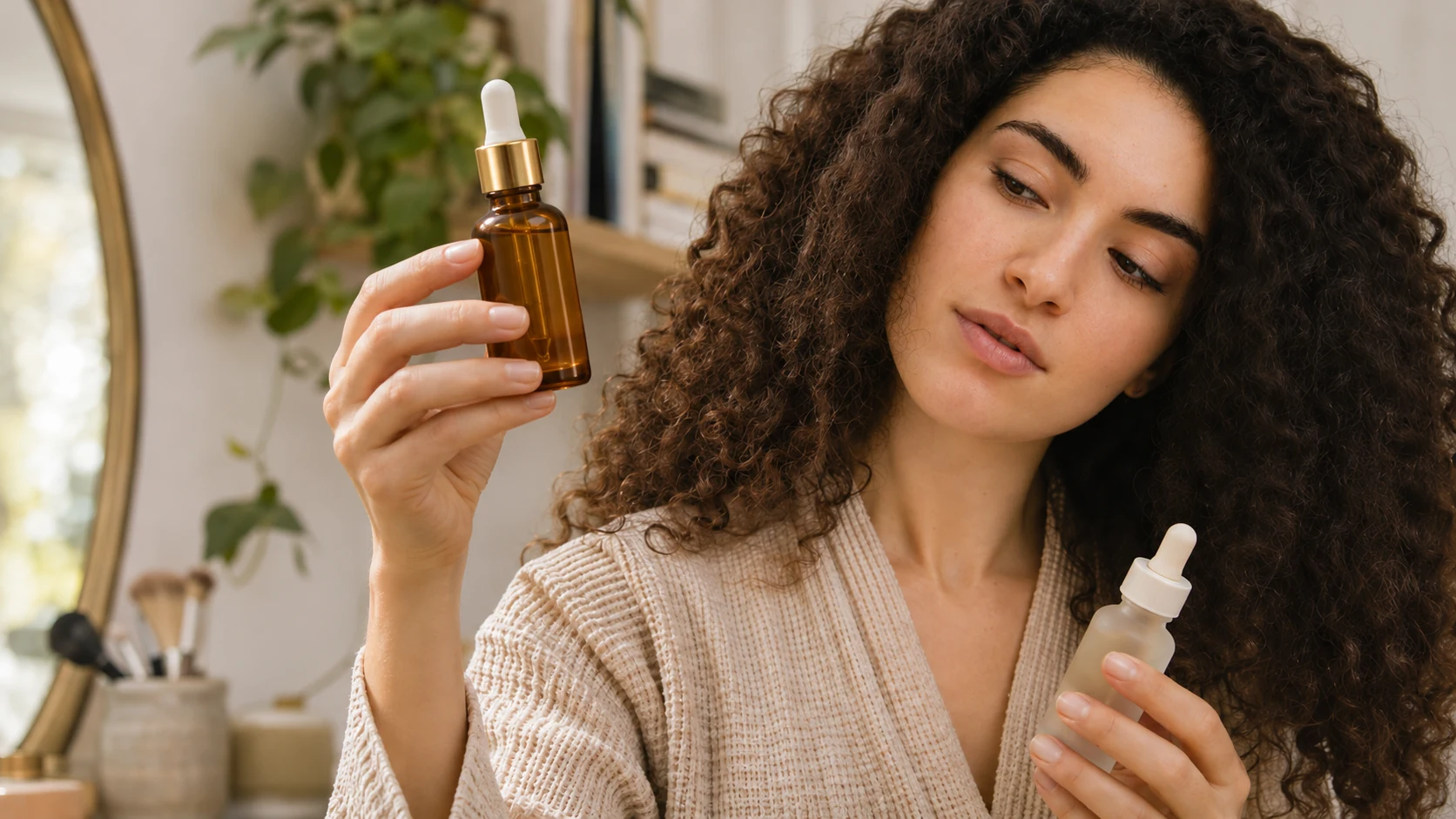
Not so long ago, we were patiently teaching our skin to tolerate retinol. We started with a low concentration, used it twice a week, found the right moisturizer, and celebrated when our face finally stopped reacting to every application. And now, just as our relationship with retinol has settled down, the beauty industry is offering a new favorite: retinal. It is appearing in serum names, being positioned as an upgraded retinoid, and promising the kind of results we once bought retinol for. A familiar story: the moment you find a good product, you start suspecting that something better is already out there.
Still, it would be unfair to write it all off as marketing. Retinal does have some compelling advantages: high biological activity, good results at low concentrations, and favorable tolerability. Modern technologies also make it possible to use these properties in cosmetic formulas. The thing is, there is a considerable distance between a promising ingredient appearing on the market and the need to urgently overhaul your skincare shelf.
How retinal became skincare’s new star
This “new” ingredient has one interesting feature: it is not actually new at all. Retinal, or retinaldehyde, has been studied for decades. It belongs to the same retinoid family as the much more familiar retinol. Both are used in cosmetics to improve skin texture, reduce fine lines, and address other signs of photoaging.
One of retinal’s key advantages lies in its chemical structure. Retinol first has to convert into retinal, and only then into retinoic acid, the form that triggers the relevant processes in skin cells. Retinal is one step closer to that active form. And this is not just a neat advertising line: studies confirm its biological activity even at low concentrations.
For example, 0.05% retinal in clinical studies improved skin texture and hydration, while 0.1% showed additional activity against uneven pigmentation. Both concentrations were well tolerated. So the interest in retinal has a very real scientific basis.
Why all the attention now? Part of the answer lies in advances in cosmetic technology. Retinal, like retinol, is sensitive to light, oxygen, and temperature. Modern stabilization and delivery systems help protect the active ingredient and make it possible to create products suitable for regular use.
But the industry needs more than good formulas. It needs novelties people can talk about, test, and compare. Ideally, the advantage of a new product should fit into one sentence. Retinal has exactly that: “One step closer to the active form than retinol.” Sounds convincing, doesn’t it? And the customer starts wondering whether it might be time to replace a trusted serum with something more current.
What brands promise — and what is worth checking
There are plenty of true claims in retinal advertising. The problems begin when those claims are stretched into conclusions that research has not yet confirmed. Let’s separate the ingredient’s real advantages from the especially bold promises.
“Faster than retinol”
Retinal is indeed closer to retinoic acid in the chain of biochemical conversions. In addition, in a direct eight-week clinical comparison, a specially developed retinal formula delivered better results than a retinol formula across most assessed parameters: wrinkle depth, hydration, elasticity, and facial contours.
That is no longer just a theoretical advantage. Retinal showed good results in a human study.
However, “better results after eight weeks” and “wrinkles disappear faster” are not the same thing. To claim that an ingredient always works faster, we need the right comparative data. Skin does not operate like express delivery, where a shorter route automatically guarantees a faster outcome.
“0.05% retinal replaces a much higher concentration of retinol”
This is where retinal really does have an interesting feature. It shows noticeable biological activity at just 0.05%, and in photoaging studies this concentration improved texture and hydration. In a direct comparison with retinol, retinal also demonstrated high efficacy.
So a small number on the label should not put you off. For retinal, 0.05% is not necessarily a weak product; it can be a perfectly effective concentration.
But marketing formulas such as “0.05% retinal equals 0.5% retinol” should be considered separately from these findings. There is no universal conversion rate between the two ingredients. If a brand promises a tenfold advantage, it is reasonable to ask which exact parameter was used to calculate it.
A detailed review of clinical studies, concentrations, and direct comparisons between retinal and retinol is available in the article “Retinal or retinol: which is more effective for the skin, and is it worth changing your routine?”.
“New-generation encapsulated retinal”
The word “encapsulated” sounds convincing, especially alongside images of microscopic spheres and complex technological names. And the technology really can be useful. Encapsulation helps protect a sensitive molecule from degradation, may improve delivery, and can influence how the product interacts with the skin. For retinal, whose stability was long one of the technological challenges, this is an important direction of development.
So encapsulation is not just a buzzword. The question is how well it has been executed. If a brand explains its proprietary delivery system and shows testing results for the finished product, that is far more interesting than an abstract promise of “future technology.” Sometimes less impressive packaging with concrete data on the formula deserves more trust than a luxury bottle with a long list of technical terms.
“Powerful results without irritation”
This is probably the most desirable promise for anyone who has ever woken up red-faced after a failed first encounter with retinoids.
And here retinal does bring good news. Its ability to combine visible activity with good tolerability has been confirmed in clinical studies. In particular, creams with 0.05% and 0.1% retinal were well tolerated during a three-month trial. And in a study published in 2026 involving 56 women over 24 weeks, only one case of irritation was reported.
This is one reason retinal is appealing for regular anti-aging care: it can deliver visible results without an obligatory period of pronounced peeling and redness. Does that mean retinal is gentler than retinol? In studies, both ingredients have shown good tolerability, and no convincing overall advantage for retinal has been established specifically on this point. Compared with prescription retinoic acid, however, retinal has a much more favorable irritation profile.
So the promise of a good balance between efficacy and comfort is well founded. But the words “no irritation” on the packaging still should not be taken literally: dryness, peeling, and stinging can occur, especially at the beginning.
How to read packaging claims
Four questions worth asking before you buy.
“10 times stronger”
Compared with what, and by which measure?
“Encapsulated”
Is there data on the efficacy of the finished formula?
“No irritation”
Who was tolerability tested on, and for how long?
“New generation”
What exactly has changed in the product?
Can you identify a good formula by the label?
Not always. But a few details can help you filter out questionable offers.
Let’s start with concentration. For retinal, there is already clinical data on the efficacy and good tolerability of 0.05% and 0.1%. So a brand does not need to offer the highest possible percentage to create an effective product. And the buyer does not need to automatically assume that 0.1% is twice as good as 0.05%.
Packaging matters too. Opaque tubes, bottles that limit air exposure, and well-considered storage conditions are especially relevant for retinoids that are sensitive to light and oxygen. A transparent jar that is opened repeatedly makes you want to look more closely at the brand’s stability claims.
Another point is the supporting ingredients. Moisturizing and softening components can help the skin tolerate retinoid care more comfortably. But a long list of actives in one formula does not necessarily make it better. Sometimes a simpler composition is the smarter choice.
Finally, price. Retinal can cost more because of the specifics of production, stabilization, and packaging. But a higher price alone does not prove better efficacy. If the price difference is significant, it is perfectly reasonable to ask what exactly you are paying for.
Who should actually try retinal
In a beauty store, all these technological details eventually come down to a simple question: buy the new serum or stick with the old one?
You have been using retinol for a long time and are happy with your skin. Fine lines look less noticeable, your complexion appears smoother, and there is no dryness. In this case, retinal probably does not need to be treated as a mandatory next step. Retinol did not stop working just because a new competitor appeared.
You are only about to try retinoids. You do not have to start with retinol. 0.05% retinal can also be a good first option. It has confirmed activity at this concentration, and studies show good tolerability. What matters far more is not trying to get three months’ worth of results in the first week. If your skin is already irritated or very dry, it is better not to rush into retinoids.
You have used retinol, but the results were underwhelming. This is where trying retinal becomes genuinely interesting, especially if uneven texture, fine lines, or signs of photoaging are your main concerns. There is clinical data showing its high efficacy, including the advantage of a specific retinal formula in a direct comparison with retinol. Before buying something new, though, it is worth remembering how long you used your previous product. If the serum was applied irregularly for three weeks, retinol may not have been the problem at all.
You have already had a bad experience with retinoids. Your skin peeled, stung, and moisturizer suddenly became the most important product in your routine. A well-tolerated retinal formula may be an interesting alternative. But if the previous product caused significant irritation, first reassess the concentration, application frequency, and combination of active products. If reactions are severe or keep recurring, it is better to consult a dermatologist.
There is also a fifth situation that should not be disguised as a scientific necessity: you simply want new skincare. There is nothing wrong with that. A pleasant texture, an interesting formula, the desire to try something different — these are all perfectly normal reasons to buy a product. Especially since retinal really does deserve attention, rather than merely having a good marketing campaign behind it.
Acne is worth mentioning separately. Retinal is also being studied for comedone-prone skin: a small study of a 0.05% nanoemulsion showed a reduction in comedones and sebum secretion over four weeks. This is another promising area of use. However, a cosmetic retinal serum is not a full substitute for prescription retinoids, including adapalene or tretinoin, when acne treatment is needed.
How to switch to retinal
It is best to introduce retinal gradually, even if you have already used retinol. Here is a simple approach to help you add the new product to your routine and reduce the risk of irritation.
Apply retinal 2 times a week to clean, dry skin, unless the manufacturer’s instructions say otherwise. Add moisturizer if needed.
Replace your previous retinol rather than layering two retinoids. In the first few weeks, set aside acid peels and other potentially irritating products.
If your skin tolerates it well, gradually increase the frequency of application. Pronounced dryness, stinging, or persistent redness is a sign to use it less often or take a break.
Every morning, use a broad-spectrum sunscreen with SPF 30 or higher. Peeling is not a sign that retinal is working.
Cosmetics with retinoids should not be used during pregnancy or when planning a pregnancy. If you are breastfeeding, discuss the use of retinal with your doctor.
If a brand promises a transformation in a few days, keep a healthy dose of skepticism. Retinoids need time. Early results are often assessed after 8–12 weeks of regular use, while changes in fine lines may take longer. This is a guideline for evaluation, not a guaranteed date when the effect will appear. A good idea is to take a photo of your face before starting and repeat it a few months later in similar lighting. Not so you can search for a new wrinkle every day, but so you can evaluate the result more objectively.
One more practical detail: do not start using retinal a week before a vacation, wedding, or another important event. Even a well-formulated product may require an adjustment period, and unexpected peeling is unlikely to be part of your plan.
Retinal is worth paying attention to not only because it has become fashionable. It is biologically active at low concentrations, has good clinical efficacy, and is generally well tolerated. These are solid reasons to consider it a serious alternative to retinol. But the next time an ad offers you a “new generation of skincare,” try asking a simple question: what exactly has improved — the ingredient, the formula, or the way it is being sold?