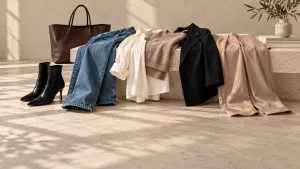



Your wardrobe may hold several pairs of good trousers, a dozen blouses, favorite jeans, dresses for different occasions, and a coat that has served you for years. Yet in the morning, the same familiar question still comes up: what should I wear? One pair of trousers has no suitable top, a dress is missing the right shoes, and a new blazer only really works with one skirt. There are plenty of clothes, but putting together a comfortable outfit is still difficult.
This is where a basic wardrobe helps. It is often presented as a ready-made list: a white shirt, a beige trench coat, black trousers, and a little black dress. But a woman who works from home and walks a lot needs completely different clothes from someone who goes to the office every day. And if you live in a warm climate for most of the year, it hardly makes sense to begin building your wardrobe with a cashmere sweater and a wool coat.
After 40, a wardrobe often contains pieces from different stages of life. A former job may have required business suits, then comfortable jeans and knitwear appeared, while dresses that used to be worn every week now wait for a special occasion. Tastes change too, as do expectations around fit, fabrics, and comfort. That is why building your own foundation should begin with how you live today. Let’s look at which pieces can form the basis of your wardrobe, how to choose them, and which purchases are truly worth investing in. If your main question is not about a set of clothes, but about how silhouettes and familiar proportions have changed, we have covered separately how to dress in a modern way after 40.
What Is a Basic Wardrobe, and Why Universal Lists Do Not Work
A basic wardrobe is made up of the clothes most of your everyday outfits rely on. They fit your lifestyle, combine well with other pieces, and are worn regularly. These might be jeans, straight trousers, several T-shirts, a shirt, a jumper, a blazer, and comfortable shoes. Or they may be mostly dresses, skirts, and cardigans, if that is what you genuinely like to wear.
What makes an item “basic” is its role in your wardrobe, not a specific cut or color. For one woman, dark blue jeans are the foundation of almost every day; for another, that role is played by wide-leg trousers. Some women wear a white shirt constantly, while others reach much more often for a blue, striped, or soft linen one.
The same applies to color. Black, white, and beige are indeed easy to combine with many shades, but a basic palette can also be built around navy, chocolate, gray, olive, or burgundy. What matters is that the colors you choose work well together and that you actually want to wear them.
A basic wardrobe is often confused with a capsule wardrobe. The difference lies in the purpose: a basic wardrobe forms the foundation of your clothing overall, while a capsule wardrobe brings together a limited set of pieces for a specific season or situation. For example, you can use your basic wardrobe to create a capsule for a workweek or a vacation. In a capsule, all or almost all items are usually planned in advance to work together. A basic wardrobe can be broader and include clothes for different weather and several areas of life. The main sign of a successful basic piece is how often it is worn. If a blazer waits for years for the right occasion, while jeans, a knitted jumper, and a shirt are constantly going back into the laundry, it is the latter that form the foundation of your real wardrobe.
To understand what that foundation consists of, simply look at your clothes without relying on someone else’s list: what do you wear every week, which items do you choose most often, and what is missing when you are getting ready to leave the house?
What Should Be in a Basic Wardrobe for Women After 40: A Practical List
The foundation of a wardrobe is built from several clothing categories. Below is a brief guide, followed by a closer look at the styles, materials, and fit details that matter when choosing them. If the proportions of your waist, hips, or bust have changed in recent years, a familiar cut may sit differently even in the same size. So when choosing the foundation of your wardrobe, assess the fit on your figure as it is today: compare waistband construction, length, and ease of movement, not just the number on the label.
Jeans and Trousers: The Foundation of Everyday Outfits
For a woman who wears jeans regularly, a practical starting point is one well-fitting pair for every day. Straight dark blue jeans without heavy fading are easy to wear with understated shirts, knitwear, and different shoes. If denim makes up a large part of your wardrobe, a second pair might be light blue jeans or a style in a different cut.
A straight cut is useful because of its neutrality, but it is worth trying other silhouettes too. Wide-leg jeans give more room through the hips and legs, bootcut styles have a slight flare toward the hem, and slimmer models may be a good choice for those who prefer more compact proportions. The deciding factor is how the jeans fit your particular figure.
When trying them on, sit down, bend over, and walk around. The waistband should not press too much into the stomach or gap at the waist. Pay attention to creases in the crotch area, the placement of the pockets, and how the fabric behaves at the knees. If jeans fit well through the hips but are slightly too big at the waist, it is sometimes easier to have the waistband adjusted by a tailor than to search for a perfect match in every measurement.
With trousers, the choice depends on your usual style. Straight styles with pressed creases work well for business and city wardrobes. Wide-leg trousers can be a comfortable alternative, especially when the fabric falls beautifully. Soft trousers with an elastic waistband suit an informal lifestyle, but here the quality of the fabric and the neatness of the cut are especially important.
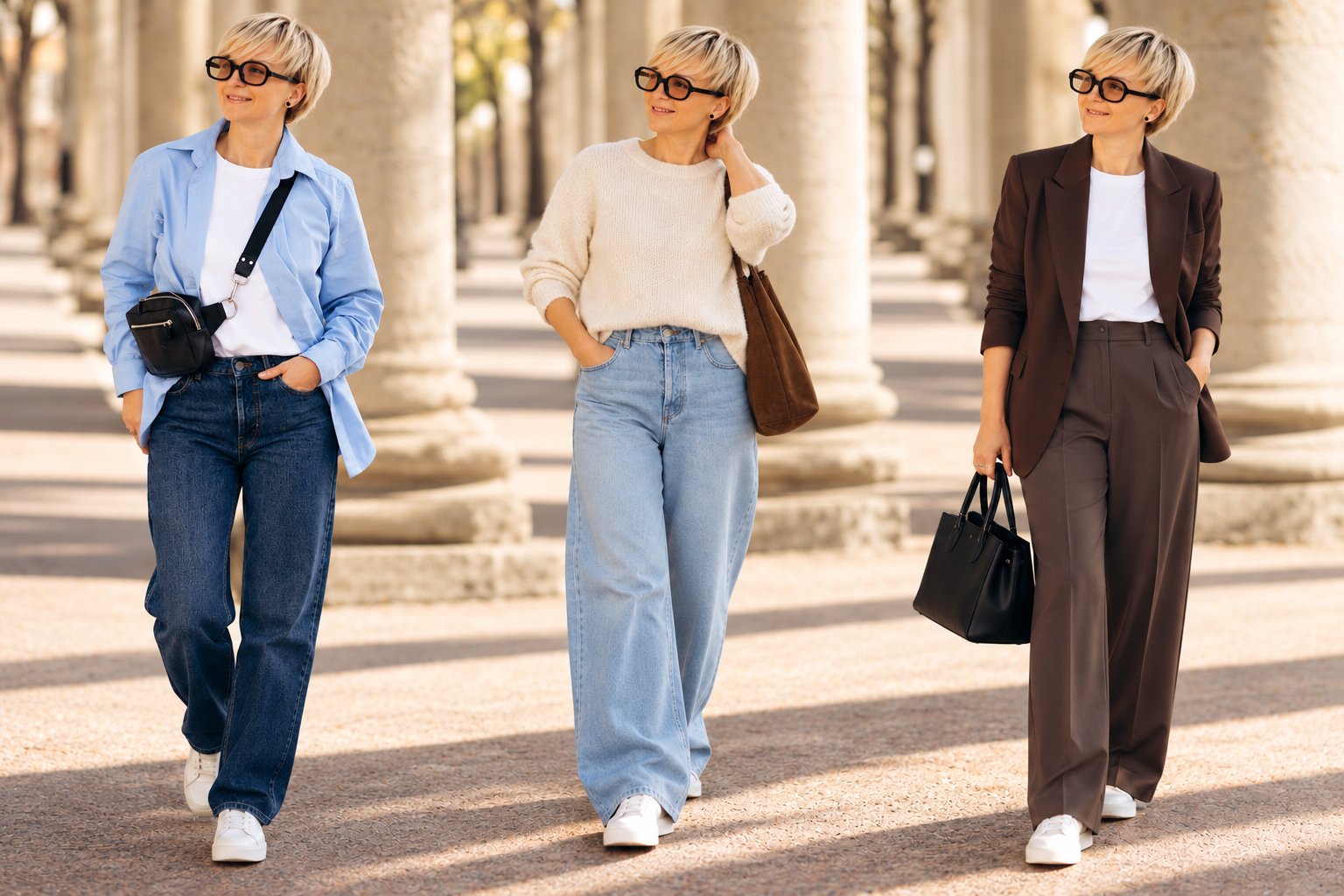
For your first basic pair, consider navy, graphite, chocolate, or another color that already exists in your wardrobe. If you love light-colored clothes, beige, milky, or light gray trousers may prove just as useful. The fabric should suit the season and the level of wear. For regular use, choose materials that hold their shape, do not crease too easily, and recover well after sitting. When trying trousers on, check whether the fabric is see-through, whether underwear lines show, and whether the knees begin to stretch out. The length of trousers should be assessed with the right shoes. A pair hemmed for heels may be too long for sneakers. If you almost always wear flat shoes, they should be your main reference point.
For many everyday wardrobes, one pair of jeans and one pair of trousers are a good start. A second pair of trousers becomes necessary when the first is worn so often that it constantly needs washing, or when you need pieces for different conditions: for example, thicker trousers for the cooler season and lighter ones for summer.
T-Shirts, Shirts, and Knitwear: Everyday Essentials
Everyday tops are the items that most often touch the skin, are washed regularly, and wear out faster. That is why the quality of the fabric, the shape of the neckline, the length, and the fabric’s ability to keep its appearance matter so much.
To begin with, it is useful to have several T-shirts that differ in color or cut. For example, a light one with a crew neck, a darker one in a looser silhouette, and another in a color you love. When trying on a T-shirt, look at how it sits on the shoulders, whether the side seam twists, whether the fabric is dense enough, and whether the sleeve length feels comfortable.
A good shirt expands the possibilities of a basic wardrobe. For restrained outfits, a cotton shirt with a defined collar and a comfortably loose cut can be very practical. If your style is softer, look at linen, viscose fabrics, or other materials that drape well. A shirt should fit properly across the shoulders and bust, not pull between the buttons, and allow your arms to move freely. If you usually wear it untucked, assess the length right away. If you plan to tuck it in, there should be enough fabric so the shirt does not slip out of the waistband as you move.
Knitwear should be chosen with your climate in mind. A fine jumper in a smooth knit is easy to wear on its own or under a blazer. A thicker sweater can become the basis of outfits in cooler weather. A turtleneck suits those who like a covered neckline, while a cardigan is useful when the temperature changes noticeably throughout the day.
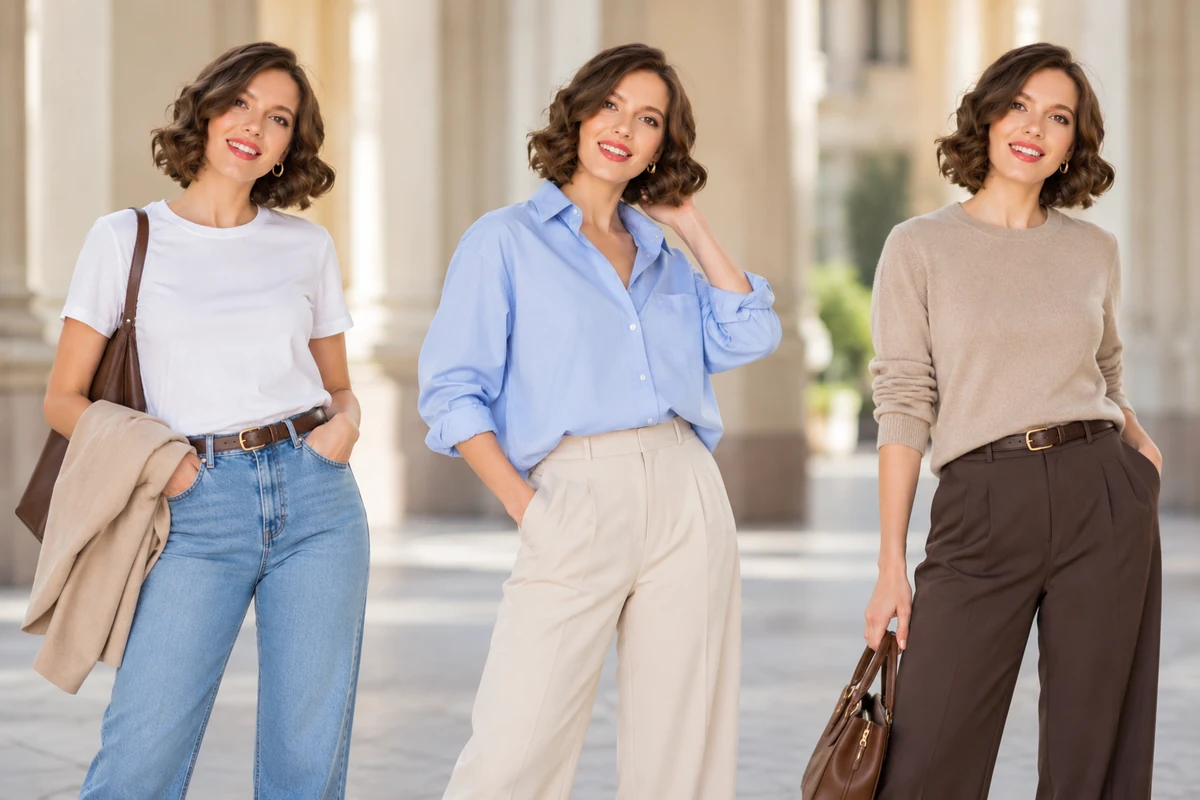
After 40, some women become more attentive to how fabrics feel, temperature comfort, or fit around the waist and bust. Trying things on without rushing helps here: an item should remain comfortable after a few minutes of movement, not just look good in front of the mirror. This is especially true of tight turtlenecks, stiff collars, and close-fitting knitwear.
Usually, it is enough to start with several T-shirts, one or two shirts, and two knitted pieces of different weights. This set can then be expanded gradually depending on what you have to wash most often and what is missing in a particular season.
A Blazer, Cardigan, or Overshirt: Choosing a Second Layer
A second layer is something worn over a T-shirt, top, shirt, or fine jumper. It helps adapt an outfit to the weather and the situation, so it deserves its own place in a basic wardrobe.
A classic blazer is worth choosing if you regularly wear structured clothing. A style with a defined shoulder line, well-shaped lapels, and a neat fit can serve you for many seasons. At the same time, it is important to assess not only the size but also the length: a shorter blazer works well with certain skirts and trousers, while a longer one may better suit a wardrobe built around straight or narrow silhouettes. The shoulders should sit according to the intention of the cut, the sleeves should allow free arm movement, and the fabric should not pull too much when buttoned. Try it on over the top you plan to wear underneath: a thin T-shirt, a shirt, or a jumper.
A knitted blazer is a good option when you want a softer fit without a rigid structure. It may have the shape of a classic jacket but feel closer to a cardigan. Here, it is important that the fabric does not lose shape at the elbows and does not stretch at the fastening.
A cardigan is especially convenient for a less formal wardrobe. Short styles with small buttons can be worn as a top in their own right, while thicker and longer ones work as an additional layer. For a basic wardrobe, cardigans with a neat shoulder line and stable edges that do not stretch out after a few wears work best.
Another practical alternative is an overshirt in thick cotton, denim, or a blended fabric. It is especially useful in a wardrobe dominated by jeans, trousers, and casual dresses.
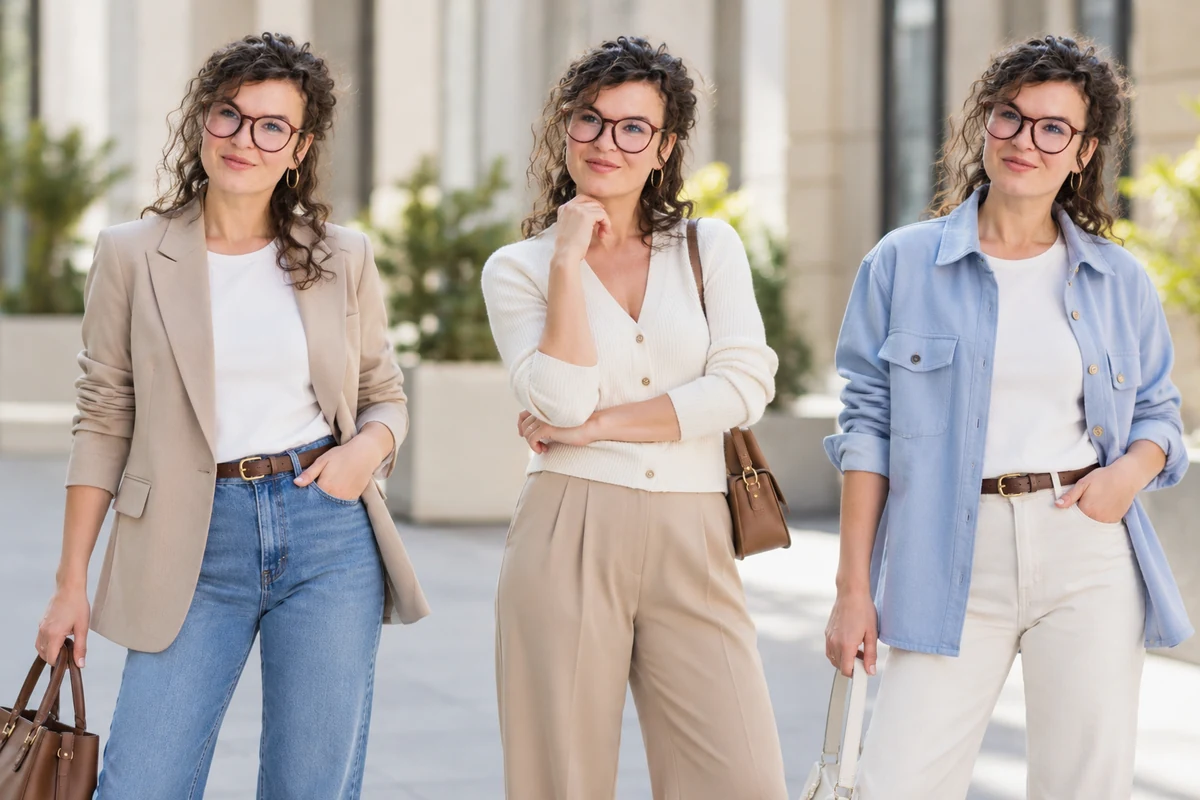
Start with one second layer that works with the largest number of your clothes. If it fully covers your everyday needs, the next one can be chosen for another season or for more formal situations.
Skirts and Dresses: Finding Styles for Real Life
In the basic wardrobe of a woman who regularly wears skirts, it is useful to have at least one style for everyday use. This might be a straight midi skirt in suiting fabric, an A-line skirt, denim, or another material that fits your usual style.
For a straight skirt, the fit through the hips, comfort at the waist, and enough freedom for walking are important. If the style is narrow, check the slit or vent. When trying it on, be sure to sit down: the waistband should not dig in, and the skirt should not ride up too much over the hips.
An A-line silhouette often allows more freedom of movement. For everyday wear, pay attention to the fabric: one that is too thin may lose its shape, while one that is too stiff may create volume that does not match the silhouette you want.
With dresses, it is easiest to think in terms of the situations in which you wear them. For one woman, a good basic dress will be a knitted midi dress; for another, a shirt dress; for a third, a simple dress in suiting fabric that can be worn to work or a meeting.
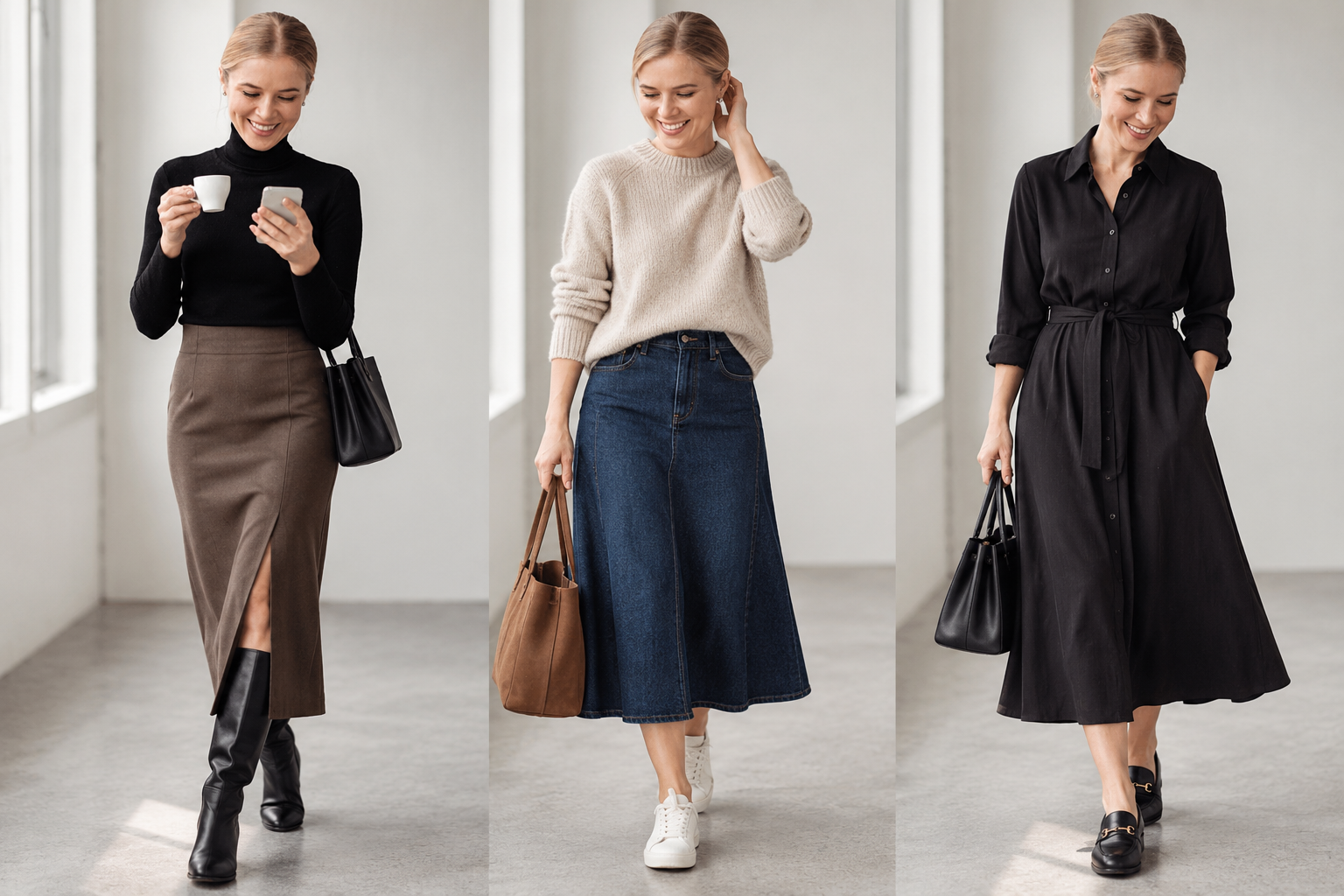
The most practical dresses are often the ones that do not require special underwear, do not restrict movement, and work with shoes you already own. When trying on a dress, check how it fits at the bust and waist, whether the fabric pulls at the shoulders, and whether it is comfortable to raise your arms and sit down. If you wear dresses several times a week, one everyday style will quickly prove insufficient. In that case, it makes sense to build a small set for different weather and situations. If you need dresses only for occasional events, one well-chosen style is enough.
Outerwear and Shoes: Purchases That Affect the Whole Wardrobe
Even well-chosen trousers, jumpers, and dresses may be worn rarely if you do not have the right jacket or shoes to go with them. That is why outerwear and shoes deserve just as much attention as the core pieces.
For a cool climate, the foundation may include a warm coat, a down jacket, and a lighter transitional jacket. For a mild winter, a lightweight coat, jacket, or raincoat that protects from wind and rain may be more practical. If you walk a lot, check the weight of outerwear, how convenient the fastening is, the sleeve length, and how well the piece protects you from your usual weather.
It is best to try on a coat or jacket over a sweater of the right thickness. If outerwear fits well only over a thin T-shirt, it may turn out to be uncomfortable in the cooler season.
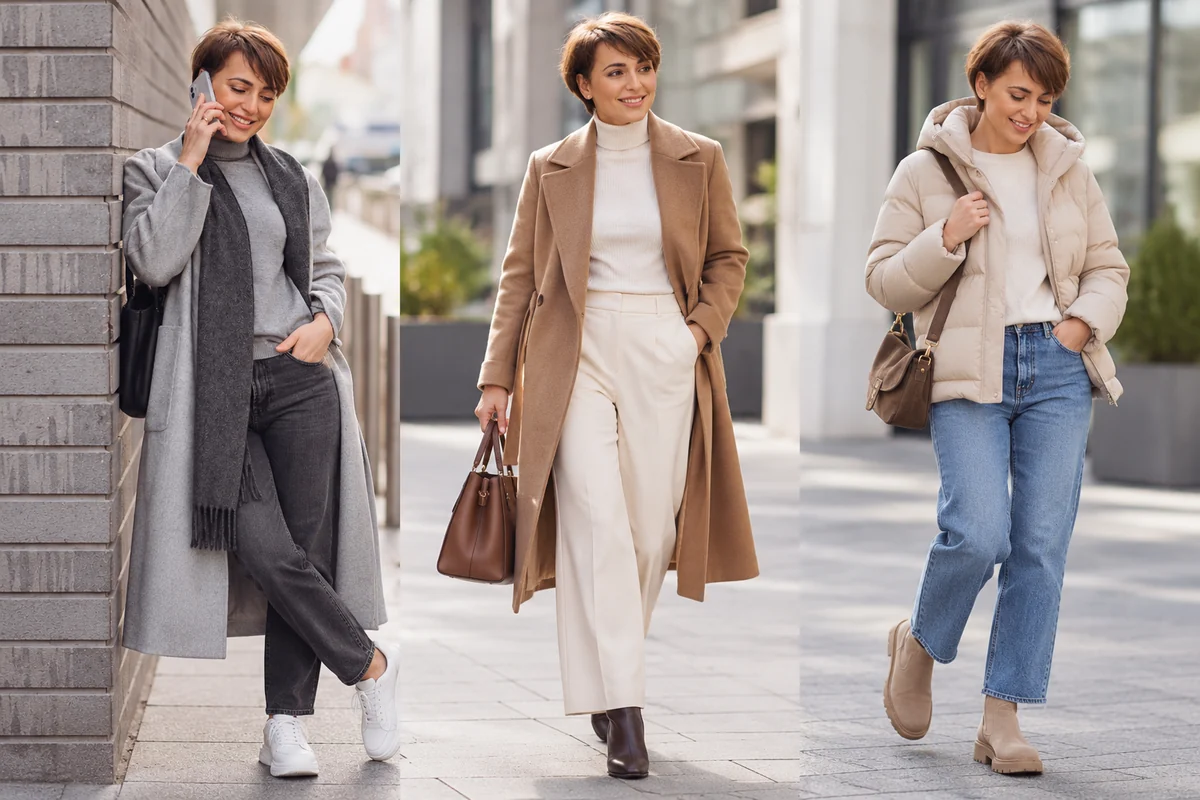
When choosing shoes, focus on your daily routes. For an active city lifestyle, leather sneakers, loafers, or boots with a stable sole may be comfortable. For the office, more restrained styles that suit the dress code may be needed. In a warm climate, good-quality sandals and lightweight closed shoes become especially important. Pay attention to the width of the last, heel support, toe room, sole flexibility, and the weight of the pair. It is better to walk around the store for longer than to buy shoes that will later be uncomfortable to wear. Ideally, try shoes on at the end of the day, when the foot may be slightly larger than in the morning. Before buying shoes, check them with the length of your trousers and skirts. One of the most common reasons good clothes go unworn is the lack of a suitable pair of shoes for a specific season.
Bags, belts, and other accessories are easier to choose once the foundation is in place. For example, a roomy work bag, a small bag for walks, or a compact evening style will have different practical value depending on your life.
How to Build Your Own Basic Wardrobe Around Your Lifestyle
One woman spends most weekdays in the office, another works remotely and often goes into town, while a third moves around a lot, travels, and meets people. Each needs her own balance of formal and casual clothing. The table below shows three examples of basic sets for one season. They are guidelines that can be adapted to your personal habits.
WARDROBE IN NUMBERS AND PIECES
Three Versions of a Basic Wardrobe
Compare how the foundation changes for different rhythms of life.
| CATEGORY | 01 / BUSINESS RHYTHM Office and meetings | 02 / CALM RHYTHM Working from home and the city | 03 / DYNAMIC RHYTHM Active days and travel |
|---|---|---|---|
| Trousers and jeans | 2 pairs of trousers, 1 pair of jeans | 2 pairs of jeans, comfortable trousers | 1–2 pairs of jeans, straight or wide-leg trousers |
| Everyday tops | 2 shirts, several basic tops | 3–4 T-shirts, a shirt | Several simple tops, a shirt or blouse |
| Knitwear | A fine jumper or turtleneck | A fine jumper and a thicker one | A jumper suited to the season |
| Second layer | A structured blazer | A cardigan, soft blazer, or overshirt | A blazer or another distinctive second layer |
| Dresses and skirts | 1 style, if you wear them regularly | According to personal preference | A versatile dress or skirt |
| Shoes | An office pair and comfortable shoes for commuting | Sneakers, loafers, or boots | A comfortable walking pair and a more formal pair |
| Main priority | A polished look throughout the working day | Comfort and easy care | Ease of movement and versatility in different situations |
Approximate sets for one season. Outerwear, bags, and seasonal additions should be chosen separately according to your climate and habits.
If during the week you work both from home and in the office, and spend weekends moving around the city, do not create three separate wardrobes. Start with pieces that work in several situations, and add specialized items only where they are truly needed.
The same item names in the table may hide different requirements. For the office, it is especially important that trousers do not stretch out after long periods of sitting, and that shirts and blazers stay neat until the end of the day. If pieces require complicated care, that is also worth considering before you buy.
When working remotely, the top half can sometimes matter most: a shirt or jumper that is comfortable to work in and looks good on video calls. For frequent travel, it is useful to assess how much fabrics crease in a suitcase or under a seat belt, and whether the clothes remain comfortable for several hours on the road.
If your lifestyle has changed, the proportions of your wardrobe can be reviewed too. For example, after moving from office work to remote work, it may make sense to keep some business clothes for meetings, while planning everyday purchases around your new rhythm. The next step is to understand what you already have and what is genuinely missing.
How to Understand What Is Missing and What to Buy First
The best way to build a basic wardrobe is to start by reviewing what you already own. This is especially helpful if your wardrobe contains many good-quality pieces, but some are barely worn.
Choose the clothes for the current season and sort them by category. Look separately at jeans and trousers, tops, second layers, dresses, and shoes. Then set aside the pieces you have worn over the past two weeks. This will help you see what you truly need in everyday life.
Next, identify the gaps. To do this, answer a few questions:
- Which pieces do I wear most often, and do I have enough of them between washes?
- What clothes do I regularly lack for work, walks, or meetings?
- Which pieces do I like on their own but rarely wear because I do not have the right shoes or top?
- Do I have many similar items, while a category I actually need is represented by only one piece?
- What do I wear most often out of necessity, even though I am unhappy with the fit or fabric?
For example, you may find that you own four shirts, but only one of them is genuinely pleasant to wear. Or that you have several pairs of classic trousers, but not one comfortable pair for every day. Sometimes the missing piece is very small: a belt in the right color, a jumper of a certain weight, or boots that work with your existing trousers. If the items you need are already there, try combining familiar clothes in a new way before adding new purchases to your list.
It is better to make your shopping list as specific as possible. Instead of “need new trousers,” write: “navy straight trousers in a medium-weight fabric that can be worn with my existing shirts and sneakers.” Instead of “buy a sweater,” write: “a fine jumper for cool days that fits under a blazer.”
Which Items Are Worth Saving On, and Which Are Worth Paying More For
Price alone says little about the quality of clothing. An expensive T-shirt can lose its shape after a few washes, while mid-range trousers may last for years. It is more useful to assess the material, construction, fit, and expected frequency of wear.
First of all, it is worth setting aside enough budget for shoes for daily walking, outerwear for difficult weather conditions, and trousers you wear constantly. In these categories, an uncomfortable fit, an unsuccessful last, or poor functionality is especially noticeable.
You can sometimes save on simple T-shirts, seasonal shirts, or everyday knitwear if you find good fabric and quality construction. Before buying, check the seams, symmetry of the details, finishing of the neckline and cuffs. With knitwear, it is important that the edges do not already stretch out during the fitting.
It is useful to consider the cost per wear. If trousers cost €100 and you wear them 100 times, one wear costs €1. A €50 dress worn twice costs €25 per wear. This is a simplified calculation that does not include care or repairs, but it clearly shows why frequency of use can matter more than the initial price.
There is another way to save: alterations. Shortening trousers, slightly taking in the waistband, or adjusting sleeve length is often easier and cheaper than searching for another style. More complex fit problems involving the shoulders, armholes, or the overall construction of the garment are not always worth fixing. Before buying, it is worth asking a tailor whether the alteration you need is possible and how much it would cost.
It is more convenient to plan purchases in this order:
- First, buy what you regularly lack for ordinary days.
- Then replace worn-out or uncomfortable items you use most often.
- Next, add clothes for seasonal needs and less frequent situations.
- Only after that, add pieces for variety, new colors, or unfamiliar silhouettes.
A dress that requires you to buy shoes, a bag, and special underwear will cost far more than the price on the shop tag. Before making such a purchase, calculate the additional costs and ask yourself whether you have a real occasion to wear the full outfit.
Ultimately, the best way to check how well your foundation has been built is to look at the three outfits you wear most often. Lay them out completely, including shoes and outerwear. Is everything comfortable? Is there anything you constantly have to replace with a random item? Could one well-chosen purchase make these outfits more practical? You may find that your wardrobe does not need a major update at all, but simply one good pair of trousers, a shirt, or a pair of shoes. That specific decision is the best place to start.