







Life with chronic fatigue and anxiety often looks like this: you fall asleep with your phone in your hand, wake up tired, run on coffee during the day, and in the evening you again promise yourself to “go to bed earlier” — and again it doesn’t work. Sleep stops restoring you, the nervous system lives in a mode of “constant alarm”, and the thought “something is wrong with me” only adds more tension.
This guide is not about magic life hacks or a perfect “blogger morning routine”. It’s about gentle, realistic changes throughout the day that help the body and brain finally exhale: from evening habits and night rest to morning and daytime rituals.
Important: this text does not replace a consultation with a doctor or psychotherapist. If you suspect you have depression, an anxiety disorder or serious health problems, be sure to seek professional help.
When sleep stops restoring you: what happens to the nervous system
Sleep rarely “breaks down suddenly”. More often it is the result of a long period when the body lives in a state of heightened readiness: stress, war, financial uncertainty, chronic workloads, gadgets until midnight, fatigue that we are used to ignoring.
The nervous system learns to stay “on edge”. We unpacked this in detail in the article “When calm brings no joy: how the brain gets used to stress”. In short, the brain adapts to the background: if the background was tension, that tension begins to feel “normal”. As a result, the body doesn’t trust relaxation — and even in bed keeps looking for danger.
Sometimes all this turns into a state we described as “quiet fatigue”: when a person doesn’t collapse from exhaustion but feels empty, and “ordinary rest” no longer works. Against this background, sleep easily becomes shallow, fragmented, with frequent awakenings and heavy mornings.
To start changing something, it’s important to look at sleep not only as “the night” but as the result of the whole day: what we do in the evening, how we spend the morning and how we in general relate to our own fatigue.
Evening: how to prepare the brain and body for sleep

Evening habits that steal your sleep
For many people, evening is the only time “for themselves”. No wonder this is when habits appear that seem to help you relax, but in fact steal your sleep:
- “Just one more episode — and then bed” → and you end up with two hours of fast-paced plot and tension.
- Doomscrolling the news → the brain gets a stream of alarming information exactly when it should be calming down.
- Alcohol “to fall asleep more easily” → may help you fall asleep faster, but it worsens sleep structure and leads to night-time awakenings.
- Late heavy food → the body is busy digesting, not restoring.
We’ll talk about these patterns in detail in a separate article “Evening habits that steal your sleep”. The task of this section is to notice which of these habits you have and choose one or two you’re ready to start changing.
This is not about bans and self-blame. The goal is to slowly reduce the “dose” of what stimulates the nervous system in the evening and add what calms it.
Screens, blue light and night news
Smartphones, laptops, TVs — all of these are sources of blue light that suppresses the production of melatonin, the “night signal” hormone. In short, the brain reads this as “it’s still daytime, not time to sleep”, even if it’s been dark outside for a while.
Content comes on top of the light: social media feeds, news, comments, work chats. Every new portion of information is a small surge of adrenaline and dopamine, an emotional reaction. Instead of a smooth “wind-down”, the nervous system gets a fireworks display of stimuli.
In the article “Screens and social media before sleep: how blue light disrupts biorhythms” we’ll look at:
- how exactly light and content from screens affect falling asleep;
- why “just 15 more minutes” easily turns into an hour;
- how to build a realistic agreement with yourself: for example, fewer screens 30–60 minutes before sleep, but without an unrealistic “always”.
Gentle evening rituals instead of self-punishment
Many of us are used to thinking that in order to finally get enough sleep we have to suddenly “become perfect”: no phone, perfect schedule, sports shape, zero evening series. This approach almost always collapses after a few days and leaves a feeling of failure.
Instead, it’s worth building gentle evening rituals that gradually send the brain a signal: “the day is ending, you can slow down”.
These can be:
- a warm shower or bath not just “to get clean” but as a switching ritual;
- dimmed lighting, swapping the bright ceiling light for a floor lamp or bedside lamp;
- 5–10 minutes of light stretching, yoga or just “rolling out” the body;
- a few minutes of touch and tenderness for yourself or loved ones: self-massage of the feet, hugs, stroking a pet.
We’ve already written about the power of touch in the article “How much touch the body needs: the neurophysiology of tenderness” — there we explain in more detail how physical contact calms the nervous system.
If you enjoy water-based, creative or “hands-on” activities, it’s useful to bring in what we describe in the article “The most body-friendly hobbies: how the body itself chooses what reduces stress and restores the nervous system”. Many of these hobbies can easily be moved to the evening hours — as a gentle transition from day to night.
Night rest: how to fall asleep and stay asleep
Sleep hygiene without fanaticism
There are many radical recommendations around “sleep hygiene”: perfect temperature, total darkness, absolute silence, a bed used only for sleep, never eating or reading in bed. For some people, such rules really work. But for most, it’s important to find a balance between real life and recommendations.
Basic guidelines:
- Temperature: cooler than during the day, but not to the point of shivering.
- Darkness: minimise bright light sources; if possible, use blackout curtains or a sleep mask.
- Silence or white noise: some people are helped by perfect silence, others by stable background noise (a fan, special apps).
It’s important not to turn these rules into yet another reason to control yourself and scold yourself for every “violation”. Neither the body nor the nervous system likes total control.
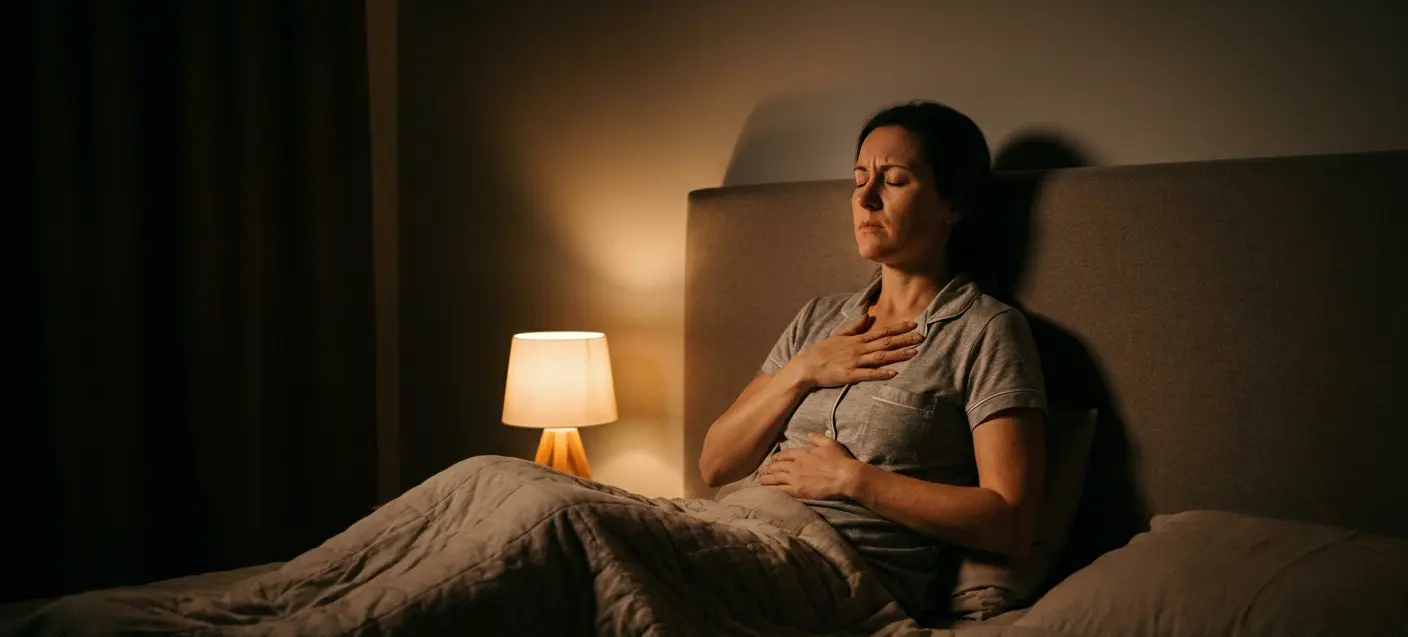
Night-time awakenings, anxious thoughts and “night terror”
Waking up at night is sometimes normal. We all go through several sleep cycles, and at the boundaries between them brief awakenings often occur. The problem starts when a person wakes up and gets “stuck” in anxious thoughts:
- replaying all the problems of the day;
- starting to analyse the future;
- running worst-case scenarios in their head.
The longer we lie there and worry, the more strongly the brain associates the bed and night with anxiety. It’s the same learning process, just an unwanted one.
In a future article “Grounding and breathing techniques before sleep: 10–15 minutes at home” we’ll collect simple practices you can use if you wake up at night and feel tense: physical grounding, breathing with an emphasis on the exhale, gently shifting attention into the body.
Night panic attacks
Night panic attacks are one of the most frightening experiences. A person can wake up with the feeling that they’re suffocating, their heart is “jumping out”, the body is trembling, and the thought in their head is “I’m dying” or “something incurably wrong is happening to me”.
In the article “What to do during a night-time panic attack: psychologist’s advice” we analyse in detail:
- what a panic attack is (and what it isn’t);
- why it can happen specifically at night;
- a step-by-step action plan during an episode;
- when it’s essential to seek help from a doctor or psychotherapist.
In this guide, it’s important to remember the main thing: night panic attacks are a very frightening but treatable condition. You’re not “going crazy” and not “broken forever” — the nervous system is simply signalling that it’s too hard for it to keep everything inside.
Morning: the first hour as a reboot for the nervous system
Mornings often start “at full speed”: alarm, phone, news, to-do list, rushing around. But it’s exactly the first hour after waking that sets the tone for the nervous system for the whole day: it can receive the signal “we’re safe” or “we’re surviving again”.

Light, water, movement: a minimal morning protocol
The simplest scheme you can adapt to yourself:
- Getting up and water. A glass of water, preferably before coffee. It’s not magic, just basic care for the body.
- Light. Open the curtains, step onto the balcony or outside for at least 5–10 minutes. Daylight helps tune your circadian rhythms.
- Gentle movement. A few minutes of stretching, gentle bends, shoulder rolls, a short walk. It doesn’t have to be a “full workout”; what matters is sending the signal: “the body is alive, we are in motion”.
We covered this in more detail in the articles “Morning rituals without meltdowns: how to start the day gently and mindfully” and “Morning rituals that change your day”. In short, morning rituals are not about efficiency at any cost but about a safe start for the nervous system.
Morning anxiety and heavy thoughts
In the morning, our cortisol level naturally rises — a hormone that helps us wake up and mobilise. In a healthy scenario, it gradually decreases afterwards. But if background anxiety is high, this peak can feel like heavy thoughts, pressure in the chest and tension in the body.
In “When calm brings no joy: how the brain gets used to stress” we already wrote that the brain can get so used to stress that calm starts to feel scary. That’s why morning anxiety often looks less like a “real problem” and more like a habit of the nervous system to “check whether everything is under control”.
Here it’s important to:
- not demand that you “wake up happy” every day;
- add something that calms you personally to your morning rituals: quiet music, gentle stretching, a few minutes on the balcony or terrace, hugs with loved ones.
Daytime: energy, microsleep and daytime sleepiness
Microsleep as a “repair pause”
In our culture, daytime sleep is often either romanticised (“I’d nap every afternoon”) or condemned (“if you lie down during the day, you’re lazy”). Reality is more complex: a short microsleep can be very helpful if:
- it lasts no more than 15–20 minutes;
- it doesn’t fall late in the evening;
- it doesn’t turn into an attempt to “escape from life into sleep”.
In the article “Microsleep: how short rest restores the brain” we explained how such a short “repair break” allows the nervous system to reboot when daytime fatigue builds up, and how to set up microsleep so that it doesn’t break your night’s rest.
When daytime sleepiness is normal and when it’s a warning sign
The desire to take a short nap after a heavy lunch, work or a very busy day is a normal reaction of the body. But if:
- sleepiness follows you every day;
- you can fall asleep almost anywhere;
- even after a full night’s sleep you feel shattered;
- other symptoms appear (shortness of breath, snoring, sharp mood swings, brain fog),
— that’s already a reason to take a closer look at your condition.
In a future article “Daytime sleepiness: when it’s normal and when it’s a reason to see a doctor” we’ll discuss where the line lies between “ordinary fatigue” and conditions that require medical examination (for example, sleep apnoea, thyroid disorders, depression).
If you recognise in yourself the symptoms of quiet fatigue — when you have no energy even for what used to bring joy — it’s important not to limit yourself to changing your schedule. In such cases, home rituals may not be enough, and professional support is needed.
How to track changes: a sleep and anxiety diary
It’s hard to assess sleep and the state of the nervous system “by eye”. In moments of anxiety it feels as if the night is always bad and the day is always exhausting, even if objectively that’s not quite true.
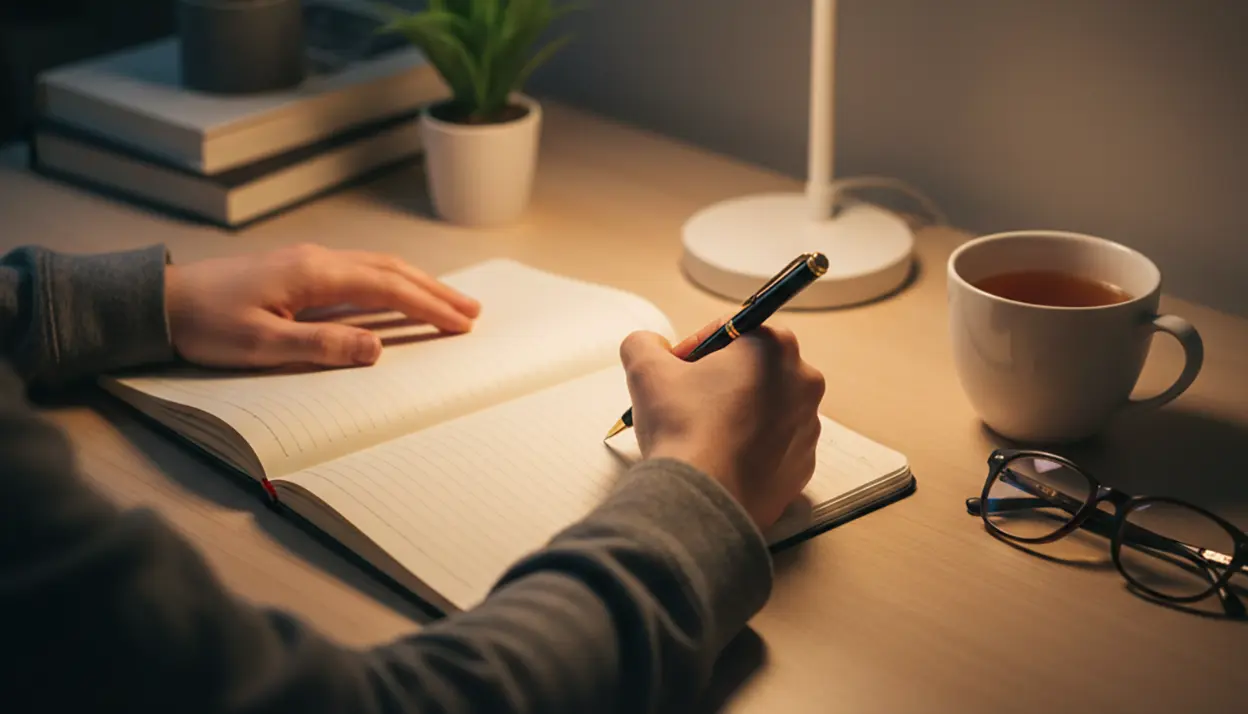
That’s why a simple sleep and anxiety diary can be a useful tool. It’s worth noting there:
- the time you went to bed and when you actually fell asleep (approximately);
- night-time awakenings (whether they occurred, how many times, with what feeling);
- morning: what time you woke up, how you feel on a scale from 1 to 10;
- daytime energy: when you felt a drop in strength, whether you had a microsleep;
- anxiety level (1–10) and major stressful events of the day;
- caffeine and alcohol (whether they were present, in what quantity and at what time).
After 2–4 weeks of such observation, specific triggers often become visible: for example, that the worst nights happen after evening news, late work or alcohol, and the best — after a walk and a calm evening without screens.
The diary is not about daily self-punishment, but about a picture that helps you notice patterns and not devalue small improvements.
Everyday regulation rituals: touch, hobbies, weekends
Touch, hugs, physical tenderness
The nervous system is regulated not only through thoughts but also through the body. Physical touch is one of the simplest and at the same time strongest ways to calm down: hugs, holding hands, massage, stroking pets.
In the article “How much touch the body needs: the neurophysiology of tenderness” we explained how touch triggers the release of oxytocin and helps the nervous system shift from “fight or flight” mode into “I’m more or less safe” mode.
You can use this both as an evening and as a daytime ritual: hugs before bed, a few minutes of self-massage of the neck, stroking a dog or cat, a warm heating pad against the body.
Hobbies that calm the nervous system
Not all hobbies are equally helpful for recovery. We analysed this in detail in the article “The most body-friendly hobbies: how the body itself chooses what reduces stress and restores the nervous system”.
Very briefly, the nervous system is especially supported by activities that include:
- water (swimming, shower, bath, walks by water);
- movement and rhythm (walking, dancing, cycling, slow running);
- contact with nature (garden, yard, forest, park);
- hand work (cooking, knitting, drawing, sculpting).
Such hobbies can become supportive rituals: for example, a short walk after work, swimming a few times a week, “weekend time” in the garden or kitchen — not as “one more task”, but as a space where the body can finally be in a safe mode.
Weekend rituals as a mini-vacation
Weekends often turn into “the day when you can finally finish all the tasks”. As a result, Sunday becomes just another working day — only without pay.
In the article “Sunday rituals: how to restore energy” we suggest looking at a day off as a mini-vacation for the nervous system:
- set aside time without work and news;
- add at least one resourceful ritual (a walk, a favourite hobby, a meeting with “your” people);
- don’t try to “catch up on your whole life in one day”.

Changing the structure of your weekends often gives a stronger effect than “the perfect morning routine”: the body begins to understand that it really has some time to recover.
A bit of biochemistry: sleep and hormones
To better understand what’s happening with sleep, it’s helpful to have a basic picture of hormones.
- Cortisol helps us wake up and be active. Ideally, it’s higher in the morning and decreases throughout the day.
- Melatonin signals to the body that “night is coming”. Light from screens and bright lighting in the evening can suppress its production.
- Serotonin is linked to mood, a sense of stability and satisfaction. Part of it is converted into melatonin.
In a future article “Sleep and hormones: how cortisol, melatonin and serotonin work together” we’ll look in more detail at how evening light, caffeine, alcohol and daily routine affect this system.
This section is not so that you begin prescribing tests and treatment for yourself, but so you can better understand why small behavioural changes can have a very noticeable effect.
When home rituals are no longer enough: quiet fatigue and professional help
Sometimes a person honestly tries to change their evenings, mornings and weekends, but:
- wakes up shattered even after a full night’s sleep;
- barely makes it through an ordinary day;
- loses interest in what used to bring joy;
- almost doesn’t feel joy or satisfaction;
- faces strong panic attacks or suicidal thoughts.
In such cases it’s often not just about sleep, but about depression, an anxiety disorder or other conditions that require professional help.
In the article “Quiet fatigue: how women’s bodies respond to constant stress and why simple rest no longer helps” we describe this state in detail. And “When calm brings no joy: how the brain gets used to stress” helps you notice the moment when the brain has become so used to stress that calm feels suspicious and “empty”.
Approximate “red flags” signalling that you should seek help:
- a sharp change in weight (without trying to lose or gain weight);
- long-term loss of appetite or, conversely, constant overeating;
- frequent panic attacks, especially at night;
- intrusive thoughts about death, a sense of hopelessness;
- severe daytime sleepiness that can’t be explained by your schedule.
Home rituals and this guide can be part of your support, but they can’t replace a consultation with a doctor or psychotherapist. Asking for help is not weakness; it’s a way to take care of yourself.
How to use this guide: a gentle 4-week plan for change
To keep this text from remaining just theory, you can turn it into a gentle four-week experiment.
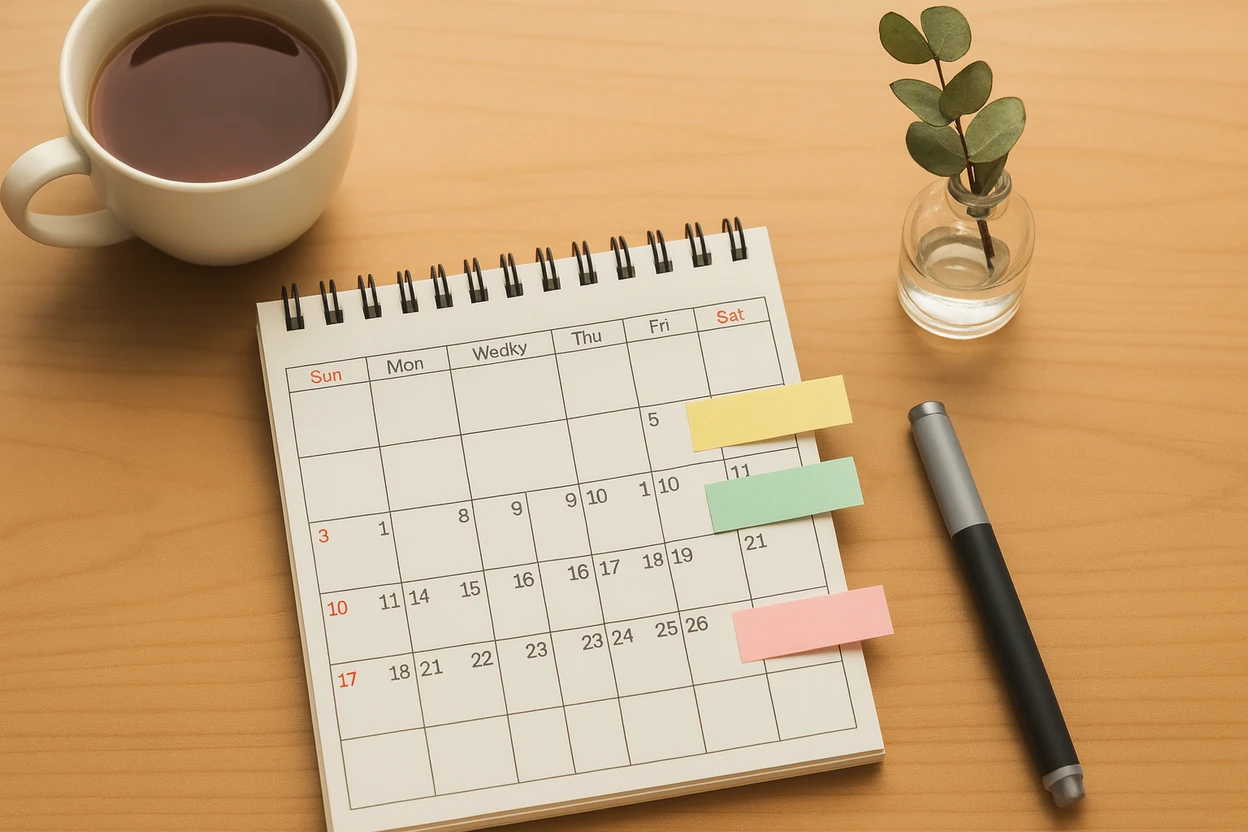
Week 1: observation and one evening step
- Start keeping a sleep and anxiety diary.
- Choose one evening habit that you feel steals your sleep the most — and try to change its format (for example, not watching the news after 22:00 or cutting down time on social media).
Week 2: morning start and bodily support
- Add a minimal morning protocol: light, water, a few minutes of movement.
- Choose one physical or grounding practice before sleep or at night — and do it at least 3–4 times a week.
Week 3: daytime energy and microsleep
- Pay attention to daytime energy dips: when they happen, what comes before them.
- If the microsleep format suits you, carefully integrate it, watching how it affects your night’s sleep.
- If daytime sleepiness is very strong, plan a consultation with a doctor, not just schedule changes.
Week 4: weekends and resourceful rituals
- Look at your weekends: what is there for your body and nervous system, not just for your to-do list?
- Add one or two resource-giving hobbies that you genuinely enjoy.
- Summarise the month using your diary: what has changed in falling asleep, awakenings, daytime energy and anxiety levels.
This guide is not a checklist on “how to become perfect”. It’s more like a map that helps you see the connection between how we live during the day and how we sleep at night. Even one small change, made gently and consistently, is already a step towards the nervous system no longer living in constant alarm mode — and towards sleep once again becoming a time of restoration.
-lazy-placeholder.webp)
-medium.webp)