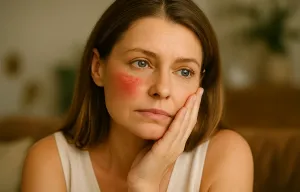







When skin becomes reactive, the label starts to feel like a safety map. But the words on the packaging are merely hints, not guarantees.
At some point, skincare stops being just a collection of jars and turns into a system of small decisions with consequences. What was once purchased almost automatically is now read more carefully: hypoallergenic, fragrance-free, for sensitive skin, dermatologist tested, non-comedogenic. When the skin starts reacting to familiar formulas, these words seem to promise peace. You want to believe that somewhere on the packaging there is the right combination that will prevent a new flare-up.
The problem is that the label is not read literally. It is read through context. Through skin type. Through the state of the barrier. Through whether you have a real allergy, sensitization, irritation, or just a period of reduced tolerance. And this is where many fall into a trap: they perceive the markers on the packaging as a promise of safety, although in reality, it's just part of the information.
This article is not about how to find the "perfect label." It's about how to read packaging soberly. Which markers can truly be helpful. Which words provide only a very conditional hint. Why the same inscription can be reassuring but not protective. And how not to confuse marketing comfort with real skin tolerance.
Why the label becomes so important when the skin starts reacting
When the skin is stable, people rarely read cosmetics like a document. They read it more as a promise of effect: hydration, radiance, anti-age, clear pores, softness, smoothness. But when the skin suddenly starts stinging, reddening, getting tired of actives, or poorly tolerating even the usual cream, the focus shifts. Safety of contact takes precedence over effect.
That's why words like hypoallergenic or fragrance-free start to look almost like lifesaving beacons. They seem to promise that someone has already checked the product for you. That the risk is lower. That the formula is "calmer." And there is a rational grain in this logic. But there is also a danger: in moments of reactivity, people easily begin to trust the words on the front label more than their own skin.
In reality, the label is useful not when it is read as a verdict or indulgence, but when it is read as a system of hints. That is, not "this inscription will definitely save me," but "this inscription can suggest where to look next - and what else to check before starting."
Where to start reading: not with beautiful words, but with the type of marker
Conditionally, all words on cosmetic packaging can be divided into three levels. The first is marketing signals that sound reassuring but guarantee little on their own. The second is technical hints that can really help narrow down the risk. The third is the list of ingredients, the only part of the label where the product starts to speak more specifically.

Marketing signals
This group most often includes words like hypoallergenic, dermatologist tested, for sensitive skin, sometimes clean, gentle, soothing. They are not necessarily empty. But they are almost never self-sufficient. They do not explain how exactly the product was tested, on what skin, under what conditions, with what frequency of reactions, and what it was compared to.
Technical hints
Here, fragrance-free is closer, sometimes non-comedogenic, sometimes clarifications about the type of product - leave-on or rinse-off, as well as the format of the formula itself: cleanser, cream, serum, SPF, mask. These are not guarantees yet, but here there is already logic that can be correlated with skin experience.
List of ingredients
The INCI list is the least emotional and most useful when the skin has become reactive. It does not promise you comfort. But it shows what the product is really made of. And although reading it is not always easy, it is the least comforting and the least deceitful.
What not to read literally
There are a few words that sound especially reassuring during a flare-up. That's why it's most important not to overestimate them.
- Hypoallergenic - does not mean that a reaction is impossible.
- Fragrance-free - does not mean automatic tolerance for your skin.
- Unscented - is not the same as the complete absence of fragrance components.
- Dermatologist tested - without details does not equal transparent proof of safety.
- For sensitive skin - is a positioning direction, not a medical conclusion.
All these formulations can be useful as weak signals. But none of them should be read as a final decision instead of the composition, your own reaction history, and a healthy way to introduce a new product.
What hypoallergenic means - and why this word is not enough
The word hypoallergenic sounds as if the product has already proven its mildness and lower risk of reactions. But this is where one of the most common label reading mistakes begins. For cosmetics, there is no universal simple guarantee that this word would automatically give to every buyer. It does not mean that the product will not cause a reaction. And it does not mean that it is already definitely safe for your skin.
In modern practice, the very presence of this word on the packaging is not a ready guarantee for the consumer. For a person with reactive skin, the correct attitude towards such a marker should be very calm: it is not proof, but only a weak signal that the brand wants to position the product as less risky. But how much less risky - the label does not explain.
Therefore, hypoallergenic is best read not as "I can definitely use it," but as "this is not enough to decide." If the skin has already experienced reactions, especially to leave-on products, this word is not enough. Here, both the composition and your own history of tolerance are needed, and, if necessary, a very cautious home test.
Fragrance-free, unscented, and parfum: where mistakes are most often made
For reactive skin, the topic of fragrance is one of the most important. Not because any fragrance is automatically "bad," but because fragrance and preservatives are among the most common causes of contact reactions to cosmetics. That's why people start reading words about fragrance on the label especially carefully.
What fragrance-free usually means
Fragrance-free is usually read as a better scenario for skin that doesn't like fragranced formulas. And in many cases, this is indeed a useful search direction. If the skin reacts to aromatic components or you just want to reduce the number of potential irritants, this marker can be a sensible hint.
But it's important not to turn it into an absolute. Fragrance-free does not automatically mean "will not cause a reaction." The formula may still contain other components that your particular skin poorly tolerates: preservatives, actives, plant extracts, acids, essential oils, complex combinations of substances, or simply a texture too rich for your condition.
Why unscented is not the same
One of the most dangerous small confusions on the label is mixing fragrance-free and unscented. They sound almost the same emotionally, but they are not the same. Unscented usually means that the product has no noticeable smell. But this does not necessarily mean the complete absence of aromatic or masking substances in the formula.
For reactive skin, this difference is not decorative. If you are trying to reduce contact specifically with fragrance components, unscented does not always provide the clarity you want to see in it. Therefore, in doubtful cases, it is more logical to trust the composition more than the impression of the smell or a single word on the front label.
What to do with the word parfum in the list
In the list of ingredients, the perfume composition is often hidden under the words parfum or aroma. For a person with reactive skin, this means a simple thing: even if the packaging beautifully speaks of mildness, the ingredient list itself still needs to be read to the end. In European practice, part of fragrance allergens is subject to separate indication on the label, but this does not negate the fact that the perfume composition itself can be marked with a general word.
Therefore, if the skin has already experienced contact reactions or you suspect fragrance sensitivity, the topic of fragrance should be read on the label especially carefully. It is at this point that the words fragrance-free, unscented, and parfum stop being trifles and become a real part of the choice.
For sensitive skin - a useful guide, but not a medical conclusion
The inscription "for sensitive skin" is perceived almost as a soothing tone of the label. It speaks the language of caution, which is very attractive at a time when the skin can no longer withstand loud promises. The problem is that this inscription does not explain what exactly the manufacturer means by "sensitive skin."
For some, it means gentler cleansing. For others, less fragrance. For some, fewer actives. For others, just a different texture. But the label itself rarely explains what exactly the product is trying to be more delicate about. Therefore, this marker is useful as a direction, but insufficient as a solution.
It works best when you don't read it separately from everything else. That is, you look not only at the front label but also at whether there is fragrance in the formula, how long and rich the composition is, whether it is a leave-on product, whether there are strong actives, whether it is overloaded with both soothing and stimulating promises at the same time.
If you are closer to the scenario of constant burning, tingling, the feeling of "too much" even without obvious rashes, it makes sense to move on to the material "Sensitive Skin After 40: Age-Related Sensitization and How to Restore Tolerance".
Non-comedogenic: useful, but not about everything
Non-comedogenic is one of those markers that is often read more broadly than it should be. It is primarily useful for skin prone to clogged pores and breakouts. In practical terms, this means: the product is positioned as one that should not contribute to comedones in most people. For acne-prone skin, this can indeed be important.
But for reactive skin, there is a fine line. Non-comedogenic does not automatically mean "does not sting," "does not irritate," "does not cause sensory discomfort," "does not enhance redness." So this marker can be useful if you are concerned about pores or acne. But it almost guarantees nothing in terms of allergies, burning, or reduced tolerance after 35-40.
In other words, non-comedogenic is a marker about one type of problem. It should not be read as a universal sign of safety for any reactivity.
Dermatologist tested: what exactly was tested - the label usually doesn't say
This is one of the most reassuring inscriptions on the packaging. It sounds solid, professional, and creates a sense of control. But this is where it's useful to temper expectations a bit. The inscription dermatologist tested itself does not explain what the protocol was, how many people participated in the testing, what their skin was like, what was considered a reaction, and what the product was compared to.
This does not mean that such an inscription is worthless. It only means that without details, it does not turn into a guarantee. For reactive skin, this is especially important. Because in a moment of flare-up, a person wants to rely on something as certain as possible. And an inscription that sounds scientific is very easy to start perceiving as proof, which is not actually visible there.
Therefore, dermatologist tested is better read as an additional, but weak factor. It can be a pleasant plus, but it should not outweigh the composition, product format, your reaction history, and the current state of your skin.

How to read the ingredient list if the skin reacts to everything
The INCI list is not created for comfort. It does not try to reassure you. That's why it's useful. When the skin has become reactive, the ingredient list should be read not as chemistry for the sake of chemistry, but as a practical map of load.
First rule: look at the beginning of the list
Ingredients in cosmetics are usually listed in descending order of predominance. This does not mean that everything below is unimportant. But it means that the beginning of the list helps to understand the basic logic of the formula: is it water-based, oilier, silicone-based, rich in moisturizers, built around emollients or actives. For reactive skin, this is important already at the level of sensation: sometimes the problem is not in one "bad" ingredient, but in the overall density or loudness of the formula.
Second rule: do not overestimate the bottom of the list, but do not ignore it
Beyond a certain point, ingredients may not be listed in a perfect strict sequence of predominance. This means that the bottom of the list is not always read as a mathematical scale of significance. But it is often where preservatives, fragrance components, dyes, and individual actives that can be important for reactive skin even in small amounts are hidden. Therefore, reading only the first five ingredients is not enough.
Third rule: look for logic, not an enemy
The worst thing you can do with INCI is turn it into a hunt for one scary word. For reactive skin, a more useful question is: does this formula look simple or overloaded? Is there fragrance here? Are there many potentially active or sensory noticeable components? Is this a product that asks for calm contact with the skin, or is it a product that already sounds like intensive intervention?
Which markers are most useful during a flare-up
When the skin is already tired, not all words on the packaging are equally valuable. Some simply reassure. Some at least help narrow down the risk a bit.
What can be really useful
- Fragrance-free - if fragrance is a frequent trigger for your skin or if you want to reduce the number of unnecessary irritants.
- Simpler formula - even if it's not a separate marker on the front label, but something visible from the composition.
- Fewer simultaneous actives - especially for leave-on products during a period when the skin poorly tolerates layering.
- Clear product logic - when it's clear from the label and composition that the formula does one or two things, rather than trying to be everything at once.
What is useful but weaker than it seems
- Hypoallergenic
- Dermatologist tested
- For sensitive skin
- Non-comedogenic, if your main problem is not pores but reactivity
These words are not useless. But during a flare-up, they should not lead the choice on their own. For reactive skin, they can only be additional weak arguments, not the center of the decision.
What on the label can really be a red flag
There is no one universal list that would be equally dangerous for everyone. But there are things to look at more closely with reactive skin.
- pronounced fragranced formula or presence of parfum, if the skin has already reacted to fragrance components;
- very long and rich ingredient list in a leave-on product when the skin is in a period of low tolerance;
- simultaneous presence of several strong actives in a product planned for daily use;
- combination of soothing positioning with a very "loud" actual formula;
- purchase based only on the front label without reading the INCI and without considering your own reaction history.
This list does not mean "you can't." It only means "extra caution is needed here." For reactive skin, this is sometimes the most valuable mode of reading the label - not to dramatize, but also not to leave the decision to the mercy of beautiful words.
When the label helps and when it no longer does
The label works well as a tool for preliminary selection. It can help you not to take an obviously fragranced formula if you already know that fragrance is a weak point. It can suggest that a product for acne-prone skin is better sought among non-comedogenic. It can indicate that the formula is too complex for a period when the skin barely withstands the base.
But the label ceases to be sufficient where there is already real unpredictability. If the skin reacts to different products, if there is a suspicion of allergy, if you have already experienced a pronounced flare-up, the packaging no longer provides sufficient clarity. At this point, other tools are needed: careful analysis of reactions, home testing without illusions, and, if necessary, clinical diagnosis.
That's why within this cluster, the label is not separated from other materials. If there are questions specifically about the nature of the reaction, it makes sense to read "Cosmetic Allergy: Why Even an Expensive Cream Can Cause a Reaction" next. If you need a practical but sober way to preliminarily check a new product, it's worth moving on to "Patch Test at Home: What It Really Shows and What It Doesn't". And if it's important to understand why the skin itself after 35-40 suddenly became less tolerant, a broader context is provided by the material "Why After 35-40 the Skin Suddenly Starts Reacting to Everything: Barrier, Hormones, Sensitization, and Silent Inflammation".
What to do if the composition looks calm, but the skin still reacts
This is one of the most important points for reactive skin. Sometimes the packaging looks right. The formula seems restrained. There seems to be no fragrance. Few actives. But the skin still responds with discomfort. In such a situation, it's very easy to decide that labels are worth nothing at all. In fact, the conclusion is more nuanced: the label can reduce risk, but it does not cancel the state of the skin itself.
If the barrier is already exhausted, if there is sensitization, if the skin after 35-40 lives in a period of reduced tolerance, even a relatively "quiet" formula can turn out to be too active for a particular moment. So the problem is not always in a deceptive label. Sometimes the problem is that the skin is not currently in a state of full contact.
That's why the words on the packaging should be read together with your own state. Not separately from it. Not instead of it. And not as a way to cancel already existing reactivity with the power of the right marker.
Practical logic of choice when the skin is already tired
During a period of reactivity, the best approach is not maximum awareness of all the ingredients in the world, but a quiet discipline of choice. Not to look for the smartest inscription. Not to try to calculate the perfect jar by one word. But to ask a few simple questions.
What is useful to ask yourself before buying
- does this product look simpler or more complex than my current base;
- does it contain fragrance or other markers that my skin has already reacted to;
- is it a leave-on product or something that washes off quickly;
- am I introducing one new product or several at once;
- am I buying it for the real logic of the formula or for the soothing inscription on the front label.
Minimum check before purchase
- look not only at the front label but also at the INCI;
- check for parfum, aroma, or other familiar triggers;
- remember your own reaction history, not just trust the brand's promise;
- do not mindlessly apply it all over the face if the skin has been unstable lately.
This logic usually saves better than trying to become a home chemist overnight. Because at the moment when the skin reacts to everything, it most often needs not an ideal intellectual victory over the label, but a reduction in noise.
Conclusion
When the skin has become reactive, the label can indeed help. But not as a guarantee, as a map of hints. Hypoallergenic does not equal safe for everyone. Fragrance-free can be a useful guide, but it does not cancel other causes of reaction. Unscented is not the same as the complete absence of aromatic components. Non-comedogenic speaks more about pores than about burning or allergy. And words like dermatologist tested without details do not replace either the composition or the skin experience.
The most accurate reading of the label for reactive skin is reading without magical thinking. Not expecting the packaging to solve everything for you. Not endowing one inscription with excessive power. And not ignoring your own reaction history. In this sense, the label is needed not to reassure at any cost. It is needed to help you narrow down the risk and make the choice a little quieter, more precise, and more mature.
Sources
- FDA. Allergens in Cosmetics.
- FDA. Cosmetics Labeling Claims.
- FDA. Cosmetics Labeling Guide.
- American Academy of Dermatology. How to test skin care products.
- DermNet. Cosmetics Allergy: Causes, Symptoms, and Treatment.
- DermNet. Open application test.
- European Commission. Fragrance allergens labelling.