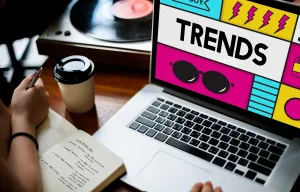






A trend can be recognized in 3 seconds - but living it as your own choice is becoming increasingly difficult.
At some point, you catch yourself in a strange scene: you’ve seen this item dozens of times. In your feed, in stories, in "collections," in refined videos with the right lighting. It seems familiar - but when it comes to trying it on, inside it feels empty. Not that it’s unattractive. It just doesn’t resonate. And then it becomes obvious: fashion has stopped arriving as a season. It comes as a stream.
Even more telling is how the "aftertaste" works. Previously, you could want an item, think about it for a few days, return, try it on, think again. Now, desire often arises as a micro-impulse: you see it, save it, and move on. Sometimes you even buy it - and then wonder why your hand doesn’t reach for it to wear. As if the decision happened not in your life, but in someone else's frame.
Trends now appear quickly, multiply at lightning speed, and die before you have time to understand if it’s for you. We have learned to recognize relevance. But that’s not the same as wanting. And the difference between "knowing" and "wanting" is precisely where style begins.
So, restraint in style is not a moral stance or about "being more modest." It’s more about the instinct for self-preservation. When there are too many images around, the body almost automatically seeks to reduce the noise. Sometimes - through clothing. Not because you "love fashion less," but because you love yourself more in a state where you are not torn apart by small stimuli.
How Visual Fatigue, Algorithms, and the Nervous System Change Fashion
The acceleration of trends didn’t happen "just like that." It is embedded in the mechanics of visual culture. What can easily be turned into a short code (silhouette, color, detail, "mood") is quickly picked up, repeated, and becomes ubiquitous. Algorithms love what can be copied effortlessly. And we, whether we like it or not, learn to see precisely these codes.
There’s one subtlety: the algorithm has no taste. It has statistics. It amplifies what works as a signal - recognizable, contrasting, easy to repeat. Because of this, a trend begins to live not as an idea, but as a template. It becomes an "entry ticket" into a certain aesthetic - and at the same time loses individuality, as it looks the same on hundreds of people.
There’s one small detail that’s easy to overlook: when a trend becomes everywhere, it doesn’t necessarily become boring. It simply stops feeling alive. It’s like quickly getting used to novelty. In everyday language - you add something to your saved items, and then don’t even open that folder. Everything has become too familiar even before it became yours.
If you want to understand more precisely how "new" arises and why it loses strength so quickly, this text reads like a foundation: Trends Today: How New Arises - and Why It Fades So Quickly.
And now - about visual fatigue, without dramatization. It often doesn’t sound like "I’m tired of the screen." It sounds like "I don’t want to choose." Like "I can’t explain what I like." Like "I buy for the picture, and then don’t wear it." This is attention fatigue - when there are too many signals, and the brain starts to economize.
In such a state, style involuntarily changes behavior. It’s less about statement and more about endurance. Less about "read at first glance" and more about "can be repeated - and won’t get boring." Less about the effect, more about the feeling. Less about what others will notice, more about how you yourself endure your day.
Why "Personalization" No Longer Impresses - and What Replaces It
Once it seemed that there was an exit: personalization. To find something "for me," to discover "my" style, to stop chasing fashion. The idea is healthy. But in reality, personalization has become yet another product. It has been learned to be sold, imitated, packaged in beautiful words. You can get "perfectly tailored" - and still not feel like yourself.
Because what we call "personalization" is often actually fitting into a template. Under "your type" within someone else's coordinate system. Under "your aesthetic" - but in a way that is easily readable by others. This is convenient for brands and platforms. But it’s not always convenient for the individual. A person lives not as a mood board, but as a day: with changes in mood, energy, the need for protection or openness.
I think that now we care more about something else: not "for me as an image," but "for me as a life." For my days, for my rhythm, for my endurance to stimulation. In this sense, restraint in style looks not like a trend, but as a way to reclaim the right not to prove.
This is very accurately revealed here: Personalization No Longer Impresses: What Happened to "For Me". It can be read not as "about marketing," but as to why imitation of uniqueness no longer gives a sense of grounding.
Restraint is Not Minimalism. It’s a Different Measure
It’s important: restraint does not equal minimalism. It can have color. With texture. With a quirky detail. But it doesn’t require you to confirm your relevance every day. It doesn’t rely on one "correct" shot. It relies on repetition.
There are things that look impressive exactly once - in a certain light, with a certain pose, with a certain mood. And there are things that withstand reality: transport, meetings, work, unexpected rain, imperfect hairstyles, changes of plans. This "endurance" is the new aesthetic value. It doesn’t shout, but holds its shape - not only of the fabric but also of your state.
Imagine two situations. The first - you assemble an outfit so that it "works" in the frame. The second - you get ready to live the day. These are different criteria. And in the era of visual fatigue, more and more people seem to be transitioning to the second logic. Not because they "gave up," but because they want to reclaim their energy.
Here, the theme of digital fatigue fits very aptly as a background - it explains why we generally strive for less stimulation, not just in our wardrobe: Digital Fatigue and Self-Care: Why Caring for Yourself Has Stopped Restoring.
When Everything Became Content: What Makes Style Human
There’s another reason that is rarely spoken about directly. In a world where everything easily turns into content, style begins to substitute presence. You seem to be "playing yourself" - and quickly get tired of it. Reserved decisions sometimes appear as a refusal of the role, rather than of beauty.
Human style today is often visible not in uniqueness, but in truth. In repeatability. In the fact that things live alongside you, not instead of you. In the fact that clothing doesn’t ask to be a character. It doesn’t require explaining who you are. It simply supports you in how you live your day.
And here it’s important not to confuse: restraint is not about "making yourself invisible." It’s more about making the noise around you invisible. So that what remains in the foreground is not the image, but the person. Not a demonstration, but a sense of presence.
Five Questions to Consider When Trends Outpace Attention
These are not rules and not a test "for the right wardrobe." This is a way to return choice from noise - to clarity. In each question, there’s a bit of nervous system, even if it sounds mundane.
-
Will this item withstand repetition? Not just one outing, but many different days - in different moods, with different people, at a different pace. If an item "works" only in one scenario, it quickly turns into a costume for a specific picture. But if it withstands repetition, it becomes part of life: you can wear it in the morning without additional negotiations with yourself. A good marker is whether you can imagine this item on a Monday when you don’t have the energy to "create an outfit," and on a Saturday when you want to look put together.
-
Does it tire me? Sometimes the body responds faster than the mind - and it’s worth trusting it. "Fatigue" can be not only physical (it presses, stings, restricts movement) but also sensory: too loud a print, stiff fabric, an unnatural cut for you that makes you control your posture or stomach all day. If you think about an item more often than about your own affairs, it takes away resources. In good clothing, you remember yourself - but you’re not forced to monitor yourself all the time.
-
Is there support in it? The fit, fabric, logic - something that doesn’t fall apart without the "right" context. Support is when an item holds the shape of your presence: in it, you don’t feel that you "need to stretch" with makeup, hairstyle, pose, or perfect mood. It is appropriate in everyday light, in real movement, and without special effects. Often support feels like a simple "I feel calm in this": the item doesn’t add tasks, it removes them.
-
Do I want to live in it, or just look good? A very simple boundary, but it saves time and money. "Living" is about movement, fit, the ability to breathe, sit, go faster, take off a layer, change plans, and not fall apart. "Looking good" is when an item is pretty, but exists under conditions: the right angle, the right weather, minimal actions. In the era of visual fatigue, many get caught up in items "for the image," and then lament that their wardrobe seems to have everything, but there’s nothing to wear. The question about "living" returns clothing to reality.
-
Can I name one reason why I like it? If a reason can’t be found, it may be someone else's signal. One reason - not to rationalize, but to feel that the choice is yours: "I like how this fabric touches my skin," "I feel good in this silhouette," "this is my color," "there’s a sense of cohesion in this." If in your head there’s only a general "that’s how people wear it now" or "I’ve seen it on everyone," there’s a chance that this is a purchase from the feed, not from you. And then it’s more honest to take a pause - sometimes for a day, sometimes for a season.

Where to Move Next
Trends will not disappear. But we can change the distance. Not to live in "catching up" mode, but to allow ourselves to choose more slowly - even if the world works fast. Restraint in style here is not fashion, but a tool: how to make the environment around you a little less loud, and your own decisions a little more yours.
If you want to delve into the fashion optics, into visual codes and the culture of images, we have compiled a selection of articles about fashion and visual culture today.
And if you want to keep the focus broader - on how our habits and criteria for "new" are changing in the era of overload - here’s the navigation: trends in the era of overload.
When trends became faster than us, style began to do what it does best: not to chase, but to adapt life so that you can remain yourself within it.