






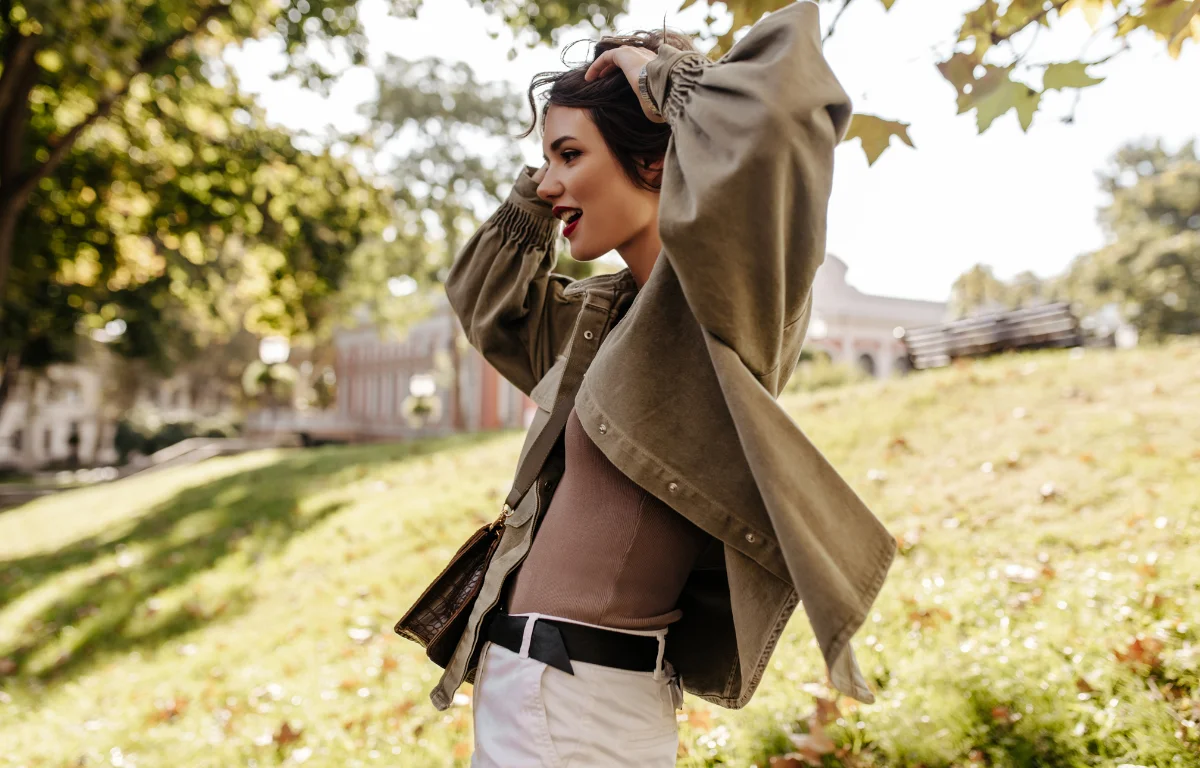
Spring almost never begins with the calendar.
It begins with the body — earlier than the weather, earlier than a wardrobe update, earlier than conscious decisions.
At some point, it becomes noticeable: familiar layers start to press, dense fabrics feel tiring, and movement asks for more space. This is not about fashion and not about the desire for “something new.” It is a physiological shift: the body leaves the winter mode of conservation and begins to look for expansion.
Spring style is not about trends.
It is the language through which the body speaks about a change of its inner season.
Why clothes feel different in spring: physiology, not mood
During winter, the body works in a mode of holding: heat, energy, resources. There is less light, the serotonin system slows down, movements become economical. Clothing during this time performs a stabilizing function — it is meant to “hold.”
As daylight increases, not only the emotional background changes. The neurohormonal system is being recalibrated:
- serotonin activity increases;
- bodily sensitivity grows;
- reactions to pressure, seams, and fabric density appear faster;
- the need for micro-movements and skin “breathing” intensifies.
That is why in spring familiar clothes suddenly feel “wrong”:
too heavy, too closed, too fixing.
This process is clearly explained in the article on seasonality and movement — how light and daily rhythm reshape bodily tempo and our perception of clothing: https://union.beauty/publications/seasons-and-motion/
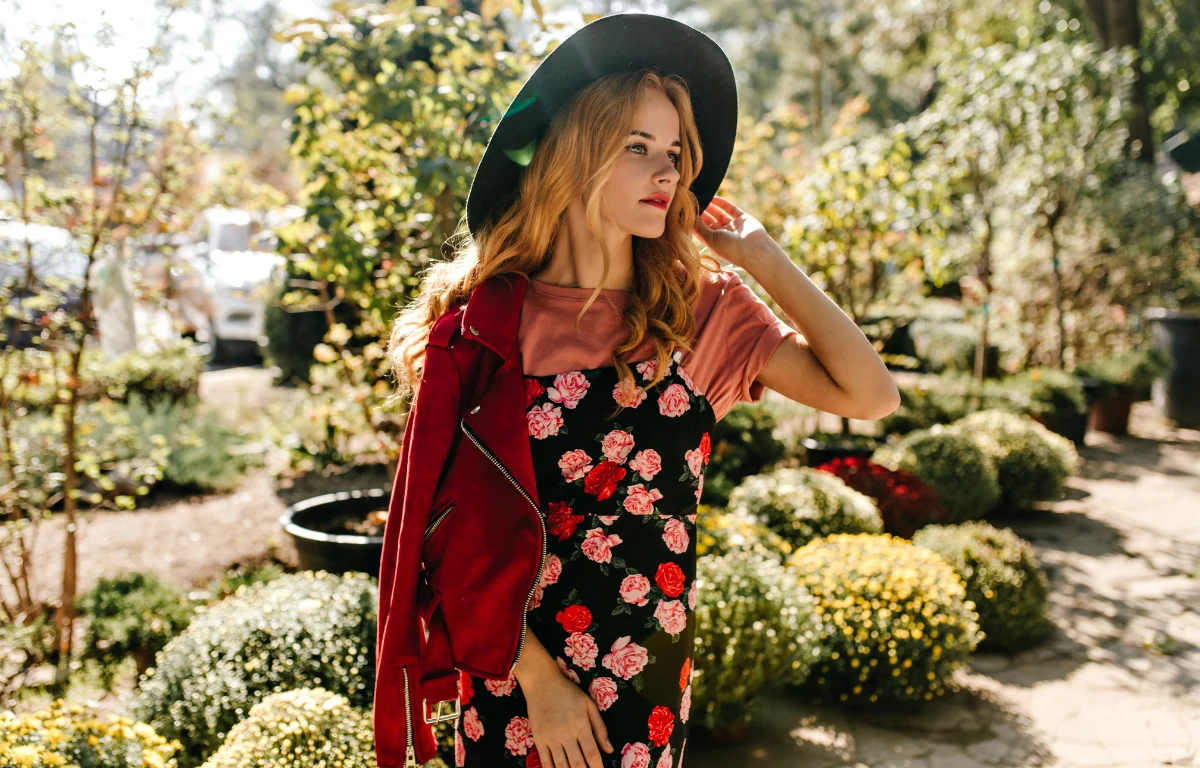
Spring awakening of the body: what actually changes
Spring is not an energy surge. It is a recalibration of sensitivity.
The body gradually becomes:
- more attentive to touch;
- less tolerant of rigid constructions;
- more sensitive to synthetics and “dead” textures;
- oriented toward movement rather than fixation.
In this period, clothing either supports adaptation or intensifies inner conflict.
That is why spring style works not as decoration, but as a regulator of state.
How spring clothing affects energy and motivation
A common mistake is expecting motivation to “switch on by itself” with the arrival of spring.
In reality, the body needs an external signal of safety and readiness for movement — and clothing becomes one of those signals.
When fabric:
- does not interfere with breathing,
- allows the body to move in micro-amplitudes,
- creates a feeling of lightness without losing shape,
— the nervous system transitions into action mode more quickly.
This mechanism is examined in detail in the article on dopamine dressing and motivation: https://union.beauty/publications/dopamine-dressing-and-motivation/
What matters here is not brightness or “uplifting” colors, but bodily coherence.
Spring wardrobe and inner readiness for change
Spring often coincides with inner questions:
“Am I ready for something new?”, “Do I want change?”, “Why does it feel like the time has come, but inside there is still a pause?”
It is important to understand: the absence of desire to renew is not always resistance.
Sometimes it is a sign that the body needs additional time for adjustment.
In such moments, clothing should not “push.” It should support presence — the sense of being in contact with oneself here and now.
This is explored further in the article on inner presence and the psychology of style: https://union.beauty/publications/inner-presence-and-style-psychology/
Style in spring can become a form of bodily honesty rather than a mask.
Spring textures: what truly works for the body
In spring, transitional textures are especially important — neither winter density nor summer openness.
On a sensory level, the most supportive are:
- fabrics with a living, mobile structure;
- materials that respond to movement rather than resist it;
- soft forms with minimal yet perceptible architecture.
Overly rigid constructions intensify inner tension.
Overly “fluid” shapes can create a sense of lost support.
The balance between softness and structure is described in detail in the article: https://union.beauty/publications/soft-and-structured-textures/
It is precisely these textures that help the body transition into spring mode without overload.
Spring awakening through clothes is not renewal, but tuning
Spring style is not about a “new look.”
It is about subtle retuning:
- when clothing becomes lighter, but not empty;
- when form supports rather than controls;
- when the body feels readiness for movement without pressure.
Often it is enough to:
- replace one dense layer with a more mobile one;
- soften the shoulder line;
- reduce pressure around the waist or collar;
- choose a fabric that “breathes” together with the body.
Such small changes work more deeply than radical wardrobe updates.
The one piece truly worth adding for spring
If you choose only one new item for spring, let it be a soft, mobile outer layer — not a coat or a rigid jacket, but something in between. A light trench, a thin jacket, a loose cardigan, or an overlay shirt. A piece that can be worn open, thrown on and taken off effortlessly. These items give the body a sense of choice and movement — which is the core spring signal for the nervous system.
Why spring style is always about trust in the body
Spring sharpens the connection between sensation and choice.
If bodily signals are ignored, style begins to irritate.
If they are listened to, it becomes a resource.
Spring awakening through clothes is not a method and not a strategy.
It is an invitation to attentiveness:
to the weight of fabric,
to the reaction of the skin,
to the desire to move or to slow down.
Clothing is not the goal here.
It is a tool of gentle transition, in which the body itself suggests the rhythm.
Conclusion
Spring does not require courage.
It requires sensitivity.
And if style during this period becomes quieter, simpler, and more precise —
it means the body has already awakened.
Sources
- Lambert, G. W. et al. Effect of sunlight and season on serotonin turnover in the brain
- Milosavljevic, N. et al. How does light regulate mood and behavioral state?
- Sansone, R. A.; Sansone, L. A. Sunshine, serotonin, and skin: a partial explanation for seasonal patterns
- Stewart, D.; Albrecht, U. Beyond vision: effects of light on the circadian clock and mood-related behaviours
- Bertani, D. E. et al. A review on the effects on mental health of exposure to light