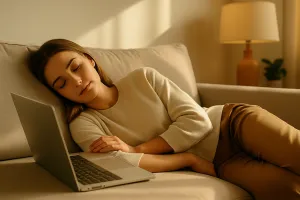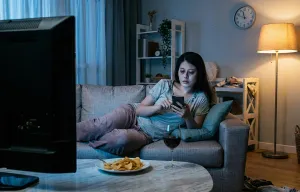







Most people today live by the principle “from screen to screen”: the phone wakes us in the morning, the laptop follows us through the day, and in the evening we again fall asleep with a smartphone in our hand. It seems like just a modern norm. But for the nervous system and sleep hormones, screens are a constant signal: “the day is still going, it’s too early to relax.”
In our guide to sleep and the nervous system we have already said that the quality of the night depends on the whole day. In the article about evening habits that steal sleep we focused on how series, late work and heavy snacks spoil recovery. In this piece we will focus specifically on screens: blue light, endless content and the habit of keeping the phone nearby until the very last minute.
How the inner clock works and why screen light interferes with it
In our brain there is a kind of “central clock” — a group of cells that track the change of day and night. They do not look at the calendar, but at light: bright daylight is a signal “we are active”, darkness is a signal “we can slow down and prepare for sleep.”
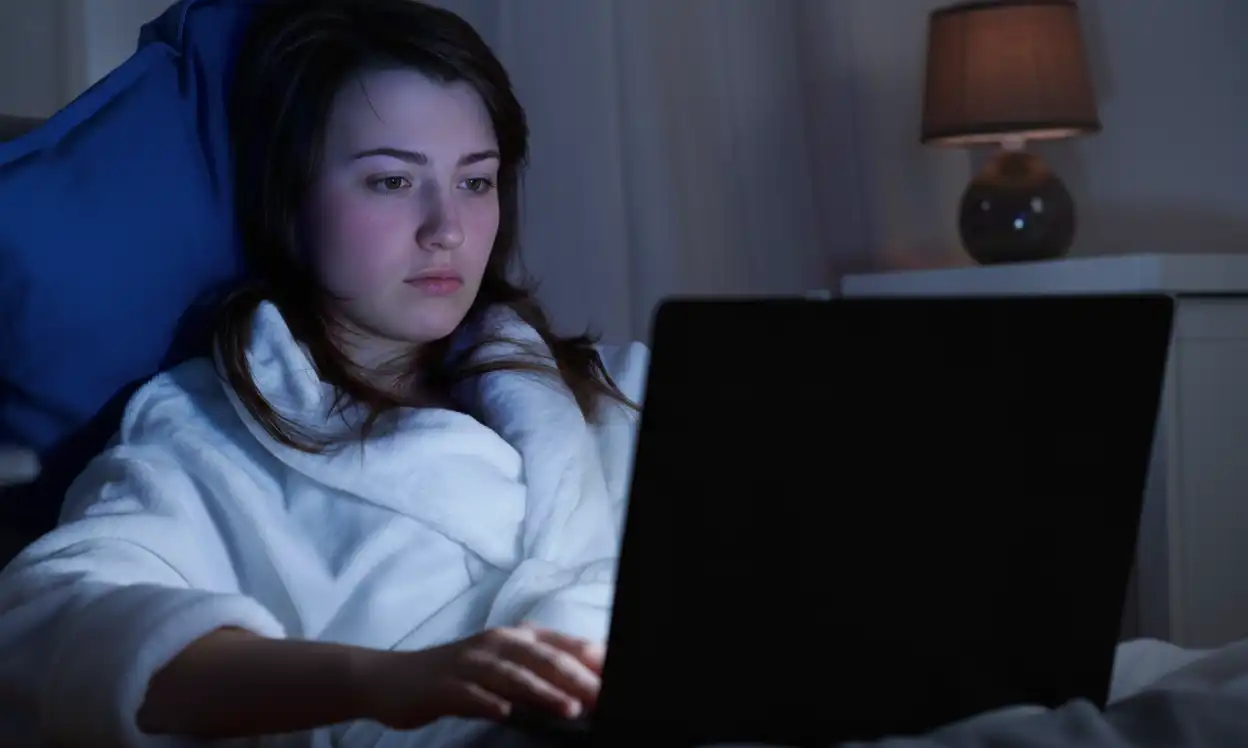
In the evening, when it gets darker, the body begins to produce melatonin — a hormone that can roughly be called a “night message for the body”: “time to slow down, sleep is coming.” If we sit in front of a bright screen, especially with a cold bluish tint, the brain perceives it as a continuation of the day.
As a result:
- melatonin starts to be released later than it should;
- it becomes harder to fall asleep, even when you are exhausted;
- sleep becomes more shallow, with fewer restorative phases;
- the morning feels “heavy”, as if you slept in fragments, not the whole night.
This does not mean that one evening with a phone “breaks” sleep forever. But the long-term habit of sitting in bright screen light until midnight creates a very clear scenario for the nervous system: “we do not switch off, we stay on alert.”
Blue light versus warm light: not all screens are the same
It is blue light that affects the inner clock the most. During the day it is useful: it helps us feel alert, supports concentration and lets the brain know that this is the active part of the day.
The problem is that:
- smartphones and laptops by default emit quite “cold” light;
- we often keep the screen very close to our eyes;
- evening screen time rarely stays within 5–10 minutes.
Warm, dim light (a floor lamp, bedside lamp, candle) is read by the brain differently: it interferes less with melatonin production and helps the body understand that the day is coming to an end. That is why it is important not only to “spend less time on the phone”, but also to change the overall picture of evening lighting.
Not only light: what endless content does to the nervous system
Light is only half of the story. The other half is the content itself. Social media feeds, news, chats, short videos are not “passive rest”, but constant stimulation of the nervous system.
Every message, headline, comment or new clip is a micro-reaction:
- anxiety from the news;
- anger or hurt from someone’s words;
- comparison with “perfect” pictures of other people’s lives;
- sudden bursts of joy, laughter, excitement.
In these moments the brain is not resting — it analyses, reacts, compares, evaluates. Instead of a smooth “fade-out” at the end of the day, the nervous system gets another wave of stimuli.
If you finish the day not with quiet, repetitive actions (rituals), but with a feed that throws up new stimuli every second, the body simply does not have time to move into recovery mode. That is why after “two hours on the phone before bed” we often feel exhausted and at the same time somehow “overheated from the inside”.
Why strict gadget bans rarely work
When sleep has been poor for a long time, the first thought is “tomorrow I’ll live properly.” A complete ban on the phone in the evening, no series, a perfect schedule, reading paper books in warm light. Such an experiment may hold for a few days, but then often ends in a breakdown and the feeling: “there’s something wrong with me if I can’t keep such a simple rule.”
The reason is not “weak will” but the fact that gadgets perform extra functions:
- distract from heavy thoughts before sleep;
- give a sense of control and connection with the world;
- become the only “personal time” at the end of the day.
If you simply take the phone away without offering the nervous system anything instead, it will cling to the old habit even more. So the task is not to forbid everything, but to gradually change the evening scenario to something gentler for the body.
How to gently change your relationship with screens in the evening
1. A “digital sunset”, not instant darkness
Instead of a harsh “after 9 p.m. the phone is banned”, you can introduce the idea of a “digital sunset”. This means that after a certain time:
- screen brightness goes down;
- a warm tint (“night mode”) is switched on;
- you move to “lightweight” content or put the gadget away altogether.
For example, after 10 p.m. — no news or work chats, only calm music, an audiobook or messaging with close ones (if it does not provoke arguments or stress).
2. First change the content, then the time
If it is still hard to shorten your time with the phone, you can start with something else: change what you watch in the evening. Less alarming news and conflict discussions, more predictable, calm content without sharp emotional jumps.
When the nervous system gets used to the idea that the evening means less “loud” emotions, it becomes easier to shorten screen time itself.
3. A “parking spot” for the phone and a no-screen corridor
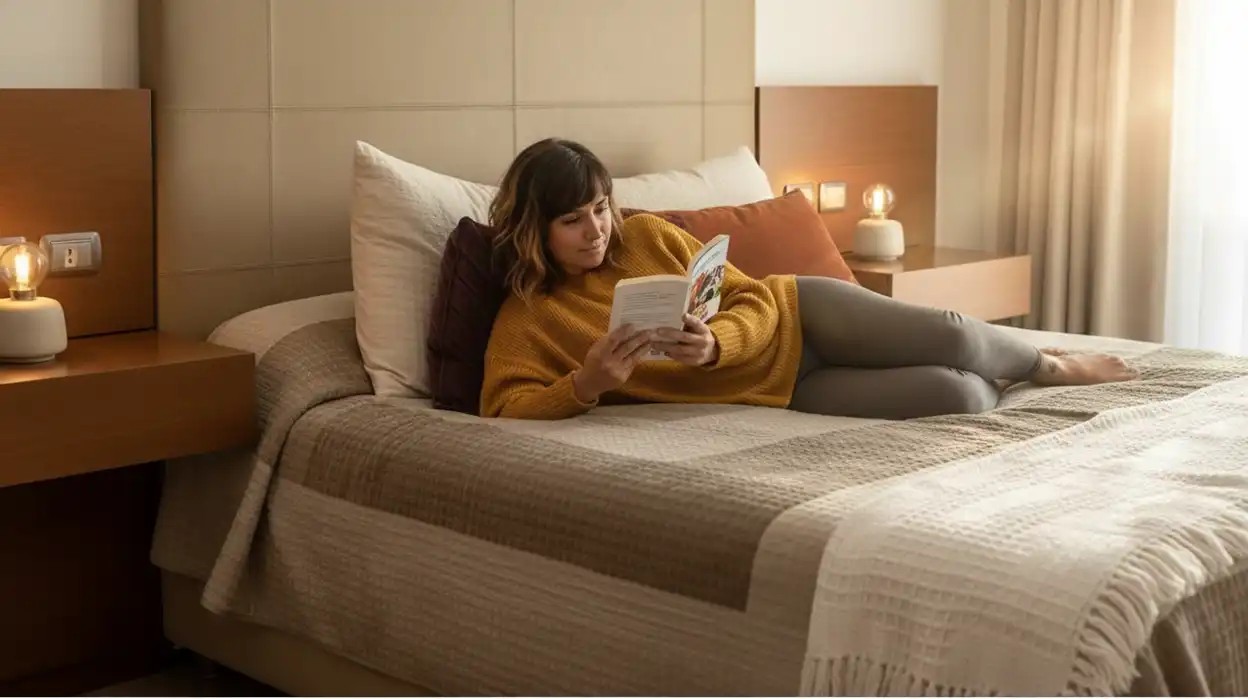
One of the most practical steps is to decide where the phone will “sleep”. It can be a shelf in the hallway, a desk or a charger in another room. The main idea: the bed is not a place for endless scrolling.
Try to create at least 20–30 minutes of a “no-screen corridor” before sleep. During this time you can:
- take a warm shower or bath;
- do light stretching or self-massage;
- write a few lines in a journal;
- spend time in hugs with a partner, child or pet.
In the article on touch and the nervous system we explain in more detail how physical contact helps the body move from “fight-or-flight” mode into a state of “I’m relatively safe”.
4. Use technical settings to your advantage
Technology can be not only a problem but also part of the solution. It is helpful to:
- switch on “night mode” or a warm blue-light filter after a certain hour;
- reduce screen brightness in the dark;
- turn off some notifications, especially informational and work-related ones;
- set a “time to finish the day” reminder 30–60 minutes before sleep.
This does not replace changing habits, but creates a gentler environment for the nervous system.
If silence without screens makes you anxious
In the article “When calm brings no joy” we wrote that the brain can get so used to stress that silence seems suspicious. That is when we want to turn on a series or social feed until the very last second — not so much for the plot as to avoid being alone with our thoughts.
In such a situation it is useful not to demand “perfect silence” from yourself, but to offer the nervous system a soft background:
- calm music or an audiobook;
- sounds of rain, the sea, a fireplace;
- warm yellow light instead of total darkness.
Bodily grounding practices also work well: a warm blanket, a hot-water bottle on the belly or feet, self-massage, slowly rolling your back on a mat. We will collect some of these practices in a separate article on grounding and breathing techniques before sleep.
What to do if you work at a screen late
There are professions and life situations where an evening without screens is still a fantasy. Working with clients in other time zones, urgent deadlines, small children who fall asleep late — all this is reality, not “bad habits”.
If it is impossible to remove evening work completely, you can at least:
- divide the evening into two blocks: a “work” one and a “recovery” one, even if the latter is only 20–30 minutes long;
- finish work emails and chats at least 30 minutes before you go to bed;
- after turning off the laptop, perform a short end-of-day ritual: write down tasks for tomorrow, close tabs, literally “remove work from sight”;
- switch from a bright monitor to warm, dim lighting and spend a few minutes stretching or in the shower.
Even a small gap between the work screen and sleep gives the nervous system a chance to lower tension at least a little.
How screens are linked to daytime fatigue and microsleep
Excess screen time affects not only falling asleep in the evening. Constant switching between apps, emails, chats and tabs exhausts attention no less than physical work. At some point the brain starts to “ask for a reboot”.
The following appear:
- a feeling of a “cotton-wool head”;
- difficulty focusing on simple tasks;
- a constant desire to “switch off for at least a minute”;
- the temptation to compensate for fatigue with one more stimulant — coffee or another portion of news.
In such situations a short daytime microsleep can help. In the article about microsleep we talk in more detail about how 10–20 minutes of short sleep help the nervous system reboot. But to prevent daytime fatigue from becoming chronic, it is important not only to add microsleep, but also to reduce sources of overload — including chaotic screen time.
When it’s time to think about extra support
Changes in the evening scenario and your relationship with screens often already bring a noticeable effect: it becomes easier to fall asleep, there are fewer night-time awakenings, and you feel more “properly rested”. But sometimes it is different: you honestly cut your screen time and sleep still remains heavy and shallow.
Look more closely at your state if:
- you wake up shattered even after a full night;
- daytime sleepiness follows you every day;
- panic attacks often appear, especially at night;
- interest in things that used to bring joy disappears;
- intrusive thoughts about hopelessness or death appear.
In such cases the problem is often not only screens, but also anxiety disorders, depression or chronic stress. In the article on “quiet fatigue” we describe in more detail the state where ordinary rest no longer restores you and strength does not return even after weekends.
Where you can start already today
You do not need to organise a “perfect evening without screens” tonight. Choose one or two changes that feel realistic for you:
- put your phone on charge not in the bed, but in another room;
- set yourself a “last news time” — for example, no later than an hour before sleep;
- switch on warm lighting and the screen’s night mode after a certain hour;
- add at least 10–15 minutes of a “no-screen corridor” before sleep — with a shower, stretching or quiet hugs.
Each of these steps is a signal to the nervous system: “our evenings are becoming safer.” Together with the other elements we talk about in the full guide to sleep and the nervous system, this gradually helps bring back the feeling that the night really restores you instead of just pushing fatigue to tomorrow.
-lazy-placeholder.webp)
-medium.webp)