







There are evenings when your body feels like a tightened string: your head hums from the events of the day, your heart beats faster and your thoughts jerk from tasks to the news and back. Your eyes already want to close, but as soon as you lie down in bed, another round of tension switches on inside. In our big guide on sleep and the nervous system we have already written about how stress disrupts the sleep–wake cycles. This article is about how to gently regain a sense of support with the help of grounding and breathing practices.
Grounding and breathing are not “magic techniques” that instantly cure insomnia. They are simple tools that help you tell your nervous system: “we are already at home, it is safe around us, you can gradually slow down”. You can adapt them to yourself, combine them with evening rituals and use them as a bridge between a tense day and sleep. We have already collected some of these evening rituals in the article on evening habits for better sleep.
What is grounding and why is it helpful before sleep?

Literally, grounding is bringing your attention back into the body and into the present moment. When we feel anxious, the mind constantly jumps into the future (“what if…”) or into the past (“why did I do it that way…”). The body in this state almost disappears from our field of view, leaving only a background discomfort.
Grounding practices help you to:
- remind yourself that “I am here and now”, not in news feeds or future scenarios;
- bring attention back to sensations of support, warmth and touch;
- reduce the intensity of anxious thoughts by at least a few points;
- send a signal to the brain that there is no danger right now and it can switch to recovery mode.
Grounding works best not as a one-time “emergency tool”, but as a small yet regular part of the evening. In this it is similar to other gentle rituals from the article on evening habits for better sleep.
How do you know that the nervous system is “overheated” and needs grounding?
Sometimes we notice only the consequence: it is hard to fall asleep, the head “won’t switch off”, and the body feels tense. But if you look closely, the signals of an overloaded nervous system appear earlier:
- by the evening you feel that there are too many thoughts and it is difficult to concentrate even on simple tasks;
- the body is tense: tight shoulders, jaw, back, and it is hard to take a deep breath;
- there is a combination of exhaustion and inner agitation: “I am tired, but I somehow cannot switch off”;
- closer to night you want to scroll through a bit more news, messages or tasks instead of finishing the day.
If this state repeats regularly, the nervous system lives as if at an increased speed. We write separately about how this affects daytime sleepiness in the article on the state “I constantly want to sleep during the day” and microsleep. In this context, grounding and breathing practices are a way to give the system at least short “windows of recovery”.
Which grounding exercises can you do at home in the evening?
Below are several options that do not require any special conditions. Choose one or two and try doing them for a few evenings in a row to feel how exactly your body responds.
The “5–4–3–2–1” exercise: returning to the here and now
Sit down or lie in a way that your back has support. Slowly scan with your attention everything that surrounds you and name to yourself:
- 5 objects that you can see;
- 4 objects or surfaces that you can feel by touch;
- 3 sounds that you can hear right now;
- 2 smells or tastes that you can detect;
- 1 thing you are grateful to yourself for today.
The goal is not to “do the exercise and fall asleep”, but to give the brain an alternative to endless chains of thoughts. You are essentially bringing it back from the future and the past into the room where you actually are.
Grounding through body support
Lie down on the bed or sofa and try to feel how your body touches the surface: the back of the head, shoulder blades, pelvis, legs. Imagine that the mattress is not just a soft surface but a reliable platform that “holds” you completely.
You can scan your body with attention from feet to the top of the head, asking yourself: “Can I allow this part of the body to become at least 5% heavier?”. You are not forcing the muscles to relax, you are offering them an option: “you do not have to hold everything up right now”.
Warmth and touch as grounding
For many people, the feeling of warmth and safe touch helps:
- wrapping yourself in a blanket or putting a warm cardigan over your shoulders;
- placing one hand on the chest and the other on the abdomen and feeling the breath move under your palms;
- gently rubbing your palms together to feel warmth and the texture of the skin.
These are not “childish” gestures but the language of the nervous system: through warmth, weight and touch it receives the signal that there is support nearby.
Which breathing exercises for better sleep actually help you fall asleep?
Breathing is one of the few processes that work automatically and at the same time can be gently regulated. When we consciously slow down the breath and lengthen the exhale, the nervous system receives the signal that it is possible to lower the tension.
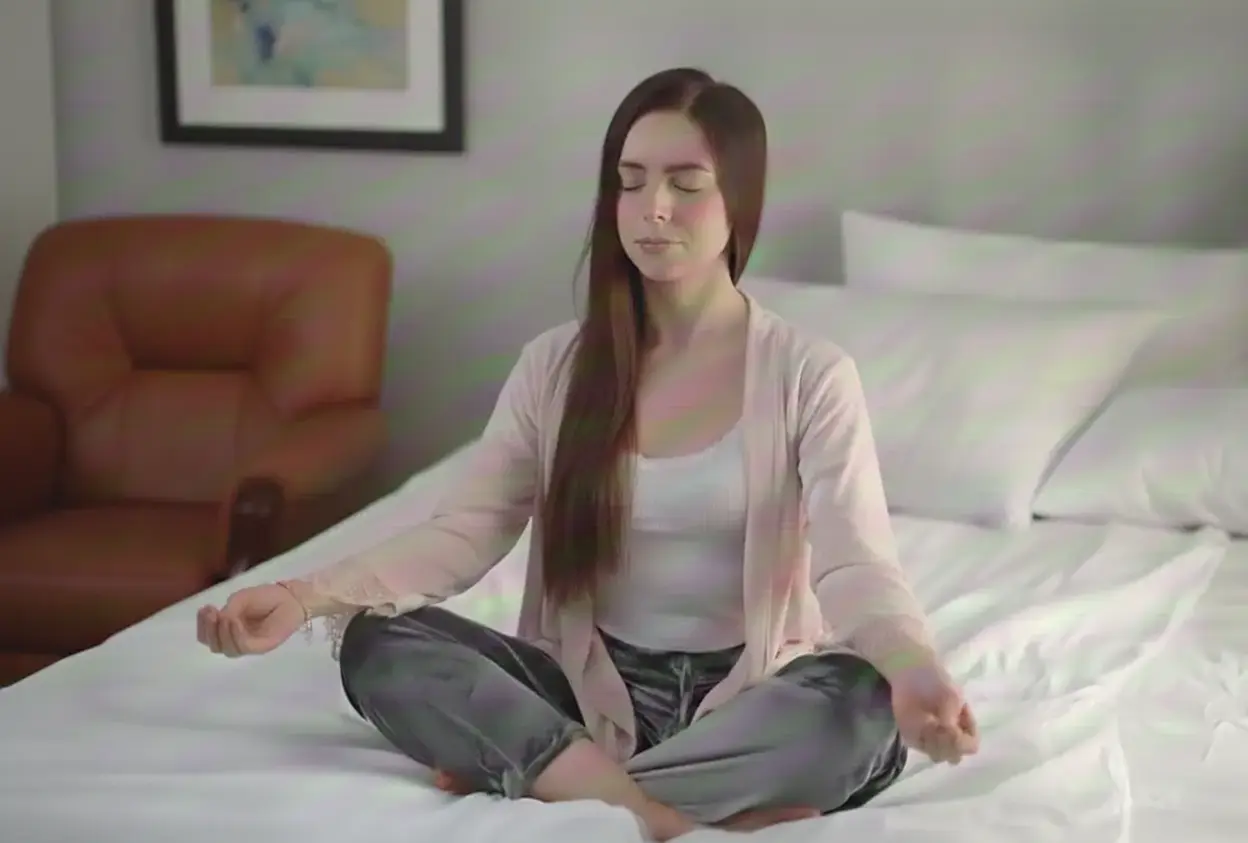
Extended exhale: a simple base for the evening
Sit or lie down with support under your back. Take a few usual inhales and exhales without changing the rhythm. Then start gradually lengthening the exhale:
- inhale for about 3–4 counts;
- exhale for 5–6 counts.
If counting is uncomfortable, you can focus on the sensation: the exhale should be noticeably longer but without feeling “out of breath”. Two to five minutes of such breathing is enough for the body to notice the change of rhythm.
“Box” breathing: structure for a scattered mind
This technique is often used in stressful situations, but it also works for the evening:
- inhale for 4 counts;
- hold the breath for 4 counts;
- exhale for 4 counts;
- hold after the exhale for 4 counts.
This forms a mental “square” of four equal segments. If long holds feel uncomfortable, you can shorten them or keep only the pause after exhaling. The main thing is not to force yourself, but to look for a variant in which the body feels a bit more space.
Breathing together with the body
If thoughts keep “running away”, combining breathing with the sensation of movement in the body can help. Place your hand on your abdomen and imagine that with each inhale it slightly expands, and with each exhale it gently lowers again. You can add a short phrase:
- on the inhale: “I notice the tension”;
- on the exhale: “I give myself a bit more space”.
The phrase does not have to be perfect; it is more important that it sounds true to you and does not provoke inner resistance.
How to combine grounding, breathing exercises and evening habits for better sleep?
These practices work better when they are built into the overall rhythm of the evening. A few guidelines:
- 1–2 hours before sleep, gradually start reducing the amount of bright stimuli: loud series, news, work emails. We talk in detail about how screens and blue light affect the sleep–wake cycle in the article on screens, blue light and sleep;
- choose one or two grounding exercises and one breathing practice as your “minimum program” for the evening;
- anchor them to a specific moment: after a shower, after switching off the laptop, before getting into bed;
- if thoughts are especially intrusive, add a short journaling session to “voice them onto paper”. We explain this in more detail in the article on the sleep diary and anxiety.

As a “minimum program”, you can try such a mini-plan for this evening:
- 3–5 minutes of extended exhale in a comfortable position;
- one simple grounding exercise that resonates with you the most;
- no highly emotional content for an hour before sleep — replace it with something neutral or calming.
It is important not to turn the evening into another project “to do everything perfectly”. If you only managed a couple of minutes of breathing or one grounding exercise, that is already a contribution.
What to do if the exercises do not help or help too little?
Sometimes even regular grounding and breathing practices provide only slight relief. This can be a signal that there are other important factors in your sleep story:
- chronic daytime sleepiness, when you “nod off” during the day and the night sleep still does not restore you. We talk about this in detail in the article on daytime sleepiness and microsleep;
- hormonal shifts, sleep apnoea and other medical conditions that affect the quality of recovery. We will discuss them separately in the article on cortisol, melatonin and the circadian rhythm;
- pronounced anxiety or depressive symptoms, when evening thoughts are saturated with a sense of hopelessness, guilt or shame.
In such cases, the practices are not useless, but they should be seen as support rather than the only pillar. An important step can be talking to a family doctor, psychotherapist or psychiatrist, depending on which symptoms are present. This does not mean that “something is wrong with you”, but rather that your nervous system needs additional help.
How to make grounding and breathing part of self-care, not another obligation?
The most common trap is to perceive these practices as another “must”: if you did not do them today, it means you did not try hard enough. This approach only increases tension.
Instead, you can try another frame: “I add these few minutes not because I have to, but because I want to give myself a bit more support”. For some people this will be two minutes of extended exhale in bed, for others a short grounding practice before turning off the light, for others a combination of breathing and a sleep diary.
Like any habit, grounding and breathing exercises need time to take root. But even small changes — for example, when falling asleep becomes 10–15 minutes easier and the morning feels slightly less exhausting — already show that the nervous system responds. And that in the story of your sleep there is not only fatigue, but also room for gentle self-care. If you want to understand more deeply how sleep is connected with the nervous system in general, you can return to our guide on sleep and the nervous system.