






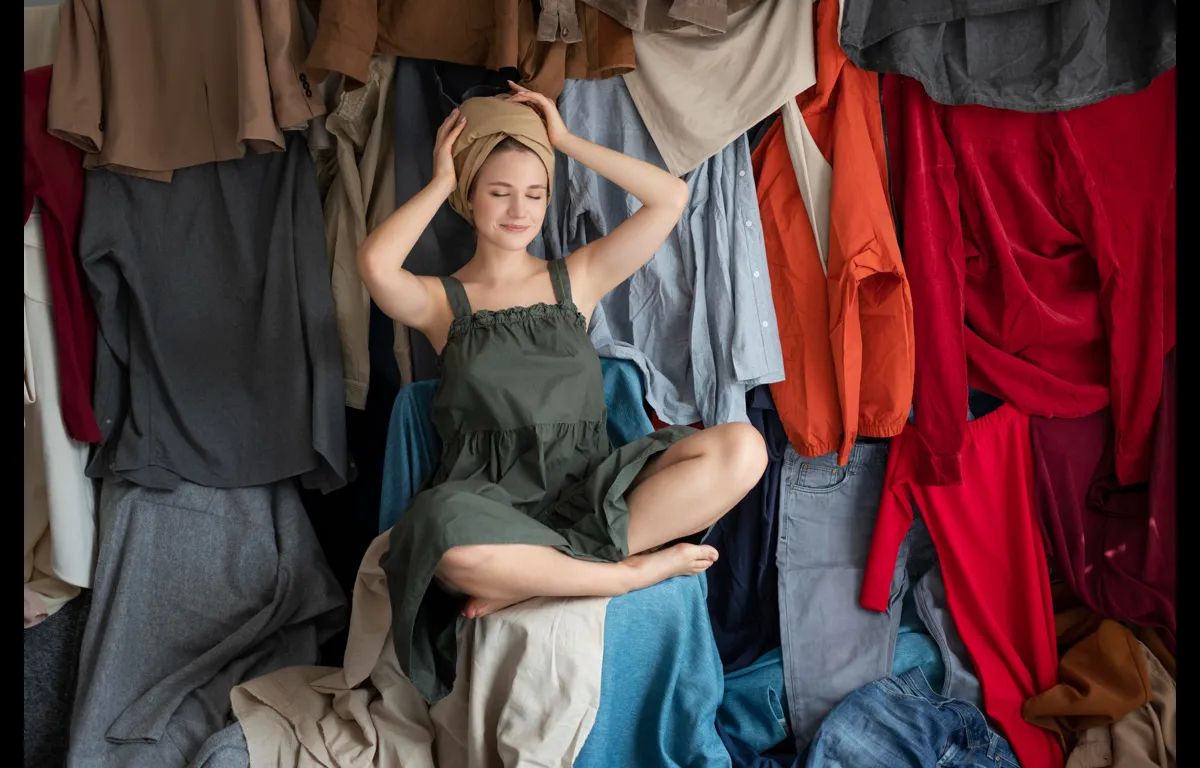
There are garments we barely notice — and those are the ones that work best. A sensory basic wardrobe is created not for style, but for quiet: quiet in the body, quiet in the nervous system, quiet in the part of us that meets the world every day. When fabrics, seams and fit do not interfere, the body seems to “align”, becoming collected and steady.
In the article What the body feels in clothes: the sensory and postural nature of style we explored how the brain responds to weight, pressure and structure. In Soft and structured textures: how fabric surfaces shape bodily perception” we examined how textures influence emotional tone. Now — the practical side. How to build a basic wardrobe that cooperates calmly with the nervous system.
.webp)
Why the sensory wardrobe is not about style
A true wardrobe foundation is neither a trend nor a capsule. These are clothes that act as a “sensory background”: they do not distract, irritate or pull attention away. They create an even environment for everything else — colour, silhouette, mood, creativity.
The brain reacts to clothing faster than we can think about it. A tiny shift of a seam, a stiff label, a fabric that is too light and flickers against the skin — all of these are small but constant sensory stimuli. The nervous system spends energy managing them, and we experience this as fatigue, irritability or instability.
A sensory wardrobe removes this noise. It provides a sense of one’s own outline and internal order.
The three sensory pillars of a basic wardrobe
1. Tactile quiet
The first layer consists of garments that touch the body directly: underwear, tanks, tops, T-shirts, soft knitwear. Their primary task is to not make themselves known. Satins, polyester and rigid synthetics create micro-loads that accumulate throughout the day.
Cotton, modal, viscose and fine merino wool stabilise. The nervous system receives the signal “safe”, while the body receives evenness and warmth.
2. Temperature balance and steadiness
The second layer supports the body’s microclimate: shirts, long sleeves, lightweight sweaters, cardigans. Warmth is one of the strongest sensory regulators. Even a slight chill across the shoulders raises cortisol levels — while steady warmth creates an inner sense of grounding.
This is the layer that quite literally “holds us together”. When it is chosen correctly, we tire less and concentrate better.
3. Structure for collectedness
The third layer — blazers, more structured shirts, light coats, defined cardigans. Structure forms the body’s boundaries. It does not squeeze or restrain — it defines. Such pieces act as a “frame” that helps the brain read the body’s position in space more accurately. This reinforces stability and presence.
Structured garments are not about strictness — they are about clarity.
How the body signals that a garment is “yours”
Everyone knows the moment: you put something on — and it either settles onto the body instantly, or it doesn’t. This is not about aesthetics, but about neurosensory fit. We perceive:
- whether the weight is distributed evenly;
- how the fabric moves with the body;
- whether the shape matches the body’s own geometry;
- whether micro-tension appears;
- whether the skin can breathe.
When a garment fits sensorially, the body relaxes immediately. When it doesn’t, subtle tension appears — and stays with us all day.
Choosing clothing as dopamine regulation
A sensory wardrobe influences not only calm but also motivation. When we put on something predictable, pleasant and stable in the morning, the brain receives a small but clear dopamine signal of “order”, “control”, “I can”. We will explore this further in the article https://union.beauty/publications/dopamine-dressing-and-motivation/
Seasonal sensory shifts
The wardrobe changes with the seasons not only stylistically, but sensorially. Summer means more air and movement; winter — more warmth and mass. In spring the body responds to light; in autumn — to its decrease. Each season has its own neurophysiology.
Summer
The body needs fabrics that breathe yet do not create “emptiness”. Soft linen, thin cotton, viscose. Seams — minimal. Contact — gentle. We will expand on this topic in the article Summer body, light and serotonin.
Winter
Winter is the season of weight. Additional mass on the shoulders and torso has a calming effect: it slows breathing, stabilises the nervous system and creates the sense of “I am here”. But the weight must be correct — not pressing, not constricting.
Autumn and spring
These are transitional seasons when the body is especially sensitive to temperature instability. Here layered combinations work best — easy to add, easy to remove. Calm comes from adaptability.
Why the sensory wardrobe is not minimalism
Minimalism is about fewer items. The sensory wardrobe is about less noise. For some it may be 15 pieces; for others — 40. It is not about quantity, but about the quality of inner experience.
When the sensory foundation is assembled, clothing stops being a stimulus — and becomes support.
This is the deepest form of comfort: not the one that decorates, but the one that helps us be ourselves.
Sources
- Abraira, V. E., & Ginty, D. D. (2013). The sensory neurons of touch. Neuron, 79(4), 618–639. URL: https://pubmed.ncbi.nlm.nih.gov/23972592/
- Grandin, T. (1992). Calming effects of deep touch pressure in patients with autistic disorder, college students, and animals. Journal of Child and Adolescent Psychopharmacology, 2(1), 63–72. URL: https://pubmed.ncbi.nlm.nih.gov/19630623/
- Kamalha, E., et al. (2013). The comfort dimension: A review of perception in clothing. Journal of Sensory Studies. URL: https://onlinelibrary.wiley.com/doi/10.1111/joss.12070
- Tadesse, M. G., et al. (2021). Comfort evaluation of wearable functional textiles. Coatings, 11(11), 1314. URL: https://pmc.ncbi.nlm.nih.gov/articles/PMC8585350/
- Kay, E., et al. (2024). Sensory considerations for emerging textile applications. Textiles, 4(1), 23–48. URL: https://www.mdpi.com/2673-7248/4/1/2