







When a child seems to "lose it over nothing," it often indicates not bad behavior, but a day where they are already struggling to process the load.
In many families, this scenario is quite familiar. After a busy day, a child might still hold it together but starts to "break down" over small things: struggles to switch tasks, gets upset over simple requests, demands screen time as if it's the only way to relax, gets stuck on routine steps, becomes either clingy or abrupt. From the outside, this can easily be misread as stubbornness, being spoiled, or trying to get their way. But often, we see something else—a state where the system has been collecting stimuli, switching, restraining, adapting since morning, and then simply runs out of flexibility.
This is why the topic of overstimulation isn't just about "less screen time" or "earlier bedtime." It's a broader question—how is the child's day structured, how much light, noise, transitions, minor demands, fragmented attention, screen pauses, and dense periods without breaks are there, and are there moments when they truly get to reduce tension, not just switch to a new stimulus.
The goal of this material is to provide a comprehensive map: where in a child's day overload most often accumulates, how it manifests in behavior, and what exactly an adult can change in the environment to reduce overall tension. This text is not about how to react to an already occurring meltdown, but about how to notice and reduce the accumulation of load before it happens.
In this topic, it's often worth looking at five areas:
- screens as a quick external state regulator;
- light, noise, and visual density of the environment;
- sleep and the quality of winding down before rest;
- fragmented attention and excess transitions;
- overall density of the day—when there are more events than the child can process.
Not "bad behavior," but an overwhelmed regulation resource
One of the main mistakes in this topic is evaluating a child's meltdown solely as a disciplinary event. As if there's a separate situation where the child "misbehaved," and the adult's task is to quickly correct it. But overstimulation works differently. It rarely begins the very second a child cries, screams, or falls to the floor. Usually, it's the final point of a process that has been ongoing for several hours.
A child's regulation doesn't have unlimited capacity. Throughout the day, a child constantly adjusts to rhythm, noise, people, demands, changes in plans, new rules, sensory stimuli. Sometimes they hold back, sometimes they endure, sometimes they switch quickly, sometimes they just get tired from the excess of stimuli. The younger the child, the fewer self-regulation tools they have. But even older children naturally have a reduced reserve of flexibility, attention, and self-control when the load continues without sufficient breaks.
That's why a child who was recently calmly performing a familiar action might suddenly cry over socks, a hairstyle, a noisy store, or a request to hurry up. Not because they're "putting on a show," but because for an overwhelmed resource, even a small task feels like too much. When this understanding comes to a family, the perspective changes: less shame, less struggle, more precision.
Why overload almost always accumulates in layers
Parents often want to find one main culprit. Cartoons. Late bedtime. Daycare. Clubs. The TV in the living room. But in reality, overload almost never rests on just one thing. It accumulates in layers. And that's why it's so easy to underestimate: each individual factor seems minor, but their sum leads to the same meltdown, after which it seems like the child lost it for no reason.
For example, a day might be quite ordinary: early wake-up, noisy morning, commute, lots of people, activities, another activity, a store on the way, half an hour of screen time, bright overhead lighting, quick dinner, rushed bath. In each individual point, there's no catastrophe. But for a child, it's not just one "ordinary day." It's a whole chain of micro-loads, between which there was no real reduction in activation.
This is why in the topic of overstimulation, it's important not to look for a culprit, but to gather a map. Not "what happened today?" but "where was the resource unable to reduce tension?". It's a different question—and it's much more useful.
How the features of maturation and capacity of a child change with age, we separately analyzed in the material "child's age and nervous system: a brief guide for parents". And the role of contact, voice, and presence of an adult—in the article "co-regulation through contact: voice, face, and boundaries". Here the focus is different—specifically on the architecture of the day and the environment where tension either accumulates or gradually subsides.
Screens as a quick regulator, not the sole cause
The screen is rarely the root cause of all children's meltdowns, but very often it becomes a powerful amplifier of an already overloaded state. Its strength lies in quickly capturing attention, sharply displacing boredom, reducing contact with internal tension, and providing the child with an instant, external way to "switch." That's why the request for a screen often sounds particularly insistent at moments when they are already exhausted.
Here it's important to see not just the fact of viewing, but its function. If the screen has become the main way to quickly calm down, the child gets used to a very intense form of regulation. Then quieter ways of recovery—lying down, being nearby, fiddling with something in their hands, sitting in silence, flipping through a book, eating slowly, looking out the window on the way—are already perceived as "insufficient." Not because they are spoiled, but because the threshold of stimulus for calming down has become higher.
Here we are not discussing what specifically to replace the screen with in a difficult moment. This is a separate conversation, which we conduct in the article "the screen as a way to calm down: 5 real alternatives". Within this text, something else is more important: the screen should be seen as part of the overall sensory architecture of the day, not as the sole root of the problem.
Light, noise, and visual pressure of the environment
Light is one of the least noticeable for adults but very strong regulators of a child's state. In many homes, tension is maintained not only by events but also by the background itself: bright overhead lighting, TV, backlights, screens in hands, sharp contrasts between rooms, many objects in the field of view. For an adult, this may seem neutral. For a child, it's a constant signal of activity.
The body doesn't just "look at the light." It orients to it as part of the circadian message: is it time to gather stimuli or time to reduce activation. When the space is too bright, it's harder for the body to transition to slowing down. That's why a child sometimes doesn't look sleepy but rather more wound up—laughs without pauses, runs, argues, can't stop. This isn't a sign of extra resource. Often it's a sign that the system is already overheated.
The same applies to noise and visual density. If there's always something talking, blinking, playing at home, if several people simultaneously address the child, if they are bombarded with requests, questions, and background sounds, they almost have no space for a quieter mode. In such conditions, even a calm-natured child can live in hidden internal tension.
Sleep and the decline in regulation capacity
Sleep is not just "night rest" and not only a matter of hours. For a child, it's the main mechanism of recovery after a day where they constantly reacted, restrained, switched, and adapted. If sleep is short, fragmented, or the period before rest doesn't provide real slowing down, the system starts the next day with a smaller reserve.
Another important thing: closer to the end of the day, children's flexibility reserve naturally decreases. Executive functions—the ability to restrain, switch, endure frustration, complete an unpleasant action—work weaker when the resource is depleted. That's why a child might seem to "worsen": argues more, clings more, handles "no" worse, reacts more sharply to touch, noise, requests to finish something.
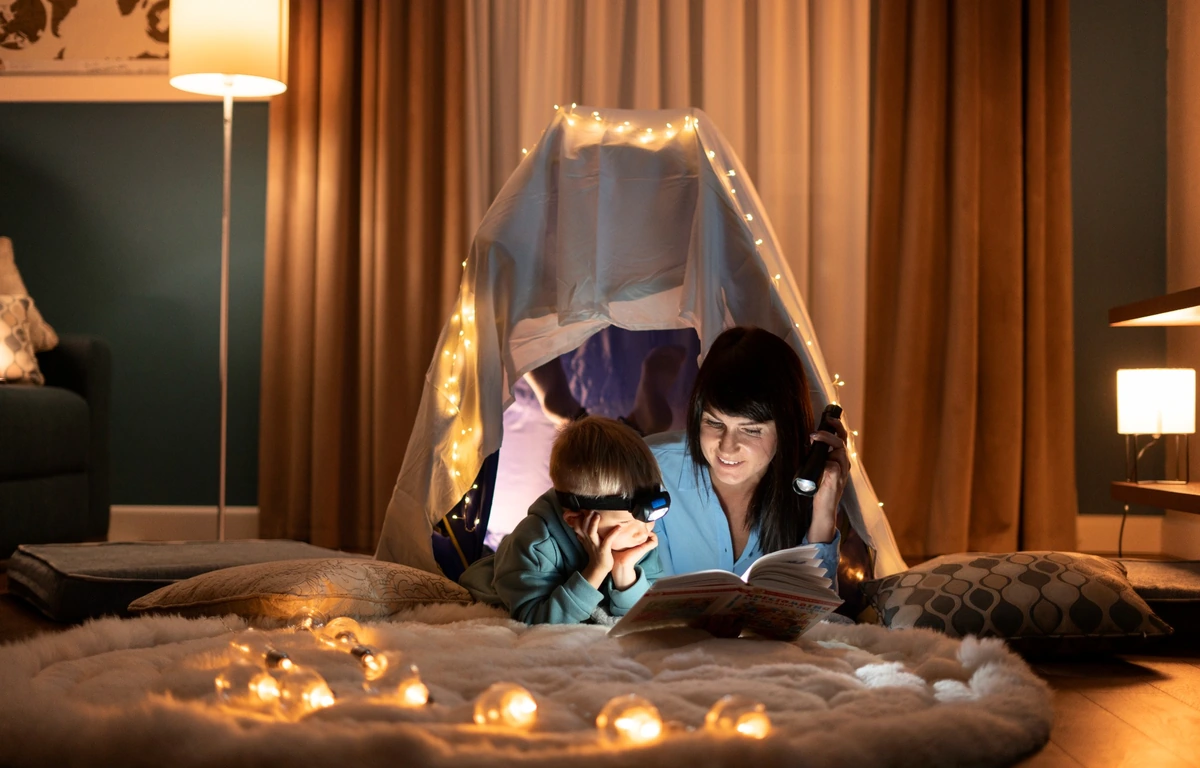
This is one of the reasons why the densest household demands shouldn't be placed on the segment where the resource is already low. If this time is filled with rush, bright light, late screens, many household tasks, and abrupt transitions, we expect maximum composure precisely when its possibilities are minimal.
Fragmented attention, transitions, and fatigue from small decisions
When talking about children's fatigue, it's usually about lack of sleep or excess activities. But the very structure of the day, where attention is constantly torn into pieces, is also very exhausting. The child was just in one format—already needs to transition to another. Just got used to one rhythm—already a new demand. Just settled emotionally—already needs to dress, go, respond, decide, refuse something.
For an adult, this might be "ordinary logistics." For a child—a large amount of invisible work. Each transition requires micro-regulation: finish the previous, endure the change, switch attention, agree with the new rhythm. If there are many such transitions, by the end of the day, they are tired not only from events but from the very necessity to constantly adapt.
Sometimes this is very clear. The child still normally went through one part of the day, still reached the next, still coped with the household. But at the usual phrase "now we do something else," suddenly tears, protest, or complete freezing begin. Not because this action is scary. But because it's another transition in a day where there have already been too many transitions.
This is where it becomes clear why children so need short stretches of single-channel activity—when they don't have to react to multiple streams at once. One action. One rhythm. One sensory layer. Without extra decisions. Without acceleration. Without background noise.
What to change in the environment, not just in behavior
Reducing overstimulation rarely starts with the "right reaction" at the moment of a meltdown. More often, it starts earlier—with reducing the overall density of the day, softening transitions, and a less aggressive background. The most useful thing here is not to wait for the moment of explosion, but to reduce the load even before it. Usually, it's not one "magic technique" that works, but a different assembly of the day.
View the day as a sequence of loads, not separate episodes
A child rarely gets exhausted from one single event. More often, they are overloaded by a combination: noise, rush, bright background, lack of pauses, several transitions in a row, an excess of small decisions. So it's useful to ask not only "what upset them?" but also "how much has the system already endured by this point?".
Reduce background density, not just the number of rules
It's not always necessary to make the day "perfectly organized." Often it's enough to remove the excess: background TV, too bright light, constant switching, hasty instructions, several parallel demands at once. Sometimes this gives more than another educational technique.
Ease transitions, not just demand obedience
Many home conflicts are not power struggles, but transition failures. So sometimes the most effective thing is not to "press for compliance," but to make the moment of change less abrupt. Leave some time between events. Don't pile three tasks at once. Don't combine changing clothes, lecturing, noise, and rush in one minute.
Bring back quiet intervals in the day
Children need not only useful activities but also space without constant consumption of stimuli. Without this, the day becomes a continuous response to the outside world. And then they start defending themselves in ways available to them—refusals, clinging, excitement, abruptness, regression in behavior.
Remember the state of the adult nearby
A child is regulated not only by the environment but also by contact. If the adult themselves speaks from overload, rushes, tenses up, increases the pace, the child reads this as additional pressure. We discussed this topic in detail in the material "co-regulation through contact: voice, face, and boundaries".
Why age changes the picture of overload
The same day is experienced differently at 3 years, 6 years, and 10 years. A younger child quickly "falls apart" externally because their inhibition and self-regulation mechanisms are still maturing. An older child can hold on socially longer but accumulate more internal tension, which manifests later—in resistance, tears, sharp fatigue, or harsher reactions to small things.
This is why this text doesn't try to give the same advice for all age groups. Its role is to show the very mechanism of overload. And age capacity is better viewed separately in the material "child's age and nervous system: a brief guide for parents". Together, these two texts work more precisely: one provides an age map, the other—a map of daily load.
When home changes are no longer enough
Not everything that looks like overstimulation is solved by rearranging the day's routine. If a child almost daily lives in a mode of severe meltdowns, poorly tolerates sound, light, or touch, doesn't recover systematically with sleep, reacts sharply to transitions, or seems to be "on edge" all the time, and simple environmental changes don't provide noticeable relief, it's worth looking more broadly.
Sometimes it's not just accumulated fatigue, but more pronounced sensory sensitivity, anxiety, regulation difficulties, or other features that are better considered with a specialist. This doesn't mean something is "wrong" with the child. It means they need more precise reading and more attentive support.
The most valuable thing parents can do in the topic of overstimulation is to stop seeing each meltdown as a separate moral issue. Often it's not a dozen different "bad episodes," but the same overload mechanism repeating in different forms. And when it becomes visible, there's room for real change.
It's worth starting not with stricter control, but with a careful review of the day's map: where there's too much light, screens, noise, rush, transitions, small decisions, and too little real slowing down. Because very often, a child doesn't need stricter control, but a day that puts less pressure on their system.
Sources
- American Academy of Pediatrics. Screen time guidelines.
- Paruthi S, Brooks LJ, D'Ambrosio C, et al. Consensus statement of the American Academy of Sleep Medicine on the recommended amount of sleep for healthy children: methodology and discussion. Journal of Clinical Sleep Medicine. 2016.
- Akacem LD, Wright KP Jr, LeBourgeois MK. Bedtime and evening light exposure influence circadian timing in preschool-age children: a field study. Neurobiology of Sleep and Circadian Rhythms. 2016.
- Westwood E, et al. The effects of light in children: a systematic review. Sleep Medicine Reviews. 2023.
- Hale L, Guan S. Screen time and sleep among school-aged children and adolescents: a systematic literature review. Sleep Medicine Reviews. 2015.
- Center on the Developing Child at Harvard University. A guide to executive function: what is it, and how is it developed?