






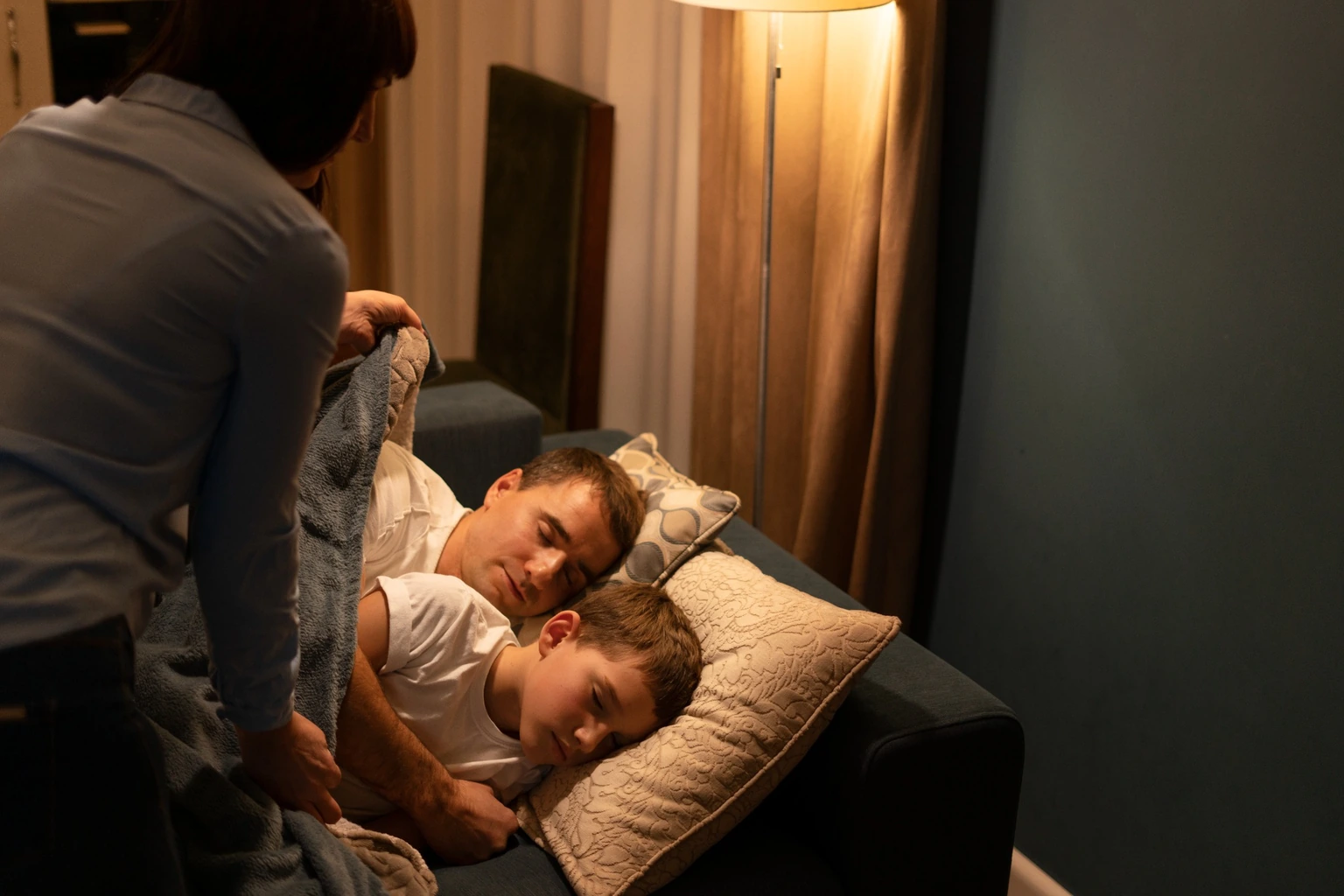
There are evenings when everything seems to go as usual: dinner, pajamas, dimmed lights. But at this very moment, the child suddenly starts arguing over trivial things, asking for more water, another story, another minute, and then seems to "come alive," even though it's clear they're already tired. In such moments, the problem often isn't that the child doesn't want to sleep. It's that they find it difficult to end the day.
Adults usually view the evening as the final task: finish things up, get ready, tuck in, turn off the lights. But for a child, the end of the day isn't just a sequence of actions. It's a transition from noise, decisions, requests, light, physical fatigue, and emotions to a state where they can release tension and fall asleep. If this transition is too abrupt, sleep easily becomes another battleground.
This is why the evening isn't always ruined by a "bad routine." Often, it's the last hour of the day that becomes overloaded with too much at once. And then, it's not stricter control that helps, but a softer and more predictable wind-down. Not a perfect life. Not perfect parents. Just an evening where the system can slow down a bit more easily.
Why falling asleep often becomes harder in the evening
By evening, a child brings not only fatigue but also the entire day's pace. Light, noise, expectations, minor conflicts, travel, activities, school, daycare, news, cartoons, background adult conversations—all of this may not always seem dramatic, but it accumulates. And at some point, instead of quiet drowsiness, there appears a strange resistance: more running, more arguing, more stalling.
From the outside, this can easily be read as "doesn't want to sleep." In reality, it's often not the sleep itself that's difficult for the child, but the moment of transition. Ending the day can be harder than we think. Especially if the last hour is filled with bright light, fast-paced content, hurry, or a sudden halt in activity. You can read more about daily stimulus accumulation in the article how to reduce overstimulation: screens, light, sleep, and attention.
It's important not to mix two different topics here. There are evenings when a child is truly "overwhelmed" more at home, and this is a separate logic we've already written about in the article why meltdowns happen more at home: what helps in the evening. And there's another situation: without a big explosion, but with constant friction, stalling, minor refusals, and exhaustion for everyone. This is the evening "wind-down" we're discussing here.
The problem isn't just the routine, but the quality of the transition between day and night
The idea of the "perfect routine" often sounds beautiful only in theory. Real life rarely follows a stopwatch. Some have activities, some have commutes, some have younger children, some work until evening, and some just have a day that didn't go as planned. But between complete chaos and the cult of the perfect schedule, there's a much more realistic option—a recognizable evening logic.
Sleep prefers predictability over rigidity. It's easier for a child to fall asleep when the evening doesn't start with a new scenario every time but has a familiar pattern: the pace slows down, demands decrease, the light softens, the adult's voice quiets, the body receives several consistent signals that the day is ending. Not because the ritual needs to be beautiful. But because repetition reduces the tension of the transition.
In other words, in the evening, it's often not sleep that's difficult for the child, but stepping off the day's pace. And the less unnecessary friction in the last hour, the more gently the body enters sleep. This is the main idea of the entire evening: not to force sleep, but to help the day come to an end.

7 steps to make the evening easier
1. Start the wind-down a bit earlier, not in the last ten minutes
One of the most common problems is that adults remember about sleep too late. Until then, the evening lives in the day's pace, and then suddenly it's: quick, shower, teeth, bed. For a child, such a turn often feels like a break, not a conclusion. It's better when the transition starts a bit earlier: the light becomes softer, the sound quieter, the movement slower, the conversations shorter.
This doesn't necessarily mean a long, complicated routine. Sometimes a simple shift is enough: the cartoon is turned off not at the last minute, but earlier; dinner ends without rush; after the bath, a new active game doesn't start. A small time buffer often saves the evening better than strictness at the end.
2. Reduce the number of small decisions
When the system is already tired, even a harmless choice can feel like too much. Which pajamas, which book, which cup for water, where exactly to lie, what to take to bed. All these are trivialities only with a fresh mind. At the end of the day, they easily turn into a series of micro-conflicts.
If possible, simplify the evening: fewer forks in the road, fewer negotiations, fewer decisions at the moment of exhaustion. For example, pajamas can be prepared in advance, books narrowed down to two familiar options, and the sequence of actions made almost the same. Not because the child needs to be "pushed." But because a tired system struggles with the unnecessary.
3. Don't leave the hardest tasks for the last hour
Sometimes the evening is spoiled not by one big mistake, but by everything inconvenient being pushed to the end of the day. Wash hair right now. Negotiate something complicated right now. Clean up, remember, respond, change without resistance, quickly decide something. If possible, it's better to move some of this load earlier.
The last hour of the day doesn't like re-education, complex agreements, and endurance tests. The evening almost never becomes softer from the phrase "let's finish this and then sleep." More often, it leads to another round of resistance.
4. Soften the environment, not just "remove the screen"
When talking about sleep, attention often focuses on gadgets. But the problem rarely lives in just one screen. The entire background affects the nervous system: overhead light, loud TV in the next room, fast video editing, active family conversations, hustle, lots of adult voices, even a too-sharp transition from a bright space to a dark bedroom. In the evening, it's not one strict rule that helps, but a general softening of the environment.
Sometimes a few simple changes are enough: remove bright overhead light, turn off background noise, don't start fast content right before sleep, don't speak louder than necessary, don't hold the phone when the evening bridge is already starting. This makes the wind-down more natural.
5. Give the body the same signal to end the day
For many children, sleep becomes easier when the body recognizes the end of the day before the adult has time to explain it. Warm water, pajamas, a soft blanket, a short book, the same phrase, a dim lamp, a familiar place next to the adult—all these are not "magical rituals," but repeatable signals. Their strength lies in not requiring additional effort. They don't explain but show: the day is closing.
No complex ceremony is needed here. Often, one short chain that almost doesn't change works. For example: water, book, hugs, dimmer light. Or bath, pajamas, short conversation, silence. Such familiarity becomes the bridge that's missing when the day was too fast.
6. Don't try to "tire them out a bit more"
The parental logic here is understandable: if the child isn't going to bed, it means they still have too much energy, they need to run, play, laugh, watch, finish. Sometimes this really works earlier in the day. But when the system is already overheated, additional stimulation doesn't calm but awakens. Especially if it's bright, fast, or emotionally intense.
If the child is already "on edge," it's better not to accelerate the evening but to gather it. Not more impressions, but fewer. Not another round of activity, but a quieter rhythm. Not to push the day to the end, but to finally let it end.
7. If everything is already falling apart - first reduce the tension
The most challenging moment comes when the adult is also exhausted. That's when a quick result is desired: be quiet, go, lie down, how much longer, we agreed already. But if the child is already on the edge, pressure rarely restores calm. More often, it adds another wave of tension.
In such moments, it's more useful to think not "how to achieve the right behavior," but "how to make it one degree quieter now." Fewer words. One step instead of five at once. A calmer voice. Fewer explanations. For example, not listing the entire evening sequence, but suggesting only the next action: now water. Or now the blanket. Sometimes this is enough to make the evening not perfect, but stop completely falling apart.
Three mistakes that most often ruin the last hour of the day
A sudden break instead of a transition
When a child lives in an active pace for a long time and is then suddenly asked to "switch off," the system often responds with resistance. Not because someone is bad. But because there was no bridge between day and night.
Too many words when everyone is already tired
Educational speeches, explanations, clarifications, reminders, complaints, agreements—all of this can be reasonable in content but poorly timed. The evening rarely withstands verbosity. When the system is exhausted, brevity almost always works better.
Trying to impose order where tension should first be reduced
Sometimes an adult tries to first achieve obedience and only then restore calm. In practice, it often works the other way around: a little less tension—and only then can something be gathered again.
Evenings look different at different ages
It's important not to expect the same level of independence from all children. A young child often needs the evening almost like an external container: the adult holds the pace, boundaries, sequence, tone, and the very end of the day. An older child can do more on their own, but that doesn't mean that after a busy day, they can easily transition to sleep without support. We often attribute more self-regulation to age than is actually present at the moment.
So sometimes it's not that the "routine doesn't work," but that expectations don't match the capabilities of this particular age and state. If a broader framework is needed, it's useful to look at the material child's age and nervous system: a brief guide for parents. It helps align not only behavior but also our expectations of it.
When to look beyond just the evening
There are situations where the issue isn't just in the last hour of the day. Sometimes the evening breaks not because the ritual is "wrong," but because the entire day has already been too dense for the system. Too little sleep overall, too many stimuli, too late arousal, a tense morning, constant screens, too few pauses, several difficult transitions in a row—and then the evening itself can't fix it all.
If falling asleep remains very difficult for a long time, if resistance repeats almost every evening, if there's sharp exhaustion during the day, frequent awakenings, a stable shift in sleep, or a feeling that the child can't seem to step off the load at all, it's worth looking at the entire rhythm more broadly. Not just what happens before bed, but how the day is structured overall.
The evening doesn't always ask parents for more firmness. Often it asks for something else—for someone to help the child exit a day that has become too much for them. A little less light. A little fewer words. A little fewer decisions at the end. A little more repetition.
Sleep becomes easier not when the family suddenly starts living perfectly. But when a bridge appears between day and night. When we stop seeing the evening as another battle for obedience and start seeing it as a transition that the child often struggles to make alone.
Sources
- Paruthi S, Brooks LJ, D’Ambrosio C, Hall WA, Kotagal S, Lloyd RM, Malow BA, Maski K, Nichols C, Quan SF, Rosen CL, Troester MM, Wise MS. Recommended amount of sleep for pediatric populations: a consensus statement of the American Academy of Sleep Medicine. Journal of Clinical Sleep Medicine. 2016;12(6):785-786.
- Mindell JA, Li AM, Sadeh A, Kwon R, Goh DYT. Bedtime routines for young children: a dose-dependent association with sleep outcomes. Sleep. 2015;38(5):717-722.
- HealthyChildren.org, American Academy of Pediatrics. Healthy sleep habits: how many hours does your child need?
- Centers for Disease Control and Prevention. Sleep - Chronic Disease Indicators.