







Sometimes the moment of choosing clothes stops before it even begins. You open the wardrobe, look at familiar items — and none of them elicit an inner sense of agreement. Your hand reaches for one option, then another, but the movement never turns into a decision. It doesn’t feel like doubt. It feels more like a bodily pause.
On days like this, the feeling of “nothing to wear” has little to do with the wardrobe itself. It is about state. And when it is read as a signal of biochemistry rather than a stylistic problem, the situation becomes far clearer.
The body does not withdraw from choice without a reason. It does so when the cost of choosing exceeds the resources available in that moment.
Choice is an expenditure of energy
At a neurophysiological level, any act of choice involves the prefrontal cortex — the part of the brain responsible for evaluating options, planning, and decision-making. Every decision requires concentration, attention, and energy.
When overall resources decrease — due to chronic fatigue, stress, seasonal changes, or emotional load — the brain begins to economize. It reduces the number of viable decisions and avoids complex scenarios. This is the moment when choosing clothes stops being automatic and starts to feel like pressure.
This process is directly linked to hormonal and neurochemical rhythms, explored in detail in the article on fashion and hormones. In this context, style is not an act of will, but part of physiological regulation.
Decision fatigue: when stopping is not a malfunction
The concept of decision fatigue describes a state in which the ability to make decisions temporarily decreases due to overload. It is not a loss of control or a weakness, but a protective response of the nervous system.
Clothing becomes one of the earliest indicators of this state because it exists at the boundary between the body and the social space. It is simultaneously about comfort and appearance — and therefore about evaluation. When resources are sufficient, this evaluation happens almost imperceptibly. When resources are scarce, every option begins to “weigh” more.
In this moment, the body is not sabotaging style. It is creating a pause to reduce load.
Dopamine and the loss of impulse
Dopamine is responsible not only for pleasure, but also for a sense of direction — the inner impulse to move toward something. When dopamine levels drop (due to fatigue, stress, or seasonal factors), the desire to experiment disappears.
During such periods, even favorite items can feel “empty.” This is not a loss of style, but a temporary shift in the motivational background. This mechanism is explored in depth in the article on dopamine and clothing choice, where style is examined as a derivative of inner activation.
Three states in which the feeling “there’s nothing to wear” arises
The state of “nothing to wear” is not uniform. It arises for different reasons, and the body behaves differently in each case. Without distinguishing between these states, choice can truly become impossible.
1. Cognitive exhaustion
In this state, the body is generally stable, but the thought of combinations, options, and evaluation triggers internal resistance.
Bodily markers: heaviness in the head, a desire to “get it over with,” irritation over small things.
Here, the problem lies not in the clothes, but in overload of the decision-making system.
2. Sensory overload
In this case, choice stops at the level of touch. Clothes feel too stiff, restrictive, or excessive.
Bodily markers: tension in the shoulders, an urge to remove the item almost immediately, a sense of compression.
The body is seeking minimal stimulation, not a new look.
3. Emotional exhaustion
Here, choice stops due to the absence of an inner “I want.”
Bodily markers: lethargy, indifference, a desire to “hide.”
This is a phase of resource conservation, not a loss of interest in style.
When “nothing to wear” is not a state, but reality
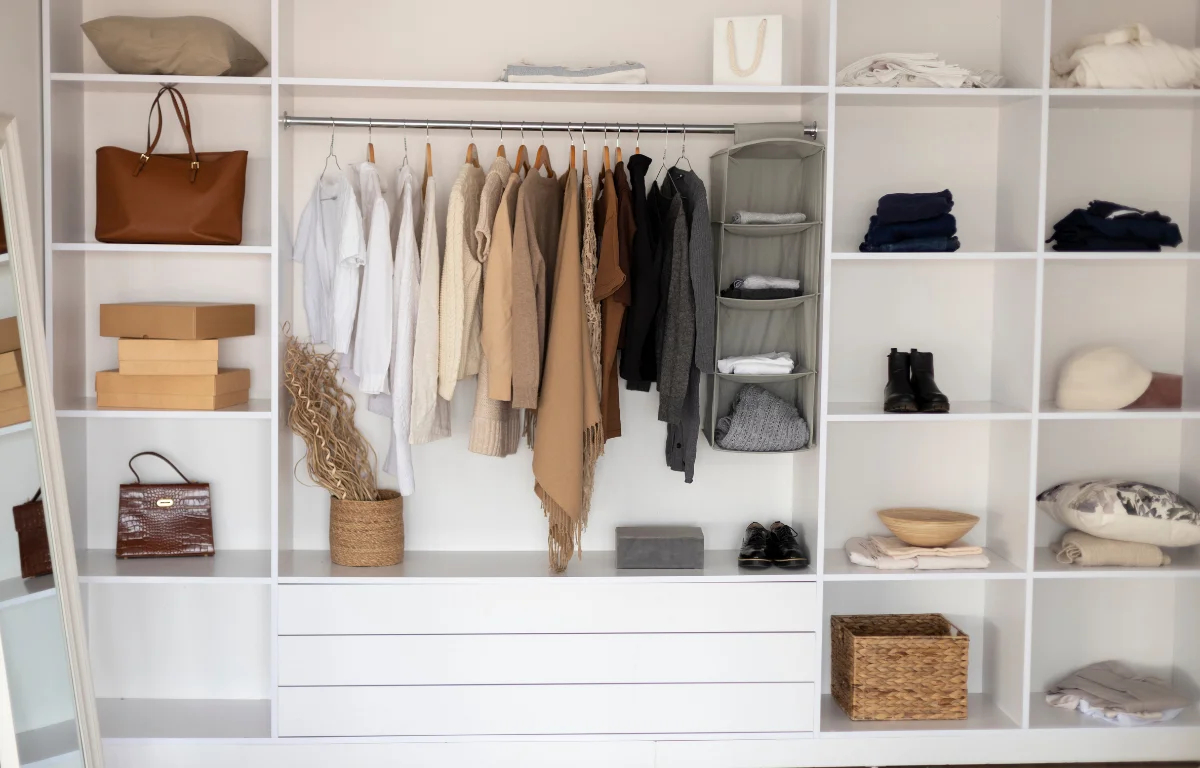
It is important to acknowledge that sometimes the feeling of “nothing to wear” has nothing to do with sensory sensitivity or exhaustion. It arises when the wardrobe objectively no longer corresponds to real life.
This often happens after changes — a new work rhythm, relocation, climate shifts, physical changes, or a transition into a new social role. In such situations, choice is difficult not because the body is overloaded, but because there are genuinely too few suitable options.
The key difference: in a sensory state, the clothes exist but the body rejects them. In real scarcity, the body is ready — there is simply nothing to choose from.
Sensory support instead of stylistic effort
In a state of heightened sensitivity, the body begins to reject excess stimuli: complex cuts, heavy layering, rigid fabrics. At this point, sensorily neutral items function as an environment rather than an image.
This approach is described in the article on the sensory basic wardrobe, where clothing is considered a form of bodily support.
What to do when the issue is state-related
When the cause is sensory or resource exhaustion, the least demanding option is not the perfect outfit, but predictability. Clothes that have previously worked on difficult days are often the safest choice.
This does not mean getting stuck in one style. It means temporarily reducing the number of decisions the body has to make in the morning.
What to do when clothes are genuinely lacking
In cases of real scarcity, the issue is resolved not through working with state, but through structure. Usually, what is missing is not “many things,” but a few items that correspond to the current way of life.
A simple marker of this state is that any choice feels like a compromise — not because the body is tired, but because the clothes do not cover basic scenarios.
At this point, it is important to pause briefly inwardly. Not for analysis or conclusions, but for differentiation. The body has already given its answer — there is no need to move faster than it allows.
When there is no need to decide
When the feeling of “nothing to wear” arises, the first internal reaction is often to do something about it: change, fix, optimize. But an important point lies elsewhere: not every such state requires action.
The state of “nothing to wear” is not always a signal to change style or update the wardrobe. Often, it is the body’s request for a pause — for fewer decisions, evaluations, and stimuli. In this moment, any attempt to “solve the problem” may only increase tension.
The body is not reacting to the absence of a perfect look, but to excess load. When choice becomes difficult, it means that resources are already being used for something more important — maintaining internal balance.
Guideline: if morning choice causes tension before any thought of style arises, this is not the moment to search for solutions. It is a moment to preserve resources. Refusing to choose in this state is not failure or laziness. It is a form of adaptation.
Sometimes the most accurate decision is not to choose better, but to stop demanding more than the body is ready to give.
Inner presence as an answer
When choice comes to a halt, attention naturally shifts from the external to the internal. Not because it is “right,” but because the body can no longer sustain external activity without support.
In this moment, breathing becomes noticeable, along with tension in the shoulders, the sensation of body weight, and the need for stability. Style ceases to be a task. It is no longer about how one looks or what one communicates.
Style becomes a space in which one can simply be — without additional evaluation, without demonstration, without explanation. Clothing functions not as an image, but as a shell: one that does not interfere with breathing, moving, or feeling.
This shift — from image to presence — is explored in detail in the article on inner presence and the psychology of style, where clothing is described as a living environment rather than a tool of self-presentation.
This is not a rejection of style. It is a temporary return to the foundation — to contact with the body. When presence is restored, the desire to choose returns on its own — not as effort, but as a natural movement.
The biochemistry of choice as a form of care
From the body’s perspective, refusing to choose is sometimes the most rational decision. It reduces cognitive and sensory load and gives the nervous system time to recover.
Thus, “nothing to wear” is not a deficit, but a marker of state. When resources return, choice appears by itself — without pressure or effort.
Important: not every “nothing to wear” needs to be analyzed. And not every one needs to be fixed. Sometimes the body asks for rest. Sometimes — for a few missing items. The ability to distinguish between these two situations already removes half of the tension.
Sources
- Baumeister R.F., Tierney J. Willpower: Rediscovering the Greatest Human Strength. Penguin Press, 2011.
- Rosenthal N.E. et al. Seasonal Affective Disorder: A Description of the Syndrome and Preliminary Findings with Light Therapy. Archives of General Psychiatry, 1984.
- McGlone F., Wessberg J., Olausson H. Discriminative and affective touch: sensing and feeling. Neuron, 2014.