






There is a particular moment when weight settles onto the shoulders — not the weight of responsibility, but the kind that gives shape.
Breathing slows. The shoulders feel heavier and warmer. The world becomes quieter.
This is not psychology or suggestion. It is the body reading a mechanical signal faster than the mind.
We have already explored how the skin and nervous system respond to fabrics, silhouettes and textures in What the body feels in clothes: the sensory and postural nature of style , and how style influences cortisol, dopamine and emotional rhythms in Fashion and hormones: how style regulates cortisol and dopamine .
Now we go deeper — into weight, into the kind of pressure that soothes more reliably than words, and into the ways the body can bring a person back into presence through simple sensory signals.
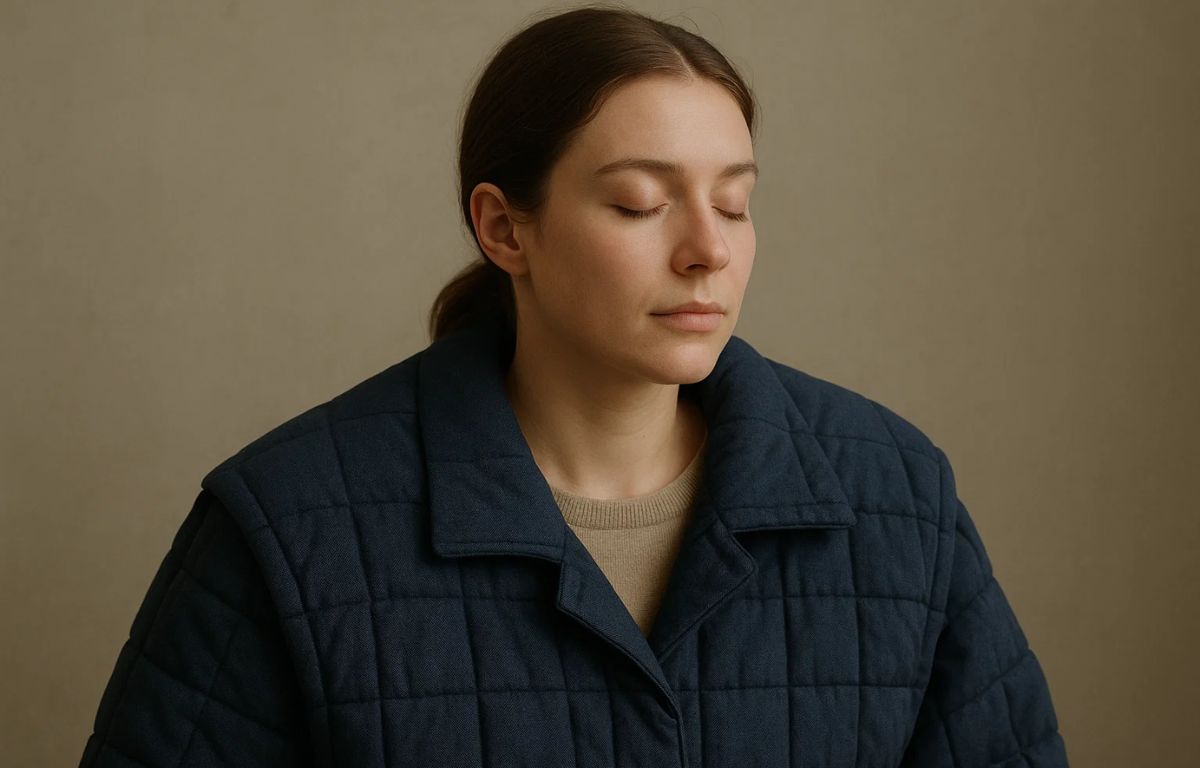
Proprioception: when weight becomes a language of the body
Proprioception is an invisible sensory system embedded in muscles, tendons, fascia and joints. When weight is added, several mechanoreceptors become more active:
- Pacinian corpuscles, which respond to rapid pressure changes;
- Ruffini endings, which calm tissues through slow, sustained pressure;
- muscle spindles, which stabilise positioning and micro-movements.
Additional weight amplifies their signals, giving the brain a clearer and more structured map of what the body is doing. This creates an effect similar to being held — a sense of internal order and predictability.
Deep pressure as the body's natural calming mechanism
Deep, evenly distributed pressure is one of the strongest biological “languages of safety.” It activates:
- the parasympathetic nervous system;
- the insula, responsible for interoception;
- the nucleus tractus solitarius, which regulates breathing and heart rate;
- a reduction in amygdala reactivity.
The result is a physiological message: “you are safe.”
Breathing slows. Heart rate evens out. Thought patterns become less chaotic — not because we try to relax, but because mechanoreceptors and neural pathways do the work on their own.
Micro-postural stabilisation: the body finding its axis
Added weight is not a burden — it is a stabiliser. Under weight, the body reduces compensatory micro-movements:
- trapezius tension lowers,
- the diaphragm descends,
- deep stabilising muscles activate naturally,
- the spine aligns into a more efficient line.
This feels like internal symmetry — the body standing with less effort, the feet grounding more fully, the neck lengthening without strain.
Emotional stability: when weight quiets internal noise
Anxiety is not thoughts — it is physiology. A hyperactive sympathetic system creates sensory noise, muscle tension, and reactivity.
Weight softens this noise by:
- reducing amygdala activation,
- boosting oxytocin-related calm,
- dampening unnecessary sensory input.
People often describe it as:
“someone switched off the extra noise,”
“my body went quiet,”
“I stopped reacting to every small thing.”
Highly sensitive nervous systems: who benefits the most
In the material High-sensitivity days style we introduce how style and textures can support highly sensitive nervous systems during overwhelmed days.
People with high sensory sensitivity (HSP), ADHD, anxiety or emotional hyper-reactivity often respond especially well to weight because:
- their baseline nervous arousal is higher,
- proprioceptive input naturally lowers this arousal,
- deep pressure replaces complex self-regulation techniques,
- clear boundaries reduce sensory overload.
For them, weight is not “clothing” — it is a regulatory tool.
Cognitive focus: weight as a tool for thinking
When deep pressure lowers anxiety and muscle noise, cognitive resources are freed.
The brain stops spending energy on:
- monitoring background stimuli,
- filtering irrelevant signals,
- balancing posture,
- constant micro-adjustments.
And redirects it to:
- the prefrontal cortex (focus, planning, decision-making),
- working memory,
- task completion,
- reduced impulsivity.
Weighted vests have shown improvements in focus even in people without attention disorders — simply due to optimised neural allocation.
Forms of added weight: integrating weight naturally into daily life
Heavy coats and dense fabrics
In Winter style and energy support we introduce how winter silhouettes — from heavy coats to dense textiles — can support nervous system stability and preserve energy.
This is the most natural way to integrate therapeutic weight into everyday life. Pressure distributes evenly, creating a protective “warm frame.”
Weighted vests
These work deeply and directly. Ideal for short sessions: walking, focused desk work, or preparing for demanding tasks.
Weighted scarves
A local intervention for the upper back and trapezius — areas where stress accumulates most intensely.
Heavy draped blankets and textiles
Perfect for evening rituals, reading, unwinding, or resetting between work blocks.
Safety and guidelines
Not medical advice — general orientation:
- optimal weight is 5–10% of body weight,
- first sessions: 5–10 minutes, gradually increasing to 20–30,
- pressure must be evenly distributed,
- signs of overload: heat, shallow breathing, elevated heart rate.
The body always communicates its limits — listening is essential.
Weight rituals: practices that restore clarity
“Inner frame” morning ritual
Put on a heavy coat and stand by the window for one minute. Warmth + weight = a grounded beginning.
Weighted scarf reset
Before a difficult conversation or call, place a weighted scarf across the shoulders for two minutes.
Evening quiet sitting
A heavy blanket on the lap signals the nervous system to shift toward rest and slower rhythms.
Task-transition ritual
One minute of added weight between tasks clears accumulated sensory noise.
Walking in a heavy coat
One of the strongest forms of natural deep pressure: step → weight → stabilisation → clarity.
Conclusion: weight as a way back to oneself
Added weight is not a burden and not an accessory. It is a quiet stabilising force that creates boundaries when the mind is tired of carrying everything alone.
In a world that demands lightness, sometimes it is weight that gives freedom — bringing the person back into the body, and the body back into calm.
Sources
- “The sensory neurons of touch” — https://pubmed.ncbi.nlm.nih.gov/23972592/
- “Calming effects of deep touch pressure” — https://pubmed.ncbi.nlm.nih.gov/19630623/
- “The comfort dimension: A review of perception in clothing” — https://onlinelibrary.wiley.com/doi/10.1111/joss.12070
- “Comfort evaluation of wearable functional textiles” — https://pmc.ncbi.nlm.nih.gov/articles/PMC8585350/