






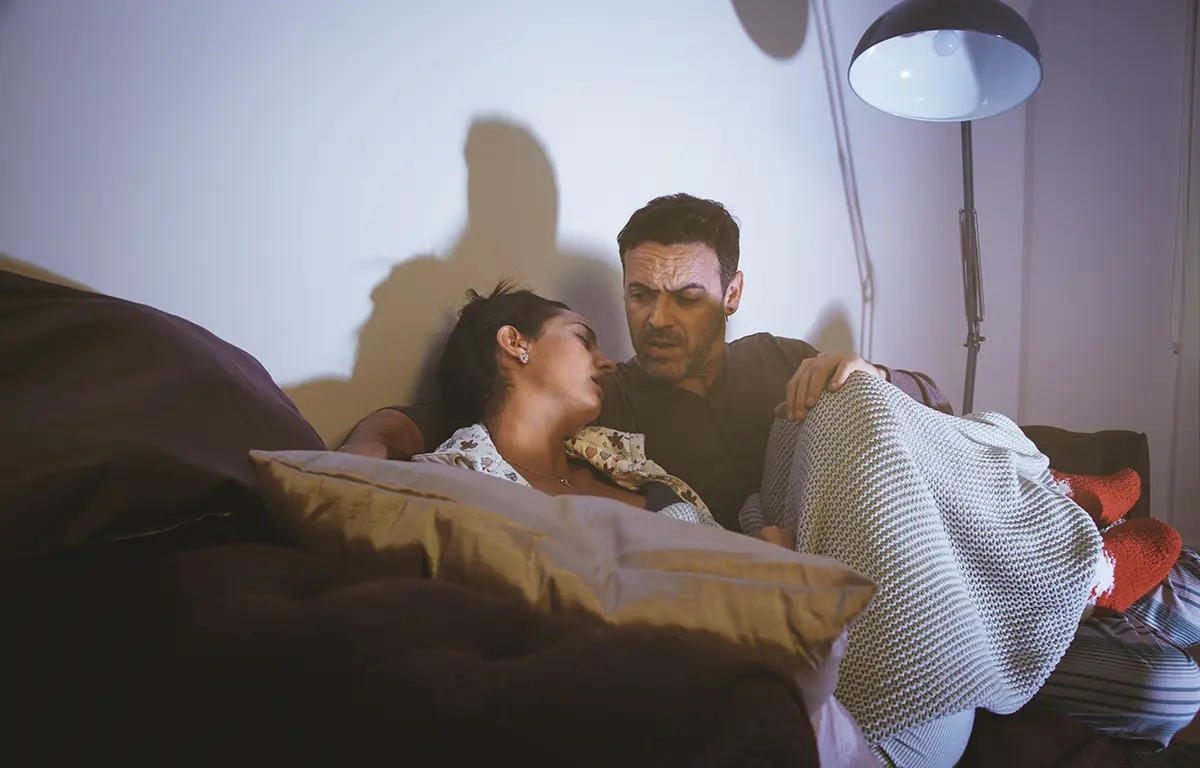
Once, sex felt like a natural continuation of closeness: a look or a touch was enough. Now instead you count the hours until sleep, turn off the light and quietly hope that tonight no one will suggest anything. Not because you stopped loving or desiring, but because inside you have long had no strength even for your own thoughts.
Stress and anxiety rarely take away libido suddenly — they do it slowly, imperceptibly, day after day. And one evening you catch yourself thinking: “I’m broken.” But what if this is not a breakdown, but a way for your nervous system to save you from yet another overload? In this article, we will look at how exhaustion switches off desire, how this differs from the influence of hormones and what can be changed so that the body again feels space for sexual desire.
When the body “switches off” desire: not a breakdown, but protection
Popular ideas about sex often contain a dangerous simplified picture: “if a person loves their partner, they always want sex.” In reality, desire is much more complex. The nervous system is responsible for survival first, and only then for pleasure. When the brain believes that you are “at the limit”, it turns off everything that is not critically important, including libido.
This is why during periods of severe burnout, anxiety or chronic fatigue many people notice: “I love my partner, but my body just doesn’t switch on.” This does not mean that you have become “bad” or “frigid”. It often means that the body has long been signalling: “I need rest, space, support,” not yet another obligation “to be desirable”.
When you look at decreased libido as a way of protection rather than a failure, there is more self-compassion and less shame. Instead of asking “why am I broken?” you can ask another question: “from what exactly is my nervous system protecting me right now?”
What does stress do to the body and nervous system?
Stress is not only about emotions. It is about how the body literally switches to a different mode of operation. When you live in constant tension, the brain more often chooses “fight or flight” or “freeze” reactions than calmness and curiosity.
In stress mode, many processes change:
- the heart beats faster, breathing becomes shallow;
- muscles tense up, especially in the neck, shoulders, jaw and lower back;
- digestion works worse, heaviness, spasms and bloating appear;
- sleep becomes shallow or fragmented, it is hard to fall asleep or wake up rested.

Sex, however, needs a completely different background: a feeling of relative safety, at least a minimum of relaxation, trust in the person next to you and in your own body. If the body believes that now it has to survive, finish work, “hold on”, it is in no hurry to switch on arousal. In such conditions libido does not disappear forever; it rather goes “under the ice”, waiting for a moment when things become a little calmer.
Why do anxiety and fatigue mute libido?
Chronic anxiety and fatigue act on desire like a heavy blanket that muffles all signals from the body. On the one hand, you can rationally understand that sex is pleasant, healthy, a way to connect with your partner. On the other hand, your head is spinning with deadlines, expenses, news, chat messages — and there is simply no room for erotic fantasies.
Lack of sleep makes this picture even harsher. When you go to bed with your phone in your hand, wake up tired and fight sleepiness during the day, the nervous system lives without a clear signal that “now it is safe”. In such conditions the body saves energy instead of spending it on arousal, orgasms and experiments.
Anxiety adds constant inner tension: the body seems to be waiting for bad news, criticism, conflict. In this state it is very difficult to surrender to the process, feel your own sensations, allow yourself to be vulnerable. Many people describe it like this: “it’s as if I can’t switch off my head, even when I want to.”
For some people, stress, on the contrary, brings more sex as a way to escape tension, check that “I’m still normal”, feel at least some control. This also does not mean that you are “wrong” — it is simply that the nervous system is looking for its own way to cope. In both cases it is important to look not only at the frequency of sex, but also at whether it feels safe and caring for you.
Hormones or stress: how to understand what is behind changes in libido?
When desire changes, you often want to explain it with one simple reason: “this is definitely hormones” or “this is definitely stress”. In reality, a combination works more often: hormonal background, state of the nervous system, sleep, relationships, experience and upbringing.
In the article Hormones, cycle and desire: why libido “jumps” throughout the month we have already discussed how the phases of the menstrual cycle influence sexual desire, sensitivity and the attitude to your own body. That is about the natural wave that changes during the month.
When stress comes to the foreground, the picture looks a bit different. Instead of a cyclical wave with ups and downs, you may feel a long period of “I don’t want anything”, which is accompanied by:
- unstable sleep or insomnia;
- a feeling that you are constantly “on edge” or, on the contrary, emotionally switched off;
- tearfulness, irritability, bursts of anger over small things;
- inability to concentrate, forgetting elementary things;
- thoughts like “I don’t manage anything”, “I can’t cope”.
If you recognise yourself more in the picture of being “chronically exhausted and anxious” with a long period of low desire, this text about stress may be more useful for you right now. If you clearly feel a wave of desire tied to the days of your cycle, it is worth turning to the material about hormones — there is more about how natural cyclicity works.
If you notice that libido has dropped together with the quality of sleep, mood and energy levels, it is worth looking not only at the cycle but also at your overall workload, the amount of rest and support in your relationships. Often the key to why the body chooses protection instead of desire is hidden exactly there.
Work, kids, household: how the daily conveyor belt changes desire
For many people the day looks like an endless list of roles: employee, mother, partner, daughter, friend. In the morning — urgent tasks, during the day — meetings and correspondence, in the evening — housework, homework, cooking, caring for relatives. In this conveyor belt it is easy to disappear as a living person who has not only duties but also desires.
One familiar scenario is a mother of a small child who simultaneously works, organises kindergarten or school, keeps track of doctor’s appointments, shopping, clubs. In the evening her body remembers not passion, but that in the morning she did not have time to sit down and eat calmly. In this reality the question “why don’t I want sex?” sounds less like a mystery and more like a logical consequence of overload.
Another scenario is a person who cares for a sick relative. Their day often consists of worrying about the loved one’s condition, organising procedures, talking to doctors, financial concerns. The nervous system is in a constant state of alertness. In such conditions sexual desire can seem “inappropriate” or “indecent”, although in fact it is simply another part of life that currently lacks resources.
When the evening turns into a “second shift” and weekends become the time to do everything that “was not done”, the nervous system does not understand when it is supposed to rest at all. The sense of your own body narrows down to signals like “it hurts”, “it is tight”, “I am tired”. In this state, a sexual proposal can be perceived not as an invitation to closeness but as yet another task on the “must do” list.
Add to this guilt — for not having done enough, for not being perfect, for snapping at the kids, for wanting silence instead of conversation. All this inner tension mutes spontaneity, curiosity and playfulness, which are so important for desire. And again, this is not about you becoming “boring”; it is about a system working at its limit.
“Gas and brakes” in desire: why stress presses all the brakes
Sex educator Emily Nagoski suggests looking at desire as a combination of a “gas pedal” and a “brake pedal”. Gas is everything that helps you feel curiosity, attraction, arousal. Brakes are everything that brings anxiety, shame, tension, a sense of danger.
For each person this list looks different, but often the “gas” includes:
- a feeling of safety next to your partner;
- simple human rest, the opportunity to exhale;
- tenderness, hugs without pressure to “move on to the next step”;
- warm words, acceptance, lack of criticism;
- the feeling that you are seen not only as a “function” but as a living person.
And “brakes” can be:
- criticism of the body, comments about weight, shape, age;
- conflicts, resentments, unspoken grievances;
- chronic stress, deadlines, financial anxiety;
- fatigue, lack of sleep, an overloaded day;
- shame about your desires or about the lack of desire.
When there is a lot of stress, anxiety and overload in life, the brakes are pressed all the time. In such a situation additional “gas” in the form of candles, lingerie or new techniques often does not work, because the brain still keeps its foot on the brake. The first step is not to force yourself to “press the gas harder”, but gently to take your foot off the brake by reducing tension and adding safety.
How to talk with your partner about stress, anxiety and sex?
For many people it is difficult to talk about sex even in calm periods, and under stress it may seem almost impossible. Because of this, the topic of libido often turns into silence, hints or quarrels. The partner may feel rejected, and you may feel guilty and “wrong”, which only increases the tension.
Several approaches can help.
- Talk about yourself, not accuse. Instead of “you are always demanding something from me”, you can say: “when I am very tired and tense, it is hard for me to tune into sex, even if I love you.”
- Explain how stress and the cycle affect you. You can show your partner a rough map: “here I usually have more energy and desire, and here I more often feel fatigue and want more silence and cuddles.”
- Offer alternatives rather than only refusing. If you don’t want sex right now but want to stay connected, you can agree on a massage, a bath together, cuddling before sleep, a conversation, a film together.
- Agree on a “language of anxiety”. If your partner perceives any “no” as a threat to the relationship, it is important to discuss this separately: “when I say no to sex, I am not saying no to you. If this scares you, let’s talk about that fear rather than about my ‘normality’.”
Psychotherapist Esther Perel reminds us that love reaches for closeness, while desire needs a bit of space and distance from which you can see each other anew. If there is no rest and at least minimal personal territory in life, desire sometimes simply has nowhere to unfold. A partner who is ready to listen, not to pressure and to look for solutions together with you becomes an ally rather than a judge of your libido.
Small steps that return a sense of safety to the body
When it comes to libido, it is very tempting to find one exercise or method to “bring back desire”. In reality, the basic steps often look much more prosaic — and it is they that create the foundation for the body to feel any resources for desire at all.

The following can help:
- Sleep and evening routine. Attempts to go to bed a little earlier, to put the phone away at least 30–40 minutes before sleep, to do something gentle for the body — a shower, stretching, cream, a warm drink.
- Redistribution of household tasks. Agreements with your partner that some tasks can be delegated, simplified or done imperfectly. Less “must”, more “this is enough”.
- Small pauses during the day. A few minutes when you allow yourself to literally stop, take a deep breath in and out, feel your feet on the floor, your back against the chair, the boundaries of your body.
- Simple grounding exercises. For example, the “5–4–3–2–1” exercise: silently name 5 things you see, 4 you hear, 3 you feel with your body, 2 smells and 1 taste. Or a few minutes just to feel how your feet touch the floor and your back rests against a support.
- Breathing pauses. Three to five slow inhales and especially long exhales, when the exhale is slightly longer than the inhale. This is a simple way to give the nervous system a signal: “we are no longer in danger, we can relax a little”.
- Small pleasures for yourself. Not as a reward “for good behaviour”, but as something that reminds you: “I matter too”. It can be a walk, tasty food, a favourite playlist, a meeting with someone with whom you feel at ease, or time for your own sensuality — without the obligation to “perform” or respond to anyone.
If you notice that desire drops together with lack of sleep and evening overload, it is helpful to look at your routine more holistically. In the extensive guide Sleep and the nervous system we talk in more detail about how evening habits, gadgets and tension affect the ability of the nervous system to switch into rest mode. Sometimes, by improving the quality of sleep, we unexpectedly improve the background for libido as well.
A separate conversation is about how sex, the nervous system and the feeling of closeness intertwine with each other. In the longread “Sex, the nervous system and closeness” we will bring together what happens to the body when it seeks protection but at the same time still wants warmth, tenderness and desire.
When is low libido no longer only about stress?
Cyclical changes in desire and temporary drops against the background of stress are not a problem in themselves. But there are situations when it is important not to be alone with this experience.
- Libido has sharply decreased or almost disappeared for a long time, and this worries you a lot.
- Severe pain appears during sex or menstruation that was not there before.
- Unusual discharge has appeared, cycles have become very irregular or too painful.
- At the same time you notice symptoms of anxiety or depression: insomnia or excessive sleepiness, loss of interest in what used to bring joy, a sense of hopelessness.
- There is a traumatic experience related to sexuality or relationships that still hurts.
In such cases it is important to turn to a doctor — a gynaecologist or family doctor — to assess your general state of health, hormonal background and the medicines you are taking. In parallel or afterwards, working with a psychologist or psychotherapist can be supportive, especially if you feel a lot of shame, fear or difficulty in defending your own boundaries.
Whose side to take — stress’s or your own?
When libido changes, the most painful part is often not the change itself but how we explain it to ourselves. Thoughts like “I am damaged”, “I am hard to live with”, “I disappoint my partner” do not help to bring desire back. They only increase anxiety and muffle any signals of desire even more.
You always have a choice: to take the side of stress, which says “you are not enough and must try even harder”, or your own side, where you honestly admit: “I am exhausted, I need space, support and time to feel alive again.” The first feeds the brakes; the second gradually gives the body an opportunity to touch its own desires again. A partner who is ready to stay close without pressure and with curiosity about your experience can become part of this support rather than another source of tension.
You can start with a small step already today. At the end of the day ask yourself: “What today was an act of self-care for me?” And if the answer seems too modest, do not punish yourself for it. Libido rarely returns against the background of violence towards yourself, but it often quietly awakens where there is more kindness than demands — both towards yourself and towards the relationship.
-lazy-placeholder.webp)
-medium.webp)