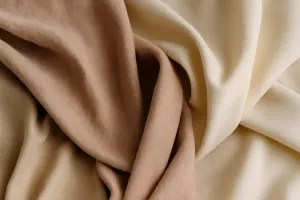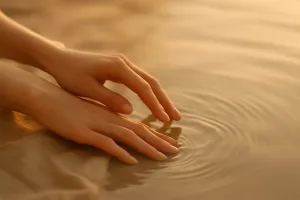







Textures are the first weather of our day. We may not have time to look out the window or check the temperature, yet the body instantly senses the temperature of a fabric, its weight, density, flexibility, or rigidity. Softness opens us outward, giving our mood a gentle roundness. Structure gathers us, aligns us, gives a sense of verticality. Together, they form the emotional climate of the body — shaping how we move, breathe, react, and inhabit our day.
We often think of textures as aesthetics. But for the body, they are a narrative it reads without translation. Textures create the background on which the nervous system sets tone and tempo. When we feel scattered, sometimes it is enough to change the fabric touching our skin.
How the body reads textures: a brief sensory neurophysiology
The skin is the largest sensory organ, and its mechanoreceptors perceive clothing as a series of codes. Together, they create a form of “tactile vision”:
- Meissner corpuscles — detect light touch and initial glide.
- Ruffini endings — respond to skin stretch and deeper shifts in tension.
- Pacinian corpuscles — perceive high-frequency vibration and micro-movements.
- Merkel cells — recognize fine surface details and texture.
Together, they produce the first impulses the body understands long before we can name our state. Softness, grain, density, fullness — all become information about safety, stability, or the need to gather ourselves.
In the article “What the body feels in clothes” we explored how quickly the nervous system responds to fabric. Here, we look at textures as a language capable of shifting the body’s tone within seconds.
Softness: how it lowers cortisol and restores a sense of safety
Soft textures — cashmere, fleece, brushed knits, airy jersey — work like a micro-dose of therapy. The nervous system experiences them as shelter, even in the middle of a tense city day.
- they reduce sympathetic activation,
- lower the frequency of micro-tensions in the muscles,
- stabilize the heart rhythm,
- create an internal sense of “I am safe”.
There is a state psychophysiologists call “soft presence” — when the body is neither tense nor limp, but balanced. Softness helps us enter this exact range.
We examined hormonal sensitivity to touch in detail in “Fashion and hormones: how style regulates cortisol and dopamine”. Here, the focus is different: softness does not make us slow or passive. It makes us open.
Structure: how it creates boundaries, verticality, and tone
Structured fabrics — suiting wool, denim, pressed cotton, resilient weaves — create a sense of boundary. Not rigidity or pressure, but pure form.
Structure is useful when we need clarity, focus, and collectedness. It:
- aligns the shoulders,
- lifts the neck,
- activates stabilizing muscles,
- creates an internal “metronome”.
This is not about discipline — it is about an internal contour, a return to ourselves through the right amount of verticality.
Morning micro-scene: softness as the first key to the body
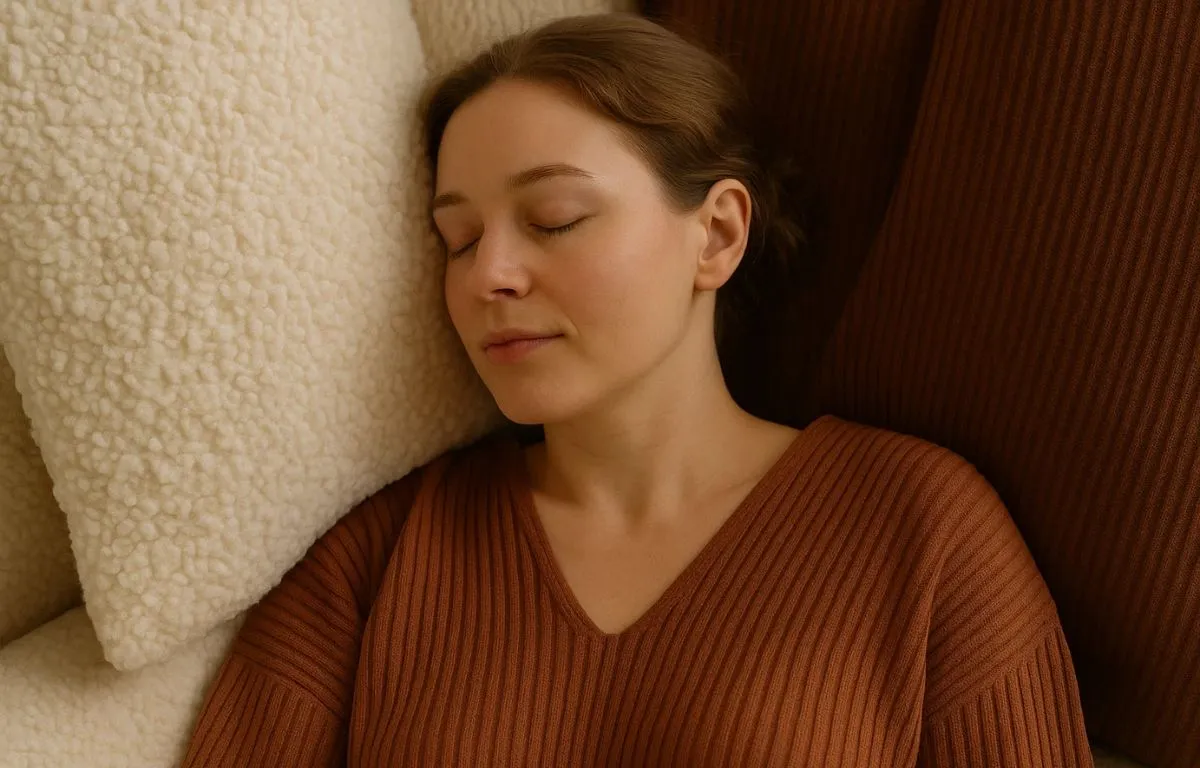
Morning. The air is cool, and the body has not yet fully leveled after sleep. A soft knitted sweater settles over the shoulders like warm fog. Breath deepens, movements soften, the day feels less sharp.
The nervous system opens from the inside out. The world does not rush into us — we open toward it gradually.
The shift toward structure: a moment of inner verticality
After the body fully awakens, softness may transition into structure. Putting on a fabric that holds shape creates a subtle lift: posture aligns, steps become more directional.
Structure does not contradict softness — it completes it. Softness prepares; structure activates.
Texture as emotional geometry
Softness is roundness. Structure is verticality. Together, they create the space in which we can move through the day with a mood that matches its tempo.
Texture becomes a way to organize ourselves effortlessly, shaping the emotional geometry of our state.
Color and texture: how they interact
Color can shift the temperature of a texture. Warm tones make softness feel closer and more tender. Cool tones sharpen structure. Light tones create lightness. Dark tones add weight and depth.
We will explore this further in the upcoming article Color as soft therapy.
Second micro-scene: daytime pace and structure as navigation
Imagine midday. You step outside: the light is harsher, the movement quicker. In a structured jacket or coat, the body receives direction. Not pressure. Not constraint. A compass.
Structure during the day is a way to avoid dissolving into a pace you did not choose — a way to remain yourself even when everything around you is in motion.
Seasonality: how textures behave in autumn
In autumn, textures sound different. The air thickens, the light deepens. The skin responds to shifts in temperature: it needs more weight, more warmth, more shelter.
This is why, in this season, our hands instinctively reach for denser weaves, warm structures, micro-pile — materials that let us move slowly and sense space more attentively.
We will continue this theme in Autumn textures and slowing down.
Texture rituals: how to choose fabrics for your state
Morning. The first minutes call for softness: lightweight home knits, a thin cotton pajama, a soft long-sleeve, a fluffy sweater, or a relaxed shoulder-line jumper. After waking — light structure: poplin shirts, fine jacquard weaves, smooth knits that hold their line and lend verticality.
Daytime. A mix of textures: the fluidity of softness + the support of structure. This may be viscose trousers, merino wool under a structured blazer, a crêpe-viscose dress with a thin suiting jacket, or mid-weight denim paired with soft cashmere.
Evening. Maximum softness: a fleece throw, brushed-pile knits, soft-fleece trousers, an oversized hoodie, jersey loungewear, or a warm, lofty alpaca sweater.
When the day is too fast. Add weight and grain: thick wool cardigans, chunky knits, heavy bouclé coats, dense wool scarves, suiting-weight skirts, heavier wool trousers. These textures physically slow movement and calm the nervous system.
When clarity is needed. Structure that holds attention and silhouette: a tailored jacket, a poplin or Oxford shirt, a clean-lined wool coat, a structured viscose sheath dress, suiting-wool trousers, or a structured vest. These are the textures that create an internal contour and help organize your thoughts.
Conclusion
Textures are a way to speak to the body without words. Softness lowers cortisol, opens and calms us. Structure adds verticality, collectedness, a sense of boundaries. Together, they form presence — the ability to live the day with clarity and depth.
Textures are an intimate geography of the inner world — and one of the gentlest forms of self-care.
Sources
- Abraira, V. E., & Ginty, D. D. (2013). The sensory neurons of touch. Neuron. URL: https://doi.org/10.1016/j.neuron.2013.07.051
- Grandin, T. (1992). Calming effects of deep touch pressure. Journal of Child and Adolescent Psychopharmacology. URL: https://www.liebertpub.com/doi/10.1089/cap.1992.2.63
- Kamalha, E., Zeng, Y., Mwasiagi, J., & Kyatuheire, S. (2013). The comfort dimension: A review of perception in clothing. URL: https://onlinelibrary.wiley.com/doi/10.1111/joss.12070
- Tadesse, M. G., Loghin, C., et al. (2021). Comfort evaluation of wearable functional textiles. URL: https://pubmed.ncbi.nlm.nih.gov/34771993/