






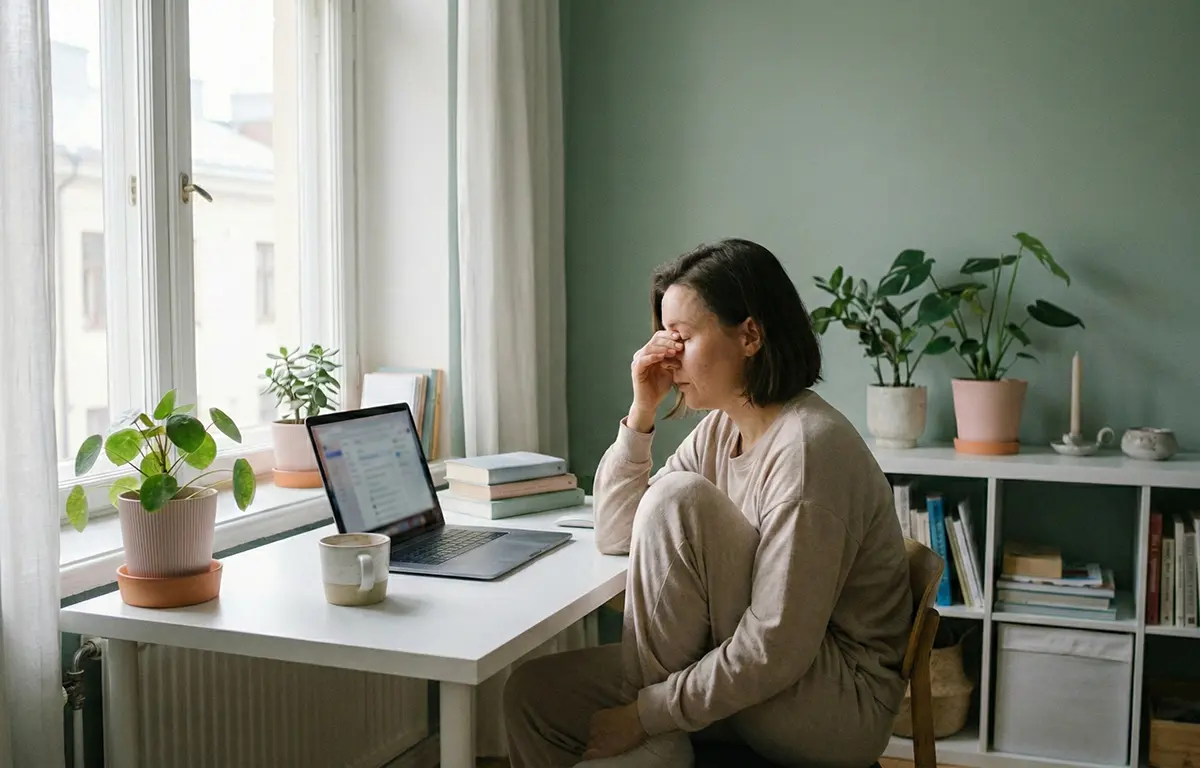
There is a state that is hard to briefly explain even to your close ones. You seem to have gone to bed more or less on time, the night went by without any drama, and yet by midday one phrase is spinning in your head: “I constantly want to sleep during the day.”
Your head feels heavy, your gaze goes out of focus, tasks you used to handle in ten minutes now stretch into an hour. People around you have the same schedule, but they seem to have enough energy for work, kids and their own plans. The comparison only reinforces the feeling that “something is clearly wrong with me.”
Daytime sleepiness can be an expected reaction of a tired brain, or it can be a signal that your nervous system has been working at its limit for a long time and does not have time to recover. In the extended guide on sleep and the nervous system we explain in more detail how the brain, hormones and nervous system regulate sleep–wake cycles. In this article, we explore where the line lies between “I’m just normally tired” and the state when daytime sleepiness becomes a symptom that is worth working with.
I constantly want to sleep during the day: is this even normal?
Short episodes of tiredness during the day are not a problem in themselves. Our circadian rhythms are arranged in such a way that most people naturally experience an energy dip in the afternoon, roughly between 13:00 and 16:00. If you have been working actively, sitting a lot, moving little or have just had a heavy lunch, it is completely natural to feel a bit sleepy.
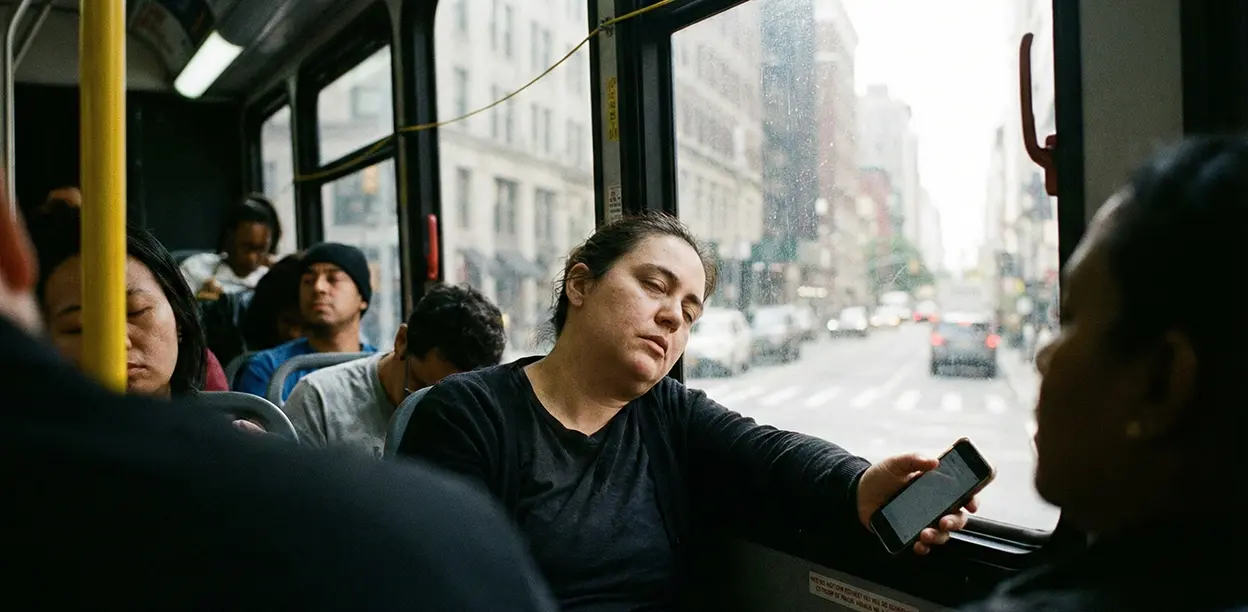
It is a different story when sleepiness becomes the background to your whole day. You wake up already feeling that “you haven’t had enough sleep”, barely make it to lunch, and after that you are literally “knocked out”. Your eyes stick together on public transport, it is hard to stay focused at work, and evening plans seem almost unreal — you just want to get home and into bed. At the same time, your night sleep may be shallow and fragmented or, on the contrary, very long but not restorative.
Try to briefly describe your “typical day of sleepiness”:
- what time you actually fall asleep, not just lie down in bed;
- how many times you wake up at night;
- at what time the thought “I constantly want to sleep during the day” first appears;
- when the sleepiness is at its peak — before lunch, after it, closer to the evening;
- how you try to cope with it (coffee, sweets, “just push through it”).
Even one such description already helps you see that what is happening to you is not “in general” but at specific hours and in specific circumstances. This is the first step toward stopping to perceive sleepiness as some abstract “laziness” and starting to notice real patterns.
What are the main reasons why you constantly want to sleep during the day?
The phrase “I constantly want to sleep during the day” almost never has a single cause. Usually it is a combination of factors: a disrupted routine, chronic stress, dietary habits, possible hormonal shifts and medical conditions.
To avoid getting lost in a long list, it is helpful to divide the causes into several groups:
- sleep schedule and sleep hygiene;
- physical and medical factors;
- mental health, anxiety and stress;
- daily habits and day rhythm.
It is also worth mentioning sleep hormones. We talk in more detail about the role of cortisol and melatonin in daytime sleepiness in the article about sleep and wakefulness hormones.
A short self-test can help you understand which direction to look first. Try to answer “yes” or “no” to these statements:
- I rarely sleep 7–8 hours in a row without long night awakenings;
- the time I go to bed varies a lot from day to day;
- in the morning I almost never feel refreshed, even on weekends;
- daytime sleepiness gets worse during periods of stress, conflict or bad news;
- I often skip meals or, on the contrary, overeat a lot;
- I have diagnoses or symptoms related to hormones, the heart, the respiratory system or blood;
- I take medications that may have a sedative effect.
If you answer “yes” to several points at once, this already suggests that the cause of your sleepiness is most likely multifactorial. And that is okay — you do not need to look for one magical button; you can work with several areas gradually.
Can “I constantly want to sleep during the day” be about lack of sleep and routine?
Yes, and this is the most common scenario. Our brain needs about 7–9 hours of quality sleep per day. If we sleep less or do not give ourselves enough deep sleep phases, the body starts “taking what it needs” during the day. You may think you sleep “normally”, but if you:
- go to bed at different times, often after midnight;
- wake up at night regularly and cannot fall asleep again for a long time;
- fall asleep with your phone in your hands or in front of a bright screen;
- wake up feeling heavy in your body and head, as if you did not rest at all,
then your brain most likely does not have time to go through all the cycles it needs for full recovery. During the day, this shows up as “energy pits” in which the thought “I constantly want to sleep during the day” seems like the only honest description of your state.
Another important point is individual rhythms. It is naturally easier for some people to get up early and for others to get up later. If the rhythm of your life radically does not match your biorhythms (for example, you are an “owl” but are constantly forced to get up at 6:00), chronic sleep deprivation and daytime sleepiness are almost guaranteed. This does not mean that you must “turn your life upside down” right now, but it is worth honestly acknowledging: part of the fatigue is not about weakness but about a conflict between reality and your body.
When is the constant desire to sleep during the day related to illnesses?
Sometimes daytime sleepiness can be a symptom of a physical condition that requires a doctor’s attention. This is not about self-diagnosis but about markers that are worth discussing with a specialist. Possible causes include:
- Thyroid dysfunction. With hypothyroidism, metabolism slows down, fatigue, sleepiness, feeling cold, weight gain and dry skin appear.
- Anemia. When the body lacks iron or vitamin B₁₂, less oxygen reaches the tissues and fatigue becomes a constant background.
- Breathing disorders during sleep. For example, obstructive sleep apnea: a person seems to sleep enough hours, but because of breathing pauses the brain constantly “wakes up” and does not enter deep sleep stages.
- Some neurological conditions. In particular, disorders related to the regulation of sleep–wake cycles.
- Side effects of medications. Sedative drugs, some antidepressants, antihistamines and other medications can intensify the feeling of daytime sleepiness.
Importantly, having these symptoms does not yet mean that you definitely have a serious disease. But it is a reason not to dump your state into the category of “I’m probably just lazy” and not to drag it out for years hoping that “it will somehow go away on its own”. Timely diagnostics often offer very simple solutions: adjusting medication doses, treating anemia, working with apnea, supporting hormonal balance.
How is daytime sleepiness different from microsleep and simple tiredness?
Simple tiredness during the day is when you want to pause, have some tea, do a few exercises, but you are still able to pull yourself together and continue with your tasks. Your concentration decreases but does not completely collapse.
Daytime sleepiness is a more pronounced state. You feel that your brain is “drifting away”, it is hard to read text, difficult to hold a thought from the beginning to the end of a sentence, and simple tasks require enormous effort. Your inner monologue often sounds like: “I constantly want to sleep during the day, why is it so hard to pull myself together?”
Microsleep is a separate story. These are short (from a few seconds to tens of seconds) episodes of involuntary falling asleep that a person may not even be aware of. From the outside, this can look like a “frozen” gaze, a brief nodding of the head or dropping out of a conversation for a few seconds.
Everyday examples of microsleep include:
- you are travelling on public transport, “black out” for a second and then do not remember part of the route;
- you sit in a meeting and catch yourself having missed a chunk of the conversation and not being sure what it was about;
- you read a text, reach the end of the page and realize you do not remember what you just read.
Microsleep is especially dangerous:
- when driving — when the driver does not remember how they passed part of the road;
- when working with machinery, mechanisms or hot surfaces;
- when caring for children, especially small ones.
If daytime sleepiness periodically turns into such “blackouts”, this is not about a “lazy personality” but about the state of the nervous system, which needs attention. In such a situation, it is important not to drag this on for months but to discuss symptoms with a doctor and, if needed, with a sleep specialist.
How do anxiety and stress make you constantly want to sleep during the day?
Anxiety rarely looks like “thoughts running in circles” only. Often it also shows up in the body: tense shoulders, clenched jaw, shallow breathing, feeling short of breath, fragmented sleep. When anxiety becomes the background, the nervous system works in “constant high alert” mode.
At night, this appears as difficulty falling asleep, frequent awakenings or early morning awakenings “with a feeling of anxiety in the chest”. During the day, it shows up as a mix of sleepiness, brain fog and inner tension. You can simultaneously feel “I am exhausted, I want to sleep” and “I am too tense to truly relax”.
Typical signs that “I constantly want to sleep during the day” is related to anxiety include:
- you wake up feeling tense, even if you have slept enough hours;
- it is hard to concentrate during the day, your head feels “woolly” or foggy;
- sleepiness gets worse on days when there is more emotional strain (news, conflicts, deadlines);
- in the evenings, a “second wind” appears — the body is tired but the mind is too wired to fall asleep.
Another factor is information overload. Constant news monitoring, endless social media feeds and comparing yourself to others create a background sense of danger and inadequacy. The brain has no chance to “switch off” and move into recovery mode.
In this case, working only on your sleep routine helps, but does not fully solve the problem. It is important to learn in parallel how to regulate anxiety: through psychotherapy, body-based practices, breathing exercises and a supportive environment. A good starting point can be simple practices that ground you and calm your breathing before sleep — we have collected them in the article on grounding and breathing exercises for better sleep. This is not a “quick fix”, but this type of work is what brings back the feeling that the day belongs to you and not to your sleepiness.
Which habits and daily rhythm intensify daytime sleepiness?
Sometimes the strongest impact does not come from one big cause but from several “little things” that together undermine your resources. Daily habits can quietly reinforce the state of “I constantly want to sleep during the day”.
- Gadgets late into the night. Screen light, fast-paced videos, news and messaging stimulate the nervous system precisely when it needs a smooth “wind-down”. We write in more detail about how screens and blue light disrupt sleep rhythms in our article about screens, blue light and sleep.
- Heavy lunches. Very fatty, heavy food causes a sharp blood flow to the digestive organs, and the brain responds with a feeling of sleepiness.
- Long periods of sitting still. When the body stays in the same position for hours, blood circulation slows down and the brain starts “saving energy” — this quickly feels like fatigue and fog.
- Chaotic schedule. One day you go to bed at 23:00, the next at 02:30, and then you fall asleep on the couch at 21:00. The nervous system does not know when to expect sleep and eventually responds with sleepiness “whenever it can” — including during the day.
- Coffee and stimulants instead of rest. Caffeine masks fatigue but does not remove it. When its effect wears off, the feeling “I constantly want to sleep during the day” becomes even stronger.
- Alcohol as a way to fall asleep. It really can help you fall asleep faster, but it makes sleep more shallow and fragmented, which only increases daytime sleepiness.
A useful experiment is to choose one habit that most strongly affects your day and change it minimally but consistently. For example, instead of completely giving up gadgets, move the most emotional content (news, heated discussions) to the first half of the day, and choose something neutral or calming in the evening before bed.
Another gentle tool is short “movement windows”. If you add several micro-breaks of 3–5 minutes throughout the day (stretching, walking, doing a few squats or simple exercises), your brain gets more oxygen and daytime sleepiness no longer feels like a solid wall.
When is the constant desire to sleep during the day dangerous and a reason to see a doctor?
There are situations when waiting for things to “go away on their own” is dangerous for your health and safety. You should see a doctor if you notice one or more of the following:

- you practically fall asleep during the day “against your will” every day;
- sleepiness interferes with your ability to work, study or care for children;
- you have episodes of microsleep while driving or performing responsible tasks;
- sleepiness lasts for more than a few weeks, even if you have already tried to regulate your routine;
- together with sleepiness you notice other symptoms: rapid weight loss or gain, pronounced weakness, shortness of breath, chest pain, a sharp drop in mood, feelings of hopelessness;
- you started taking new medications and noticed that “I constantly want to sleep during the day” appeared right after that.
You can start with a family doctor: tell them what your day looks like, how you sleep, when you most want to sleep and what other symptoms are present. A specialist can order blood tests, hormone checks, sleep studies or refer you to other specialists. This is not a “journey into the unknown” but an attempt to find specific leverage points.
It is important to remember that seeking help does not cancel your real workload and stress, but it does mean that you are no longer alone with the symptom. This already shifts you from “there is something wrong with me” to “something is happening to me, and I am looking for support”.
What to do if you constantly want to sleep during the day: where to realistically start?
When it feels like “I constantly want to sleep during the day”, it is easy to blame yourself for laziness, weakness or lack of willpower. In reality, sleepiness is the body’s language, not a verdict on your character. And you can work with it step by step.
It is helpful to choose one or two small steps for the next two to three weeks instead of trying to change everything at once. For example:
- Stabilize your sleep schedule. Choose an approximate bedtime and wake-up time and keep them within a one-hour range, even on weekends.
- Make your evenings a bit calmer. Less bright screens 40–60 minutes before bed and more routine, soothing activities: a shower, stretching, light reading.
- Add short “recovery windows” during the day. 5–10 minutes of a quiet walk, breathing practice, stretching or simply a mindful break without your phone.
- Try a lighter lunch. Sometimes it is enough to swap very heavy meals for lighter ones so you are not “knocked out” by sleep after eating.
- Track the link between anxiety and sleepiness. Notice on which days sleepiness is especially strong, what preceded it, what news, meetings or stressors were around.
If you want to tidy up your evenings in a more systematic way, take a look at our article on evening habits for better sleep — it gathers examples of gentle rituals that make falling asleep easier.

A simple sleep and sleepiness diary can also help. For one to two weeks, write down:
- when you went to bed and when you actually fell asleep (approximately);
- how many times you woke up and why;
- your energy level in the morning, afternoon and evening on a scale from 1 to 10;
- episodes when you particularly strongly wanted to sleep during the day;
- special events of the day: stress, conflict, an important meeting, changes in diet.
We explain separately in the article on sleep diary and anxiety how to use a sleep diary not only to work with your schedule but also with anxious thoughts before bed.
Such a diary does not turn you into a “patient”, but it does give you — and, if needed, your doctor — a real picture instead of scattered impressions. Often, already at the stage of recording, people notice that there are days when sleepiness is milder, and you can lean on these days to build change.
If after a few weeks of small changes you notice at least slight relief, this is already a sign that the nervous system is responding. If sleepiness does not decrease and the thought “I constantly want to sleep during the day” only grows louder, this is a reason not to blame yourself but to seek professional help.
Daytime sleepiness is not an enemy and not a sign of weakness. It is a way for the body to say: “this is hard for me, I need different conditions.” Listening to this voice is the first step toward making your day stop being a battle with sleepiness and become a space for living again.






-lazy-placeholder.webp)
-medium.webp)