






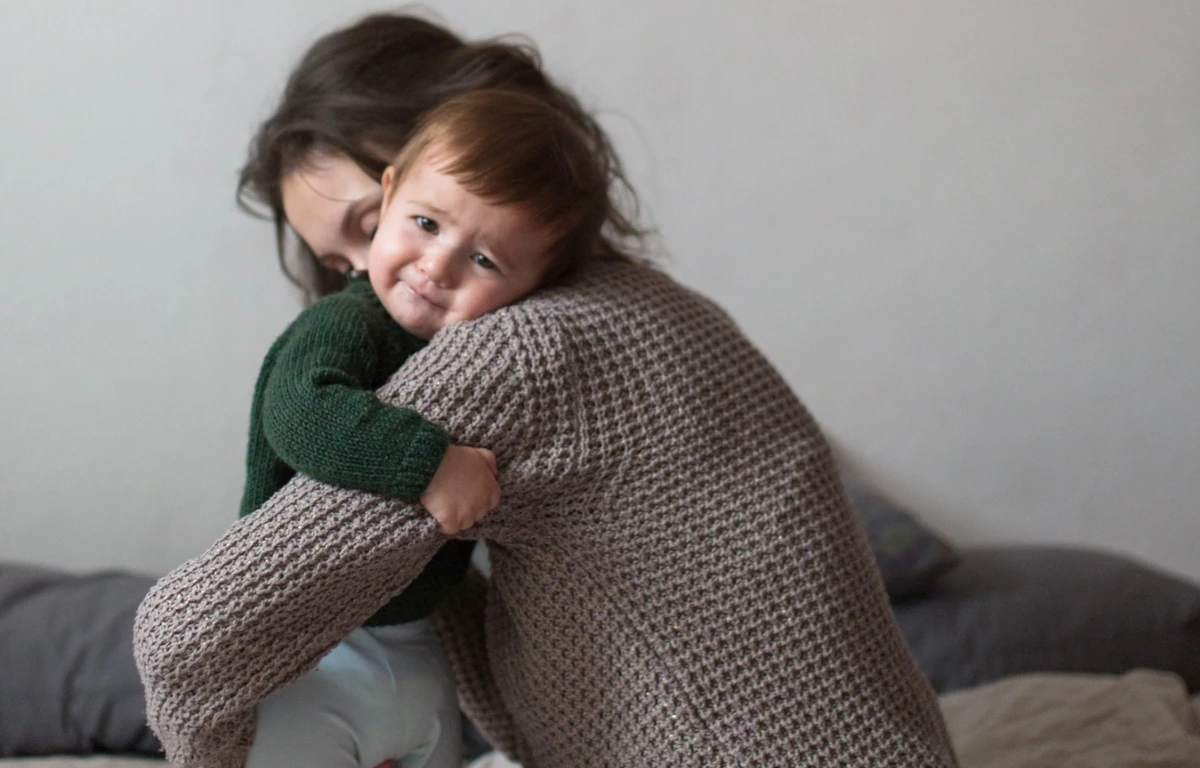
Almost every adult has days when a child seems to stop moving even a step away. They follow you into the room, ask to be picked up, sit next to you just when you need to respond to an email, prepare food, finish work, or simply have a moment alone. They might repeat phrases like, "Stay with me," "Don't go," "Sit here," "Look at me," and sometimes they don’t even ask with words—they just cling physically, grab your hand, snuggle up, hover nearby, and seem unable to maintain distance.
On the surface, this can easily be interpreted as spoiled behavior, demandingness, or a habit of taking up all the adult's space. But in reality, it's much more complex. The same behavior can mean very different things. Sometimes a child literally "hangs" onto an adult because they are overtired and can no longer cope with the day. Other times, it’s due to anxiety after separation, a new situation, conflict, illness, or overload. And occasionally, it’s because they have physically been close to their parents all day but emotionally haven’t received the fulfilling contact that makes it easier to breathe and let go.
This is why it’s important not to rush to conclusions. Not every instance of "clinginess" is manipulation. And not every request for closeness needs to be immediately satisfied or abruptly cut off. Often, it’s more beneficial to first understand what the child is trying to achieve through this behavior: grounding themselves, calming down, checking the adult's availability, or simply getting the contact they’ve been missing.
In the broader topic of co-regulation through contact: voice, face, and boundaries, we’ve already discussed that a child often stabilizes not on their own but through the presence of a more resilient nervous system nearby. Here, we will focus on one specific and very relatable scenario: what it means when a child "clings," won’t let go, and seems to constantly ask to be close.
Why a Child Suddenly Won't Step Away
For an adult, this behavior is exhausting not just in practical terms. It often strikes at the most sensitive spot—the feeling that something is endlessly being demanded of you, and you no longer have anything to give. This is why it’s so easy to provide an explanation that seems to simplify the complexity: "spoiled," "used to it," "manipulating," "needs to learn independence." The problem is that a hasty label almost never helps to respond more accurately.
When a child won’t let go, they aren’t always asking for "more attention" in a superficial sense. Often, they are seeking support. For toddlers and younger children, contact with an adult is not just warmth and relationship. It’s also a way to gather themselves after being overwhelmed, reduce their internal amplitude, and shift their system from a state of tension to one of safety. Where an adult sees clinginess, a child’s nervous system is sometimes just looking for a place to relax a bit and not have to hold on alone.
Most often, this behavior stems from one of four things or a combination of them:
- overtiredness and depletion of resources by the end of the day;
- anxiety after changes, separation, stressful events, or overload;
- a deficit of genuine contact, where the adult's presence was felt but emotional fulfillment was lacking;
- a transitional period—after kindergarten, school, travel, illness, guests, new activities, or conflict.
So, "clinginess" in itself doesn’t explain anything. Context does. When it started, what time of day it intensifies, what happened before, how the child appears physically, whether tension decreases after brief warm contact, or, conversely, if the contact doesn’t satisfy them and they continue to feel very agitated inside.
How to Distinguish Fatigue from Anxiety and Genuine Need for Contact
This is where an adult can either relieve a lot of tension or, conversely, inadvertently intensify it. Because if you confuse fatigue with the need to "build character," the child will become even more overwhelmed. If you mistake anxiety for a tantrum, they will cling even harder. And if you label a lack of attention as a "habit of being clingy," it will leave a bitter residue in the relationship, even though the child is simply not satisfied with the presence.
When It Looks More Like Fatigue
An overtired child clings differently. Their behavior often shows less genuine interest in the adult and more of a need to literally lean on them. They may be lethargic, irritable, tearful, react sharply to minor issues, ask to be picked up, request to sit next to you, and show no desire for anything new. This often intensifies in the evening or after a very busy day.
In such a state, the child usually doesn’t need lengthy explanations, educational talks, or suggestions like "go play by yourself, you’re already big." Their system isn’t asking for development. It’s asking for a reduction in load. Lowering noise, light, pace, the number of words, choices, and demands—sometimes this helps more than any correct phrase.
Signs that you are likely dealing with fatigue:
- behavior intensifies closer to evening;
- the child struggles more with ordinary transitions;
- they quickly get upset or cry "for no reason";
- they don’t want activities or novelty, only closeness and calm;
- after rest, food, or sleep, the situation noticeably improves.
When "Clinginess" Stems from Anxiety
An anxious child holds onto an adult differently than a tired one. They may exhibit more tension, wariness, and checking behaviors. It’s as if they constantly want to ensure that you are present, available, won’t disappear, won’t leave suddenly, and that the world around them is still controllable. This leads to repeated questions, a desire to be close even in situations where they previously managed on their own, difficulties with transitions, and resistance to separation, especially after changes or stressful events.
Sometimes adults expect anxiety to manifest as clear fear. But in children, it often looks like clinginess. The child doesn’t say, "I’m scared." They express it through their body: "Don’t go," "Sit here," "Come with me," "Me too," "Where are you going?" This isn’t always about controlling the adult. Often, it’s about trying to regain a sense of predictability.
Signs that the behavior may be anxiety-driven include:
- intensification after kindergarten, school, guests, travel, new activities;
- increased clinginess after conflict, illness, or separation;
- constant questions about whether you will return, when exactly, where you are going;
- difficulties falling asleep or transitioning to a new environment;
- visible relaxation not from entertainment but from predictability and calm presence.
When a Child Truly Lacks Attention
This is perhaps the most subtle area, as it can outwardly appear almost the same. The child seems to be constantly nearby but doesn’t seem to be satisfied. Why does this happen? Because physical presence and contact are not the same thing. You can spend half a day together and not give the child the feeling that they have truly been seen, held, and responded to not just functionally but with genuine attention.
This often occurs in families where an adult sincerely does a lot for the child, but almost all contact is directive: get dressed, eat, don’t be late, do your homework, wash your hands, hurry, be careful, not now. Such days can be very caring yet simultaneously very poor in fulfilling presence.
A clear sign that this is indeed about a lack of contact is that after a brief but fully engaged interaction with the adult, the tension genuinely decreases. Not after a cartoon, not after bribery, not after distraction. But after ten minutes where you were truly with the child—eye contact, voice, attention, without interruptions from the phone, chores, or parallel tasks.
.jpg)
In What Situations "Clinginess" Intensifies
After Kindergarten or School
This is one of the most typical moments. The child has spent several hours in an environment where they had to hold themselves together, respond to others, follow rules, endure noise, wait, switch tasks, and be "composed." Even if the day went well, their nervous system often comes home already on edge. And it is precisely at home, near a safe adult, that this composure begins to crumble. This is when the impression arises that the child has "suddenly become clingy." In reality, they often just returned to a place where they no longer have to hold themselves so tightly.
After Illness, Shock, or High Stress
After states where there has been a lot of physical or emotional strain, the system may behave for some time as if its reserve of strength is diminished. The child may become more sensitive to separation, ask more to be close, and react more sharply to distance. It’s important not to be alarmed by the mere fact of regression. A small step back in the need for closeness after a challenging period is often a normal part of recovery.
Before Bedtime
Evening "clinginess" often isn’t about character or a behavioral problem. This is a time when the day ends, energy drops, and internal self-regulation mechanisms weaken. This is why, before bedtime, a child may need hands, voice, a repeated ritual, sitting close, or a few extra minutes by the door. Sometimes, adults add the most tension right here when they start arguing with a tired nervous system instead of easing the transition a bit.
During Periods of Change
Moving, traveling, guests, a new environment, a new routine, the return of one parent, or, conversely, temporary absence—all of these can temporarily heighten the need for contact. The child doesn’t always have the words to say: "I’m currently living in conditions where there is too much unknown." But their body can express this very clearly: "Don’t go far."
What Helps Depending on the Cause
One of the main mistakes adults make in such moments is responding not to the state but to the external form of behavior. If you only respond to the form, it becomes a struggle against "clinginess" as such. If you respond to the state, there’s a chance that the behavior will change on its own because the cause fueling it will diminish.
If the Child is Overtired
Here, it’s not about stimulation but about reducing intensity. Fewer words, less noise, fewer tasks, less "let’s hurry." More slowness, predictability, and ritual. In overtiredness, the child often doesn’t need to be pushed towards independence right at the peak of exhaustion. Sometimes it’s better to provide brief support now so that tomorrow they have the resources to let go again.
Simple things help: quiet presence, one familiar ritual, sitting next to them, a calm voice, reducing external stimuli. There’s no need to make this a grand pedagogical system. A tired nervous system usually needs not education but a gentle landing.
If the Child is Anxious
Anxiety is alleviated not just by closeness but by predictable closeness. It’s important for the child not only that you are nearby now but also that they can understand the form of your leaving and returning. Here, naming the state without dramatization helps: "You want me to be closer right now," "It seems you feel calmer when you can see me." A short framework works well: "I’ll go to the kitchen for three minutes and come back," "I’m in the shower now, then we’ll sit together some more."
Where an adult simply disconnects and disappears, anxiety often grows. Where they show consistency, return, and their availability, it slowly diminishes. Not immediately. But steadily.
If the Child Truly Lacks Attention
Then the most valuable thing often becomes not "being nearby longer" but "being truly present." A few minutes where you are not split can sometimes do more than a long evening of half-contact. This doesn’t mean that the adult should turn into an endless resource. It simply means that the child’s nervous system distinguishes very well between formal presence and genuine.
Contact that fulfills usually has several characteristics:
- you look at the child, not at a screen at the same time;
- your response is not only functional but also emotional;
- there is shared attention in the moment, not just management;
- the child feels that they are not being pushed away internally.
Conversely, contact that often does not fulfill looks like this: the adult is physically present but mentally elsewhere; responds in fragments; constantly puts the child "on hold"; provides a lot of organization but little warm focus.
When It’s Important to Provide Closeness and When to Gently Reinforce Boundaries
One of the most painful points for parents is the fear of "overdoing" it in one direction. If you provide closeness, will it lead to dependency? If you restrict it, will it come off as coldness? In reality, the question is usually not whether to provide contact but what form it takes.
There are moments when closeness is genuinely needed as a temporary support. And there are moments when the child is no longer calmed by contact but is holding onto it inertially, while the adult begins to feel overwhelmed inside. Here, a sharp rejection is not needed, but rather a form. Not pushing away, but a boundary that can be sustained.
This is specifically addressed in the material boundaries without shame: what to do when you need to stop right now. In the context of "clinginess," boundaries are also necessary, but they should not sound like rejection but rather like preserving the relationship in a realistic form. For example: "I see you want to be very close. I can’t hold you all the time right now, but I can sit next to you," "I’m not going anywhere, but I need to finish this in five minutes, and then I’ll come back to you."
A child finds it easier to accept a boundary when it sounds like connection rather than punishment. Not "finally move away," but "I’m with you, even when I can’t be completely merged with you."
What Not to Do
There are several reactions that are very understandable humanly but almost always worsen the situation.
- Don’t be too quick to label it as manipulation. The child may indeed be testing boundaries, but often the primary intention is not to control but to cope with their state.
- Don’t shame them for needing closeness. Phrases like "What are you, a baby?" "You’re already big," "How long are you going to cling?" often strike not at the behavior but at the child’s very right to seek support.
- Don’t demand autonomy precisely when the system is clearly overwhelmed. Independence grows better not from rejection but from the experience of sufficient safety.
- Don’t confuse your fatigue with the child’s behavior. Sometimes the first signal of a problem is not their "clinginess" but that you have long been without resources, and any request for contact feels like an attack.
This is especially important because in real life, a child and an adult almost always bring their own fatigue into this scene. The child seeks support, while the adult has long been without it. And then the everyday scene of "won’t leave me alone" becomes not just a child’s issue but a theme of family overload.
A Few Words About Age
The need for clinging and closeness is interpreted differently at various ages. For a toddler, it’s often a more natural way to experience the world in general. For a preschooler, it’s a way to return to support during periods of overload. For a younger school-aged child, it’s already a more contextual matter that can particularly intensify after stress, new demands, or exhaustion. If you want to better understand what is more expected at a certain age and what requires closer attention, it’s helpful to refer to the material the child's age and nervous system: a brief guide for parents.
When to Pay Closer Attention
Clinginess in itself is not a sign of a problem. But sometimes it becomes one of the markers that a child is going through a period that exceeds their usual self-regulation capabilities. It’s worth being more attentive if the need to literally not let go of the adult has sharply intensified and does not subside, if it is accompanied by strong separation anxiety, a sharp decline in sleep, frequent physical complaints without an obvious cause, regression after a stressful event, or a feeling that the child can hardly feel safe anywhere without physical clinging.
It’s important not to scare yourself in advance, but also not to undervalue the signal. Sometimes such behavior is the first indication that the child currently needs a bit more support than usual.
The Main Thing to Remember
When a child "clings," an adult often wants a quick answer: what does it mean and how to make it stop. But in most cases, it’s more useful to ask a different question: what are they trying to hold onto through this closeness? Themselves? Calmness? Contact? Predictability? The answer to this question almost always changes the tone of the entire scene.
Because not all child "clinginess" means the same thing. And the more accurately we read its cause, the less struggle, shame, and exhausting rejection there is in the home. Sometimes a child truly needs to be supported. Sometimes they need help experiencing anxiety in a more predictable form. Sometimes they need to be fulfilled with contact, and only then asked for distance. And almost always, we should first see in this behavior not a bad intention but a signal about their state.
Sources:
- Graf N, Zanca RM, Song W, Zeldin E, Raj R, Sullivan RM. Neurobiology of Parental Regulation of the Infant and Its Disruption by Trauma Within Attachment. Front Behav Neurosci. 2022;16:806323. doi:10.3389/fnbeh.2022.806323.
- Gunnar MR, Donzella B. Social regulation of the cortisol levels in early human development. Psychoneuroendocrinology. 2002;27(1-2):199-220. doi:10.1016/S0306-4530(01)00045-2.
- Gee DG, Gabard-Durnam L, Telzer EH, Humphreys KL, Goff B, Shapiro M, Flannery J, Lumian DS, Fareri DS, Caldera C, Tottenham N. Maternal buffering of human amygdala-prefrontal circuitry during childhood but not during adolescence. Psychol Sci. 2014;25(11):2067-2078. doi:10.1177/0956797614550878.
- Feldman R. Parent-infant synchrony and the construction of shared timing; physiological precursors, developmental outcomes, and risk conditions. J Child Psychol Psychiatry. 2007;48(3-4):329-354. doi:10.1111/j.1469-7610.2006.01701.x.
- Verhagen C, Boekhorst MGBM, Kupper N, van Bakel H, Duijndam S. Coregulation between parents and elementary school-aged children in response to challenge and in association with child outcomes: A systematic review. Dev Psychol. 2024. Advance online publication. doi:10.1037/dev0001864.
- Masi G, Mucci M, Millepiedi S. Separation anxiety disorder in children and adolescents: epidemiology, diagnosis and management. CNS Drugs. 2001;15(2):93-104. doi:10.2165/00023210-200115020-00002.