


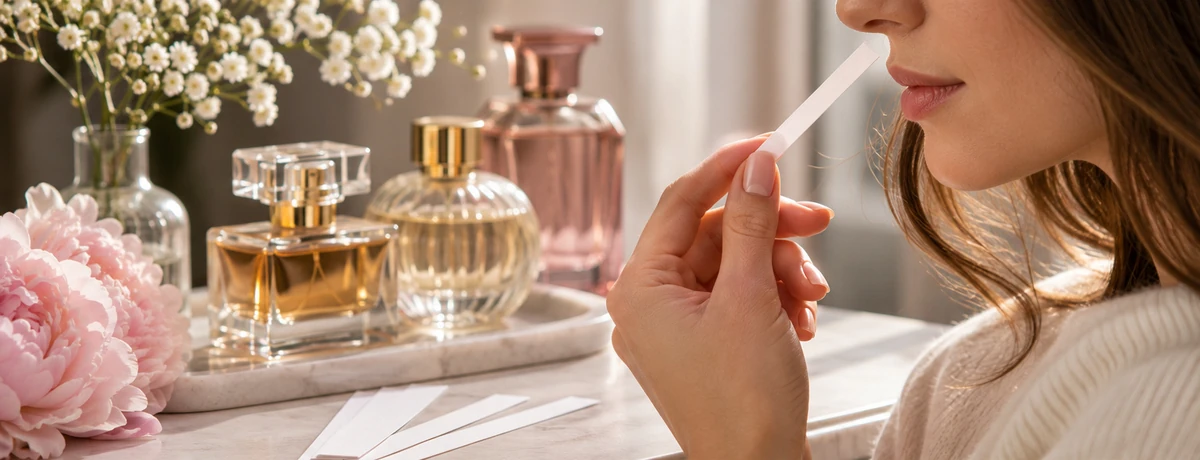
Sometimes it only takes a few seconds to decide a fragrance is perfect. But once you get home, that same composition may suddenly feel too sweet, too intense, or simply different from what you remembered. That does not always mean the perfume has changed. More often, the conditions, our attention, and the way we experience scent have changed. So how should you test perfumes to make more informed decisions?
Everything happens faster in a perfumery
In a store, it is easy to get carried away by the moment: a beautiful bottle, a familiar brand, a salesperson’s recommendation, a few successful first seconds. A scent that was completely unknown just moments ago can start to feel like an obvious choice. Only later does it turn out that what impressed us at first does not necessarily suit us in everyday wear.
When preparing descriptions for Perfumesso.pl, I separate what can be organized on a product page from what the customer should assess for themselves. The fragrance family, notes, and overall character of the composition make initial comparison easier. But they do not determine whether a perfume will remain enjoyable throughout the day. For me, that distinction is the starting point for honest communication about fragrance.
That is why it helps to think of perfume testing as a small process rather than a single decision made at the shelf. Here are seven mistakes that can make evaluation harder — and how to avoid them.
Mistake 1. Judging a perfume only by the first spray
Your first contact with a fragrance can be very persuasive. Fresh citrus notes may feel instantly energizing, while a sweet or spicy opening can immediately draw attention. The problem begins when we try to predict the entire wearing experience from those first few seconds.
Perfume ingredients evaporate from the skin at different rates. This has been confirmed by studies measuring how fragrance substances dissipate from the skin [1]. The division into top, heart, and base notes helps describe how a scent develops, but it does not create rigid time frames. That is why, in product descriptions, I also refer to the character of the composition as well as its approximate longevity and projection — as comparison points, not a promise that everyone will experience it in exactly the same way.
What should you do instead? Revisit the scent after some time has passed. Instead of asking only “do I like it right now?”, it is also worth asking “do I still want to wear it once the initial effect fades?”. There is no need to time it with a stopwatch — what matters is not treating the opening as the whole composition.
Mistake 2. Testing many strong fragrances one after another
Comparing five or six scents in just a few minutes may seem like a good way to find a favorite. In practice, though, one stimulus can start to overlap with the next, and your ability to detect differences and judge intensity may begin to shift.
When we smell the same scent for a longer period, our response to it can weaken. Scientists call this habituation. Other intense smells in the environment can also make evaluation more difficult. At the same time, there is no single universal break between tests that works for everyone and every fragrance.
What should you do instead? Limit the number of compositions you compare at once and do not try to test everything in a single visit. If you can no longer clearly tell the scents apart, it is wiser to stop than to force one more decision. [2, 3]
Mistake 3. Treating a paper blotter like your own skin
A test strip is very useful: it lets you quickly check whether a certain fragrance direction interests you at all. But it should not determine your purchase if what matters is how the perfume will actually smell when worn.
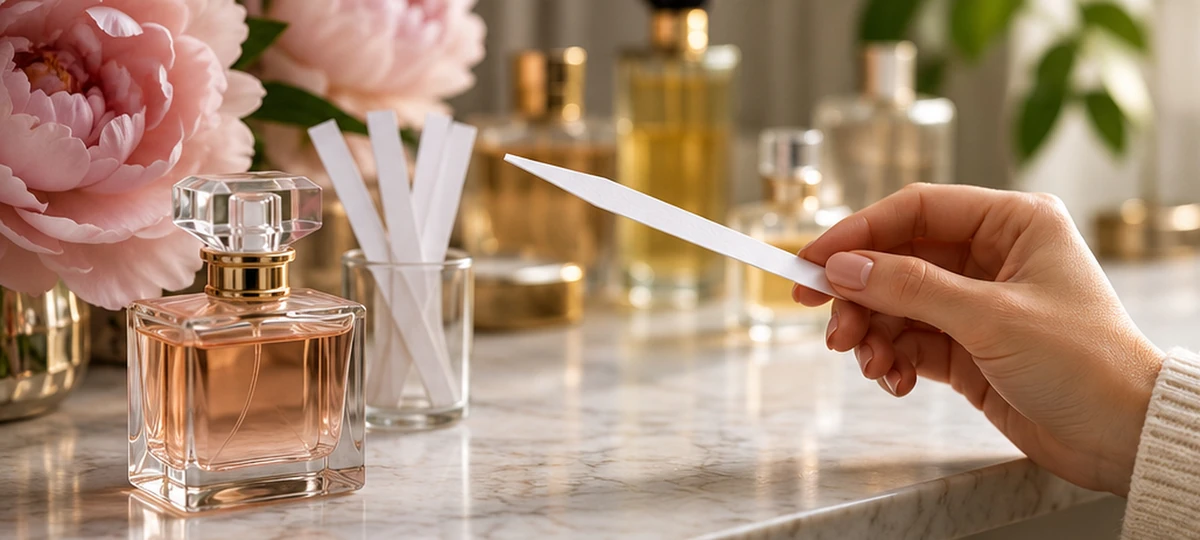
Paper and skin differ in temperature and other properties, so a fragrance may release differently from each. A study published in the journal Talanta compared the evaporation of perfume ingredients from, among other things, a test strip and forearm skin. This is one of the reasons why a scent on a blotter does not have to match how we will perceive it on skin [4].
What should you do instead? Treat the blotter as a selection step, not the final test. If a composition stands out, try it later on your own skin, following the manufacturer’s instructions. If irritation occurs, discontinue use.
Mistake 4. Applying a new scent over earlier fragrances
A visit to the perfumery often begins with some scent already on your skin: perfume worn in the morning, a fragranced body lotion, or hand cream. If you add another composition on top of that, you may end up evaluating a blend of impressions rather than the new product itself.
You do not need to give up all cosmetics to test perfume properly. It is enough to choose an area where no other clearly scented product has been applied beforehand. This matters especially when comparing delicate compositions with more intense ones.
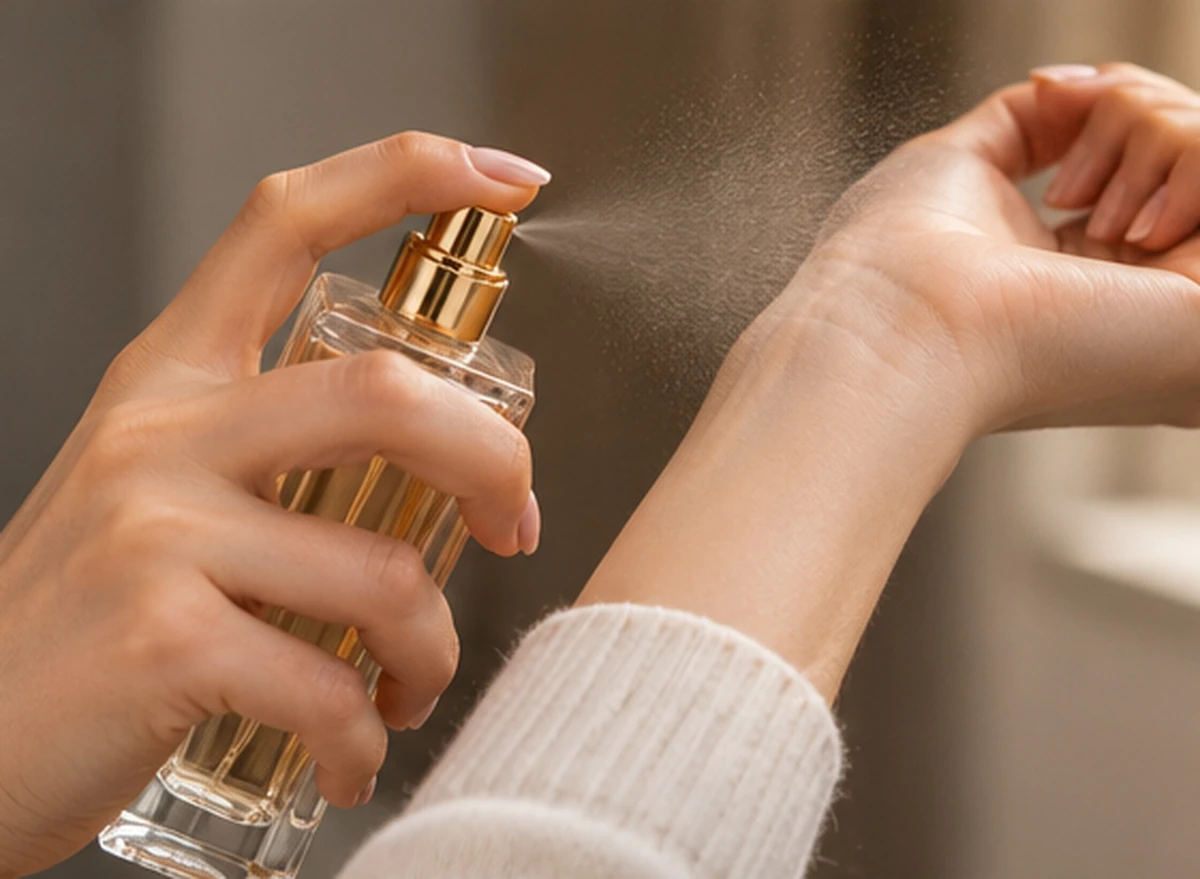
What should you do instead? When testing a fragrance on skin, aim for conditions that are as neutral as possible. If you are comparing two products, apply them separately and keep track of where each one went. It is a simple way to avoid later wondering, “which one am I actually smelling right now?”
Mistake 5. Comparing impressions from different situations as if they were identical
The same scent may feel different in a crowded perfumery, at home by an open window, or during your normal daily routine. The surrounding smells, temperature, method of application, and amount used may all vary. On top of that, there is attention: in a store we analyze every nuance, while during the day we often stop consciously noticing our own perfume.
So the phrase “it smells different at home” should not automatically be interpreted as proof that the composition in the bottle has changed. It is just as likely that we are comparing two different experiences.
What should you do instead? Whenever possible, test the same scent in conditions similar to the ones in which you plan to wear it. It is also worth keeping the number of sprays similar. The point is not laboratory-level control over every variable, but a comparison that genuinely helps you decide.
Mistake 6. Taking someone else’s opinion as your own verdict
“Most complimented,” “perfect for any occasion,” “very long-lasting” — descriptions like these may encourage you to explore a fragrance, but they should not make the decision for you. Two people can honestly and accurately describe their own impressions and still disagree about the very same composition.
Not everyone perceives scents in the same way. Research shows that genetic differences can affect how we detect certain fragrance molecules. That is one reason to be cautious with promises of a “perfect scent for everyone.”
What should you do instead? Use reviews like a map, not a final verdict. Pay attention to descriptions of qualities that matter to you — for example freshness, sweetness, or dryness — and base the final choice on your own experience. [5]
Mistake 7. Buying on impulse before getting to know the scent outside the store
Another mistake appears at the decision stage itself: you may genuinely like a fragrance and still buy a full bottle too quickly. An attractive display, a limited-time offer, or an enthusiastic recommendation can all push you toward an immediate purchase before you consider whether you will actually want to wear that composition outside the perfumery as well. At this point, the issue is no longer judging the first notes, but the timing of the buying decision.
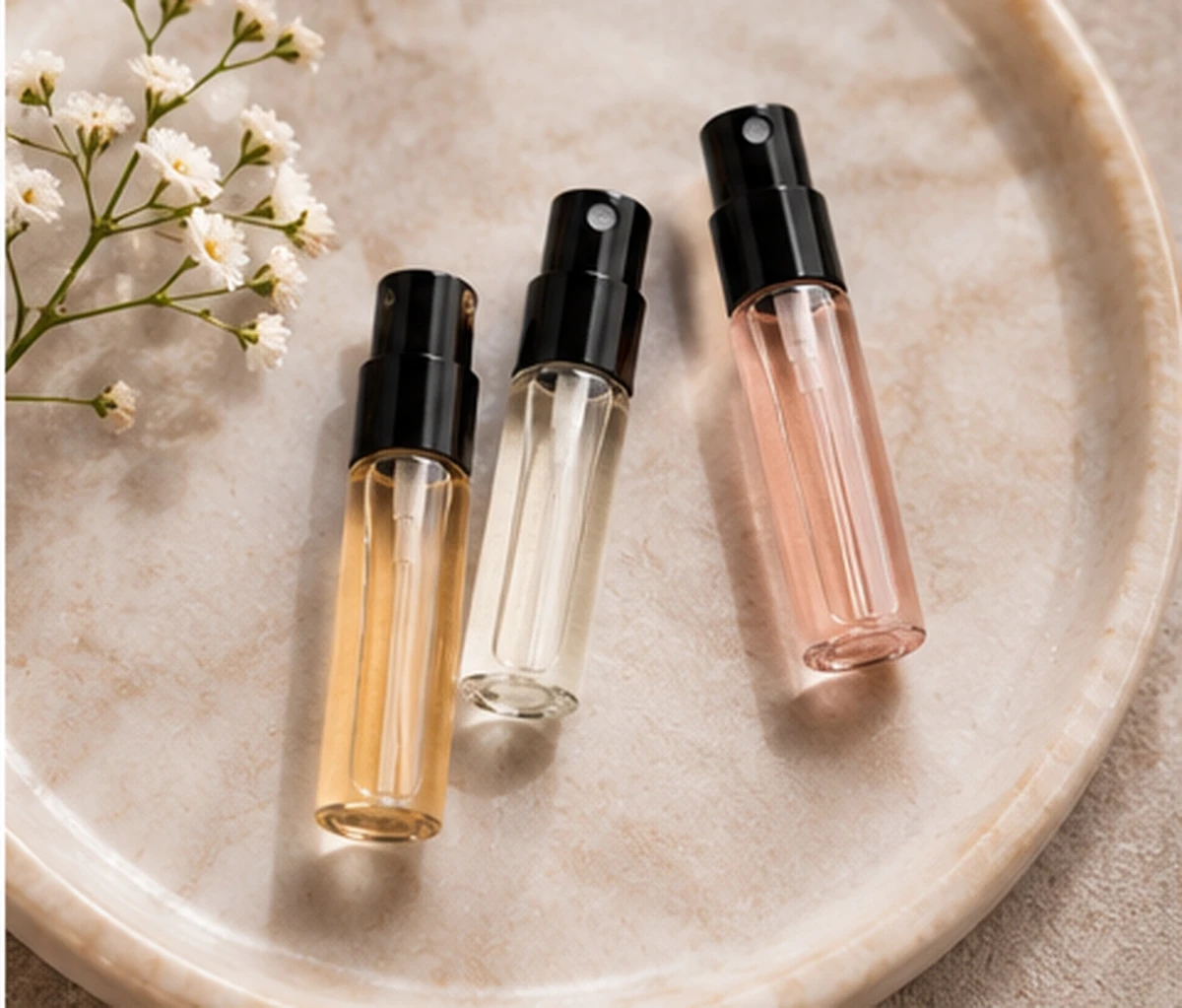
One way to reduce the cost of a disappointing purchase is to get to know the composition in a smaller size first. When describing product variants, I pay attention not only to the volume in milliliters, but also to the approximate number of sprays. The label “2 ml” alone may say very little to someone who has never used decants before. The number of sprays depends on the atomizer, while the number of full applications also depends on how many sprays someone uses each time. A smaller format lets you revisit the fragrance, but it does not guarantee the right decision and may also be useful for regular use or travel.
What should you do instead? Before buying, ask yourself whether you already have enough experience with the scent and whether it suits the situations in which you want to wear it. If it is a new or expensive composition, it is worth giving yourself the chance to reassess it rather than buying purely in the heat of the moment.
A simple way to test more calmly
Instead of trying to find the perfect fragrance in one intense session, it helps to follow a simple order. First, choose a few compositions based on their overall character and do an initial check on paper strips. Then test one or two options separately on skin. After that, come back to your impressions later instead of judging the scent only by its opening.
It is also a good idea to jot down a few short notes in your own words: “fresh at first, then sweeter,” “pleasant, but too intense for work,” “I want to come back to this one.” You do not need to identify every note or know perfumery terminology. The note is there to help recreate your own experience, not to sound professional.
It is also worth remembering that impressions can change as we get used to a stimulus. If, after some time, we stop consciously noticing our own perfume, that alone is not proof that it has disappeared completely.
The best fragrance is not always the one that impresses fastest
The goal is not to find the “objectively best” perfume, but to discover how well a scent fits you in everyday life.
From working on product offers and descriptions, I have taken away one principle above all: instead of assuring people that a particular fragrance will be perfect for everyone, it is better to provide clear reference points. The character of the composition, the dominant notes, or its approximate projection can help narrow the choice. But the decision of whether a scent truly matches our preferences is best left to personal experience.
So if a fragrance captivates you in the perfumery, that is a great start. It does not have to be the end of the search. Sometimes the best step before buying is not another spray, but a little time.
Sources
[1] Vuilleumier C., Flament I., Sauvegrain P. (1995), Headspace analysis study of evaporation rate of perfume ingredients applied onto skin, International Journal of Cosmetic Science. DOI: 10.1111/j.1467-2494.1995.tb00110.x. PubMed
[2] Pellegrino R. et al. (2017), Habituation and adaptation to odors in humans, Physiology & Behavior. DOI: 10.1016/j.physbeh.2017.04.006. PubMed
[3] Beekman T.L. et al. (2022), Should Panelists Refrain from Wearing a Personal Fragrance Prior to Sensory Evaluation? The Effect of Using Perfume on Olfactory Performance, Foods. DOI: 10.3390/foods11030428. PubMed
[4] Hadjiefstathiou E. et al. (2025), An innovative device for in vivo and in vitro study of fragrance evaporation after application on skin or model surfaces, Talanta. DOI: 10.1016/j.talanta.2024.126851. PubMed
[5] Trimmer C. et al. (2019), Genetic variation across the human olfactory receptor repertoire alters odor perception, PNAS. DOI: 10.1073/pnas.1804106115. PubMed
Owner of Perfumesso.pl
She specializes in product communication, fragrance composition analysis, and the development of perfume assortments. In her publications, she combines e-commerce experience with knowledge grounded in scientific sources.
Perfumesso.pl