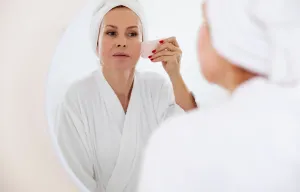







This aesthetic is easy to recognize not by appearance, but by feeling. In a woman who enters without obvious makeup, yet with a sense of inner composure. In choosing the same coat for several seasons in a row. In a gesture without haste, but with precision. As if nothing special has happened — and that is exactly why it feels convincing.
It can be noticed in other small details as well: a calm choice of table without the need to sit at the center of the room; a suitcase without “outfits for every day”; skin that looks alive rather than perfected to an effect. This is not a display — it is a state.
The “I didn’t try” aesthetic has become one of the clearest markers of contemporary luxury. Yet it is still often mistaken for carelessness or a lack of effort. In reality, it is about something else entirely: a shift of focus from result to state, from demonstration to inner stability.
When effort stops being a value
For a long time, visible effort functioned as an argument. A complex look, carefully constructed makeup, obvious work on the body signaled that time, control, and resources had been invested. This was read as status.
Ten years ago, complexity was an advantage. The more steps, details, and explanations involved, the more convincing the result appeared.
But at a certain point, this signal broke. Not because effort became unnecessary, but because there was simply too much of it. When complexity turns into a norm, it stops impressing. Effort is no longer read as mastery — it begins to read as tension.
It is against this backdrop that a different code emerges: the absence of demonstration.

“I didn’t try” as a social language
Today, the invisibility of effort is read as a sign of resource. It does not look like indifference — it looks like grounding. Like the ability not to explain, not to prove, not to persuade.
In social space, this works instantly. A person who does not comment on their choices or justify them is automatically perceived as more stable. Where there is no demonstration, a sense appears that everything is already in place.
This is an important shift:
status stops being a visible result and becomes a feeling of stability that requires no confirmation.
That is why the “I didn’t try” aesthetic does not compete for attention. It does not require validation — and that is precisely what draws attention to it.
Trends today: how “new” appears — and why it fades so quickly
Why demonstrative grooming has begun to look outdated
It is important to say this clearly: grooming has not lost its value. What it has lost is the need to be visible. When every step of care becomes part of a display, the result begins to exist separately from the lived sensation.
Excessive grooming today is often read not as care, but as anxiety. As if the result matters more than the state. As if the external is meant to compensate for inner instability. This is where fatigue lies — not from care itself, but from the constant need to look like a result.
Sometimes it even looks convincing — but not for long. Where there is too much control, tension inevitably appears.
This shift cannot be understood without its broader context: the rejection of ideals and the turn toward sincerity.
The fashion of sincerity: how naturalness replaces ideals
Invisibility as the new luxury
Classical luxury was always about complexity: rare materials, craftsmanship, exclusivity. Contemporary luxury is increasingly about the absence of overload. About a state where nothing presses, strains, or requires constant intervention.
The invisibility of effort means:
- a stable appearance without sharp peaks;
- repeatable choices that require no explanation;
- no need to constantly “maintain” the result.
This type of luxury is harder to replicate than a striking look. It cannot be assembled from instructions — it is shaped by rhythm of life.
Why this aesthetic is not for everyone — and why that is normal
The “I didn’t try” aesthetic often provokes resistance. It is perceived as privilege or as indifference. In reality, it requires an inner permission not to prove one’s value through results.
Perhaps this is not your phase yet — and that is normal. Where there is still a need for confirmation, this aesthetic does not work, or it appears as a mask.
Why the old anti-age language has stopped working
When aesthetics shift from demonstration to state, language is the first to crack. Words like “fight,” “correction,” “control,” “restore” sound too loud for a reality in which stability, not victory, is valued.
This language was formed in a time when change had to be shown. In a new aesthetic, it begins to feel like pressure — even when intentions remain caring.
This is precisely where the need arises not for new products, but for a reconsideration of the narrative itself.
[Next article: “When anti-age became toxic”]
Instead of a conclusion
The “I didn’t try” aesthetic is not a rejection of care or style. It is a rejection of the constant need to explain oneself to the world. Not minimalism, but sufficiency. Not simplification, but the removal of excess.
This is an aesthetic that is felt before it is understood.
That is why today it reads as a new kind of luxury — quiet, stable, and understated.