






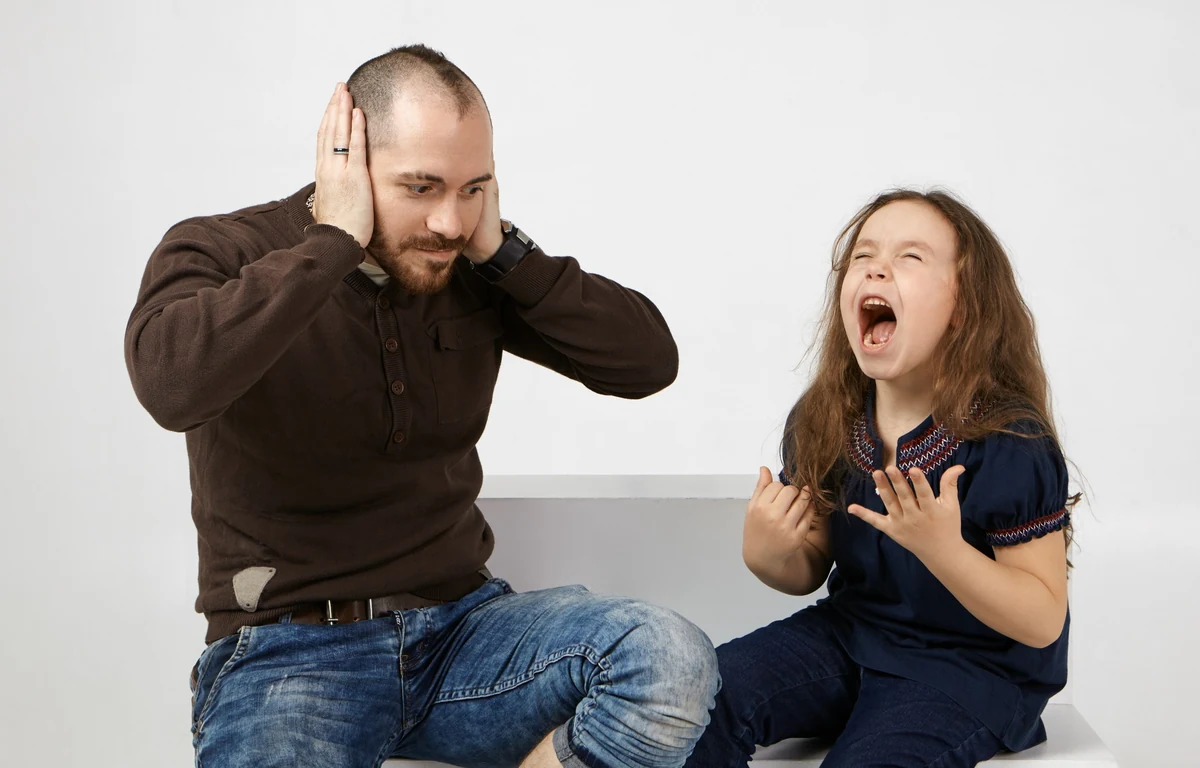
In moments of strong emotions, it's not just the "right words" that soothe a child. Initially, they perceive something else: your voice, face, pace, the safety of your presence, and whether there is any clarity in the scene. This is why co-regulation through contact often works before explanations, arguments, and punishments. It's not that words aren't important, but an overwhelmed nervous system first seeks support, not meaning. Supportive interactions with an adult are considered one of the foundations for developing self-regulation, and close relationships can buffer a child's stress response.
There are times when a child seems to stop hearing you. They cry over trivial matters, shout, act rudely, push away, and argue as if it's not about the specific situation but some internal turmoil. For an adult, this is exhausting, especially when you're already tired, in a hurry, or simply don't have the energy to be "wise." In such moments, it's easy to think the problem is disobedience, a bad character, manipulation, or spoiling. But often, it's not a moral failure or a "battle for power" in its pure form. Often, it's a nervous system that's overwhelmed.
This is where many parents intuitively feel something but can't always explain it. A child doesn't calm down on their own. Initially, they calm down with someone. Their future ability to hold themselves together, not fall apart from frustration, and experience strong emotions without self-destruction doesn't come from nowhere or just from prohibitions. It largely grows from repeated experiences: there's someone nearby who doesn't disappear, doesn't shame, doesn't frighten further, doesn't turn boundaries into a war, and helps the system return to a more stable state. In modern literature, this is described as co-regulation - a process where an adult helps a child learn to better regulate their emotions through warm and sensitive interactions.
Why Contact Often Works Before Explanations
The idea of a child as a small rational being that just needs to be "convinced well" often crashes against reality in the most tense moments. When emotions are high, when the child's body is tense, breathing is short, eyes are sharp or, conversely, empty, access to complex thinking truly becomes worse. Not permanently, not catastrophically, but enough that long explanations, subtle nuances, moral conclusions, and appeals to "you know" almost don't work as adults would like.
This is one reason why words often don't "get through" in acute moments. Not because the child is demonstratively ignoring you, but because their system is currently occupied with another task - enduring the level of internal tension. In such a state, they read what's more basic much faster and more accurately: intonation, speed, facial expression, body pressure, sharpness of movement, your own excitement. It's not just what you said, but who you became at that moment for their nervous system.
What a Child Perceives Before the Content of a Phrase
- whether there is aggression, haste, fear, or humiliation in your voice;
- whether your face looks like a source of threat;
- whether you are consistent or "falling apart" yourself;
- whether the boundary sounds clear or chaotic;
- whether you add another stimulus or reduce the intensity of the scene.
This is why the same phrase can either help or worsen the situation. "Enough" can sound like a frame or like a blow. "I see you're angry" can be a support or a phrase said through clenched teeth, making things worse. For an overwhelmed child, the tone and state of the adult often matter as much as the wording. Responsive, back-and-forth interaction is described as one of the bases for developing brain architecture, and data on social buffering shows that the supportive presence of a significant adult can mitigate the physiological stress response in childhood.
Co-regulation Is Not Permissiveness
One of the most common misconceptions about co-regulation is the idea that it's something soft, spineless, and dangerous: standing by, understanding everything, forgiving everything, not forbidding, not stopping, not demanding. Because of this, some parents reject the idea before they even understand what it's about. In reality, co-regulation doesn't remove boundaries. It makes the boundary more accessible to the child's nervous system.
Both extremes poorly serve a child. Rigidity without contact frightens and raises tension even higher. "Kindness" without a frame leaves them in chaos, where no one holds the form of the scene. The best option is a warm but clear presence. You don't humiliate. You don't lecture at the peak of a breakdown. You don't make the child bad for simply struggling. But you don't dissolve in their emotion, don't cancel the boundary, don't retreat just because everything is very loud now.
That's why phrases like "I see you're having a hard time. I won't allow hitting," "You can be angry. Pushing is not allowed," "I hear you don't want to. We're going out anyway" work more powerfully than it seems. They contain both contact and structure. And structure for an overwhelmed nervous system is often as important as empathy. Family co-regulation in modern literature is directly described as a process that unfolds not only in the "adult-child" duet but at the level of the entire family environment, where the combined action of warmth, predictability, and boundaries is crucial.
A Boundary That Calms, Not Humiliates
There's a big difference between a boundary as a guide and a boundary as revenge. The first reduces chaos. The second adds threat. A child keenly senses whether the adult is genuinely stopping a dangerous or destructive action or simply "regaining power." And that's why sometimes it's not the prohibition itself that hurts the most, but how it's delivered - with sarcasm, shame, demonstrative coldness, or overt contempt.
A good boundary has one important property: it doesn't make the child entirely bad. It names the action, holds the frame, but doesn't destroy the relationship. This is not a trifle. This is how a child gradually develops a sense that strong emotion doesn't eject them from contact and doesn't make them "unacceptable." And that's much more than just "behaving quietly."
What Happens to the Adult at This Moment
Many texts for parents are frustrating because they often miss one important truth: the adult is also a living person with their own nervous system. They also have limits. They also explode after the tenth repetition, lack of sleep, noise, anxiety, the feeling of not being heard, respected, and constantly being pushed to the edge. That's why texts about co-regulation become truly useful only when they stop demanding perfection from a parent.
The truth is, you can't be a calm support all the time. And you shouldn't. But you can do one very important thing - notice when you start losing your part of the scene. When you speak faster. When you no longer look at the child but pressure them. When you want not to help the situation end but to win. When there's not a boundary but resentment in your voice. This small internal note - "I'm also close to the edge" - sometimes matters more than another psychologically correct phrase.
For co-regulation, an adult often needs to first notice and ground their own state a bit: take a pause, exhale, take a second not to respond from a point where there's no contact or clarity. This is not an "additional bonus" to parenting but part of the mechanism itself. If an adult is completely lost in their reaction, it's very difficult for them to be a regulator for someone else.
Pause as a Real Action
We often think that action is to say, explain, stop, react. But sometimes the strongest action is a short pause. Not theatrical. Not demonstrative. Just two or three seconds where you don't follow the child's wave but separate from it a bit. In this pause, another response option is born. Less automatic. Less traumatic. More adult not in the sense of "correct," but in the sense of stable.
This pause often separates a boundary from humiliation. It helps not to overwhelm with words, not to start proving the obvious, not to turn a difficult moment into a scene that will need long repairs. The child doesn't see your internal work in detail but feels its consequence very well.
When Things "Explode" at Home Right After Kindergarten, School, or Extracurricular Activities
For many parents, this is one of the most painful and unfair scenes. All day the child seemed to hold it together. Was "normal." Didn't create drama in front of others. But at home - within ten minutes, tears, rudeness, arguments, motor excitement, a scandal over a trifle. And the natural adult thought here is almost always one: why do we get the worst of it?
But in the logic of the nervous system, this often means not that the child "sat on your head," but that at home they stop holding the facade. A safer place often becomes a place of unloading. Not beautiful, not convenient, not touching, but very raw and awkward. If you look only through the eyes of morality, you want to "stop this" immediately. If you look a little wider, you see something else: the system has been gathering for a long time, holding back a lot, overworked somewhere, and now it's falling apart.
In such scenes, it's often not a big educational conversation at the entrance that helps, but a small bridge between modes. A quieter entry home. Fewer questions from the doorway. Water. A snack. A few minutes without pressure. A predictable order of actions. Not as a "trendy psychological practice," but as a way not to throw the nervous system from one overloaded mode to another. We separately discuss how the environment generally overheats a child in the material How to Reduce Overstimulation: Screens, Light, Sleep, and Attention. Here, the principle is important: not everything that looks like a behavioral problem starts with behavior.
Why Evenings Often Break Down "Out of Nowhere"
Evening scenes are especially insidious because they resemble sabotage. The child seems to deliberately start running, fooling around, laughing, arguing, stalling, asking for one more story, one more glass of water, one more minute. Parents feel like they're just refusing to go to bed, testing boundaries, mocking tired adults. Sometimes that's partially true - boundaries are indeed tested. But very often, beneath this behavior lies something else: an exhausted system that, instead of calming down, accelerates even more.
When a child is already exhausted, their nervous system may behave not quieter, but louder. And this is one of the reasons why adult haste works so poorly in the evening. The more we want to "quickly finish this," the more tension we bring into the scene ourselves. And the child reads this tension perfectly. Sometimes it's your haste that makes falling asleep longer, not shorter.
Here, it's important not to duplicate material about sleep but to maintain the line of this pillar. The essence is not in separate life hacks. The essence is that in the evening, co-regulation often looks very simple: fewer stimuli, fewer words, fewer negotiations, fewer choices, a slightly slower pace, a little less of your irritated energy in the room. Not magic. Not "perfect parenting." Just reducing complexity at a moment when the system is already on the edge. Supportive relationships with an adult in such situations are considered a factor that helps buffer the stress response and maintain a healthier stress system setting. Also read: An Evening Without Struggle: 7 Steps to Make Sleep Easier (Without a Perfect Routine)
When It Didn't Work Out for You
Here's the section without which a text about co-regulation remains too smooth and a bit dishonest. Sometimes you lose it. You speak sharply. You raise your voice. You say something harsher than you intended. You enter a conflict not as a support, but as a second emotional wave. This doesn't mean the idea of co-regulation "doesn't suit you." It means you're a living person, not a method.
What's important is what happens afterward. In good texts about relationships, development, and regulation, there's almost always a theme of repair, that is, restoring contact after a breakdown. It's important because children don't live in an ideal environment but in real families where people get tired, irritated, sometimes make mistakes, and speak incorrectly. For a child, it's critically important not that there were never cracks in the house. But whether these cracks can be repaired.

What Repair Looks Like in Everyday Life
- "I spoke too harshly just now";
- "I'm angry, but I don't want to scare you";
- "The boundary remains, but I want to say it differently";
- "What happened was hard for both of us";
- "Let's come back to this more calmly."
These phrases don't contain self-humiliation of the adult and don't remove the boundary. But they have something very important: the child sees that the relationship doesn't break completely due to tension. That emotion isn't equal to rupture. That after a difficult moment, you can return to each other. Sometimes this teaches regulation more deeply than a dozen "correct" moments where no one ever made a mistake. A separate continuation is the article on how to reconcile after a quarrel.
How Co-regulation Changes with Age
Co-regulation at three years old and at fourteen years old is not the same, and it's important not to fall into another extreme here. A small child needs more external supports literally with body and rhythm: closeness, simple phrases, help with transitions, fewer stimuli, physical organization of the situation. For a teenager, such a tactic may seem humiliating or intrusive. But that doesn't mean they no longer need contact.
Data on parental buffering shows that parental support remains a powerful stress buffer in late childhood, but its direct impact on the HPA axis weakens in adolescence, and the transition through puberty can be an important point of change. This doesn't cancel co-regulation but changes its form. For a teenager, it more often means respect, a non-humiliating boundary, the right to pause, clarity without intrusion, tone without sarcasm, presence without "in-your-face" control.
That's why this article shouldn't be turned into a big text about all age-specific features. For that, you already have a separate material "Child's Age and Nervous System: A Brief Guide for Parents". Its role is to lay out the map by age. The role of this article is to explain the principle itself: why contact, voice, face, pace, and boundary work as a regulatory environment.
What Usually Worsens the Situation
Not because you're a "bad parent," but because that's how tension is structured, in acute moments, several typical things often harm:
- too many words at the peak of emotion;
- attempting to educate when the child is already overwhelmed;
- shame, sarcasm, comparisons;
- demanding to "become normal" immediately;
- your own excitement masquerading as control;
- a boundary presented as revenge, not as a guide.
Most of this we do not out of cruelty but exhaustion. That's why the idea of co-regulation is so uncomfortable and valuable at the same time. It brings us back to a very simple but complex question: what am I adding to the scene with my presence right now? More fire or a bit more form?
What Really Helps Most Often
Not "secret techniques." Not psychological perfection. Not a magic phrase after which the child suddenly becomes mature. Most often, a combination of simple things helps: noticing that the child has had enough; not amplifying it with your state; slowing down the pace; reducing words; making the boundary clear; giving the system time to come down from the peak; and only then talking about conclusions.
If you lack live language in the moment, it's logical to move on to the article Phrases That Help When Emotions Are High. If you see that the environment systematically overheats the child, you need the text How to Reduce Overstimulation: Screens, Light, Sleep, and Attention. And if you want to understand why the same scene looks different at 4, 8, or 14 years old, then you should read "Child's Age and Nervous System: A Brief Guide for Parents".
It's important to understand that calm in contact rarely arises from one correct thought. It arises where the adult begins to see not only behavior but also the load, not only the boundary but also the relationship, not only their fatigue but also the possibility not to pass it on without a filter.
Not Everything Here Is About Parenting
Perhaps one of the most important thoughts for parents sounds very simple: not every breakdown is a pedagogical mistake. Not every tear is manipulation. Not every "not hearing" is disrespect. Part of the behavior is indeed related to boundaries, consistency, and family rules. But a large part is related to age, load, sensitivity, fatigue, transitions, and whether there is an adult nearby from whom you can borrow stability for a moment.
And perhaps this is what makes the topic of co-regulation so important. It doesn't offer to become perfect. It offers something else: in a difficult moment, to be for the child not another source of chaos, but a temporary form in which they can gather a little. Supportive interactions with an adult are considered an important mechanism for the healthy development of stress systems and future self-regulation.
References
- Center on the Developing Child at Harvard University. Serve and Return: Back-and-forth exchanges shape brain architecture.
- Center on the Developing Child at Harvard University. Toxic stress: what is toxic stress?
- Center on the Developing Child at Harvard University. Stress disrupts the architecture of the developing brain.
- Gunnar MR, Donzella B. Social regulation of the cortisol levels in early human development. Psychoneuroendocrinology. 2002.
- Gunnar MR, Hostinar CE. The social buffering of the hypothalamic-pituitary-adrenocortical axis in humans. Social Neuroscience. 2015.
- Flannery JE, et al. The role of social buffering on chronic disruptions in quality of care and physiological stress systems. 2017.
- Paley B, Hajal NJ. Conceptualizing emotion regulation and coregulation as family-level processes. Development and Psychopathology. 2022.
- Harvard Health Publishing. Co-regulation: Helping children and teens navigate big emotions. 2024.