






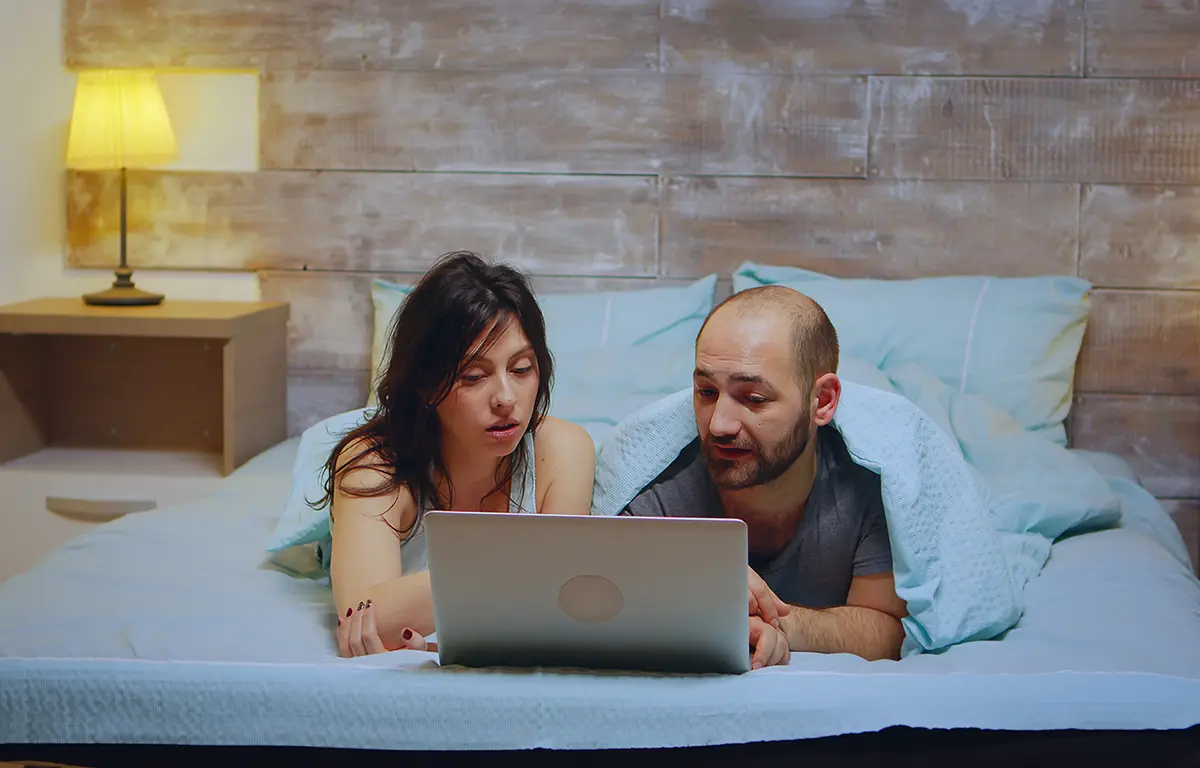
Porn exists not because there's "something wrong" with people, but because we are curious, sexual, love stories and images. For some, it's a way to relieve tension, for others — to peek for ideas, and for some — to support fantasy when there's no partner or no resource for intimacy. Sometimes porn can even be useful: it helps to understand what exactly excites, expands the understanding of the variability of desire, and gives a push to talk about fantasies or new formats of tenderness.
The key difference is in how you use it. Porn can be an episodic tool or a background that doesn't interfere with live intimacy. Or it can become the main and only channel of arousal, where everything is controlled, quick, and without vulnerability. In the first case, it is rather neutral or resourceful. In the second — it often brings tension, shame, distancing from a partner or from one's own body.
A couple has been together for several years. He sometimes watches porn, she finds out accidentally and feels not so much anger as a sharp comparison with the actresses: "I'm not like that, I don't look like that, I don't react like that." Tension appears in bed: she starts to "be better," and he fears she will notice that he "doesn't get excited the same way." Sex becomes rarer, and both think that "the chemistry is gone," although the real problem is in shame and comparison.
In our article "Sex, the Nervous System, and Intimacy" we analyze how stress, experience, and interaction in a couple affect desire and safety. Here — about porn: what can be resourceful in it, where it distorts expectations, how to distinguish habit from compulsiveness, and how to return to live intimacy without pressure.
Sexologist Daria Nepochatova in a material for "Suspilne" about supporting intimacy in a couple reminds:
"For a quality sex life... you need to allocate time. It's also work."
This is not about "fulfilling a plan" and not about technique for the sake of technique. It's about the fact that intimacy needs space: rest, attention, conversation, the right to stop and agree. When we replace live contact with ready-made scenarios, sex begins to feel like a demand. And where there is a demand, the nervous system more often chooses tension instead of desire.
When Porn Can Be Useful
To not turn the topic into a complete "minus," it's important to directly name resourceful scenarios. Porn can be useful when it doesn't replace contact but complements sexuality and gives more choice.
- For oneself: helps to better understand what excites, which fantasies "work," what pace and context are liked, what is definitely "not mine."
- For a couple: sometimes becomes a reason for a conversation about desires and fantasies, gives ideas for role play, new atmosphere, more diversity, if both are okay with it.
- As a bridge to intimacy: for some, it's a gentle way to "get in the mood" when the body is tense or needs time to warm up, especially if there's a lot of stress in life.
But even a resourceful scenario requires two things: clarity ("why are we doing this?") and boundaries ("what suits us and what doesn't?"). It's the boundaries that maintain safety and prevent porn from becoming a source of comparisons, secrets, or pressure.

Porn and Real Sex: Why Expectations Don't Match
Porn is a product. It has a lot of editing, angles, acting, selection of "best shots," and absence of everyday details. Real sex is the contact of two people and two nervous systems. It has pauses, laughter, shyness, fatigue, awkwardness, the need to change pace, ask for tenderness, or, conversely, more intensity. It's not "worse," it's more alive.
The trap arises when porn becomes the standard of evaluation. Then reality begins to seem "not like that": not as fast, not as bright, not as continuous. A person may start to think that the problem is in the body or in the partner, although the problem is in comparing live contact with a production.
Very common porn expectations that make real sex tense:
- Continuity: as if you can't stop, exhale, change position, clarify.
- Readiness "from the first second": as if the body should react instantly.
- Perfect reaction: as if arousal should look obvious and without doubts.
- Focus on spectacle: as if "how it looks" is more important than "how it feels."
A man is used to porn as a quick "switch." In real intimacy, he needs more time to warm up, but he perceives it as a failure and starts to accelerate: more stimulation, fewer pauses. The partner feels pressure and stops relaxing. As a result, they get stuck: he — in performance anxiety, she — in defensive tension.
To return to reality, a simple question helps: "Are we talking about our contact now or about someone's show?" As soon as you shift the focus from evaluation to sensation, there is more room for pleasure.
If you're close to the topic of body contact and the right to your own pace, pay attention to the article "Slow Sex and the Nervous System: Why Slowing Down Is Sometimes More Important Than Techniques" — it helps to restore safety through slowing down, not through pressure.
Porn and Expectations in Sex: How the "Right Scenario" Is Formed
The brain learns through repetition and reinforcement. If certain plots or types of stimulation often lead to arousal, the nervous system remembers this path as short. This forms the "right scenario": not necessarily consciously, sometimes even contrary to one's own values.
Expectations can imperceptibly change not only sex but also self-esteem: "there's something wrong with me if I don't react the same way," "I have to look different," "I need to try harder." And where "have to" appears, ease often disappears.
Psychologist-sexologist Olga Magerovska in an interview with "Volynnews" about intimate stereotypes directly says:
"But in porn — it's not true... It's not true, in life everything is different."
Porn shows a picture that is assembled from takes, editing, and a clearly constructed dramaturgy. If perceived as the norm, it creates inflated expectations for the body, reactions, and pace: as if arousal should be instant, sex — without pauses, and pleasure — obvious and "right."
In real life, desire more often requires safety, time, and contact, not a perfect scene. When you shift the focus from "how it looks" to "how it feels," tension decreases, and intimacy becomes more accessible.
A useful practice: separate fantasy from instruction. Porn can be a fantasy if you perceive it as fiction, not as a norm. Try this question after viewing: "What from this could be pleasant in reality, and what is only for the video?" This returns choice and reduces comparison.
Another trap is the standard of "constant novelty." Porn easily creates a sense of endless variety. Real relationships require a different novelty: novelty in communication, in pace, in the format of intimacy, in sensations, not just in changing pictures. This can be learned if you see porn not as a "norm" but as one of the genres of fantasy.
Sex educator Yulia Yarmolenko in the article "How to Talk to Children and Adolescents About Pornography?" on the educational platform Sexinforia warns:
"...in pornography, unhealthy sex is shown... which leads to unrealistic expectations..."
In porn, what in real intimacy requires agreements and care is often normalized: pace "through force," ignoring discomfort, lack of pauses, and boundary checks. Because of this, people bring not only scenarios but also pressure into the bedroom: "have to endure," "have to prove," "have to correspond."
For the nervous system, this is a signal of danger, not an invitation to pleasure. Therefore, it's important not to fight porn as a phenomenon but to return reality: boundaries, consent, pace, contact, and the right to "different."
How Porn Affects Libido
The impact of porn on libido is not the same for everyone. There are people for whom it doesn't interfere at all. There are those for whom it sometimes helps: warms up fantasy, gives ideas, reduces shame, creates a bridge to conversation with a partner. And there are those for whom it starts to displace live contact.
Most often, porn "wins" over reality not because it's "stronger," but because it's simpler for an exhausted nervous system. In porn, there's less vulnerability, more control, and more predictability: no need to negotiate, no risk of refusal, no need to endure awkward pauses. For a stressed body, this can be attractive.
To restore balance, an honest question helps: does porn now add to my resource or take it away? If it adds — it doesn't conflict with reality. If it takes away — it's worth changing not "morality," but the structure: sleep, stress, rhythm, contact, and also the framework of use.
If desire disappears against the background of fatigue and anxiety, also look at "Stress, Anxiety, and Sex: Why Desire Disappears When We're Tired" — it explains why libido often drops not because "feelings have cooled," but because of the state of the nervous system.
Mini-diagnosis without labels:
- After porn, do I feel lighter and warmer towards myself or empty and tense?
- Do I choose this or am I "pulled" automatically?
- Does porn add ideas to real sex or distance me from it?
- Do I have other ways to relax besides porn?
If most answers are about automatism and distancing, it's worth building a gentle restructuring rather than increasing control.
Porn and Erectile Dysfunction: What Can Really Be Related
This topic often sounds alarming, so it's important to speak without panic. Erection is affected by sleep, stress, anxiety, overall health, alcohol, medication, hormonal and vascular factors, as well as the fear of "not coping." Porn can be part of the picture, but it's rarely the sole cause.
What is sometimes associated with porn, but in fact is often tied to the nervous system:
- Performance anxiety: "I have to show results," "I must not let down."
- Comparison: the image in the head is stronger than the sensation in the body.
- Overstimulation: when the brain gets used to very strong visual stimuli, but in reality, time and contact are needed.
- Fatigue and lack of sleep: the body simply doesn't have the resource to "turn on."
A useful shift in focus: not "why it doesn't work," but "what prevents relaxation." Sometimes the issue is not in sex, but in the fact that the nervous system doesn't exit the tension mode.
If you have a lot of internal criticism, shame, or fear of "being wrong," support can be found in "Shame, Upbringing, and Prohibitions: How the Inner Critic Prevents Enjoyment".
When to seek help: if difficulties recur and cause severe distress, if there's pain, if there's a sharp deterioration, or if the fear is so strong that you avoid intimacy. This is not about "weakness," but about care.
Porn and Shame: Why It Feels Bitter After Viewing
Shame after porn can arise even in people who generally have a loyal attitude towards sexuality. The reasons are different: upbringing, taboo, fear of "being exposed," internal conflict with values, or the feeling that viewing has become too frequent and displaces other things.
Shame is not cured by shame. If you respond to yourself with self-punishment, the cycle often intensifies: tension → porn as a quick discharge → shame → even greater tension. The way out is to return clarity and choice to yourself.
Practice "deciphering shame":
- What exactly is my shame about? About the fact of porn, about specific content, about frequency, about secrecy, about betrayal of agreements?
- What need was I trying to meet? Relaxation, loneliness, anxiety, boredom, desire, control?
- What gentle step returns respect for myself? Time limitation, honesty with myself, pause, another way to calm down?
Sometimes shame decreases when you make the process less secretive, at least for yourself: not "I failed again," but "I noticed a pattern, I'm learning to manage it." This is a different tone, and the nervous system responds to it differently.
Porn and Relationships: What Really Hurts in a Couple
In relationships, porn becomes a painful topic not because "it's always bad," but because it touches on trust, self-esteem, and boundaries. For some couples, porn is a neutral thing. For others, it's a feeling of betrayal. Often the most painful is not porn, but hiding: "you're doing this behind my back."
What usually underlies the conflict:
- Fear of replacement: "I'm not attractive enough."
- Fear of comparison: "I'm not as interesting."
- Lack of contact: viewing displaces conversations, touches, togetherness.
- Broken agreements: one considers it okay, the other doesn't, but it's not discussed.
A woman notices that she sometimes agrees to what is uncomfortable for her because "it's accepted" and "that's what people do." She's ashamed to say "slower" or "it hurts me." Then irritation and avoidance of sex appear. When they start talking about boundaries and pace, the quality of intimacy sharply improves — not through new techniques, but through safety.
Agreements can be different — and that's normal. There are couples who agree not to watch porn because it's calmer and more trusting for both. There are couples who agree that watching is allowed, but with rules: no hiding, no content that hurts the partner, and no replacing real intimacy. What's important is not "what's right," but whether it gives both of you safety and contact.
If after arguments there is coldness and silence, and intimacy becomes even more difficult, a useful addition will be "Silence After a Fight: Why We Distance and How to Return Dialogue and Intimacy".
Sometimes it's useful to temporarily remove the focus from porn and return the focus to contact: "how do we restore intimacy so that it's safe for both?" This often reduces tension and makes the conversation more productive.
Porn Addiction or Habit: How to Understand the Difference
People often call any discomfort around porn "addiction." But it's more useful to assess not the label, but the degree of control and consequences. A habit doesn't ruin life. Compulsiveness gradually narrows the freedom of choice.
Signs that it resembles compulsiveness:
- you do it even when you don't want to, and feel "pulled";
- more time or stronger stimulus is needed for the same effect;
- there are recurring consequences: lack of sleep, conflicts, loss of motivation, guilt;
- attempts to reduce end in breakdowns and self-punishment.
But even if there are signs, it's not a verdict. It's a signal: the nervous system chose this way of regulation because it worked. Now it's necessary to expand the set of ways and regain control.
Compulsive Porn Viewing: What to Do
The best strategy is not to "break yourself," but to regain choice. For this, three supports are needed: triggers, pause, alternatives. They are simple, but they work only when you don't punish yourself for breakdowns, but return to the plan.
Track Triggers
Write down for 7 days: when exactly you're drawn to porn, what was before it, what state the body is in, what emotion, what need. Common triggers: fatigue, anxiety, loneliness, boredom, conflict, shame after failure, night time, alcohol. When you see a trigger, you see not "weakness," but a pattern. This gives a chance to change the scenario.
Insert a Pause
A pause of 60–120 seconds is not about heroism, but about returning contact. Try this: set a timer for 90 seconds, take 5 slow exhalations, name 3 sensations in the body and one emotion. Not to "win," but to return choice.
Give the Body an Alternative
The alternative should be short and real. Not "I will now meditate for an hour," but "I will do something for 3 minutes." For example: water or shower, short walk, warm-up, warm tea, write thoughts in 5 lines, simple routine.
If you lack gentle bodily tools to reduce tension, look at "Self-Touch and the Nervous System: How Gentle Intimacy with Yourself Supports Desire". There is an approach "without forcing," which often reduces the need for a "quick escape."
And an important point: if you break down, don't cancel the plan. The best thing you can do after a breakdown is to return to the care regime: sleep, food, movement, contact, not self-punishment.
How to Reduce Porn and Restore Desire
Restoring desire is not just "less porn." It's more resource, more sensitivity, and more safety in the body. When the nervous system is exhausted, it seeks the simplest way of discharge. Therefore, the first step is to restore the base.
What works practically:
- Frame, not prohibition: for example, "no later than 11:00 PM" or "only on weekends." The frame returns control.
- Sleep: if you're sleep-deprived, compulsive patterns intensify, and libido drops.
- Stress: 10–20 minutes of movement or air reduce tension better than self-orders.
- Contact without the obligation of sex: hugs, shared shower, tenderness without expectations.
- Novelty in reality: different pace, different time, different agreements, more conversations about desire.
For many, the key change is slowing down. Not making sex "according to plan," but restoring safety through pace and touch. Here "Slow Sex and the Nervous System: Why Slowing Down Is Sometimes More Important Than Techniques" can help.
If you want it to be as specific as possible, try a 14-day experiment: set a frame for porn, add 2 alternatives for triggers, add one "small contact" daily (hugs, conversation, tenderness without expectations of sex) and once every 3 days briefly write down what has changed in tension, sleep, desire, intimacy.
How to Talk to Your Partner About Porn
A conversation about porn is rarely about porn. It's about safety, trust, jealousy, shame, and the need to feel desired. Therefore, it's important to speak gently and specifically, without labels.

The structure of the conversation that reduces conflict: intention ("I want more intimacy and trust"), feeling ("it hurts/scares me"), specifics ("I'm affected by hiding/frequency/agreements"), need ("it's important for me to speak honestly"), agreement ("let's define boundaries").
Sometimes it's useful to formulate simple rules that support trust: "we speak honestly if the topic starts to affect sex," "we don't use porn as a way to avoid intimacy," "we agree on what's okay for us." It sounds mundane, but it's the mundane rules that often calm the nervous system.
If the conversation regularly turns into a quarrel, and then into coldness and distance, it's useful to return to the topic of dialogue and rapprochement: "Silence After a Fight: Why We Distance and How to Return Dialogue and Intimacy".
Sometimes the best format is to invite support: consultation with a psychologist, sexologist, or couple therapy, where there are safe rules of conversation.
When to Seek Help
It's worth seeking help if the topic of porn or related patterns cause severe distress and really spoil life or relationships. This doesn't mean there's "something wrong" with you. It means the situation has become difficult and needs support.
Markers that help will be appropriate:
- feeling of loss of control, escalation, recurring consequences;
- sexual difficulties against the background of anxiety, shame, fear of "not matching";
- after viewing — sharp guilt, disgust with oneself, mood failures;
- panic, flashbacks, traumatic reactions;
- inability to talk in a couple without destroying trust.
A psychotherapist helps with anxiety, shame, compulsiveness, and trauma. A sexologist — with desire, arousal, communication, and intimacy scenarios. A doctor is needed if there's physical pain, somatic suspicions, or a sharp deterioration in function.
Porn doesn't make you "bad" or "wrong." What's important is whether you have the freedom of choice and whether it helps you be closer to yourself and your partner. When there's more resource, clarity, and safety, the chance for real intimacy returns — live, imperfect, and therefore genuine.
-lazy-placeholder.webp)
-medium.webp)